

68% of AI & B2B SaaS leaders in our client and prospect base plan to grow LATAM headcount over the next 12 months. The market data says they are the majority now, not the early adopters: 70% of US tech firms already hire from LATAM, over 80% of US companies are exploring nearshore partnerships, and software engineer placements in the region grew 250% year over year.
Market trends | Based on LatamCent 2026 pipeline conversations, benchmarked against ManpowerGroup, Deloitte, Near’s 2026 State of LatAm Hiring Report, and Lightcast/Revelio Labs | Last updated July 2026
Key findings
- 68% of AI & B2B SaaS leaders plan to grow LATAM headcount in the next 12 months.
- 70% of US tech firms already hire from LATAM; 80%+ are exploring it.
- 72% of US employers report skills shortages (ManpowerGroup).
- 84% of placements are mid or senior level; a third are senior.
- Software engineer placements grew 250% year over year.
In 2021, nearshore hiring was a cost hack. In 2026, it is a board-level talent strategy, and the companies doing it best would keep doing it if the savings disappeared tomorrow.
We are in hiring conversations with US AI & B2B SaaS founders and operators every week: intake calls, expansion discussions, closed-lost follow-ups. Aggregating those conversations across our 2026 pipeline, 68% of AI & B2B SaaS leaders plan to grow LATAM headcount in the next 12 months. Among companies that already have one LATAM placement, the number is higher still: the second hire is easier to justify than the first, and the fifth is easier than the second.
The external data says our pipeline is not an outlier. It is the market. Deloitte reports over 80% of US companies are actively exploring nearshore partnerships, and roughly 70% of US tech firms already hire from LATAM. Remote hiring into nearshore regions has grown 285% since 2016 per Lightcast and Revelio Labs. US remote hiring in Latin America jumped 161% in 2023 alone and has accelerated through 2026.

Here is what changed.
The four drivers, ranked by how often we hear them
| Driver | How often it leads the conversation | What leaders actually say | The external data |
|---|---|---|---|
| US talent scarcity for specific roles | Most common opener in 2026 | “We’ve had this AI role open for five months” | 72% of US employers report struggling to find skilled talent (ManpowerGroup, 39,000 employers surveyed) |
| Runway math under investor pressure | Close second | “Same burn, two more engineers” | Companies save $35k-$64k annually per LATAM hire (Near, 2,000+ placements analyzed) |
| Proof from the first placement | The expansion driver | “Our first LATAM hire outperformed, send me three more” | LATAM hires stay 66% longer than US equivalents (Near 2026 report) |
| AI roles the US market cannot fill | Fastest growing | “Every applied AI engineer here has four offers” | FDE postings up 800%+ YoY; 87% of LATAM startups have adopted AI, so the talent is AI-native |
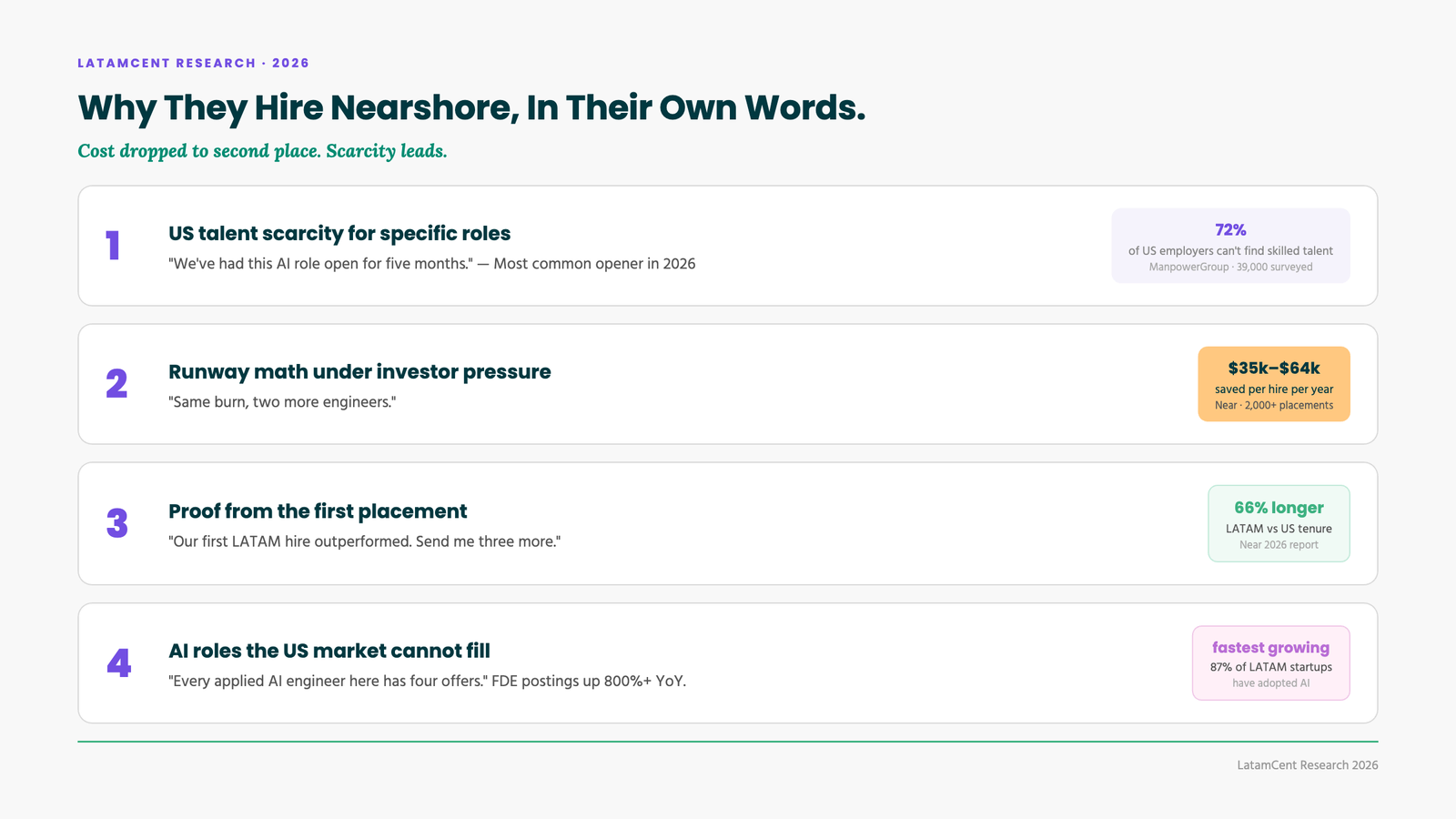
The ranking is the story. Cost has dropped to second place. The 2026 conversation opens with scarcity, and the scarcity is worst in exactly the roles AI & B2B SaaS companies must fill: engineering, applied AI, and data.
This is not a junior-talent market anymore
The most persistent misconception about nearshore hiring is that it is a way to buy cheap junior labor. The 2026 placement data demolishes it. In Near’s analysis of 2,000+ US-company placements across 411 roles, 84% were mid-level or senior positions, and a full third were senior-level: VPs, directors, and executives. Our own placement mix says the same thing, up to and including a recent CTO placement at roughly $250k total package.
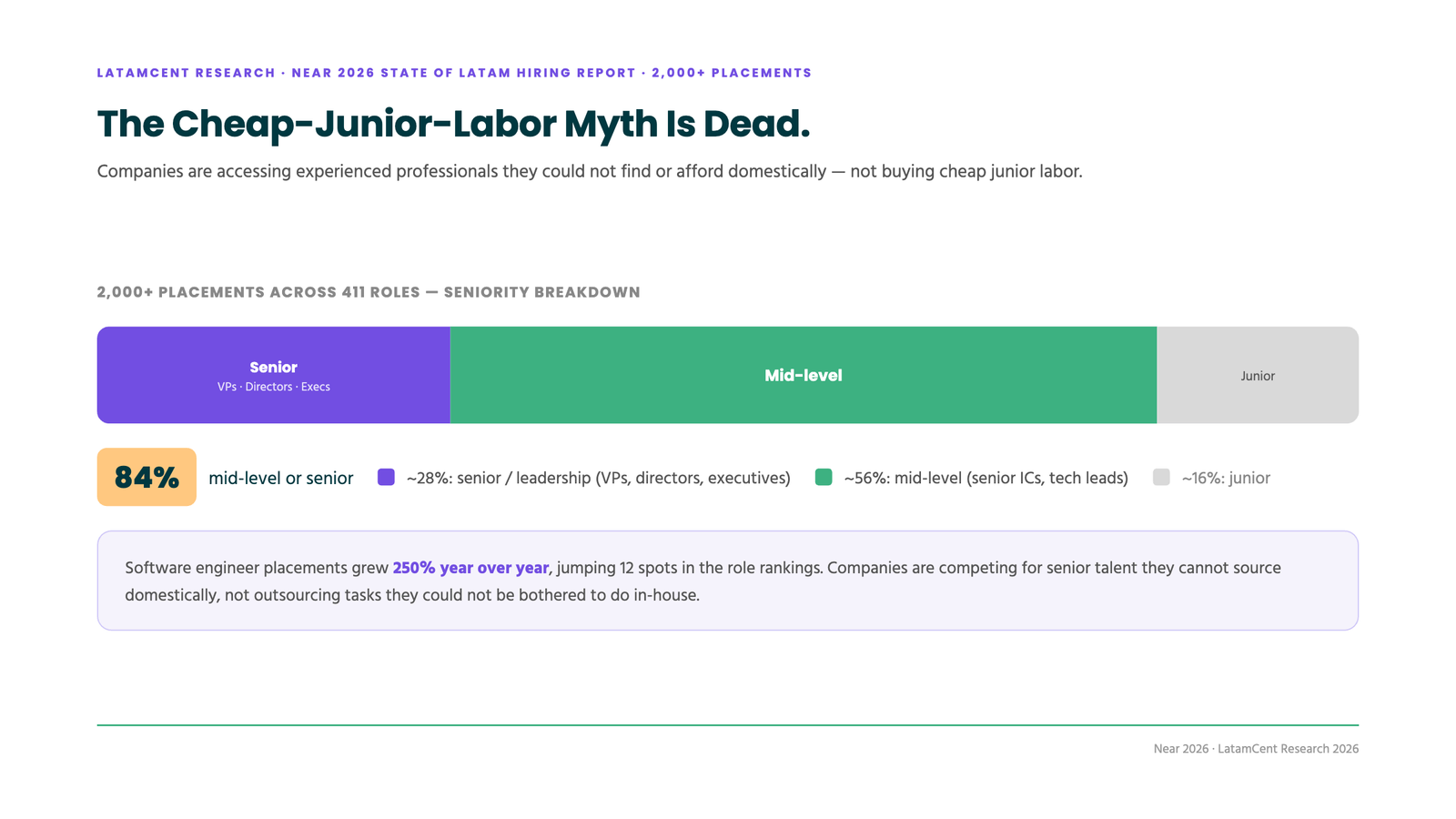
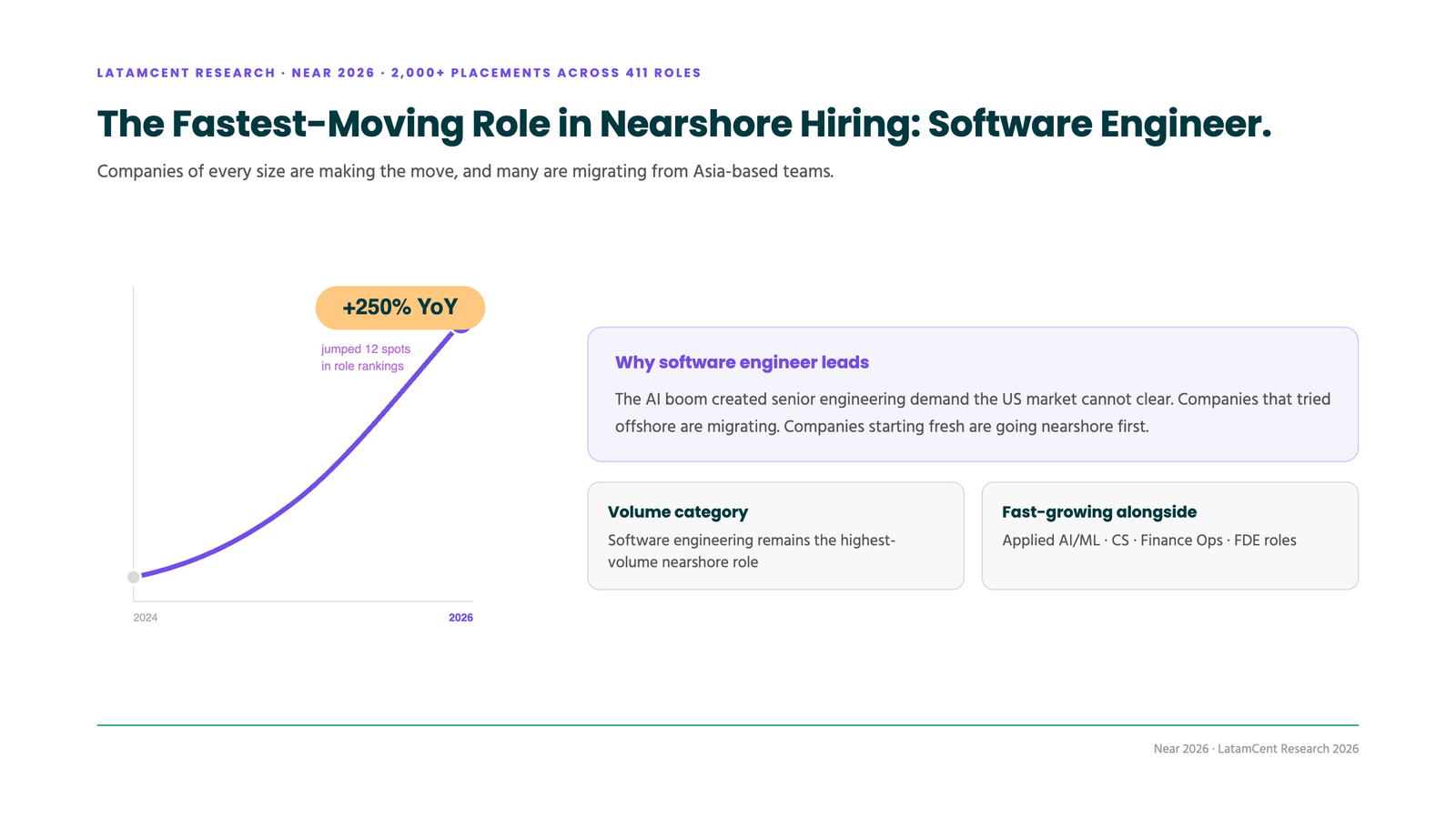
US companies are not hiring in LATAM to save money on entry-level seats they could fill domestically. They are accessing experienced professionals they could not afford, or could not find, in the US. Software engineer placements grew 250% year over year in that dataset, jumping 12 spots in the role rankings, and the fastest-growing demand segments in our own pipeline match: applied AI/ML engineering, customer success, and finance operations.
The supply side matured while nobody was watching
The region can absorb this demand because the ecosystem underneath it compounded:
Latin America now has roughly 2 million software developers concentrated in Brazil, Mexico, Argentina, and Colombia. The regional IT market is projected to hit $27.5 billion in 2026. VC funding into LATAM rebounded to $4.1 billion in 2025, up 13.8%, with Brazil alone attracting over $2 billion across 363 deals. The digital transformation market across the region is projected to grow from $107 billion in 2025 to $242 billion by 2030. And 87% of LATAM startups have adopted AI, which means the engineers you hire are not playing catch-up on modern stacks. They built on them.
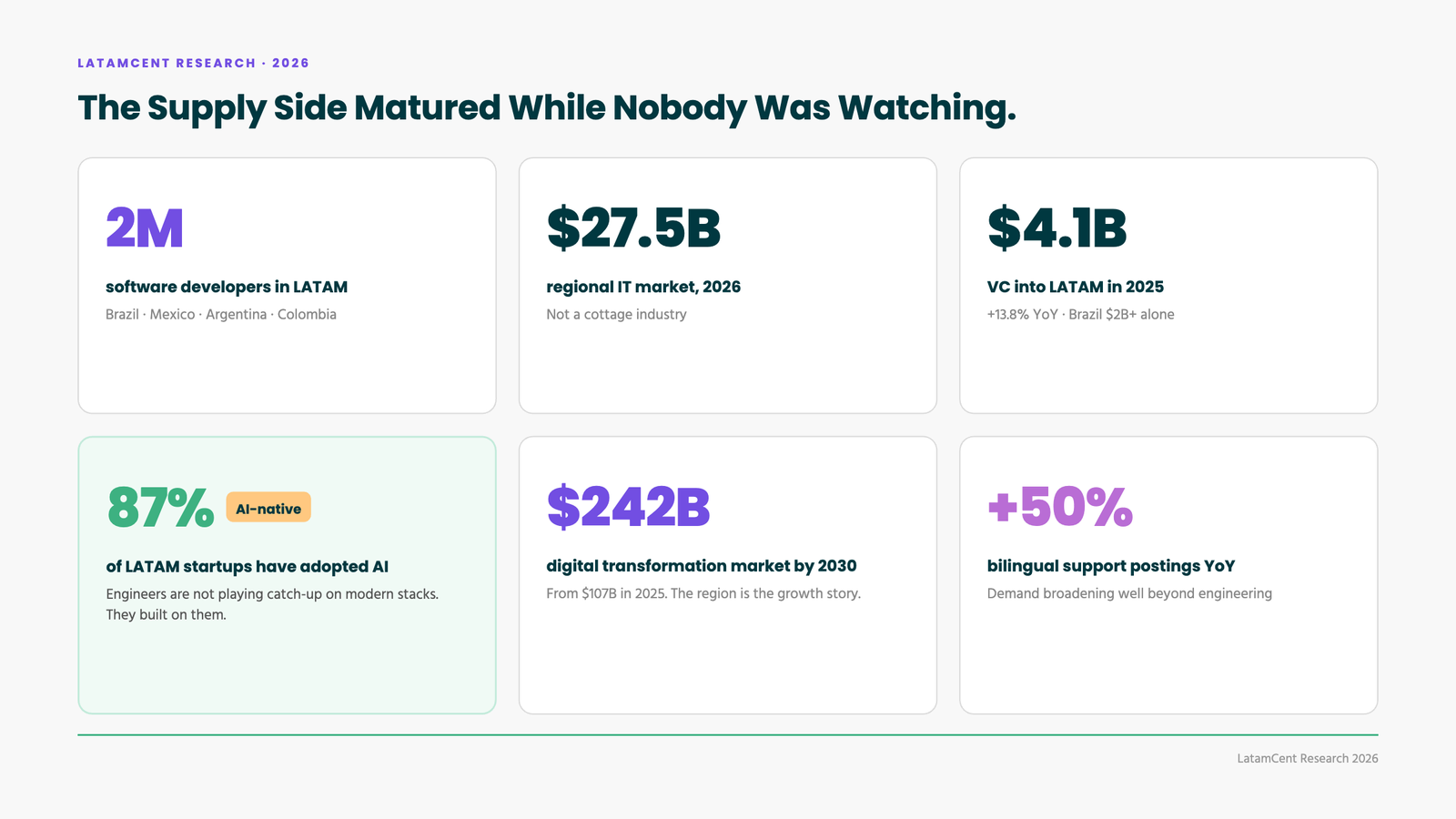
Demand is broadening beyond engineering too: bilingual customer support postings grew 50% year over year across the region, and finance, RevOps, and marketing operations roles are following the same curve.
The compounding effect nobody models
The most predictive variable in our data for whether a company grows LATAM headcount is not industry, funding stage, or burn rate. It is whether they already have one successful placement.
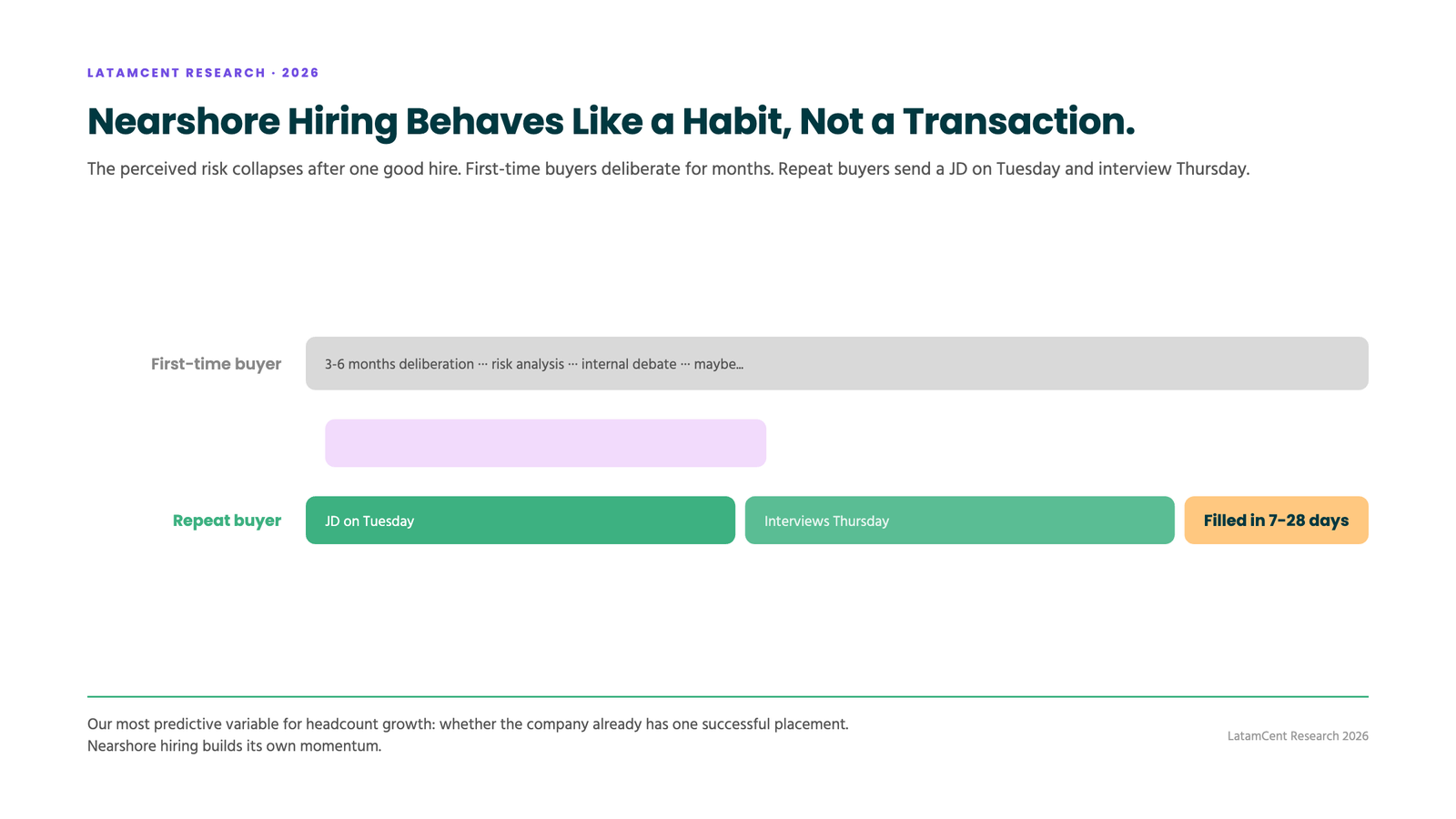
First-time nearshore buyers deliberate for months. Repeat buyers send a JD on Tuesday and interview Thursday. The external data captures the same behavior: companies that hire nearshore build entire departments after their first few hires, filling roles in 7-28 days that previously took 3-6 months. The perceived risk collapses after one good hire, which is why the 68% figure skews heavily toward companies with existing placements. Nearshore hiring behaves like a habit, not a transaction.
What the skeptical 32% say
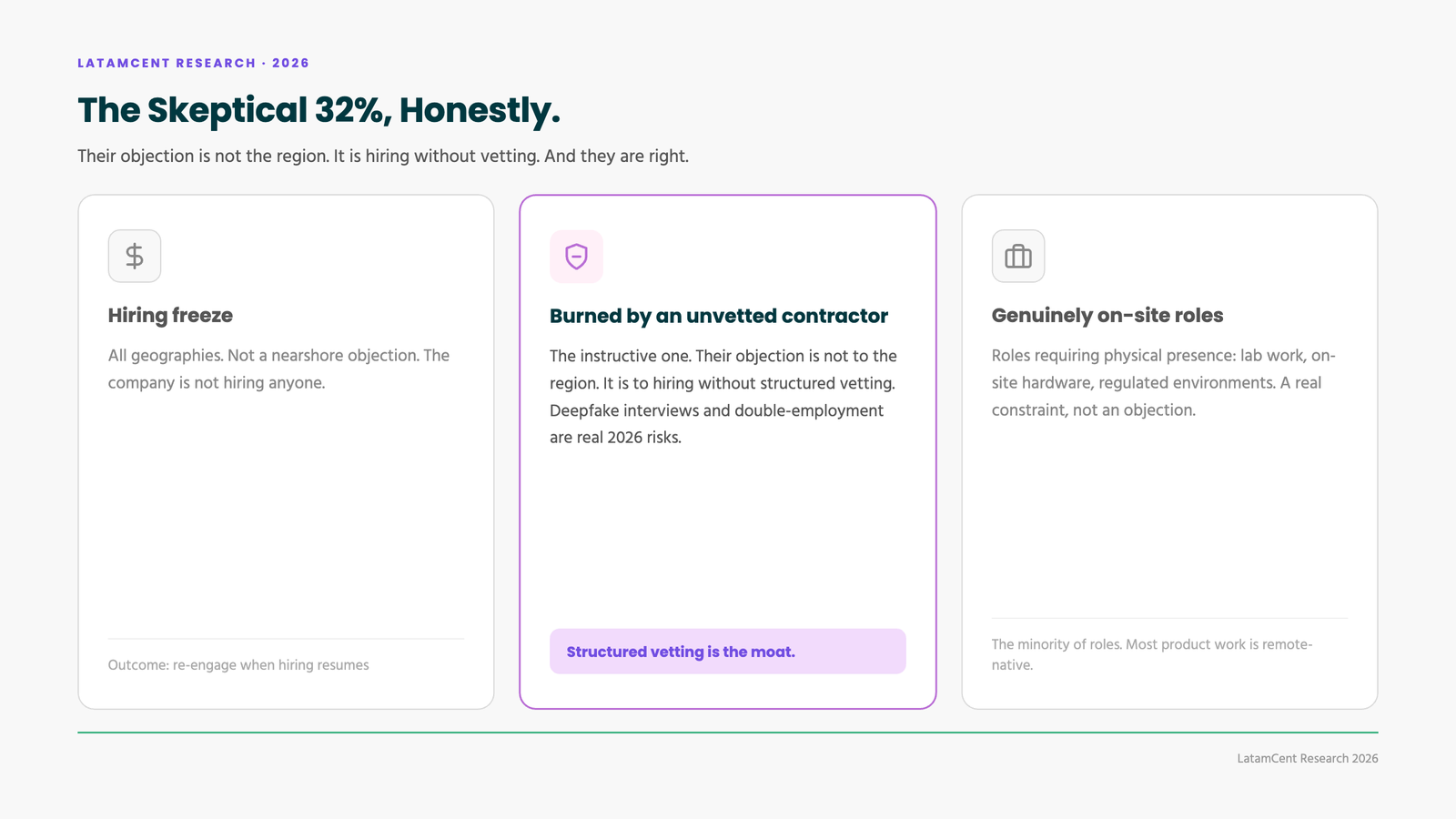
Honest research includes the no votes. The companies not expanding LATAM headcount cluster into three camps: companies with hiring freezes across all geographies, companies burned by a bad experience with an unvetted contractor or a body-shop agency, and companies whose roles genuinely require on-site presence. The second camp is the instructive one. Their objection is not to the region. It is to hiring without vetting, and they are right. A 2026-specific version of this risk is real: agencies across the market now report candidates using deepfakes in video interviews and professionals secretly working multiple full-time jobs. Structured assessment, live interviews, and reference checks are no longer nice-to-haves. They are the moat.
One honest caveat: the window is pricing itself
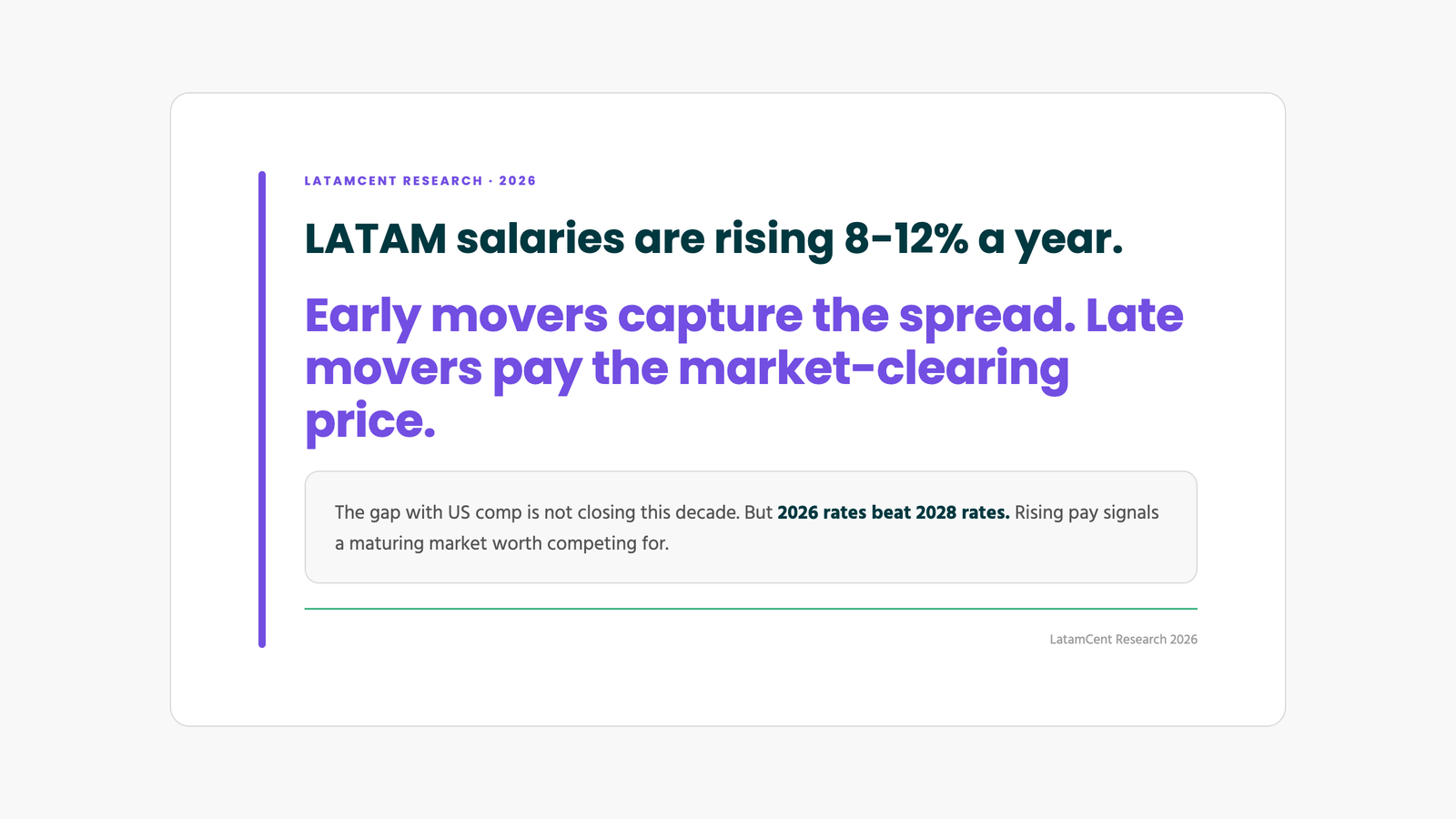
LATAM salaries are rising 8-12% annually in most markets, with 2026 rates projected 10-15% above 2025. That is not a reason to wait. It is the opposite: rising comp signals a maturing market, and the absolute gap with US salaries is not closing this decade. But the companies locking in senior LATAM talent at 2026 rates are getting a better deal than the ones who start in 2028. Early movers in any talent arbitrage capture the spread. Late movers pay the market-clearing price.
Methodology
The 68% figure is drawn from LatamCent’s 2026 client and prospect conversations: intake calls, expansion discussions, and pipeline interactions with US AI & B2B SaaS leaders, weighted toward companies with 30-1,000 employees. This reflects our market sample, not a randomized industry survey, and skews toward companies already considering nearshore hiring. External benchmarks: ManpowerGroup 2026 Global Talent Shortage Survey (72% of US employers, 39,000 employers across 41 countries); Deloitte nearshore partnership data (80%+ exploring, ~70% of US tech firms hiring from LATAM); Near 2026 State of LatAm Hiring Report (2,000+ placements, 411 roles, 84% mid/senior, 250% software engineer growth, $35k-$64k annual savings per hire, 66% longer retention, 7-28 day fills); Lightcast/Revelio Labs (285% growth in nearshore remote hiring since 2016); regional ecosystem data (2M developers, $27.5B IT market, $4.1B VC in 2025, 87% AI adoption among LATAM startups, digital transformation market $107B to $242B by 2030); LATAM salary trend data (8-12% annual growth, 2026 rates 10-15% above 2025).
The companies expanding LATAM headcount in 2026 started with one hire. Start with yours. Pre-vetted talent, 21 days or less, replacement guarantee. Book a free hiring call at latamcent.com.
This study is part of our Research & Insights series.
Cite this research
Found this useful? You are welcome to cite or link this study. Suggested citation:
LatamCent. "Why AI & B2B SaaS Companies Are Hiring Nearshore in 2026" Research & Insights, LatamCent, 2026, https://latamcent.com/research-insights/why-saas-companies-hire-nearshore-2026/.