



Hiring great developers is hard, but hiring them fast, within your means, and without timezone issues is even harder.
That’s why more U.S. companies are turning to nearshore software development partners in Latin America. With timezone alignment, strong English skills, and deep technical talent, LATAM has become the preferred region for building agile, reliable engineering teams.
But not every company offering nearshore development services works the same way, and the difference shows in project delivery, communication, and long-term value.
This guide covers what nearshoring means, ten nearshore software development companies for 2026, and how to choose the right partner for your hiring goals.
Key Takeaways
Nearshore teams in Latin America work U.S. hours and speak strong English, so delivery stays in step with your sprints.
Nearshore software companies mostly place engineers into your team and handle sourcing, vetting, onboarding, payroll and compliance.
Judge a partner on four things: engineering-led screening, English and agile readiness, speed, and fit with your tools.
The top 10 list below starts with LatamCent and compares each company on those four factors.
Before you sign, ask five questions: how the company vets developers, how fast it fills roles, what hours they work, what happens if a hire does not fit, and how pricing works.
Quick compare
Top 10 nearshore software development companies at a glance
- 01LatamCent
- 02BairesDev
Best for
Teams that need broad skill coverage across full-stack, QA, cloud and mobile
Read the profile - 03Cheesecake Labs
- 04DNAMIC
- 0510Pearls
- 06Azumo
- 07Gorilla Logic
- 08Vates
- 09Near
- 10Luby Software
Full profiles of all 10 companies below.
What is a Nearshore Software Development Company?
A nearshore software development company recruits and places remote engineers from nearby regions, typically Latin America, into U.S. tech teams.
The focus is on long-term staffing, not outsourced delivery.
Hiring managers partner with nearshore teams to find backend developers, mobile engineers, DevOps specialists, or full-stack talent, to build internal capacity without the delays and costs of hiring locally.
Nearshore software development companies handle candidate sourcing, vetting, technical assessments, and onboarding. Support usually extends to contracts, compliance, and payroll, removing barriers that slow down team expansion.
For SaaS companies, nearshore software development means back-end, front-end and DevOps engineers who join the product team in U.S. hours and work in the same sprints and tools.
With timezone alignment, cultural compatibility and fluent English, nearshoring helps scale AI and ML teams too, with quicker collaboration and efficient project management.
Latin American countries like Brazil, Argentina, Mexico, and Chile keep attracting interest as nearshore development destinations because of their strong technical skills, competitive rates, and similar business practices.
Nearshore software development in Brazil is covered by BairesDev, Cheesecake Labs, Near and Luby Software. For nearshore software development in Mexico, look at BairesDev, DNAMIC, Gorilla Logic and Near. Each country has its own hiring guide, for Brazil and Mexico.
Why U.S. Companies Are Choosing Nearshore Companies for Software Development
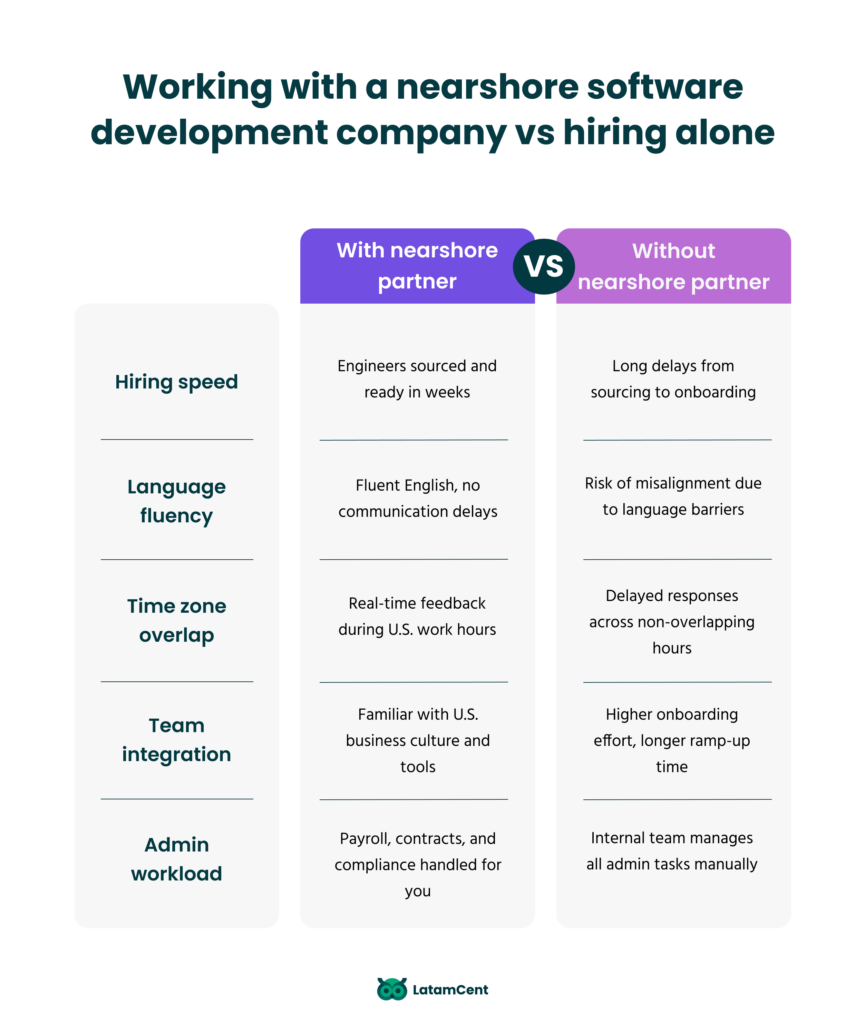
More B2B SaaS teams are relying on nearshore partners to fill key technical roles without overextending budgets or timelines. Developers based in Latin America have strong technical capabilities, fluent English, and familiarity with U.S. business practices, which makes integration smooth.
Hiring with a nearshore software development company gives direct access to vetted engineers ready to join internal teams.
Nearshore companies can help hire the most technical roles, like:
- Front-end developers
- DevOps engineers
- Back-end developers
- Mobile developers
They also take care of sourcing, vetting, onboarding and payroll, which reduces administrative overhead for expanding teams.
Time zone overlap makes daily collaboration easier, especially when project managers need fast feedback or updates during sprint cycles. Cultural alignment also improves long-term communication, helping nearshore teams stay synced with internal priorities.
Factors That Define a Great Nearshore Development Partner
Proven Engineering Technical Expertise
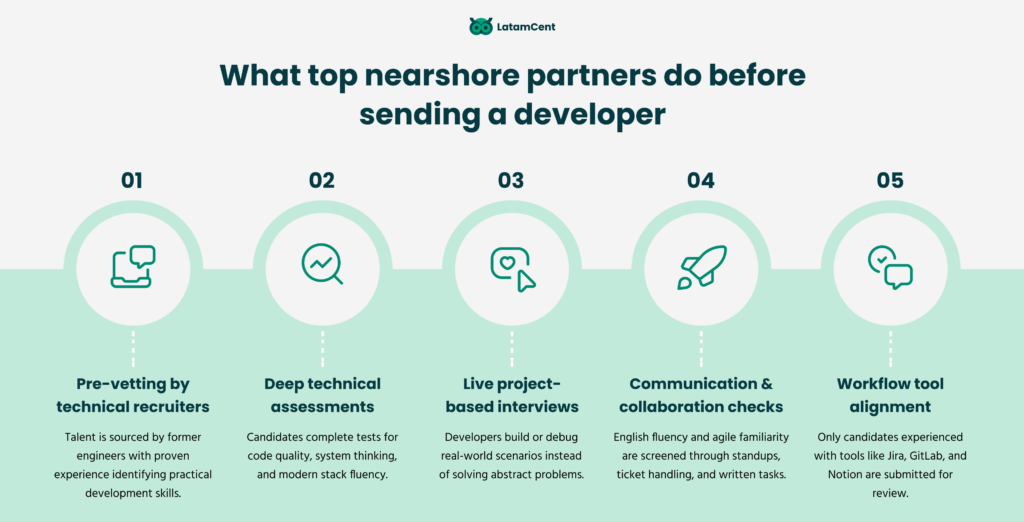
What makes nearshore software development companies stand out is who does the hiring.
Recruiters from nearshore companies studied software engineering or worked in dev roles before moving into talent. That experience shows in how candidates are screened.
They test how a developer handles state logic, test APIs, document their decisions, and review pull requests. A resume doesn’t mean much without proof of real skills. Every candidate is tested for fluency in current stacks and performance under pressure.
Clean code and strong systems thinking come first.
U.S. companies hiring remote software development teams need talent that integrates quickly. Nearshore partners build pipelines with developers who have shipped high-quality software solutions.
English fluency & Agile Compatibility
Language differences cause delays.
Engineers need to write updates, join standups, and explain blockers clearly. Every candidate is screened on communication, written, verbal, and collaborative.
Many nearshore developers were prepared in agile methodologies early on, having used project management tools like Jira, ClickUp, or Trello. They’ve run sprint demos, estimated tickets, and pushed releases inside fast-moving teams.
Teams hiring nearshore software development services want consistency. Developers must align with internal culture and workflow. Strong communication and shared context keep projects moving without extra handholding.
Turnaround Speed, Communication, & Vetting Practices
Strong nearshore software development companies deliver qualified candidates in days, not weeks. That speed comes from a refined vetting system and a curated pipeline of skilled professionals in software engineering, QA, and DevOps.
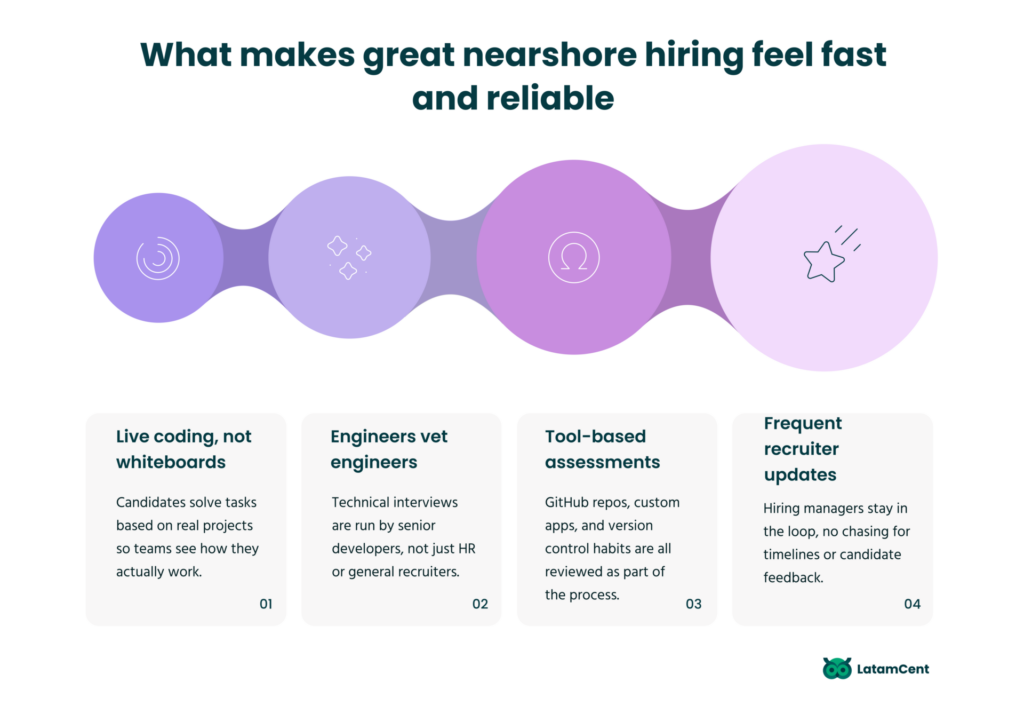
Candidates go through multi-step assessments:
- Live coding sessions based on real software development projects
- Technical interviews with senior engineers
- Reviews of GitHub history or custom-built apps
- English fluency and communication checks across written and verbal formats
Recruiters stay in close contact during the hiring process. Updates are frequent, and feedback cycles stay tight. U.S. project managers never have to track status or ask twice for changes.
Reliable nearshore partners respect urgency, communicate clearly, and vet like engineers, because many of them are.
Ability to Integrate With Internal Tools & Workflows
Hiring nearshore development teams only works when workflows line up. That means more than syncing calendars, it means engineers who know the tools your team uses daily.
Most developers placed by top nearshore software providers have experience working inside tools like Jira, Linear, Notion, or GitLab. They understand sprint velocity, know how to update tickets, and can jump into Slack threads without slowing things down.
Compatibility also shows up in subtle ways: following naming conventions, documenting pull requests properly, or adapting to your team’s branching strategy.
The best nearshore software development partners prioritize cultural alignment and workflow readiness, besides technical capabilities.
That’s how integration feels natural from day one.
Top 10 Software Development Nearshoring Companies in LATAM
Each profile summarizes the company’s Clutch or G2 profile and its own site, checked in November 2026. LatamCent comes first. The rest are ordered by public Clutch rating, and companies with the same rating are ordered by our judgment of the four factors above. Time-to-hire figures and similar numbers are the companies’ own claims, and details a company does not publish are left out.
Use the table to compare the ten companies side by side. Select a company name to jump to its profile.
| Company | Engagement model | Latin America presence | Core skills | Rating |
|---|---|---|---|---|
| 1. LatamCent | Staffing into existing delivery teams, with compliance, payroll and HR | Recruits across Latin America, entities in 15+ countries | Backend systems, mobile apps, API integration | 5.0 G2 |
| 2. BairesDev | Nearshore outsourcing and staff augmentation | Offices in Argentina, Brazil, Mexico and Colombia | Full-stack, QA, cloud, mobile | 4.9 Clutch |
| 3. Cheesecake Labs | Custom software projects at all stages | Office in Florianópolis, Brazil; U.S. headquarters in San Francisco | Web, mobile, blockchain | 4.9 Clutch |
| 4. DNAMIC | Staff augmentation with full-cycle recruiting | Offices in Costa Rica and Mexico | Agile engineering, data-driven assessments | 4.9 Clutch |
| 5. 10Pearls | Full-cycle delivery, from planning to maintenance | Offices in Colombia, Costa Rica and Peru; U.S. headquarters in Virginia | Cloud, web and mobile, legacy modernization | 4.9 Clutch |
| 6. Azumo | Dedicated teams with U.S.-based project managers | Office in Rosario, Argentina; engineers across Latin America | AI, data engineering, web, mobile | 4.9 Clutch |
| 7. Gorilla Logic | Long-term engineering partnerships | Offices in Colombia, Costa Rica and Mexico; U.S. headquarters in Colorado | Cloud, DevOps, QA, full-stack | 4.9 Clutch |
| 8. Vates | Cross-functional teams with iterative delivery | Offices in Argentina and Chile | Custom software, QA, R&D | 4.9 Clutch |
| 9. Near | Teams staffed in a few weeks | Argentina, Colombia, Mexico and Brazil | Full-stack, QA, cloud | 4.9 Clutch |
| 10. Luby Software | Outsourcing with distributed agile teams | Headquartered in São Paulo, Brazil | Mobile, web, AI, data analytics, cybersecurity | 4.8 Clutch |
Ratings are each company’s public Clutch or G2 score.
1. LatamCent
Best for: B2B SaaS teams that want engineers placed inside their existing workflows
LatamCent, a top nearshoring & staffing agency for building teams in Latam, connects B2B SaaS U.S. companies with Latin American software developers through an engineering-led recruitment process.
LatamCent also manages compliance, payroll and HR administration, in the way Employer of Record (EOR) providers do.
How LatamCent measures up
- Engineering expertise: Recruiters hold software engineering or IT degrees and run peer-level code reviews, architecture discussions and technical interviews. Candidates take hands-on assessments in backend systems, mobile app development and API integration.
- English and agile: English fluency evaluations include sprint planning and asynchronous written updates. Candidates are also vetted for familiarity with agile methodologies.
- Turnaround and vetting: Every candidate passes hands-on assessments, an English fluency evaluation and a cultural alignment check before placement.
- Tools and workflow: Engineers join existing delivery teams on Jira, Slack and GitHub.
2. BairesDev
Best for: Teams that need broad skill coverage across full-stack, QA, cloud and mobile
BairesDev focuses on identifying the top 1% of Latin American software developers for general nearshore software development outsourcing.
Skill sets include full-stack development, quality assurance, cloud services, and mobile app development.
How BairesDev measures up
- Engineering expertise: Applicants take written and online tests, then HR and technical interviews. The technical evaluation covers programming languages, Agile methodologies and AI coding tools.
- English and agile: BairesDev requires developers to be fluent in English and evaluates Agile methodologies.
- Turnaround and vetting: BairesDev says full-time developers can onboard within two weeks, and that it receives more than a million applications every year.
- Tools and workflow: Most developers live in Latin America and work similar hours to U.S. clients. Sample profiles sit in Mexico City, São Paulo and Bogotá.
3. Cheesecake Labs
Best for: Founders who want design and engineering from one team
Cheesecake Labs delivers web and mobile app development from the U.S. and Brazil, with a timezone that suits U.S. teams.
Active since 2013, the company combines design thinking and engineering to support custom software development projects at all stages.
They stand out in design-led processes and strong QA practices. Teams run design sprints and prototype fast.
How Cheesecake Labs measures up
- Engineering expertise: At least two peers review and approve every feature merge request. Each project repository runs automated checks for code quality and dependency vulnerabilities.
- English and agile: Teams run design sprints and hold weekly check-ins with the client.
- Turnaround and vetting: A Solutions Architect assesses the client’s needs and picks team members from inside the company. The team spends one week getting up to speed before the kick-off meeting.
- Tools and workflow: A shared Slack channel supports real-time collaboration, and a Customer Success Manager represents the client during development.
4. DNAMIC
Best for: Teams that want staff augmentation with hands-on onboarding

DNAMIC offers nearshore software development as a staff augmentation partner, a model that is often compared to full outsourcing in the staff augmentation vs outsourcing debate. Services cover full-cycle recruiting, onboarding and technical interviews that align with agile methodologies.
What sets DNAMIC apart is a strong focus on data-driven assessments and industry expertise.
Teams are evaluated using real coding challenges, performance metrics, and domain-specific case studies. Onboarding includes shadowing and immediate pairing with U.S.-based project managers.
How DNAMIC measures up
- Engineering expertise: Teams are evaluated with real coding challenges, performance metrics and domain-specific case studies.
- English and agile: Full-cycle recruiting, onboarding and technical interviews follow agile methodologies.
- Turnaround and vetting: DNAMIC says it assembled three full-stack engineers in two weeks for an online learning platform.
- Tools and workflow: Onboarding includes shadowing and immediate pairing with U.S.-based project managers. Teams work from Costa Rica, where a CINDE advisor says the time zone is similar to the U.S.
5. 10Pearls
Best for: Teams that need cloud, DevOps and legacy system modernization

10Pearls delivers full-cycle nearshore software development, from planning and architecture to maintenance and digital transformation. Teams work across cloud services, web and mobile apps, and legacy system modernization.
10Pearls offers technical assessments, security audits and DevOps strategy before code reaches production. Engineers align to the client’s time zone and use agile methodologies.
How 10Pearls measures up
- Engineering expertise: 10Pearls says it hires the top 1% of tech talent. Teams work across Docker, Kubernetes, AWS, Azure and Google Cloud, and offer security audits and DevOps strategy before code reaches production.
- English and agile: 10Pearls says its nearshore experts are English-proficient. 10Pearls offers agile development and a proprietary Lean Product Accelerator for new products.
- Tools and workflow: Engineers use the client’s preferred collaboration tools and align to the client’s time zone.
6. Azumo
Best for: Companies building AI and data products
Azumo builds dedicated nearshore software development teams, specializing in AI, data engineering, web applications and mobile app development.
Founded in 2016, Azumo supports SMB and enterprise clients using modern stacks like Docker, Kubernetes and React.
Azumo pairs developers with U.S.-based project managers and offers virtual CTO consulting.
How Azumo measures up
- Engineering expertise: Azumo specializes in AI, data engineering, web and mobile. Engineers use AI coding assistants such as GitHub Copilot, Cursor and Claude Code, and virtual CTO consulting is available.
- English and agile: Developers join the client’s sprints and code reviews.
- Tools and workflow: Developers use the client’s tools and follow the client’s code standards. Engineers across Latin America and the Caribbean work hours aligned to North American business hours.
7. Gorilla Logic
Best for: Teams that want a long-term engineering partner and a vetted shortlist
Gorilla Logic offers nearshore software development from Costa Rica, Mexico and Colombia. Services cover agile product engineering, cloud-native solutions, QA and platform delivery.
Gorilla Logic focuses on building long-term engineering partnerships.
Teams include cloud architects, DevOps experts, QA engineers, and full-stack developers aligned to U.S. time zones. Their nearshore model emphasizes collaboration through shared sprint rhythms, daily standups, and integrated project management tools.
How Gorilla Logic measures up
- Engineering expertise: Skills are tested across dozens of roles and technologies, and screening is customized to each client. Problem-solving and collaboration are assessed too.
- English and agile: Team members are tested for English fluency. Delivery follows Scrum, Kanban or SAFe, with daily standups and retrospectives.
- Turnaround and vetting: Gorilla Logic presents the top three candidates, all able to do the job. Gorilla Logic says Maxar released new services into production in the first month.
- Tools and workflow: Teams work in the client’s tools and processes, with U.S. time zone alignment and Slack and Zoom during the client’s workday.
8. Vates
Best for: Companies that value formal certifications and Jira-based delivery
Vates is a nearshore software development company with offices in Argentina and Chile, now part of EPAM. Its ISO and CMMI certifications underpin agile web development, testing and R&D.
Project managers assign developers, QA experts, and systems engineers to cross-functional teams. Each group works through iterative delivery, using Jira and Atlassian tools to maintain workflow transparency.
Project managers assign developers, QA experts and systems engineers to cross-functional teams that deliver iteratively.
How Vates measures up
- Engineering expertise: Vates says it hires the top 1% from a database of more than 25,000 candidates. Vates holds CMMI Level 5 and ISO 9001, and offers testing as a service.
- English and agile: Delivery teams and project managers are Agile and Scrum certified.
- Turnaround and vetting: Vates says team ramp-up is 10% faster than the industry average.
- Tools and workflow: Vates is a certified Atlassian Gold Partner. Working hours match those of U.S. and Canadian clients.
9. Near
Best for: Teams that need a qualified shortlist quickly
Near builds nearshore software development teams focused on speed and alignment. The company recruits engineers in full-stack development, quality assurance and cloud services across Latin America.
Near says it staffs teams in a few weeks, with sprint cycles and coordination matched to U.S. project managers.
Talent is recruited from major Latin American countries with a focus on English fluency and agile development workflows.
How Near measures up
- Engineering expertise: Near interviews candidates on the languages and frameworks they have shipped and on what each personally owned end to end.
- English and agile: Every developer is interviewed in English about their own projects, and shortlisted candidates arrive with a video introduction.
- Turnaround and vetting: Near says the first shortlist arrives in 3 to 5 days and most companies hire in under three weeks. References are checked before the offer, and check-ins follow at 30, 60 and 90 days.
- Tools and workflow: Developers work U.S. business hours. Managers can request a specific overlap, such as a 10 a.m. Eastern standup, and Near screens for it.
10. Luby Software
Best for: Companies with security and privacy review requirements

Luby Software offers a nearshore software development outsourcing model from Brazil, with engineers in mobile, custom web development, AI, data analytics and cybersecurity.
Their strength is full-stack expertise, advanced tech stacks like AI/ML and platform engineering, and certifications that ensure quality assurance and process rigor. Project managers lead distributed teams through agile ceremonies, sprint demos, and backlog management.
How Luby Software measures up
- Engineering expertise: Luby says it offers pre-selected senior developers, with a Tech Lead and Delivery Manager on each squad. Luby has delivered software for more than 24 years.
- Turnaround and vetting: A Solutions Architect proposes the squad’s roles, seniority and stack within 24 hours of a client describing its roadmap.
- Tools and workflow: Onboarding fits the client’s own processes and tools, with CI/CD, test coverage and observability. Luby holds ISO/IEC 27001 and ISO/IEC 27701 certifications.
Which Nearshore Software Development Partner Should You Choose?
Match your situation to the partner type:
- Engineers placed inside your existing team, with payroll and compliance handled: LatamCent.
- A qualified shortlist fast: Near and Luby Software both state quick turnaround.
- Design and engineering from one team: Cheesecake Labs.
- AI and data products: Azumo.
- Cloud, DevOps and legacy modernization: 10Pearls.
- Formal certifications and Jira-based delivery: Vates. For security and privacy reviews, see Luby Software.
- Staff augmentation with hands-on onboarding: DNAMIC.
- Broad skill coverage across full-stack, QA, cloud and mobile: BairesDev.
- A long-term engineering partner with a vetted shortlist: Gorilla Logic.
Software Development Nearshoring: LATAM vs Offshore Models
LATAM nearshoring gives U.S. teams something offshore outsourcing rarely can: clarity.
When developers work in the same time zone, speak fluent English, and understand U.S. product culture, small things don’t get lost. Slack messages make sense, sprint goals are clear, and feedback lands the first time.
Engineers from Latin American countries like Colombia or Brazil match tech talent and align with the work culture of internal teams.
Timezone delays impact speed. Waiting 12 hours for a reply or holding sprint planning across opposite calendars adds real drag. That’s where rework comes in. A feature gets built wrong, a spec gets misunderstood, or no one flags an edge case in time.
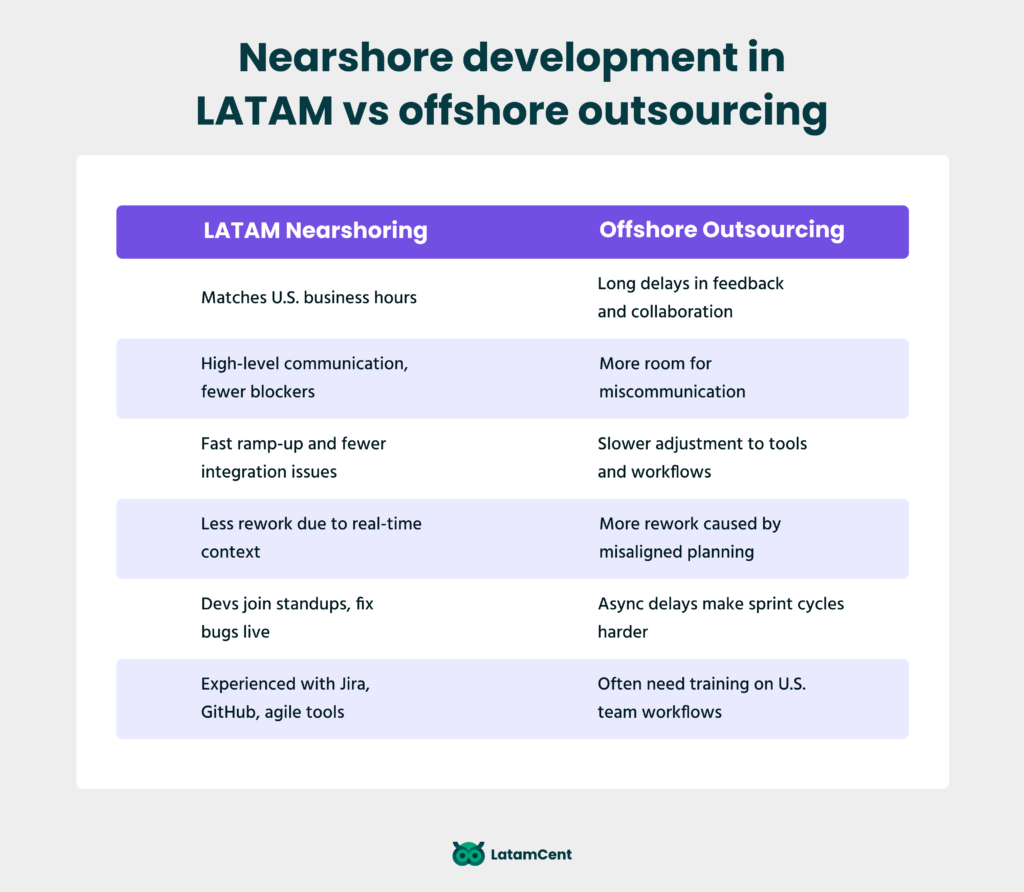
Nearshore software development teams solve this by being online when the rest of the product team is, debugging, reviewing code, or pushing fixes in real time.
Offshore companies may offer lower rates, but time saved in onboarding, fewer blockers during build and less rework after QA can offset the difference.
Candidates at good nearshore partners are vetted for technical expertise and process fluency before they reach you.
Distributed SaaS teams can reduce delivery lag by learning how to run effective standups across time zones with nearshore teams.
Here’s why nearshore software development partners in LATAM are gaining ground:
- Daily collaboration during U.S. business hours
- Strong English skills and cultural alignment
- Faster onboarding and less rework
- Developers familiar with Jira, GitHub, and agile workflows
- Less time lost to delays and handoffs
Questions to Ask Software Development Nearshoring Companies
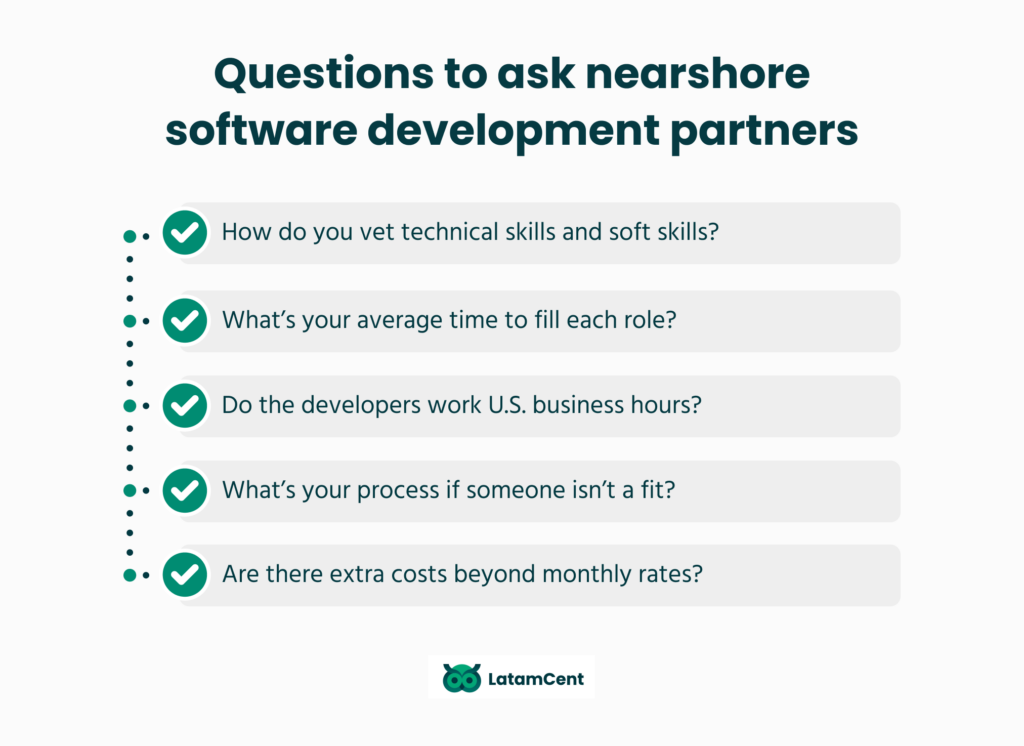
What’s Your Developer Vetting Process?
Not every nearshore company screens for the same things, and most won’t show you how their process works unless you ask. You want to know who’s doing the vetting, what technical standards they use, and how deep the evaluations go.
Ask if candidates are tested in relevant programming languages or just reviewed on GitHub.
See whether code quality, documentation, and communication are all assessed, or if it’s just a basic skills checklist. If you’re building a custom software development team, you need nearshore developers who’ve worked inside agile development teams.
The best nearshore partners can help you decide if you need a freelancer, contractor, or full-time hire based on your product roadmap and delivery urgency.
How Fast Can You Fill a Role or Team?
Speed is important, but not at the cost of quality.
Some nearshore software providers will promise a full squad in days, only to shuffle resumes that hardly match your requirements. Others take four to six weeks and hand over three people who are exactly what you need.
Ask for specifics.
How long does it take to source? How many pre-vetted software developers are in their current pipeline? If you’re scaling fast, you need a partner with dedicated teams that matches your time zone, tools, and tech stack.
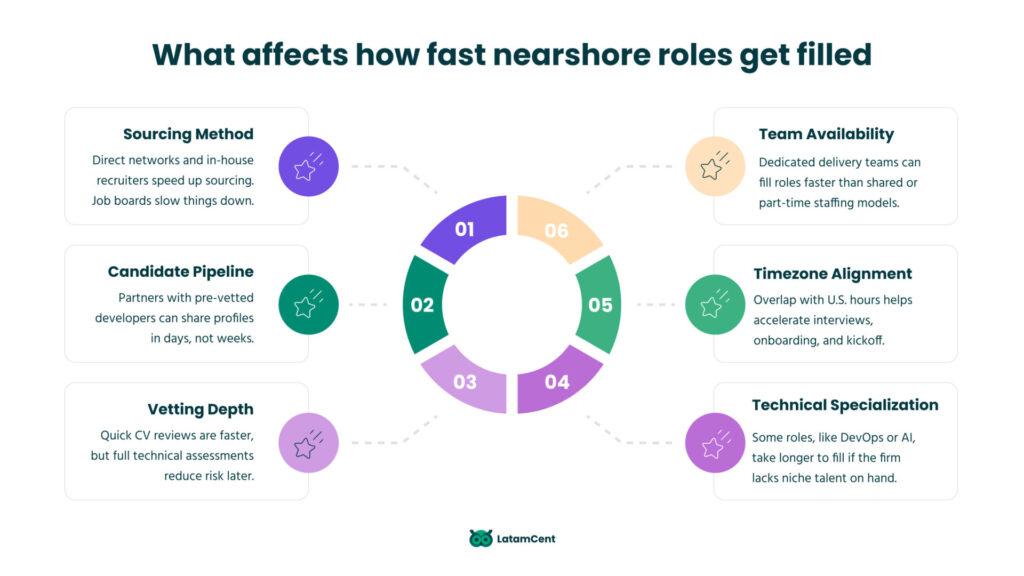
Find nearshore development companies that have a track record of ramping up software projects without ignoring steps.
Do the Candidates You Send Work U.S. Business Hours?
Time zone overlap makes or breaks delivery speed. If your standups happen at 9 a.m. EST, but the team logs in at noon, you’re always three hours behind on decisions.
Ask when the candidate developers are online. Not just a general “yes, we align”, get specifics.
Can they join daily calls? Will project managers respond midday? Most nearshore teams in Latin America work U.S. hours, but make sure the company isn’t stretching the truth just to land the contract.
What Happens if a Developer Isn’t a Good Fit?
No process is perfect. Even with vetting, sometimes someone doesn’t gel with your stack, your culture, or your workflow.
What matters is how the nearshore partner handles it.
Ask about replacement timelines. Ask if you’ll be billed during the change. A solid nearshore software development company already has backup candidates pre-screened and ready to step in, protecting your timeline and keeping the software project moving without a reset.
How is Your Pricing Structured, & Are There Hidden Fees?
Transparency should be standard, but it isn’t. Some nearshore companies add fees for onboarding, HR support, compliance, or replacement guarantees.
Get a clear breakdown of what’s included.
Is the cost per developer flat, month-to-month? Is payroll handled, or is it managed separately? For U.S. companies focused on cost efficiency and predictability, a clean pricing model matters as much as the talent itself.
Bonus tip: Ask if the pricing changes by country. Some nearshore development companies operate around multiple LATAM locations with different rate bands, it’s worth knowing upfront.
Conclusion
The difference between a good outsourcing partner and a great one comes down to process, alignment, and trust. The best nearshore software development companies help build real teams that ship faster, collaborate better, and scale at your speed.
Latin America has become a strong nearshore destination for U.S. startups that need speed without sacrificing quality. Choosing the right partner still requires asking the right questions, understanding how they vet developers, and knowing how their model fits your internal workflows.
Frequently Asked Questions
What is a nearshore software development company?
A nearshore software development company supplies engineers or full teams from nearby countries, which for U.S. companies usually means Latin America. Some place engineers directly into your team, and others deliver whole projects.
Which nearshore software development company is best for U.S. startups?
The best fit depends on how you want to work. LatamCent places engineers into existing teams and handles compliance, payroll and HR. Other companies in the list focus on project delivery, AI and data work, or cloud modernization. Use the table and the guide above to match your situation.
How are nearshore teams different from offshore teams?
Nearshore teams work in U.S. business hours, so standups, code reviews and feedback happen in real time. Offshore teams often sit many time zones away, which adds waiting time and rework.
What roles can I hire through a nearshore software development company?
Common roles include back-end, front-end, full-stack, mobile, DevOps, QA and cloud engineers. Some companies also place data and AI engineers.
How fast can a nearshore company fill a software developer role?
Speed varies by company, and the figures are the companies’ own claims. Near says its first shortlist arrives in 3 to 5 days and most companies hire in under three weeks. Luby says a Solutions Architect proposes a squad within 24 hours. Ask each company for current numbers.
Do nearshore developers work U.S. business hours?
Most nearshore teams in Latin America do. Ask when each developer is online and whether they can join your daily standup, because a general answer of alignment is not enough.
What should I ask a nearshore software development company before signing?
Ask how it vets developers, how fast it fills roles, what hours its developers work, what happens if a hire is not a good fit, and how pricing is structured. Get any fees for onboarding, HR, compliance or replacements in writing.
Can nearshore software development companies cover AI and ML work?
Yes. Azumo lists AI and data engineering, Luby Software lists AI and data analytics, and BairesDev lists AI among its services. LatamCent also places AI and ML engineers. See the full list of nearshore and staffing companies for hiring AI engineers.
What is a dedicated nearshore development team?
A dedicated nearshore development team is a group of engineers who work only on your product, take part in your sprints and use your tools from a nearby time zone. This differs from project outsourcing, where a vendor delivers an agreed scope. Ask who manages the engineers day to day.
Hiring software engineers in Latin America?
LatamCent places vetted software engineers from Latin America with U.S. SaaS teams. Tell us about the role you need to fill.
Looking at a specific role? See how to hire nearshore software developers.