


Quick compare
Top 6 (out of 16) IT staff augmentation companies at a glance
-
01LatamCent
Best for
Nearshore engineers on U.S. hours
Recruits, vets, and employs Latin American engineers who work inside U.S. AI and SaaS teams.
Starting price
Custom quote
Quote after a kickoff call
Book a callKey services5
- Talent-as-a-Service (contractor of record)
- Direct hire
- AI/ML, back-end, and full-stack engineers
- GTM and customer success roles
- Payroll and compliance in Latin America
Pros4
- $835K saved a year for Monarch, with 88% retention
- Median of 19 days to an accepted offer
- 93% first-placement success and a 60-day guarantee
- Hires beyond engineering, into GTM and CS
Cons2
- Latin American talent only, by design
- Not a freelance marketplace or project shop
-
02BairesDev
Best for
Large LatAm teams, fast
Staff augmentation, dedicated teams, and outsourcing from 4,000+ engineers across Latin America.
Starting price
Not published
Clutch lists a $50K+ minimum project
Read the reviewKey services4
- Staff augmentation
- Dedicated teams
- Software outsourcing
- AI transformation
Pros3
- Teams stand up in about 2 to 4 weeks
- Scaled a Pinterest team from 5 to 233 developers
- 4,000+ engineers across 20+ countries
Cons2
- $50,000+ minimum project size on Clutch
- A single review on G2
-
03Toptal
Best for
One senior specialist within days
A vetted freelance marketplace that matches individual specialists, often within 24 hours.
Starting price
Not published
Third-party: $500 deposit
Read the reviewKey services3
- Freelance developers and designers
- Hourly, part-time, or full-time
- Toptal Projects managed teams
Pros3
- Average match in under 24 hours
- No-bill trial of up to two weeks
- One of the deepest review bases on G2
Cons3
- Global talent, so time zones vary
- You manage individual freelancers
- Highest rates in this group
-
04Near
Best for
Long-term LatAm hires
Recruits Latin American professionals for direct hire or ongoing staffing across functions.
Starting price
Not published
You pay only if you hire
Read the reviewKey services3
- Direct hire
- Staffing with payroll and compliance
- RPO and executive search
Pros3
- 180-day replacement guarantee
- Shortlists in 3 to 5 business days
- 160,000+ pre-vetted professionals
Cons2
- Generalist across functions
- Price is the top complaint on G2
-
05Distillery
Best for
A boutique nearshore partner
A 250+ person firm that can staff your team now and deliver a full project later.
Starting price
Not published
Clutch lists $50 to $99/hr
Read the reviewKey services3
- Staff augmentation
- Dedicated teams
- Custom software development
Pros3
- CVs in as little as 2 days
- Engineers across six Latin American countries
- Can take on full projects
Cons2
- Small review base
- Part of the bench is in Eastern Europe
-
0610Pearls
Best for
Managed nearshore teams
A 1,300+ person firm with delivery in Costa Rica, Colombia, Peru, and Pakistan.
Starting price
Not published
Clutch lists a $50K+ minimum project
Read the reviewKey services3
- Staff augmentation
- Dedicated product teams
- Custom development
Pros3
- ISO 27001 certified
- Multi-year client engagements
- Latin American delivery centers
Cons2
- $50,000+ minimum project size on Clutch
- No published time to start
Ratings checked November 2026. Full reviews of all 16 companies below.
Most IT staff augmentation companies sell the same promise: vetted engineers, fast. Very few publish the numbers that would let you check it.
The label also covers very different businesses. A freelance marketplace, a nearshore staffing firm, a $4 billion U.S. contract staffing company, and a contingency recruiter all call themselves IT staff augmentation companies.
They are not selling the same thing, and they do not fit the same startup.
Here is our 2026 shortlist of 16 IT staff augmentation companies for U.S. startups, ranked on what each one actually delivers and what it publishes to back it up. LatamCent takes the top spot.
The criteria are below, along with every company’s pricing, ratings, and fit, so you can check the order yourself.
Key Takeaways
The short version, before the full breakdown.
Staff augmentation adds engineers, not management. You run the work. If you want a vendor to own scope and delivery, you are buying project outsourcing instead.
Region decides cost and overlap. Senior developers bill at about $55 to $85 an hour in Latin America and $150 to $200 in the U.S., per 2026 rate data from a nearshore staffing firm.
Almost nobody publishes prices. Of the 16 companies here, only ValueCoders posts rates on its site. Kforce discloses its average bill rate in its annual report.
Weight named results over logos. A named client with a defined metric beats a wall of enterprise logos. Fewer than half of these firms publish one.
Read the guarantee. Replacement terms range from none to 180 days, and they matter more than the time-to-hire headline.
What IT Staff Augmentation Actually Is (and What It Is Not)
IT staff augmentation is a hiring model where an outside partner supplies engineers who work inside your team. They join your standups, take tickets from your backlog, and push to your repo.
You manage the work. The partner handles sourcing, vetting, contracts, and usually payroll and compliance.
Four other models get sold under the same name, and most disappointed buyers bought one of them by accident:
- Team augmentation. A small pod, such as two developers and a QA engineer, joins as a unit. Still staff augmentation, just packaged.
- Project outsourcing. The vendor owns scope, delivery, and the team. You get output, not teammates. See staff augmentation vs outsourcing for where that line falls.
- Freelance marketplaces. You hire and manage individual contractors through a platform. Fast, but nobody manages continuity for you.
- Contingency recruiters. They find a full-time employee and charge a fee when you hire. Useful, but nothing is augmented: the hire is yours from day one.
Most IT staff augmentation services bundle five pieces of work: sourcing, technical vetting, contracts and IP assignment, payroll and compliance in the engineer’s country, and replacement if a placement fails. Prices differ mainly by how many of those five sit inside the fee.
Staff augmentation sells you engineers. Outsourcing sells you output. Marketplaces sell you access. Know which one you are buying before you compare prices.
How We Ranked These IT Staff Augmentation Companies
Full disclosure: LatamCent publishes this guide, appears on the list, and ranks itself first. We have a stake in the result, so the standards below are public and every company, ours included, is judged on the same four. Where another company is the better fit, its entry says so.
A ranked list is only worth reading if you know what earned the order. Every company below was measured against the same four standards, using its own site, public filings, and review platforms such as G2 and Clutch.
- Proof you can check. Named clients with defined metrics count most. Logos and anonymous case studies count less. Where a rating rests on only a few reviews, we say so.
- Time to a working engineer. What the company says publicly about shortlist and hire timelines, and whether its own case studies support it.
- Fit for a U.S. startup. Time zone overlap, minimum commitments, and whether the company is built for a 20-person team or a Fortune 500 procurement office.
- Transparency. Published pricing, replacement terms, and honest scope. Where a company publishes nothing, the entry says so, so you know what to ask for on the first call.
Ratings and figures were checked in November 2026. Where a company does not publish something, we say so rather than estimate it.
The 16 Best IT Staff Augmentation Companies for U.S. Startups (2026)
Sixteen companies made the list, ordered by how well they meet the criteria above for a U.S. startup.
The first eight lean nearshore or offshore and are built with smaller teams in mind. The second eight are large U.S. staffing firms, which tend to suit later-stage companies better than seed-stage ones.
Each entry covers what the company is genuinely good at, what it can prove, what it costs, and the buyer it fits best.
1. LatamCent, Best for Nearshore Engineers on U.S. Hours
LatamCent is a nearshore hiring partner for AI and SaaS companies. The company recruits and vets engineers across Latin America, places them inside U.S. teams, working U.S. hours, and handles their payroll and compliance, so a startup gets a full-time teammate without opening an entity abroad.
Companies work with LatamCent in one of two ways. With Talent-as-a-Service, LatamCent acts as the contractor of record and handles payroll, compliance, and replacements. With direct hire, the engineer joins your own payroll. Nearly every client chooses the first.
The clearest example is Monarch, formerly TestBox. LatamCent built Monarch an eight-person engineering team in Brazil, from an engineering manager down to senior and full-stack engineers. Monarch reports $835,000 a year in savings, 63% below U.S. cost, and 88% retention.
Retention is the figure that matters. Savings mean little if the engineer leaves after six months, and LatamCent publishes the client, the headcount, and the share of placements that stayed.
The speed shows up in other accounts too. Flxpoint cut its time to hire from eight to ten weeks down to two to three across 19 hires, and CargoFax found its first engineer, a senior Python developer, on the first attempt. “We got it right on the first try,” says co-founder Joel Olivier Baussaun.
Behind those results is a process built for fit rather than volume. Every search starts with a kickoff call and a role-specific interview plan, and talent partners who specialize in that role source 1,100 to 1,700 candidates before running technical exercises and reference checks. Your team only meets the finalists.
The timeline follows from the process. First vetted candidates typically arrive within seven days, most hires close in 21 days or less, and the median time to an accepted offer is 19 days. Every placement carries a 60-day replacement guarantee, backed by a 93% first-placement success rate.
The bench also reaches past engineering. Alongside AI and ML engineers, back-end and full-stack developers, LatamCent fills GTM and customer success roles. SpendHound grew its customer success and procurement team from four or five people to almost 30 with LatamCent.
Best suited to U.S. AI and SaaS companies that want senior engineers on their hours, inside their tools, with payroll and compliance handled. LatamCent is not a freelance marketplace or a project shop, and it does not pretend to be.
2. BairesDev, Best for Standing Up a Large LatAm Team Fast
BairesDev is the name most founders hear first when they start looking at Latin America, and for good reason. Nacho De Marco and Paul Azorin started the company in Buenos Aires in 2009, opened in San Francisco three years later, and built a bench of more than 4,000 engineers across 20+ countries in the region.
Size is the whole pitch. BairesDev says a team typically stands up in about two weeks, and closer to four for larger groups, which is fast for the number of people involved. The best-known example is Pinterest, where it scaled a team from 5 developers to 233.
Read that number for what it is. Headcount growth shows BairesDev can deliver volume, but it does not tell you what those developers shipped, and the company publishes little in the way of outcome metrics.
The same goes for the “top 1%” line, which comes from hiring fewer than 1% of roughly 2.5 million applicants a year. The figure measures how selective the funnel is, not how skilled the engineers are.
Pricing is where smaller buyers run into trouble. BairesDev does not publish rates beyond saying engineers come in 30% to 50% below U.S. cost, and its Clutch profile lists a $50,000 minimum project size next to a 4.9 rating from 63 reviews.
Best suited to funded startups and scale-ups that need five or more nearshore engineers within a month. A seed-stage team hiring its first developer is not the buyer this model is built around.
3. Toptal, Best for One Senior Specialist Within Days
Toptal sits in a different category from most of this list. Founded in 2010 by Taso Du Val and Breanden Beneschott, the company runs a vetted freelance marketplace rather than a staffing firm, and that difference shapes everything about how you work with it.
Where Toptal wins is speed for a single hire. The company says its average time to match is under 24 hours, with work starting within 48, and it backs that with a trial of up to two weeks that you are not billed for if the fit is wrong. No one else here moves that fast for one senior person.
The vetting story is the famous “top 3%”, drawn from more than 200,000 applications a year. Buyers seem to agree it holds up: Toptal carries 4.7 on G2 across 270 reviews, the deepest review base of any company on this list.
The trade-off is cost and management. Toptal does not publish rates, but third-party trackers report a $500 refundable deposit and typical rates of $60 to $150 an hour, with specialists above $200. Clutch lists a band of $100 to $149.
Because the talent is global, you also manage individual freelancers across whatever time zone they happen to live in, and nobody manages continuity for you if someone leaves.
Best suited to startups that need one senior specialist this week and will pay a premium for speed and a no-risk trial.
4. Near (HireWithNear), Best for Long-Term LatAm Hires With a Long Guarantee
Near, which many buyers still know by its HireWithNear domain, runs the model closest to LatamCent’s on this list. Founded in Texas in 2021, the company recruits Latin American professionals for U.S. companies, either as direct hires or through ongoing staffing where Near carries payroll and compliance.
Two things stand out. The first is the guarantee: placements come with 180 days of replacement cover, the longest of any company here. The second is the review base, with 4.8 on G2 from 163 reviews and 4.9 on Clutch from 56.
The process claims are tight as well. Near says shortlists arrive in three to five business days and most roles close within 21 days, drawing on a network it puts at more than 160,000 pre-vetted professionals. The named proof is CyberFortress, which Near says hired 22 people and saves $1.2 million a year.
Near covers far more than engineering, from operations to sales, so it reads as a generalist rather than a technical specialist. Fees are not published, you pay nothing unless you hire, and among G2 reviewers price is the most common complaint.
Best suited to startups building long-term Latin American teams across several functions that want the longest guarantee in the category.
5. Distillery, Best for a Boutique Nearshore Partner That Can Also Deliver Projects
Distillery is the boutique option among the nearshore firms. Andrey Kudievskiy founded the company in the Los Angeles area in 2012, and it has grown to about 250 people, with engineers in Mexico, Argentina, Brazil, Colombia, Peru, and Uruguay, plus Poland, Romania, and Georgia.
Staff augmentation is only part of what Distillery does. On Clutch, custom development makes up a larger share of its work than augmentation, which is useful if you expect to hand over a full project later. The company says it can send CVs in as little as two days.
Clients rate it highly, at 5.0 on Clutch, though from only 14 reviews, and cost is the category reviewers score lowest. Rates are not published, and the third-party figures disagree: Clutch shows $50 to $99 an hour with a $25,000 minimum, while DesignRush lists $100 an hour and $50,000.
Because part of the bench sits in Eastern Europe, ask for a Latin American engineer if same-day collaboration with a U.S. team matters.
Best suited to startups that want a smaller, agency-style nearshore partner able to staff a team now and deliver a project later.
6. 10Pearls, Best for a Managed Nearshore Team With Enterprise Process

10Pearls brings enterprise process to nearshore staffing. Co-founder and CEO Imran Aftab leads a firm founded in 2004 in Vienna, Virginia, that now employs more than 1,300 people across delivery centers in Costa Rica, Colombia, Peru, and Pakistan.
The company sells staff augmentation across onshore, nearshore, and offshore talent, alongside dedicated product teams, and holds ISO 27001 certification for information security.
What its Clutch reviews describe is longevity. One client, Technisys, has run a team of nine developers and QA engineers through 10Pearls since 2019, and an Austin fintech credits a 14-person team with lifting its code quality grade from D to B.
Those reviews average 4.9 across 36 clients. Clutch lists rates of $25 to $49 an hour, which is low for the region, but also a $50,000 minimum project size that rules out very early teams.
10Pearls does not publish a time to start, and with centers in Pakistan, you should ask specifically for Latin American engineers if you need U.S. overlap.
Best suited to funded startups that want a managed nearshore team with security certification and a partner built for multi-year engagements.
7. ScienceSoft, Best for Compliance-Heavy Products
ScienceSoft is the oldest company on this list, founded in 1989, and the process shows it. Headquartered in McKinney, Texas, with 750+ staff, the firm delivers mostly from Europe, including Latvia, Lithuania, and Poland.
You can bring ScienceSoft engineers into your team under your own project manager, take a dedicated team, or outsource a project outright. The timelines are unusually specific: CVs with rates within 24 hours, interviews within two to four days, and engineers on your team within one to two weeks.
The certifications explain who buys from it. ISO 9001, 27001, 27701, and 13485 cover quality, security, privacy, and medical devices, which matters to health and fintech products. The longest-running example is Viber, where three ScienceSoft teams of more than 40 developers have worked for over five years.
On Clutch, ScienceSoft rates 4.8 from 46 reviews, with an hourly band of $50 to $99 and a $5,000 minimum. Many of those reviews describe project and security work rather than augmentation, so ask for staffing references specifically.
The real cost is the clock. Europe sits about seven hours ahead of U.S. Eastern time, leaving a short window of shared hours each day.
Best suited to health, fintech, and other regulated startups that value certified process over same-hours collaboration.
8. ValueCoders, Best for the Lowest Cost When Async Work Is Fine
ValueCoders does something almost nobody else on this list does: it publishes its prices. The India-based firm, founded in 2004 with 675+ full-time staff, lists developers at about $1,750 to $2,500 for junior roles, $2,500 to $3,500 for mid-level, and $3,500 and up for senior, figures that read as monthly.
At those numbers, ValueCoders is by far the cheapest option here. The company says developers can start within a day to two weeks and offers a risk-free trial, although its own pages describe that trial as both seven days and two weeks.
The review base is thin, with 5.0 on Clutch from seven reviews, so references are worth asking for.
The bigger consideration is time. India sits 9.5 to 10.5 hours ahead of U.S. Eastern, so daily standups and same-day code review are hard to sustain, and most work runs asynchronously.
Best suited to budget-limited startups with async workflows and well-defined tickets.
9. Insight Global, Best for High-Volume U.S. Contract Hiring

Insight Global is where the list moves from nearshore specialists to the big U.S. staffing firms. Glenn Johnson founded the company in Atlanta in 2001, and it now ranks second among U.S. IT staffing firms, with an estimated $3.28 billion in 2025 IT staffing revenue, according to Staffing Industry Analysts.
The scale is hard to match. Insight Global runs more than 70 offices across 35 states and says it has 2,000 recruiters and 50,000+ consultants, covering everything from temporary contractors to permanent hires, RPO, and managed services.
The speed claims match the size: talent in as few as two days, screening within 24 to 48 hours, and people typically working within one to three weeks. You pay nothing until the first hire starts.
What is missing is published proof. Insight Global shows a wall of enterprise logos, including Home Depot and CVS, but no case studies with numbers, no G2 or Clutch reviews, and no pricing.
Best suited to startups that need many U.S.-based contractors quickly and want one vendor for both contract and permanent roles.
10. Kforce, Best for Longer U.S. Contract Engagements
Kforce is the most transparent of the large U.S. firms, mostly because it has to be. Founded in Tampa in 1962 and publicly traded, the company reports its numbers to investors, and they say a lot about what buying from it looks like.
Kforce ranked third among U.S. IT staffing firms in 2026, with $1.22 billion in 2025 IT staffing revenue. Contract staffing makes up 98% of the business, and about 7,800 consultants were on assignment at the end of 2025.
The annual report also gives the rare price signal in this category: an average technology bill rate of about $90 an hour, with assignments averaging around ten months. For anyone trying to understand what a U.S. contractor costs through a large firm, that number is a useful anchor.
The same report is clear about the customer. Kforce says it serves primarily Fortune 500 and similarly sized companies, so a startup is a small account, and the review platforms reflect that, with a single review on G2 and none on Clutch.
Best suited to funded startups that need U.S.-based contractors for engagements of six months or more and can pay U.S. bill rates.
11. Apex Systems, Best for U.S. Contractors With a Path to Mexico

Apex Systems, based in Glen Allen, Virginia, belongs to Everforth, the staffing group that called itself ASGN until April 2026 and ranks fifth among U.S. IT staffing firms. Apex places contract, contract-to-hire, and permanent IT staff.
What sets it apart from the other U.S. firms is a nearshore option. Everforth runs delivery centers in Guadalajara and Monterrey, so a company can start with U.S. contractors and shift some work to Mexico later without changing vendors.
Clients rate the service well. Apex earned a ClearlyRated client NPS of 80 in 2026, against an industry average of 47, and one case study describes placing 23 project managers in four months for a clinical-tech client at rates about 18% below average.
Pricing and time to fill are not published, and Everforth describes its commercial clients as Fortune 1000 and large mid-market companies.
Best suited to later-stage startups that want U.S. contractors now and the option of Mexico-based delivery later.
12. Mondo, Best for Fast Onshore Contract Talent
Mondo built its reputation on speed. Michael Kirven founded the agency in 2000, Addison Group acquired it in 2018, and today it runs 11 U.S. offices from its Philadelphia headquarters, filling contract, contract-to-hire, and full-time roles in AI, IT, digital marketing, and creative.
Mondo is one of the few staffing firms that publishes speed targets: three to five days for contract talent and eight to ten days for full-time hires. The company also cites a 75% fulfillment rate, though without saying what that figure measures.
Proof is where Mondo goes quiet. There are no named case studies, no client reviews on G2 or Clutch, and no published pricing.
Best suited to startups that need onshore contract talent in tech or marketing within a week.
13. Dexian, Best for One Vendor Across Onshore, Nearshore, and Offshore

Dexian is the product of a merger. DISYS, founded in 1994 by Maruf and Mahfuz Ahmed, combined with Signature Consultants in 2021, and the two rebranded as Dexian in 2023. The company now reports more than 10,000 employees, 70+ locations, and 370+ clients.
Range is the strength. Dexian sells contract, contract-to-hire, permanent, and managed staffing programs, with delivery in the U.S., Mexico, Brazil, India, and Europe, so one vendor can cover onshore, nearshore, and offshore needs at once.
According to the company, contract placements often happen within days, while specialized roles take a few weeks. The one quantified case study, a 46% staffing cost reduction for an energy company, does not name the client.
Clients stay an average of 11 years, which says a lot about who the model is built for. There are no G2 or Clutch reviews, and pricing is not published.
Best suited to later-stage companies that want one vendor managing onshore, nearshore, and offshore staff together.
14. TEKsystems, Best for Enterprise-Scale U.S. IT Staffing
TEKsystems is the largest IT staffing firm in the U.S. Part of Allegis Group and based in Hanover, Maryland, the company was founded in 1983 and led the 2026 Staffing Industry Analysts ranking with $3.92 billion in 2025 IT staffing revenue, ahead of Insight Global.
TEKsystems sells IT staffing, managed services, and project-based IT services across a national bench. On G2, it shows 4.3 from eight reviews, and like most firms its size, the company does not publish pricing or time to fill.
Size brings breadth rather than focus. A startup filling two roles will be a small account next to the enterprise programs TEKsystems is built for.
Best suited to later-stage companies that need a national bench and a single master services agreement.
15. Akkodis, Best for Large Contract Programs Under One Agreement

Akkodis is the Adecco Group’s technology brand, formed in 2022 from AKKA and Modis. The company describes a workforce of 50,000 tech experts across 30 countries and sells contract, contract-to-hire, direct hire, RPO, and managed services.
The credentials point to large buyers. Akkodis holds a Texas state IT staff augmentation contract and was named a Leader in U.S. contingent staffing by Everest Group in 2022.
For a startup, there is little to go on. Akkodis publishes no rates or hiring timelines, has no G2 or Clutch reviews, and reported a 4% revenue decline in 2025.
Best suited to large companies and public-sector buyers running volume contract programs.
16. CyberCoders, Best for Contingency Full-Time Hires
CyberCoders closes the list because it is a different kind of company. Founded in Irvine, California, in 1999 and now part of Everforth, the firm is a permanent-placement recruiter, and Everforth’s filings describe it as specializing in recruiting professionals for permanent placements.
The distinction matters if you are comparing it with everyone above. CyberCoders finds full-time employees and is paid on contingency when you hire, so nothing is augmented and there is no bench of contractors behind the hire.
Fees are not published, and G2 shows 4.1 from four reviews.
Best suited to startups making individual full-time U.S. hires that want to pay only on success.
Side-by-Side Comparison
With all 16 reviewed, the differences come down to three things: the model each company sells, where its engineers live, and how much it is willing to put in writing. Against the criteria this list was ranked on, they sort like this.
| Company | Model | Where engineers are | Published pricing | Time to hire (as stated) | Ratings |
|---|---|---|---|---|---|
| LatamCent | Staff augmentation (TaaS) or direct hire | Latin America | Not published | Typically 21 days or less; median 19 | G2 5.0 (4) |
| BairesDev | Staff aug, dedicated teams, outsourcing | Latin America | Not published; Clutch $50 to $99/hr, $50K min | About 2 to 4 weeks | Clutch 4.9 (63) |
| Toptal | Freelance marketplace | Global | Not published; third-party $60 to $150/hr | Match under 24 hours | G2 4.7 (270) |
| Near | Staffing or direct hire | Latin America | Not published | 21 days or less | G2 4.8 (163) |
| Distillery | Staff aug and projects | LatAm and Eastern Europe | Not published; Clutch $50 to $99/hr | CVs in 2 days | Clutch 5.0 (14) |
| 10Pearls | Staff aug and product teams | LatAm and Pakistan | Not published; Clutch $25 to $49/hr, $50K min | Not published | Clutch 4.9 (36) |
| ScienceSoft | Team aug and outsourcing | Europe | Not published; Clutch $50 to $99/hr | 1 to 2 weeks | Clutch 4.8 (46) |
| ValueCoders | Dedicated offshore developers | India | $1,750 to $3,500+ per developer | 1 day to 2 weeks | Clutch 5.0 (7) |
| Insight Global | Contract to permanent, RPO | U.S. plus offshore | Not published | 1 to 3 weeks | None found |
| Kforce | Contract staffing | U.S. | Average bill rate about $90/hr (10-K) | Not published | G2 (1) |
| Apex Systems | Contract, contract-to-hire, perm | U.S. plus Mexico | Not published | Not published | G2 (1) |
| Mondo | Contract, contract-to-hire, perm | U.S. | Not published | 3 to 5 days contract | None found |
| Dexian | Contract, perm, managed programs | U.S., Mexico, Brazil, India | Not published | Days to a few weeks | None found |
| TEKsystems | IT staffing and services | U.S. | Not published | Not published | G2 4.3 (8) |
| Akkodis | Contract to managed services | Global | Not published | Not published | None found |
| CyberCoders | Contingency permanent placement | U.S. | Not published | Not published | G2 4.1 (4) |
Ratings show the score and, in brackets, the number of reviews, checked in November 2026.
Read across the rows and three groups emerge. The nearshore firms, LatamCent, BairesDev, Near, Distillery, and 10Pearls, offer U.S. hours at Latin American rates and differ mainly on scale, guarantees, and minimums. Toptal and ValueCoders sit at the two extremes, one built for speed and the other for price.
The large U.S. firms, from TEKsystems to Akkodis, trade transparency for breadth. Most publish neither prices nor timelines, because their buyers negotiate both inside enterprise contracts.
The ratings column says as much as the scores do. A 5.0 from seven reviews and a 4.7 from 270 are not the same signal, and only a handful of companies here have enough reviews to show how they treat a typical client.
Proof: What Published Results Look Like
Several companies on this list publish client results. The table shows the strongest one from each, and what the number actually measures.
Named clients are marked.
| Company | Published result | What the number measures | Client named? |
|---|---|---|---|
| LatamCent | 8 roles in Brazil; $835,000 saved a year; 88% retention | Payroll savings vs U.S. market rates, and how many placements stayed | Yes, Monarch |
| LatamCent | Time to hire from 8 to 10 weeks down to 2 to 3 | Speed across 19 hires | Yes, Flxpoint |
| BairesDev | Team scaled from 5 to 233 developers | Headcount growth, not a business outcome | Yes, Pinterest |
| Near | 22 hires; $1.2 million saved | Savings across a multi-role team | Yes, CyberFortress |
| ScienceSoft | Delivery cut from 5 to 6 months down to 3 | Release cycle for a 19-developer team | Yes, IBM (Tivoli product team) |
| Apex Systems | 23 project managers in 4 months | Fill speed and rates about 18% below average | No |
| Kforce | Over $630,000 in cost savings | Recruiting cost for a health insurer | No |
| Dexian | 46% staffing cost reduction | Cost on one talent program | No |
When a vendor hands you a number, ask which of these it resembles, and which one it is hoping you assume.
“I was blown away because LatamCent was able to find more than one qualified candidate who met all of it.”
Alex Nauda, CTO, Monarch (formerly TestBox)
U.S.-Based vs Nearshore vs Offshore IT Staff Augmentation Companies
Where the engineers sit drives cost, overlap, and the kind of company you are dealing with more than any other choice.
The largest IT staff augmentation companies in the USA are big. The 57 largest U.S. IT staffing firms generated $27.4 billion in 2025.
TEKsystems led at $3.92 billion, followed by Insight Global at $3.28 billion and Kforce at $1.22 billion, per Staffing Industry Analysts. Their scale helps with volume hiring and U.S.-only roles.
For a startup filling two to five engineering seats, fit and speed usually matter more than size.
| U.S.-based firms | Nearshore (Latin America) | Offshore (India, Eastern Europe) | |
|---|---|---|---|
| Examples here | TEKsystems, Insight Global, Kforce, Apex Systems, Mondo | LatamCent, BairesDev, Near, Distillery, 10Pearls | ValueCoders, ScienceSoft |
| Overlap with U.S. Eastern | Full | 0 to 3 hours difference | Eastern Europe about 7 hours ahead, India 9.5 to 10.5 |
| Senior developer bill rate | About $150 to $200/hr | About $55 to $85/hr | Varies by country |
| Built for | Enterprise programs, on-site or U.S.-only roles | Startups that run live standups and same-day code review | Well-scoped, async work |
Nearshore IT Staff Augmentation in Latin America
Nearshore IT staff augmentation places Latin American engineers on U.S. teams. Most of the region sits 0 to 3 hours from U.S. Eastern time.
The overlap is the whole argument. Questions get answered the same day, and remote engineers join live standups instead of reading notes the next morning.
| Country | Time zone | vs U.S. Eastern (winter) | Senior bill rate |
|---|---|---|---|
| Mexico | UTC-6 | 1 hour behind | $60 to $85/hr |
| Colombia | UTC-5 | Same time | $50 to $70/hr |
| Brazil | UTC-3 | 2 hours ahead | $55 to $80/hr |
| Argentina | UTC-3 | 2 hours ahead | $50 to $75/hr |
| Chile | UTC-3 in summer, UTC-4 in winter | 1 to 2 hours ahead | $58 to $80/hr |
Bill rates come from 2026 rate data published by Trio, a nearshore staffing firm. For country-level detail, see how to hire in Brazil and how to hire in Mexico.
How Much Does IT Staff Augmentation Cost?
IT staff augmentation is billed by the hour, by the month per engineer, or as a one-time direct-hire fee. Region and seniority set most of the price.
Two kinds of numbers get quoted, and mixing them up causes most of the confusion. A bill rate is what a provider charges you per hour, including its margin.
An employment cost is what the engineer costs per year in salary, taxes, and benefits, before any provider fee.
Start with bill rates. The same Trio data puts Latin American rates 40% to 60% below U.S. onshore rates for comparable seniority.
| Seniority | Latin America (bill rate per hour) | United States (bill rate per hour) |
|---|---|---|
| Junior | $20 to $40 | $80 to $120 |
| Mid-level | $35 to $60 | $120 to $160 |
| Senior | $55 to $85 | $150 to $200 |
Employment cost tells the same story on a full-year basis. LatamCent’s own placement data puts a senior software engineer at $80,000 to $110,000 a year in Latin America against $200,000+ in the U.S.
An AI/ML engineer costs $95,000 to $130,000 against $210,000 to $280,000. Those are employment costs, so a provider’s service fee, quoted per role, comes on top.
Published provider pricing is rare, which is itself useful information. Here is what the 16 companies actually disclose:
- ValueCoders posts developer rates of $1,750 to $3,500+ on its site, the only full rate card on this list.
- Kforce reports an average technology bill rate of about $90 an hour in its annual report.
- BairesDev, 10Pearls, Distillery, and ScienceSoft show hourly bands and minimum project sizes on Clutch, from $5,000 to $50,000+.
- Toptal publishes no rates; third-party trackers report a $500 refundable deposit.
- Everyone else, including LatamCent, quotes after a call.
When you compare quotes, ask what sits inside the fee: payroll, compliance, equipment, and replacement. A low hourly rate that bills replacement separately is not low.
Want a number for your own role? Book a kickoff call with LatamCent and get a cost estimate for the role, stack, and seniority you need.
Staff Augmentation Company vs Employer of Record (EOR)
Many teams looking at Latin America also weigh an employer of record, or EOR. Platforms such as Deel and Remote employ the engineer on your behalf and handle local payroll, benefits, and compliance.
The difference is who finds the engineer. An EOR starts once you have already chosen someone, so you still post the role, screen the applicants, run the technical interviews, and absorb the cost if the hire does not work out.
A staff augmentation company does the search for you: it sources and vets candidates, presents a shortlist, replaces a placement that fails, and handles payroll and compliance as well.
An EOR makes sense when you already have a candidate, or a recruiter with time to run international searches. When finding and vetting the engineer is the bottleneck, a hiring partner covers the part an EOR leaves to you. For a country-by-country view of EOR options, see employer of record providers in Latin America.
Benefits of IT Staff Augmentation Services for B2B SaaS Startups
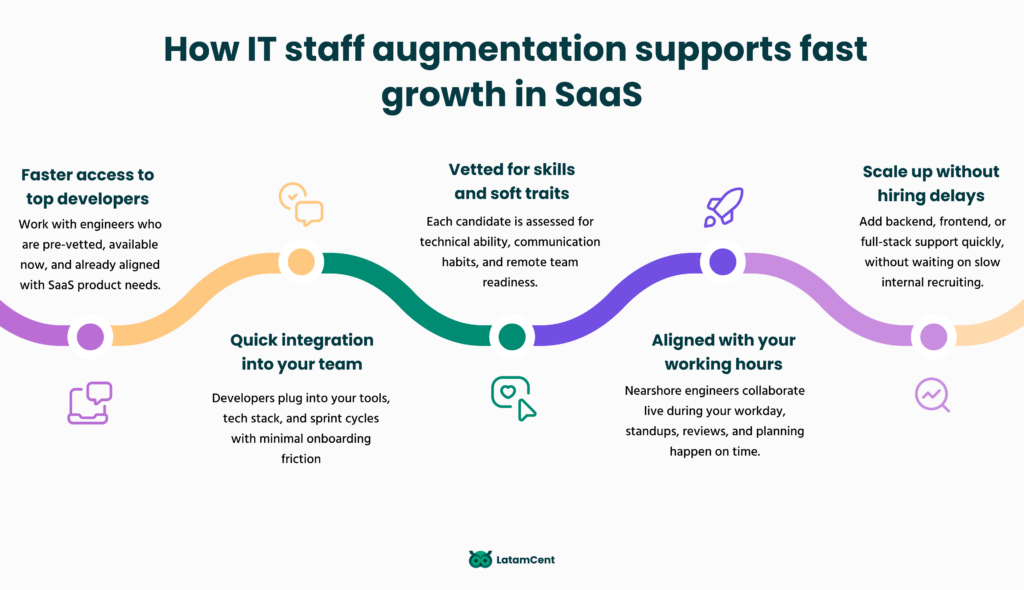
The case for staff augmentation comes down to five things a startup cannot easily build on its own.
Faster Access to High-Performing Developers
Hiring locally can take months. Most startups do not have that runway.
IT staff augmentation services cut the timeline by connecting founders with engineers who are already vetted and ready to start. You get access to:
- Developers with custom software and emerging-tech experience
- Specialists in QA, data science, mobile, and UI/UX
- Engagement models that flex for short or long projects
New hires start contributing to product delivery without the back-and-forth of a long hiring process.
Engineers Who Integrate Quickly Into Your Team & Stack
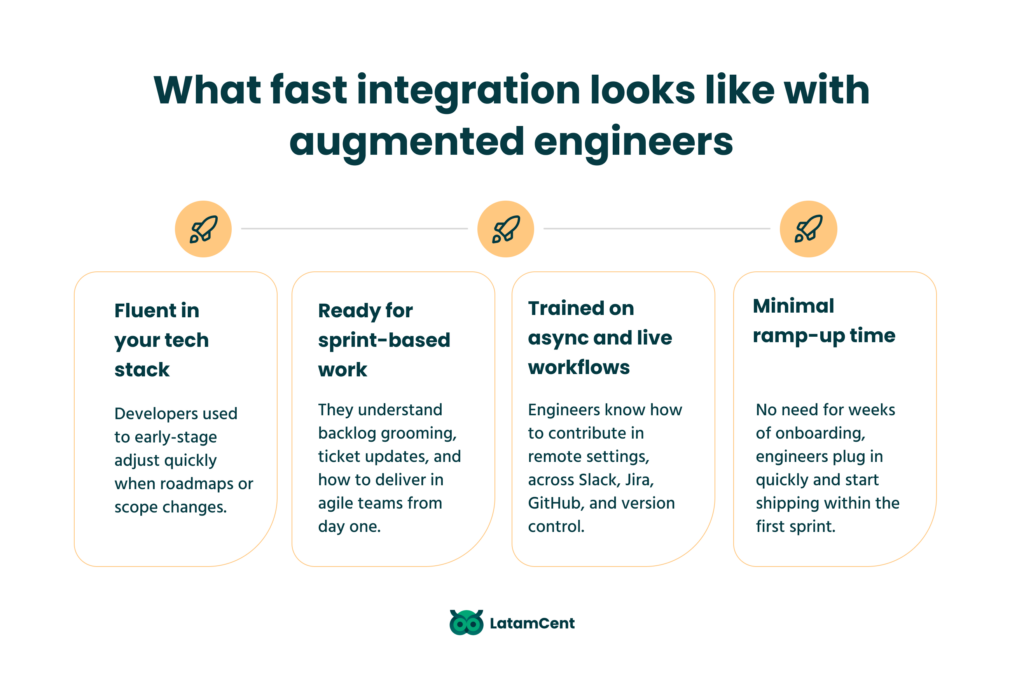
Adding people only helps if it does not add friction.
Good staff augmentation companies screen for engineers who already know standard SaaS stacks such as React, Node.js, Python, and AWS. They plug into your project workflows instead of waiting weeks for onboarding.
The result is a team that keeps its velocity while headcount grows. Your roadmap stays intact and releases stay on schedule.
Talent Vetted for Technical Skill & Communication
Strong providers vet for more than syntax. Screening usually covers hands-on coding tests, English fluency checks, and collaboration exercises.
Recruiters also watch how candidates take feedback and explain architecture choices. For a SaaS founder, that means engineers who can run a standup, write clear documentation, and keep work moving.
Three quick checks when you evaluate a provider:
- Do they run live technical challenges?
- Do they screen written and spoken English?
- Can they share references from SaaS clients?
Time Zone & Workflow Alignment for Real-Time Collaboration
Feedback speed sets product velocity. When engineers share U.S. hours, questions get answered the same day and bug fixes do not wait until tomorrow.
Nearshore teams in Latin America give you that overlap for standups, code reviews, and launches. The Latin America time zone table shows the hours by country.
Flexibility to Scale Engineering Capacity Without Delays
A funding round or a big new customer can force a startup to grow faster than internal hiring allows. Waiting four to six months for recruiting risks missed deadlines and lost revenue.
With staff augmentation, you add roles in weeks. A startup might bring in:
- QA engineers to stabilize new features
- Data engineers to fix analytics pipelines
- Mobile developers to ship customer-facing apps
Scaling up, or down, becomes part of how you operate. Budgets stay under control and capacity matches the roadmap.
What To Look For in an IT Staff Augmentation Company
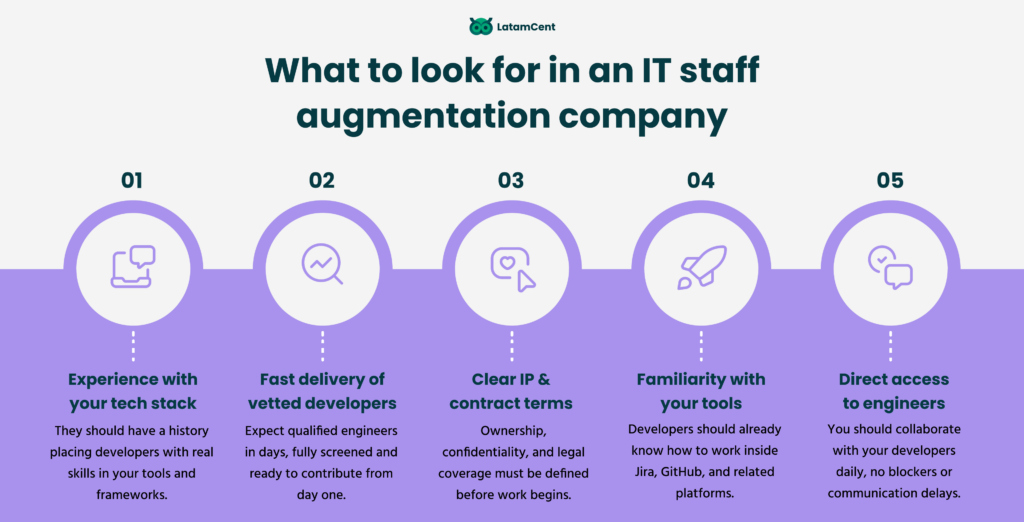
Every provider looks the same in a sales call. Each one promises vetted engineers in weeks.
Five checks show which ones will actually place the right engineer and which will just forward résumés.
Proven Experience Hiring for Your Tech Stack
A staff augmentation company should show a track record in the frameworks, languages, and infrastructure you actually use.
If your product runs on React, Node.js, and AWS, ask for placements in that exact stack. General software experience is not enough.
Ask for a named client and a defined result while you are at it. Headcount scaled is not the same as savings, and savings are not the same as retention.
Fast Delivery of Pre-Vetted Developers
SaaS deadlines do not wait for slow recruiting. The best firms keep vetted engineers ready to step in, so you add a developer in weeks, not months.
Expect vetting to include:
- Live coding tests in your stack
- English and communication checks
- Fit checks for distributed teams
Ask for the replacement terms in writing, too. Guarantees on this list run from none to 180 days.
Clear Ownership & IP Terms From Day One
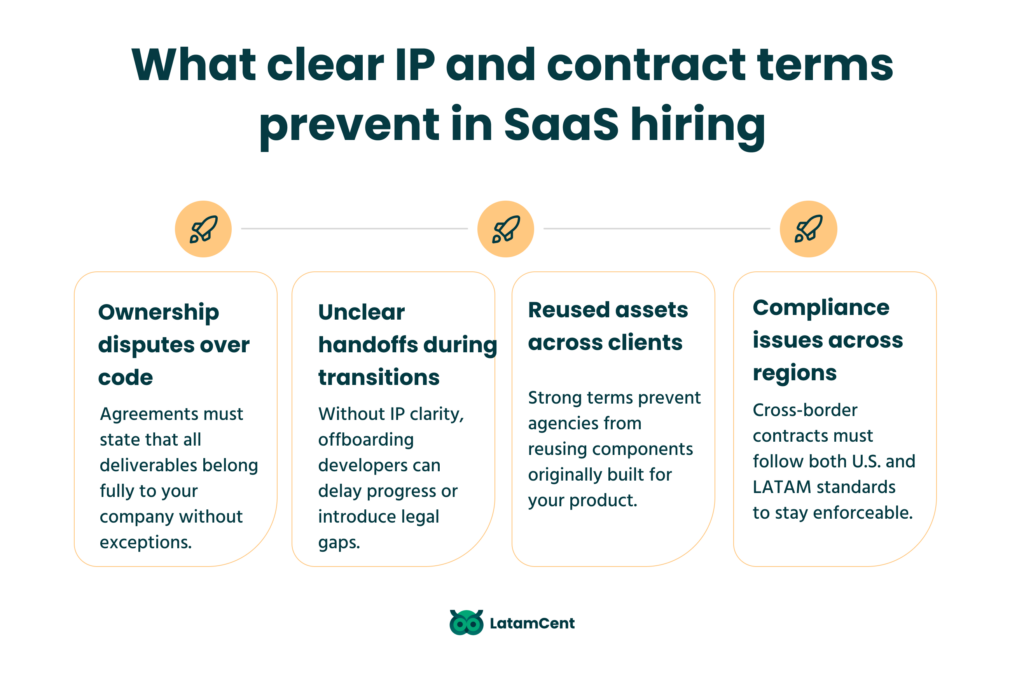
Nothing kills trust faster than doubt over who owns the code.
Your contract should state three things:
- All code contributions belong to your company
- Confidential data is protected by clear clauses
- Jurisdiction is specified to avoid disputes
Ask for the IP clause before the first interview, not after the offer. Investors check it during diligence, and a vague clause can stall a round.
Talent Ready to Work in Your Tools & Process
Engineers who need weeks of onboarding burn runway. The right partner sends people who already know the tools you use every day.
Access to GitHub or Jira is the easy part. Augmented engineers should join a sprint, pick up tickets, and follow your code review rituals from week one.
Confirm three things:
- Experience with your CI/CD pipeline
- Comfort with your project management tool
- Willingness to follow your documentation and testing standards
Direct Communication With Developers
Layers of account managers slow projects down. The best staff augmentation companies give you a direct line to every engineer.
Standups, Slack threads, and sprint reviews should include the developers themselves. If an account manager sits between you and the person writing code, you bought a project, not a teammate.
How to Hire an IT Staff Augmentation Company
- Write a one-page brief. Role, stack, seniority, start date, budget, and the hours of overlap you need.
- Shortlist three providers by model first. Decide between marketplace, nearshore staffing, U.S. contract firm, or recruiter before comparing names.
- Ask every provider the same six questions. Time to first shortlist, vetting steps, IP clause, replacement terms, what the rate includes, and notice period.
- Test finalists on real work. A paid trial or a ticket from your backlog shows more than a coding quiz.
- Prepare week one. Grant repo, Slack, and Jira access before day one and assign a code-review buddy.
When Staff Augmentation Is the Wrong Call
Staff augmentation adds engineers and leaves management with you. The model goes badly in three situations.
Nobody owns the technical direction. Without a tech lead to assign and review work, augmented engineers stall within weeks. Fix that first or buy outsourcing.
You want a fixed outcome by a fixed date. If you need a vendor accountable for delivery, a project contract fits better than hourly capacity.
You need one hire, permanently, in the U.S. A contingency recruiter such as CyberCoders is cheaper than an ongoing staffing fee for that job.
Roles Filled Through Software Development Staff Augmentation
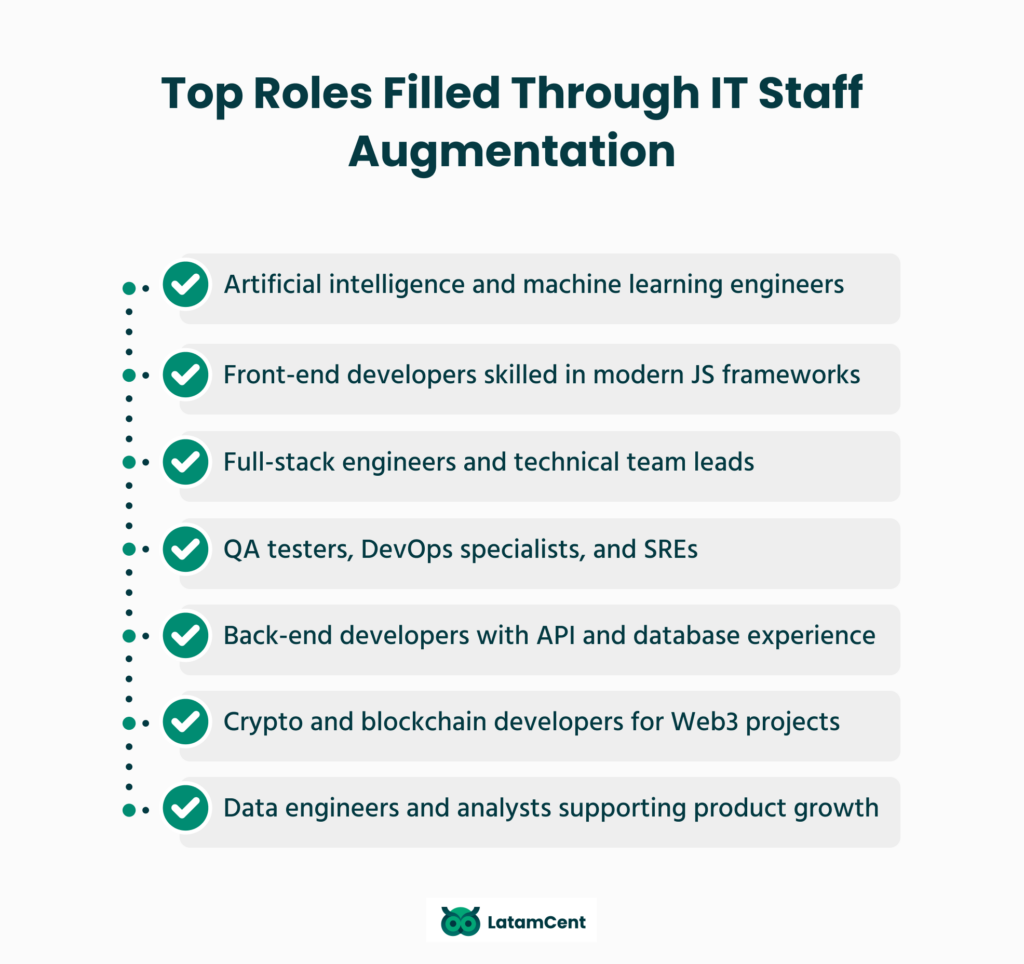
Software development staff augmentation covers every seat on a product team. U.S. SaaS startups request these roles most often.
Artificial Intelligence & Machine Learning Engineers
SaaS startups lean on generative AI engineers, machine learning engineers, and AI/ML DevOps engineers to differentiate the product.
Augmented AI talent typically works on:
- Building and training machine learning models
- Computer vision and NLP features
- Data pipelines that let AI features scale
Front-End Developers & UI/UX Designers
A polished front end drives adoption. Front-end developers bring responsive design, accessibility, and modern JavaScript frameworks.
- React, Vue.js, and Angular
- Close work with design on customer-facing flows
- Performance across browsers and devices
UI/UX developers join the same sprint and turn research into flows the front-end team ships.
Full-Stack Engineers & Tech Leads
Full-stack engineers, including full-stack mobile engineers, handle both ends of a feature. Tech leads guide architecture and mentor junior developers.
- Designing scalable APIs and databases
- Running sprint planning
- Owning features end to end
Fewer handoffs mean faster releases without overloading the core team.
QA, DevOps, & SREs
Shipping features is half the job. QA testers, DevOps engineers, and site reliability engineers (SREs) keep the product stable at scale.
- Automated tests for faster releases
- CI/CD pipelines across distributed teams
- Monitoring for uptime and resilience
Back-End Developers
Every reliable app runs on a solid back end. Back-end developers bring APIs, databases, and integrations that move a startup past its MVP.
- Database design and optimization
- APIs for web and mobile apps
- Secure third-party integrations
Common stacks include Node.js, Python, Java, and C#/.NET.
Crypto & Blockchain Developers
SaaS products increasingly add blockchain features, from payments to identity. NFT developers and crypto specialists bring niche skills few teams have in-house.
- Designing and auditing smart contracts
- Building decentralized apps (dApps)
- Secure crypto payment flows
Data Engineers & Analysts
Growing startups need insight, not just data. Data scientists, data engineers, and analysts turn raw data into decisions.
- ETL pipelines for large datasets
- Data warehouses built to scale
- Analysis that guides product and revenue
Talk to LatamCent
Most startups do not have a hiring problem. They have a speed and focus problem: the right engineer exists, but finding, vetting, and employing them in another country takes time nobody on the team has.
On a short kickoff call, tell us the role, the stack, and the hours you need covered. We will tell you what a realistic timeline and cost look like, and whether LatamCent’s staff augmentation services fit.
Book a kickoff call. If a U.S. firm, a freelancer, or one of the companies above fits you better, we will say so.
Frequently Asked Questions About IT Staff Augmentation
What is tech staff augmentation?
Tech staff augmentation is a hiring model where a company adds external engineers or specialists to its own team through a partner. The engineers work inside your tools and processes under your management, while the partner handles sourcing, contracts, and often payroll.
What is an example of staff augmentation?
A SaaS startup scaling its AI roadmap adds three nearshore data engineers through a staffing partner. They join daily standups, use the company’s tools, and ship alongside the in-house team.
How does staff augmentation work?
You define the role, stack, and start date. The provider sends pre-vetted candidates, you interview and pick, and the engineer joins your sprint. The provider handles the contract, payroll, and replacement if the placement fails.
What is the difference between staff augmentation and IT services?
Staff augmentation supplies individual professionals who join your team under your management. IT services, or project outsourcing, hand an entire project or function to an external provider that owns delivery.
Who is the largest IT staffing firm?
In the U.S., TEKsystems is the largest IT staffing firm, with $3.92 billion in 2025 IT staffing revenue according to Staffing Industry Analysts. Randstad is the world’s largest staffing firm overall.
What are the biggest IT outsourcing companies?
Major IT outsourcing companies include Accenture, Tata Consultancy Services (TCS), Infosys, and Cognizant, each running large-scale technology projects worldwide.
How much does IT staff augmentation cost?
Senior engineers bill at about $55 to $85 an hour in Latin America and $150 to $200 an hour in the U.S., based on 2026 rate data. Most providers do not publish their own fees and quote after a call.
How fast can a staff augmentation company place an engineer?
Published timelines range from under 24 hours to match a freelancer on Toptal to about 1 to 6 weeks for a staffed engineer. LatamCent reports a median of 19 days to an accepted offer.
Is staff augmentation good for startups?
Yes, when the startup has a tech lead who owns the roadmap. Staff augmentation adds engineers without long recruiting cycles or a foreign entity, but it does not replace technical leadership.
What is the difference between nearshore and offshore staff augmentation?
Nearshore engineers work in nearby time zones, such as Latin America for U.S. teams, with 0 to 3 hours of difference. Offshore engineers work in distant time zones, such as India, with little live overlap.
Who owns the code written by augmented engineers?
Your company should own it. The contract needs an IP assignment clause that transfers all work product to you, and you should read it before the first interview.