
Nearshore Software Development
Hire nearshore developers in Latin America who work your hours.
LatamCent is a nearshore recruiting and staffing company for US tech teams. Instead of outsourcing your project to a dev shop, you build a nearshore development team of vetted, full-time Latin American engineers who join your team, cost about 60% less than a US hire and work your hours. Our nearshore software development services cover sourcing, screening, payroll and compliance, so nearshore software outsourcing feels like hiring in-house, with no local entity needed.
- 170+ hires placed
- Hired in 21 days or less
- 96.9% client expansion
Trusted by top companies: See case studies








Why hire nearshore?
A nearshore software development team gives you time zone overlap, lower costs and smoother communication.
Nearshore costs 60–66% less than a US hire
For the same roles, nearshore software development hires cost far less than US hires, and you keep your working hours. Offshore can cost less still, but it comes with a 9 to 12 hour time gap.
$1.2M+ saved a year by Flxpoint with a LatamCent nearshore team of 19
Costs vary by role and seniority.
Example: machine learning engineer, average salary in each market. Flxpoint’s full team ran 66% below US cost.
Fewer barriers, shared business practices
Nearshore software development engineers work your hours and share many of your business habits, so there is less to translate and less to explain. Strong English closes the rest of the gap, so it is worth checking before you hire.
- Same working hours. Questions get answered in the moment, not the next day.
- Shared business practices. Engineers fit into your standups, tools and way of working with less friction.
 How we check English and communication
English test
Every candidate takes an English language test before we shortlist them.
Live interview
A Talent Partner interviews them about past work and judges how clearly they explain it.
Role-play exercise
They work through a realistic scenario, so we hear how they communicate in practice.
Responsiveness check
We track how quickly and clearly they reply during the hiring process.
Nearshore keeps you in the same workday
Count the hours of a normal 8-hour day when you and your engineer are online together. Nearshore keeps most or all of them, so you can ask, review and decide in real time. Offshore keeps none.
Based on a US Eastern time team. Latin American countries sit within 0 to 3 hours of Eastern time (see the countries tab).
Nearshore talent across Latin America
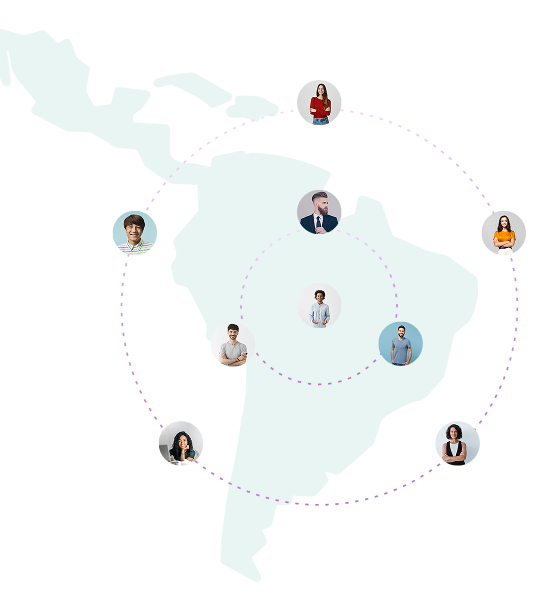
Most nearshore software development hires land in Mexico, Colombia, Brazil and Argentina, and LatamCent recruits across the whole region.
- Mexico1–2 h behind
- Colombia0–1 h behind
- Brazil1–2 h ahead
- Argentina1–2 h ahead
- Chile0–2 h ahead
- + a dozen moreSee all guides
Time shown against US Eastern time, and it shifts a little with daylight saving. We also hire in Costa Rica, Guatemala and Ecuador.
Why LatamCent and how we work
96.9% of clients expand their team after the first hire. That's not a recruiting agency's metric. That's a signal the hires actually work out.
hires placed with 50+ B2B SaaS companies since 2023
LatamCent was built by builders, recruiters, and operators who have shipped product, not a generic staffing desk.
off Eastern or Pacific time
Your engineers are in standup with you, not asleep during your sprint review. For a SaaS company that ships fast and needs its engineers in the same meetings as the rest of the team, nearshore is usually the right trade.
against your specific role
Candidates are sourced and screened before you ever see a profile, so the people you interview are already qualified for the job, not a general applicant pool.
ownership of anything built
Who owns the code and IP? You do. Every engagement is structured so your company keeps full ownership of anything built.
Our nearshore services
Whether you need one senior engineer or a full squad, our nearshore talent solutions set up your nearshore software development team around the way you already work. Every hire is full-time and stays embedded in your team for the long term, not a freelancer or a project contractor.
What you can build
Staff augmentation
One engineer or several join your team and work inside your standups, tools and process. It is the usual choice when a SaaS engineering team needs to fill a specific gap.
- Works in your standups, tools and process
- Best for filling a specific skill gap
- Payroll, compliance and local employment law handled by LatamCent
Dedicated nearshore development team
A full pod put together by LatamCent: engineers, QA and whatever else the project needs, working as one unit against your roadmap.
- Engineering, QA and supporting roles in one team
- Works against your roadmap as a self-contained unit
- Same payroll and compliance handling, no local entity needed
How you hire
Talent as a Service (TaaS)
For AI & B2B SaaS teams that need to hire quickly and stay focused on building, TaaS provides vetted professionals from Latin America ready to join your projects, with all logistics handled.
- Talent sourced, screened, and onboarded by AI & B2B SaaS hiring operators
- Payroll and compliance fully managed through LatamCent
- Easy replacements when priorities or roles change
- Candidates ready to start within days, not months
Direct Hire
Recruit full-time AI & B2B SaaS professionals directly into your company. We handle sourcing, screening, and coordination, ensuring every hire fits your product, workflow, and long-term growth plan.
- Targeted sourcing from top LATAM professionals
- Multi-step vetting covering technical skills and collaboration
- Payroll and compliance fully managed by our team
- Typical time-to-hire within 21 days
Not sure which fits? Compare staff augmentation, dedicated teams and nearshore development centers, or read staff augmentation vs outsourcing.
From kickoff to signed offer in 21 days or less
-
1
We scope and source
Once the agreement and retainer are signed, our Talent Partners get to work. They start from your job requirements and time zone needs, then search the market across Latin America for engineers who fit both and build a shortlist.
-
2
We vet the shortlist
Every candidate goes through the same checks: an English test, a personality assessment, and a technical review. We then interview them about their past work and how they communicate, so you only meet people who clear the bar.
-
3
You choose, we onboard
You review the strongest profiles, interview them, and pick the engineer who fits your team. From there we take over the paperwork: reference checks, legal agreements, and payroll setup, so they can start contributing right away.

Nearshore software engineers by role and stack

Hire nearshore developers for your stack
Most nearshore searches start with a language, not a job title. LatamCent recruits Latin American engineers and programmers across the stacks below, vetted against the frameworks, cloud and tooling you actually run.
Nearshore .NET developers (C#)
Nearshore .NET developers in Mexico, Colombia and across Latin America who build and maintain ASP.NET Core APIs, Blazor front ends and SQL Server data layers, often on Azure.
- C#
- ASP.NET Core
- Entity Framework
- Blazor
- SQL Server
- Azure
Nearshore Java developers
Nearshore Java development for Spring Boot services, event-driven systems on Kafka and JVM stacks that also use Kotlin or Scala.
- Java
- Spring Boot
- Hibernate
- Kafka
- Kotlin
- Scala
Python developers
Python engineers for Django and FastAPI back ends, data pipelines and the services that sit behind AI features.
- Django
- FastAPI
- Celery
- PostgreSQL
- Airflow
- dbt
Node.js and TypeScript developers
Node.js developers for NestJS and Express APIs, serverless functions and real-time services, typed end to end with TypeScript.
- Node.js
- TypeScript
- NestJS
- Express
- Prisma
- AWS Lambda
React, Angular and Vue developers
Frontend developers who ship fast, accessible interfaces in the framework you already use, from Next.js apps to large Angular codebases.
- React
- Next.js
- Angular
- Vue.js
- TypeScript
- Storybook
Mobile developers (iOS and Android)
Mobile engineers who build cross-platform apps with React Native or Flutter, or native Android with Kotlin, and who overlap your US hours for release days.
- React Native
- Flutter
- Expo
- Kotlin
- Firebase
QA and test automation engineers
Nearshore QA engineers who write automated end-to-end and API tests, wire them into CI and own release quality inside your sprint.
- Playwright
- Cypress
- Jest
- Postman
- CI pipelines
DevOps and cloud engineers
DevOps and site reliability engineers who run your CI/CD, infrastructure as code and Kubernetes clusters across AWS, Azure or Google Cloud.
- AWS
- Terraform
- Kubernetes
- GitHub Actions
- Datadog
Niche stacks: Go, Rust and Elixir
Hard-to-find specialists for performance-critical services: Go with gRPC, Rust with Tokio or Actix, Elixir with Phoenix. Expect a longer search and a higher salary band.
- Go
- Rust
- Elixir
- Phoenix
- gRPC
Also PHP and Laravel, Ruby on Rails, and legacy stacks like COBOL. For AI and machine learning roles, see AI/ML engineers.
What nearshore developers cost in 2026
Latin America is where US companies find affordable software developers who still work US hours. Hiring nearshore costs about 60% less than a US hire for the same role, because salaries across the region are lower while the work happens in your time zone. These are average annual salaries from LatamCent's role pages.
| Role | US salary | Nearshore salary | Savings |
|---|---|---|---|
| Back-end developer | $135K | $54K | $81K (60%) |
| Front-end developer | $135K | $54K | $81K (60%) |
| Full-stack developer | $135K | $54K | $81K (60%) |
| Machine learning engineer | $135K | $54K | $81K (60%) |
| DevOps engineer | $130K | $40K | $90K (69%) |
Price a nearshore squad
Pick the roles you need to compare annual salary cost.
Planning estimate from average salaries. Partner fees, benefits and equipment are not included.
How nearshore pricing works
Engineer salary
Most of what you pay. It depends on the role, the seniority and the stack. A Go or Rust specialist costs more than a mid-level React developer.
Partner fee
What the nearshore company charges for sourcing, vetting, payroll and compliance. Some charge a monthly markup or subscription. LatamCent charges a flat fee per role, with no subscription.
Local employment costs
Statutory benefits, payroll taxes and local holidays differ by country. A good partner shows these as their own line, not buried in an hourly rate.
Worried about agency margins? Ask any partner to split the price into salary and fee. See the pricing section of our buyer’s guide for what to check.
Nearshore development center, dedicated team or staff augmentation?
The four common models differ in who manages the engineers, whether you need a legal entity in Latin America, and how fast you get your first hire. LatamCent offers the two highlighted ones.
| Factor | Staff augmentation | Dedicated nearshore team | Nearshore development center | Project outsourcing |
|---|---|---|---|---|
| What it is | Engineers join your existing team | A full pod (engineers, QA, lead) working your roadmap | Your own office and entity in a Latin American country | A vendor delivers a scoped project |
| Who manages the work | Your engineering managers | You, like any in-house team | Your local leadership | The vendor’s project manager |
| Local entity needed | No | No | Yes, plus local HR, legal and office | No |
| Time to first engineer | 21 days or less to a signed offer | First hires in 21 days, team built in waves | Months of legal, hiring and office setup | Depends on vendor bench |
| Who owns the code and IP | You | You | You | Check the contract |
| Best for | Filling a specific skill gap fast | A new product line or a second engineering hub | Large companies planning 50+ engineers in one country | Fixed-scope work you do not want to manage |
Many teams build a dedicated nearshore team first and treat it as a nearshore development center without the entity. It gives you the same hub of engineers in your time zone, minus the office lease and local incorporation.
What it actually looks like once you hire

Flxpoint
E-commerce operations SaaSFlxpoint runs a SaaS platform for e-commerce operations out of Jacksonville Beach. Revenue was growing 50% a year, and the team wanted to keep offering one-to-one customer support without a matching jump in US payroll. Through LatamCent it hired 19 people across engineering, sales and customer success.
“Building a full-funnel nearshore team allowed us to scale revenue without scaling burn. The economics made sense.”


TestBox
Product evaluation SaaSTestBox helps revenue teams evaluate software using real workflows. As engineering grew in Brazil, job posts brought volume but not the technical depth Lead Engineer Lucas Soranzo needed. LatamCent sourced vetted engineers against TestBox's own criteria and organized the pipeline with a shared tracker.
“We definitely noticed the difference in the level of the candidates that we get just organically from the candidates that we get from LatamCent.”

LatamCent makes nearshoring feel like an
extension of AI & B2B SaaS teams


Before LatamCent, we spent hours sorting through resumes that didn’t fit.
They changed that completely. Every candidate we got was pre-vetted, relevant, and ready to go. The process saved our team time, and the hires have already made a measurable impact. It finally feels like working with a real partner, not just a vendor.

Darko Davkovski
Co-Founder & COO at Growth Era

We needed SDRs who could start fast and deliver results right away.
LatamCent understood exactly what we were looking for and found candidates with real SaaS experience. The process was quick, transparent, and every hire has been a strong performer. They’ve become our go-to for SDR hiring in LATAM.

Jed Mahrle
Founder & CEO at Practical Prospecting

We needed to scale our engineering and delivery teams fast without sacrificing quality.
LatamCent brought us strong, technically capable candidates who fit right in with our culture and workflow. The process was fast, communication was seamless, and every hire added immediate value to our projects. LatamCent has become our go-to partner for nearshore hiring.

Lindsay Morton
HR Business Partner at SourceFuse
LatamCent helped us grow our customer base while staying on budget.
We use their LATAM hires alongside our U.S. and India teams, and the time-zone fit makes management simple. The vetting saves me hours; every candidate already meets the bar, so interviews are worth it. We’ve seen stronger support and onboarding metrics, and I now send all new CS openings to LatamCent first.

Joshua Stockam
COO at Flxpoint
We needed to expand our analytics team fast but still stay within budget.
LatamCent helped us find the right analyst with the technical skills and attention to detail we needed. The process was efficient, communication was proactive, and every step felt easy. Having that extra support made our team more efficient and allowed us to deliver stronger client results.

Darreon Day
Director of Analytics and Research at ClearlyRated
We needed someone to step in fast and keep our marketing momentum strong.
LatamCent found the right person with the skills and cultural fit we were looking for. In just 90 days, we saw a 25% lift in engagement and brand consistency across every channel. The process was fast, clear, and it felt like working with a real partner.

Stephen Banbury
VP of Marketing at ClearlyRated

LatamCent made hiring engineers simple.
Every candidate we received was highly qualified and aligned with what we needed. The process was fast, communication was clear, and it saved our team countless hours on screening. Thanks to LatamCent, we were able to scale development faster and focus on shipping product.

Victor Moreno
CTO at Kredit Academy
I always say there’s no Steve Jobs without Steve Wozniak, and that’s what this hire became for us.
Without LatamCent, there’s no app. I needed someone who could take ownership and execute. LatamCent helped me find a developer who wasn’t just technically strong but also believed in the mission and came in ready to build. As a solo founder, that changed everything.

Evan Leaphart
CEO of Kredit Academy

LatamCent helped us scale quickly when growth was creating demand our team couldn’t handle.
Instead of juggling job descriptions, recruiting, and endless interviews, we had vetted candidates within days, complete with video screenings that made decisions easier. Each hire integrated seamlessly, delivered quick impact, and kept us moving. What stood out most was the communication and speed: LatamCent felt like an extension of our team, so we could focus on client work while they handled hiring.

Peter Schuette
Director at Elumynt
Hiring CSMs in the U.S. wasn’t scalable, but LatamCent made it possible.
They helped us expand customer success and sales with vetted LATAM talent who fi t right in. The process was fast, collaborative, and efficient, and the speed and quality of candidates stood out right away. Thanks to LatamCent, we’re delivering a stronger customer experience while continuing to scale with confidence.
Travis Mariea
CEO at Flxpoint

We had reached a point where contractors were slowing us down instead of helping us scale.
LatamCent took the time to understand our product, our codebase, and the kind of ownership we needed in our first full-time engineer. Within weeks, we hired a senior developer who brought structure, accountability, and real momentum to our roadmap. The entire process felt organized, transparent, and aligned with our culture. That one hire completely changed our product velocity.

Joel Olivier Baussaun
Co-Founder at CargoFax
As our engineering team in Brazil grew, finding developers with the right experience became difficult.
Job posts brought volume, but not the level we needed, and managing the pipeline took time away from engineering work. LatamCent delivered pre-screened candidates aligned with our requirements, which made the process easier and more effective. The quality was noticeably higher than what we sourced ourselves, and their support helped us stay organized and move faster. It gave us a reliable way to keep growing the team without slowing down development.
Lucas Soranzo
Lead Engineer at TestBox
Ready to grow your AI & B2B SaaS team? We’ll help you hire faster and scale with confidence.
Build your dream teamHow to hire a nearshore software development team: the 2026 guide
What US engineering leaders ask before they sign with a nearshore software development company: setup options, timelines, RFP questions, vetting, pricing and scale.
What is a nearshore development center, and do you need one?
A nearshore development center (NDC), or nearshore development centre in British English, is a software engineering hub you run in a nearby country. For US companies, that usually means Mexico, Colombia, Brazil or Argentina. The engineers work only on your product, in your time zone, as part of your organization.
There are two ways to get one. You can incorporate a local entity, lease an office and hire through your own HR team. Or you can work with a nearshore staffing partner that recruits the engineers and handles their contracts and payroll, while they work inside your team day to day.
When building your own center makes sense
Owning the entity pays off at scale. Companies planning 50 or more engineers in a single country, with local leadership already in place, can absorb the legal setup, payroll administration and office costs.
When a partner-run team is the better call
Most B2B SaaS companies with 30 to 1,000 employees are not at that point. A dedicated nearshore development team gives the same result: a stable group of engineers who only work for you. You skip the incorporation, the local labor counsel and the months of setup.
Rule of thumb: start with a partner-run team. Revisit an owned center once the team is large enough that the local entity costs less than the partner fee.
How to hire nearshore developers in 6 steps
The process looks like any engineering hire. The difference is who handles sourcing, contracts and payroll.
- Define the role and the overlap you need. List the stack, seniority and the hours the engineer must share with your team. A Pacific time team needs different countries than an Eastern one.
- Pick an engagement model. Choose staff augmentation, a dedicated team or direct hire. The model comparison above covers the trade-offs.
- Shortlist two or three nearshore companies. Compare their vetting process, time to hire, pricing transparency and IP terms. Our list of software development nearshoring companies is a starting point.
- Review vetted profiles, not raw resumes. A good partner sends 3 to 5 candidates who already passed English, technical and communication checks.
- Run your own final interview. Keep one technical round led by the engineer who will work with the hire most.
- Onboard like an in-house hire. Give accounts, a buddy and a small first ticket in week one. Treat them as part of the team from day one.
How long from signed contract to code in production?
Plan for roughly 5 to 8 weeks from signed agreement to a nearshore engineer shipping code in production. Hiring itself takes about 3 weeks. Most of the rest is the notice period at the engineer’s current job.
- Day 0Agreement signedThe partner scopes the role with you: stack, seniority, time zone and interview steps.
- Day 1 to 10Sourcing and vettingWith LatamCent, the first 3 to 5 vetted profiles usually arrive within 10 days.
- Day 10 to 21Your interviews and offerYou interview the shortlist and pick a hire. Most roles reach a signed offer in 21 days or less.
- Week 4 to 7Notice periodEmployed engineers usually give their current employer 2 to 4 weeks of notice. Ask about it in the first interview.
- Week 1 on the jobOnboardingAccess, environment setup and a small first pull request.
- Weeks 2 to 4Production contributionsReviewed code ships to production on your normal release cycle.
Engineers who are between jobs can start sooner. If a deadline is fixed, tell your partner at kickoff so they can screen for availability.
How to run an RFP for nearshore engineering services in Latin America
A nearshore RFP should test how a vendor hires and supports engineers, not how polished its deck is. Keep it short, send it to three to five firms, and ask every vendor the same questions so the answers are comparable.
Questions to include
Talent and vetting
- How do you source candidates for our exact stack?
- Which English, technical and soft-skill checks run before we see a profile?
- How many profiles do you send per role, and how fast?
Speed and scale
- What is your median time from kickoff to signed offer?
- How many engineers have you placed in our stack this year?
- How would you staff five or ten roles at once?
Commercials
- What share of the monthly rate is salary versus your fee?
- Is there a replacement guarantee if a hire does not work out, and for how long?
- Are there minimum terms or conversion fees for hiring directly?
Legal and security
- Who holds the engineer’s contract (employer or contractor of record), and in which country?
- How is IP assigned to us in the contract?
- Can engineers work inside our SSO, devices and access policies?
How to score the answers
| Criterion | Suggested weight | What a strong answer looks like |
|---|---|---|
| Vetting depth | 30% | Named steps, role-specific technical review, sample scorecards |
| Time to hire | 20% | A median in days, backed by client references |
| Price transparency | 20% | Salary and fee shown as separate lines |
| Retention and replacement | 15% | Clear replacement terms and client expansion data |
| IP and compliance | 15% | IP assignment to you, local labor compliance handled |
Finish with a paid pilot hire from the top two vendors. One real placement tells you more than any proposal.
How nearshore agencies vet senior software engineers, and what you should still test
Picture a Series B team hiring a senior back-end engineer in Mexico or Colombia. A good nearshore agency already checked English, communication and core skills. Your job is to confirm the engineer can own systems at your scale.
Split the screening so nobody tests the same thing twice:
| Stage | Run by | What it tests |
|---|---|---|
| English and communication | Partner | Written and spoken English, clarity explaining past work |
| Technical review | Partner | Core language and framework skills for the role |
| System design | You | Trade-offs on a problem close to your architecture |
| Code review exercise | You | Reading an existing pull request and spotting real issues |
| Team fit | You | How they handle disagreement, ownership and async updates |
Skip long take-home projects for senior candidates. Strong engineers often have several offers, and a four-hour assignment is where you lose them. Our interview plans by role include ready-made question sets.
Nearshore developer rates and agency margins: are you overpaying?
You are likely overpaying if the vendor will not tell you what the engineer earns. A blended hourly rate can hide a large margin, and you cannot compare vendors without the split.
Three checks keep pricing honest:
- Ask for salary and fee separately. The engineer’s pay should be the largest part of your cost.
- Benchmark the salary. A back-end developer in Latin America averages about $54K a year, against $135K in the US.
- Check exit terms. Look for conversion fees, minimum commitments and replacement costs before you sign.
For reference, LatamCent charges a flat fee per role with no subscription, contingency direct hires are no win, no fee, and placements come with a 60-day replacement guarantee.
Underpaying is a risk too. Engineers paid below market leave, and every departure restarts your hiring clock. The aim is a market salary with a visible, fair fee.
Replacing an offshore team in India, Ukraine or Eastern Europe with nearshore
Teams usually make this move for one reason: a 9 to 12 hour gap turns every code review into a next-day conversation. Moving from India or Eastern Europe to Latin America brings that work back into one shared workday.
Some teams move for a different reason: an engineering partner in Ukraine or elsewhere in Eastern Europe can no longer supply the same capacity. In that case, hire senior engineers first, so the people who absorb the handover can make architecture calls on their own.
A phased move protects delivery:
- Start with one nearshore pod on a well-defined area, such as a service or a product surface.
- Run both teams side by side for a few sprints so knowledge moves through pairing and code review.
- Shift ownership area by area once the nearshore team handles on-call and releases on its own.
- Keep offshore where it still fits, such as overnight QA runs or follow-the-sun support.
Flxpoint, for example, runs LatamCent hires alongside its US and India teams. Its COO says the time zone fit is what makes the mixed setup simple to manage.
Scaling: hiring 10 to 20+ nearshore engineers
Hire in waves, not all at once. A team of 20 strangers starting on the same Monday has no one to learn from. Three waves give each group a base to onboard into. The same plan works for an enterprise of 500+ employees standing up its first Latin American engineering team.
| Wave | Who to hire | Why |
|---|---|---|
| 1 | A tech lead plus 2 to 3 senior engineers | They set conventions and become the onboarding buddies |
| 2 | Mid-level engineers and a QA engineer | Add throughput once the codebase and process are documented |
| 3 | Remaining roles, such as DevOps, data or more engineers | Fill gaps the first two waves exposed |
Flxpoint built a 19-person nearshore team through LatamCent across engineering, sales and customer success. It cut hiring time from 8 to 10 weeks down to 2 to 3 weeks per role.
Security, IP and compliance without a local entity
You do not need to incorporate in Latin America to hire there. As contractor of record, LatamCent manages the contract, payroll, taxes and compliance for each hire, so recruiting and the employment paperwork sit with one partner instead of a recruiter plus a separate employer of record (EOR). Your side of the setup covers four things:
- IP ownership. With LatamCent, your company owns 100% of the code and IP your engineers create.
- Access control. Engineers work inside your SSO, repositories and permission model, like any employee.
- Devices and data. Apply the same device, VPN and data-handling policies you use for US remote staff.
- Offboarding. Revoke access centrally on the last day, the same as for anyone else.
Regulated teams in fintech or healthtech should share their security questionnaire during the RFP, so the partner can confirm each control before the first hire.
Best countries for nearshore software development
Time zone is the first filter. After that, choose based on where your stack’s talent pool is deepest. LatamCent recruits across Mexico, Central America and South America, so you do not have to pick one country.
| Country | vs US Eastern | Good fit for |
|---|---|---|
| Mexico | 1 to 2 h behind | US Central and Pacific teams (California, Texas), large engineering market |
| Colombia | 0 to 1 h behind | East Coast teams that want the same working hours |
| Brazil | 1 to 2 h ahead | The largest tech talent pool in Latin America |
| Argentina | 1 to 2 h ahead | Senior engineers and product-minded developers |
| Chile | 0 to 2 h ahead | East Coast overlap, smaller talent market |
| Guatemala and Costa Rica | 1 to 2 h behind | Central time overlap, often used alongside Mexico |
Teams on Pacific time, like California startups, usually hire in Mexico or Central America, or agree a later working day with engineers further south. Time shifts a little with US daylight saving. Each country hiring guide covers rates, benefits and compliance notes.
Want vetted profiles for your stack in about 10 days? Tell us the role and the hours you need.
Start hiringFrequently asked questions
What is nearshore software development?
Hiring engineers in a nearby time zone instead of offshore or onshore, so your remote team works the same hours you do. For US companies, that means Latin America.
What is nearshore software outsourcing?
It means handing software work to engineers in a nearby country, usually within 0 to 3 hours of your time zone. With LatamCent it works like hiring: the engineers join your team and your process, and we handle payroll and compliance. If you are weighing the models, read our comparison of staff augmentation vs outsourcing.
What is a nearshore development team?
A group of engineers in a nearby country who work your hours as an extension of your in-house team. LatamCent can place a single engineer or assemble a full pod with engineering, QA and other roles, as described under our services.
What is a nearshore development center?
A software engineering hub in a nearby country that works only on your product, in your time zone (in British English, a nearshore development centre). You can build one by opening a local entity and office, or get the same result faster with a dedicated nearshore team hired through a staffing partner like LatamCent, with no entity needed.
How is nearshore different from offshore?
Time zone overlap, mainly. Offshore development in India or Eastern Europe usually means a 9 to 12 hour gap and async-only collaboration. Nearshore in Latin America means your engineer is in standup with you.
Is nearshore software development cheaper than offshore?
Not always. Offshore can cost less on paper, but the 9 to 12 hour gap means async handoffs and delayed code review. Nearshore keeps you in the same workday and still comes in far below US cost.
How much does a nearshore development team cost compared to hiring in the US?
Costs vary by role and seniority. A back-end, front-end or full-stack developer in Latin America averages about $54K a year against $135K in the US. Flxpoint’s nearshore team ran 66% below what the same roles would have cost in the US, saving over $1.2 million a year. See rates by role.
How do nearshore agency fees work?
You pay the engineer’s salary plus the partner’s fee for sourcing, vetting, payroll and compliance. Vendors charge monthly markups, subscriptions or one-time fees. LatamCent charges a flat fee per role with no subscription, contingency direct hires are no win, no fee, and placements include a 60-day replacement guarantee. Ask every vendor to show salary and fee as separate lines. See how to check agency margins.
Which countries are best for nearshore software development?
Most of our nearshore hires land in Mexico, Colombia, Brazil and Argentina, and we recruit across the region, including Costa Rica, Guatemala and Ecuador. Each country has its own guide with typical rates and compliance notes. See our hiring guides by country.
What nearshore software development services does LatamCent provide?
LatamCent is a nearshore recruiting and staffing company, not a dev shop: we place full-time engineers on your team rather than running outsourced projects. We source, vet and hire engineers in Latin America and handle contracts, payroll and compliance. You can add engineers to your team, build a dedicated team, or hire through Talent as a Service or Direct Hire. Roles run from back-end, front-end and full-stack to AI/ML and blockchain.
Is LatamCent an employer of record (EOR)?
No. LatamCent works as contractor of record rather than an EOR, and the result for you is similar: one partner handles recruiting, contracts, payroll, taxes and compliance. You hire in Mexico, Colombia or anywhere in Latin America without a local entity and without a separate EOR contract.
Are nearshore engineers full-time and long term, or freelancers?
Full-time. LatamCent only places full-time engineers who stay embedded in your remote US team for the long term, not freelancers, gig workers or temporary project contractors. 96.9% of clients expand their team after the first hire.
Can you hire nearshore .NET and Java developers?
Yes. We recruit .NET developers for C#, ASP.NET Core, Entity Framework and Azure, and Java developers for Spring Boot, Hibernate and Kafka, along with Python, Node.js and front-end stacks. See every stack we hire for.
Do you provide nearshore QA and testing engineers?
Yes. QA and test automation engineers can join your team on their own or as part of a dedicated nearshore team, working with tools like Playwright, Cypress, Jest and Postman inside your CI pipeline.
Can you find niche stack specialists like Rust, Elixir or Go developers?
Yes. We source Go, Rust, Elixir and Scala engineers in Latin America, as well as mobile developers for React Native, Flutter and Kotlin. Niche searches take longer and pay above the regional average, so share the requirements early.
What is the difference between staff augmentation and a dedicated nearshore team?
With staff augmentation, one or more engineers join your existing team and work inside your process. A dedicated team is a full pod with engineering, QA and whatever the project needs, working as a self-contained unit against your roadmap. See both under our services.
How do I choose a nearshore software development company?
Ask how candidates are vetted, how quickly you can hire, who handles payroll and compliance, and who owns the code. Our guide lists the exact questions: how to run an RFP for nearshore engineering services.
What is the easiest way to hire and manage nearshore software engineers?
Use a staffing partner that handles sourcing, vetting, contracts and payroll, then manage the engineers like your in-house team: same standups, tools, code review and one-on-ones. Because they work your hours, nothing needs to run async. See our playbook on how to manage Latin American workers.
How fast can we actually hire someone?
Most roles close in 21 days or less, from kickoff call to signed offer. The first 3 to 5 vetted profiles usually arrive within 10 days.
How long from signed contract to the first engineer contributing in production?
Plan for about 5 to 8 weeks. Hiring takes up to 21 days, the engineer usually gives 2 to 4 weeks of notice at their current job, and reviewed code ships within the first few weeks after onboarding. See the full timeline.
Can you hire 10 or more nearshore engineers at once?
Yes. We recommend hiring in waves, starting with a tech lead and senior engineers, so later hires have someone to onboard with. Flxpoint built a 19-person team through LatamCent.
Can we move work from an offshore team in India to nearshore?
Yes. Most teams start with one nearshore pod on a defined area, run it next to the offshore team for a few sprints, then shift ownership area by area. See moving from offshore to nearshore.
Do we need to set up a legal entity in the country we're hiring from?
No. LatamCent handles employment compliance and payroll in each country we place in, so you hire without opening a local entity.
Who owns the code and IP?
You do. Every engagement is structured so your company keeps full ownership of anything built.
How do nearshore agencies like LatamCent vet engineers?
Every candidate takes an English test, a personality assessment and a technical review, then a Talent Partner interviews them about past work and how they communicate. You only see people who clear the bar for your specific role.