


Last updated: July 2026 · Reviewed by the LatamCent team
Quick Facts About Chile
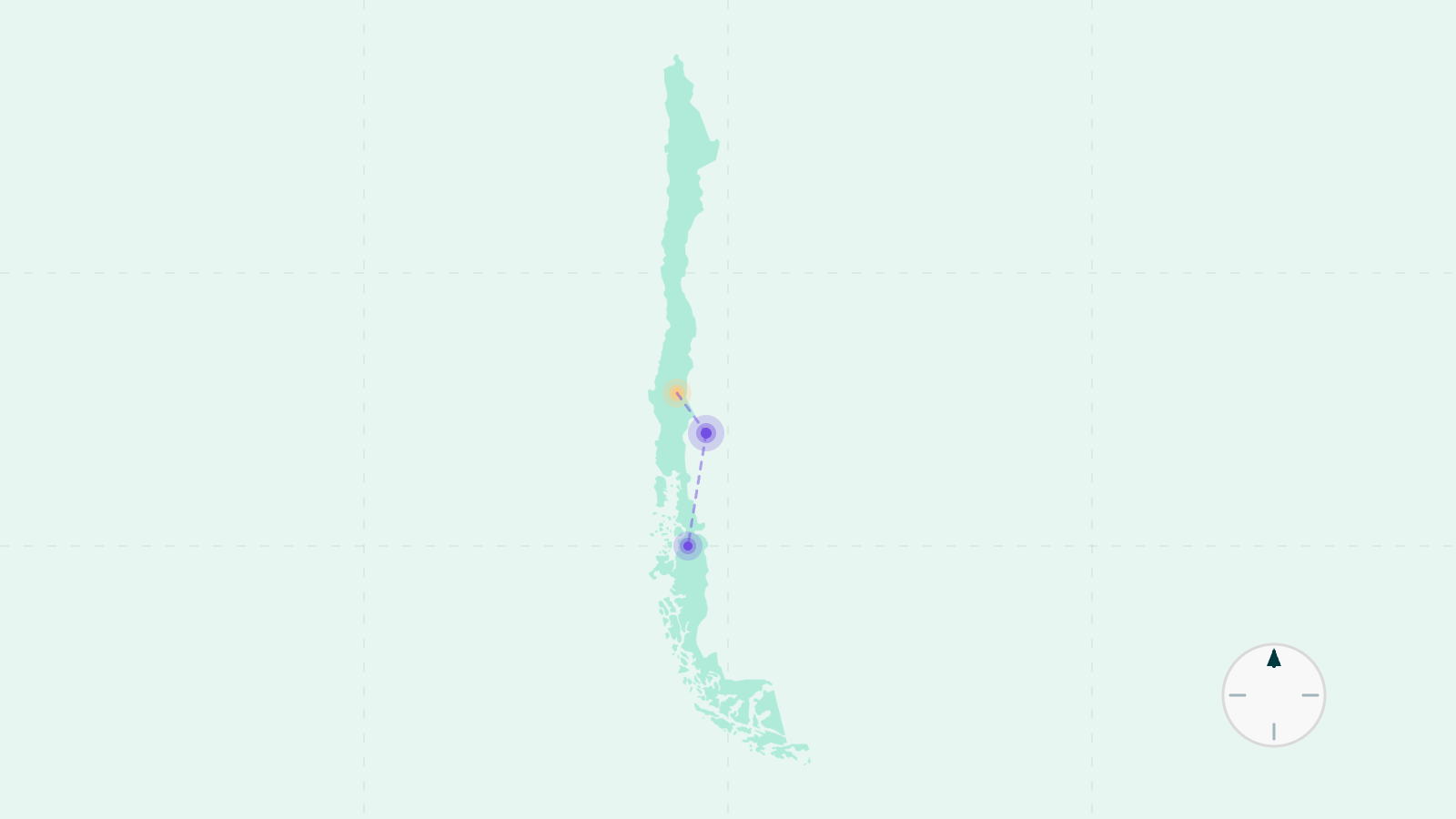
| Official LanguageSpanish | Time ZoneChile Standard Time (CLT), UTC-4 (UTC-3 during DST) |
| English SpeakingModerate English proficiency, with higher levels among IT professionals | Capital CitySantiago |
| CurrencyChilean Peso (CLP) | Top Talent HubsSantiago, Valparaíso-Viña del Mar, Concepción, Antofagasta |
| Payroll CycleMonthly | Internet Connectivity94.1% internet penetration |
| Popular IndustriesMining and metals, energy, global services, food industry, financial and retail services, tourism | Average Internet Speed280 Mbps fixed broadband (varies by source) |
| Dial code+56 | Taxpayer Identification NumberRUT / RUN |
| Top International CompaniesMicrosoft, AWS, Google, Oracle, SAP, Salesforce | Tech Startups836+ tech startups, including 2 unicorns. Such as: NotCo, Buk, and Houm. |
Chile’s Economy

Chile’s GDP reached approximately USD 330 billion in 2024, placing it among the five largest economies in Latin America. Mining, energy, global services, and fintech are the main drivers, and the combination has produced a more technically diversified workforce than commodity-heavy economies typically do.
Those sectors matter because each one trained a different kind of professional. Mining and energy operations produced engineers comfortable with high-volume, systems-intensive environments. The global services sector built a workforce already calibrated to international client standards, which compresses onboarding time for U.S. teams. Walk into any mid-size tech company in Santiago and you will find fintech professionals who navigated Law 21.521’s open-finance requirements from the inside, not from a textbook.
Inflation ran at 2.8% year-over-year in March 2026, which means compensation planning holds without competing against currency erosion. Peso volatility against the USD is a separate consideration: at senior levels, candidates with international options price currency risk into their expectations, and that affects offer structuring.
Ley 20.241 and Law 21.521 shaped the tech talent pipeline that exists today. The first provides a 35% R&D tax credit extended through 2035, pulling engineering investment into Chile rather than away from it. The second established the fintech and open-finance regulatory structure that built compliance and product talent at scale in Santiago.
For AI & B2B Tech companies hiring employees in Chile, that means senior engineers and fintech-literate product professionals are available now, without the formation lag you absorb in earlier-stage markets.
Why Should AI & B2B SaaS Companies Hire in Chile?

Nearshore talent in Chile offers something most LATAM markets cannot combine: a workday that overlaps almost entirely with U.S. Eastern hours (wider than you get hiring in Brazil or Argentina), English proficiency that sits above the regional average, and a talent pool deep enough to hire at every seniority level. The question is where that combination comes from.
When a recruiter arrives in Chile, the market has already done a layer of qualification work. Pontificia Universidad Católica de Chile ranked first in Latin America and the Caribbean in 2026, and that ranking shapes who enters the talent pool, not just who wins awards. Universidad de Chile placed in the top ten. Technology represented 27.1% of undergraduate enrollment in 2024, producing approximately 225,000 technical and professional graduates that year, enough that the pipeline does not thin out as a team scales. Many of those graduates have already shipped code for international clients. The ramp-up time a U.S. team would otherwise absorb has already been compressed before sourcing begins.
That volume communicates in English. Santiago scores 578 on the EF EPI 2025, placing it among the higher-performing cities in Latin America for English proficiency. Technical interviews in English are standard practice at companies with international exposure. Screen for it explicitly, and the time between first contact and a qualified candidate in front of your team shortens materially.
Chile runs on UTC-4 during standard time and UTC-3 during daylight saving, giving U.S. Eastern teams seven to nine hours of daily overlap depending on the season. Standups, code reviews, and sprint ceremonies run without calendar adjustment. The timezone does not require adaptation. What it does require is confirming the budget works at this quality level.
Senior software engineers in Chile earn approximately USD 3,558 to 6,115 per month. Junior profiles range from USD 1,223 to 2,224. U.S. equivalents for comparable roles among software developers in Latin America run two to four times higher. That gap allows teams to bring on senior technical capacity earlier in the funding cycle than domestic hiring would allow, which is the decision that changes what ships in the next two quarters.
| Role | Junior (USD/mo) | Mid (USD/mo) | Senior (USD/mo) |
|---|---|---|---|
| Software Engineer | 1,223–2,224 | 2,300–3,500 | 3,558–6,115 |
| Data Engineer / Data Scientist | 1,400–2,400 | 2,600–3,900 | 4,000–6,300 |
| DevOps / Cloud Engineer | 1,500–2,500 | 2,800–4,200 | 4,200–6,500 |
| QA Engineer | 1,100–1,900 | 2,000–3,000 | 3,200–4,800 |
Remote infrastructure is mature. Ley 21.220 established a compliance structure for distributed work, and internet quality in Santiago and secondary cities supports reliable remote team collaboration. One data point to plan around: 87.3% of Chilean job postings in 2024 were listed as onsite. Remote-first candidates exist, but the pool is narrower than the headline numbers suggest. Screen for remote preference before advancing candidates.
For AI & B2B SaaS companies building:
- Back-end and full-stack engineering teams
- Data engineering and Machine Learning Engineer
- DevOps and Cloud Back-End Developers
- Fintech-adjacent product and compliance roles
- Finance operations and FP&A
Chile fits the model for technical depth, timezone alignment, and English proficiency in technical roles. GTM roles in English-language outbound are a narrower fit and require explicit proficiency screening before moving candidates forward.
Popular Roles to Hire in Chile

Hiring developers in Chile draws from a market shaped by four distinct sectors: mining and energy produced systems engineers, global services built an international-client workforce, and fintech scaled up under Law 21.521. GTM and finance hiring are viable too, with the tech talent pipeline extending into Valparaíso and Concepción beyond the Santiago hub. The realistic profiles differ by function, and the constraints differ by language requirement.
Technical & Engineering Teams

Cloud, data, and backend infrastructure is where Chile runs deepest. A decade of fintech build-out and mining-tech modernization produced engineers who shipped into production environments with real compliance constraints, not sandbox ones.
- Back-End Developers: Python, Java, and Go with REST API and serverless architecture experience. Strong pipeline from companies that built financial and enterprise systems at scale.
- Full-Stack Software Engineer: Python or Java on the backend, React on the front. Well-suited to early-stage SaaS teams that need engineers who own vertical slices of the product end to end.
- Cloud and DevOps Engineers: AWS, GCP, Terraform, Lambda, EC2, and S3 experience is available. Cloud adoption at Chilean scaleups and multinationals has produced engineers with real production exposure, not just certification credentials.
- Data Engineer and Data Scientists: ETL pipelines, ML workflows, SageMaker, and Bedrock. Chile’s financial services and mining sectors have driven demand for data-intensive environments, which means these profiles have worked under production constraints, not just in academic settings.
- Generative AI Engineers: A growing segment. Profiles with applied LLM and generative AI experience exist, concentrated at companies with international product exposure. Sourcing timelines are longer than for backend or data roles.
- Full-Stack QA Engineers: One of Chile’s more reliable technical categories for remote integration. Cost-competitive and well-suited to distributed teams needing quality coverage without adding full engineering headcount.
- Cybersecurity Analysts and Pentesters: Demand from banking, fintech, and government modernization has built a local security analyst pool. Profiles with international certifications exist but move fast.
Go-To-Market (GTM), Finance & Marketing

GTM hiring in Chile is strongest for Spanish-language coverage and internal SaaS operations. English-facing commercial roles are viable at the senior level with explicit proficiency screening.
- Sales Development Representatives (SDRs): Strong pipeline for Spanish-language outbound B2B SaaS prospecting. English-language outbound requires confirmed bilingual proficiency before advancing candidates.
- Account Executives: New-logo sales profiles exist, particularly at companies with U.S. or European client exposure. Screen for familiarity with SaaS deal cycles, not just closing volume.
- Customer Success Managers: One of Chile’s stronger GTM profiles for U.S. SaaS teams. Implementation and retention experience is available, and bilingual CSMs with international client exposure exist at a meaningful depth.
- Revenue Operations Managers and Sales Operations: Profiles familiar with SaaS tooling and reporting are available in Santiago. Screen for CRM experience and pipeline analytics specifically.
- FP&A Analysts and Financial Analysts: Solid pipeline shaped by Chile’s mature financial services sector. Professionals with IFRS exposure and familiarity with SaaS subscription models exist, particularly at companies with international reporting obligations.
- Growth Marketing Managers and Content Writers: Available for Spanish-language regional go-to-market. Profiles with U.S. market campaign experience are limited; screen for this explicitly.
Security, Support & HR
Operations and HR roles in Chile benefit from the depth the financial services and global services sectors have built over two decades.
- Customer Support Representatives and Implementation Specialists: Available in Santiago and secondary cities. English-language support profiles exist but require screening. Strong fit for SaaS teams needing an English-speaking workforce for Americas timezone coverage.
- Cybersecurity and IT Support: Available with demand driven by banking regulation and fintech compliance requirements. Profiles with cloud security experience are competitive to source.
- HR Business Partners: Available for companies building local people operations. Familiarity with Chilean labor law is standard among experienced HR professionals.
- Talent Acquisition and Recruiters: Experienced sourcing professionals familiar with hiring for international companies are available. Useful for teams scaling fast and building global talent acquisition capacity in the region.
- People Operations and HR Systems: Profiles experienced with international workforce management and HR systems for distributed teams are available, concentrated in Santiago.
The roles above represent what is realistic to source in Chile. How the hiring relationship is structured determines what you can compliantly offer them.

Chile · CLP to USD
The peso your budget pays, in real dollars
Convert Chilean pesos to US dollars at today’s rate, then see what a decade of peso movement means for what your Chilean hire actually costs you.
Live FX moves daily. Figures use annual average mid-market rates for historical years and a July 2026 reference rate for “Today.” Use this to plan, not to lock a contract.
USD to CLP, 10-year trend
Higher line = weaker peso = your dollar buys more Chilean talent. The peso has lost roughly a third of its value against the dollar since 2016, which is tailwind for US buyers paying in USD.
Sources: OECD / U.S. Federal Reserve (FRED) annual average USD/CLP; latest spot via Trading Economics, July 2026. Rates are period averages and will differ from any single day’s quote.
Ways U.S. Companies Can Hire Talent in Chile

U.S. companies have three legal paths to hire in Chile: setting up a local entity, using an Employer of Record, or engaging independent contractors. The right choice depends on headcount, how fast you need to move, and whether you can absorb direct payroll obligations from day one.
Before choosing between these paths, it helps to understand how staff augmentation differs from outsourcing.
Entity vs. EOR vs. Contractor in Chile at a Glance
| Factor | Local Entity | Employer of Record (EOR) | Independent Contractor |
|---|---|---|---|
| Setup time | 2–4 months | Days to 2 weeks | Immediate |
| Upfront cost | High (incorporation, legal rep, bank) | Low (per-employee fee) | Lowest |
| Employer cost uplift | ~5.8% + admin overhead | ~5.8% (indefinite) built in | None (contractor invoices) |
| Compliance burden | You own it directly | Provider carries it | You carry misclassification risk |
| Misclassification risk | Low | Low | High (Arts. 7 & 8, retroactive) |
| Best for | Permanent teams, local invoicing | 1–10 hires, fast, compliant | Short, deliverable-scoped work |
Not sure which path fits your first Chilean hire? LatamCent scopes the role, the compliance model, and the timeline in a 30-minute call, so you know whether it is sourceable before you spend cycles on it. Talk to our team about hiring in Chile.
Setting Up a Local Entity in Chile
Chile offers several entity structures for foreign companies. The SpA (Sociedad por Acciones) is the most common choice for foreign investors: it requires only one shareholder and no minimum capital, which removes two of the most common barriers to entry for companies incorporating abroad. The Limitada (Ltda.) works well for smaller operations with a fixed partner structure. Larger companies with external investors or complex governance may use an S.A. Single-owner operations can use the EIRL, and foreign companies can register a branch office rather than incorporating a new entity.
Registration follows this sequence:
- Incorporate the local company or register the branch with the relevant registry
- Appoint a Chile-resident legal representative
- Obtain the RUT (tax identification number) from the SII
- File the Inicio de Actividades with the SII to activate tax obligations
- Obtain municipal patente and any sector-specific permits
- Open a local bank account and set up payroll operations
From day one, the Código del Trabajo governs every employment relationship. Mandatory obligations include:
- Written employment contract in Spanish
- AFP pension contributions and SIS disability insurance registration
- Unemployment insurance (Seguro de Cesantía) contributions
- Occupational accident insurance registration
- Statutory benefits: annual leave, severance accrual, and public holiday entitlements
Entity setup is the right structure when you plan to hire a significant team, need local invoicing capability, or are building a permanent operational presence. For companies hiring one to five people, the setup timeline and administrative cost rarely justify the investment before the first hire is onboarded.
Use Employer of Record (EOR) in Chile

An Employer of Record in Chile is a third-party company that becomes the legal employer of your hire. Your company directs the day-to-day work. The employer of record in Chile handles everything the Código del Trabajo requires.
The EOR in Chile manages:
- Employment contracts compliant with Chilean labor law
- Global payroll processing and SII tax filings
- AFP, SIS, and Seguro de Cesantía contributions
- Occupational accident insurance registration and reporting
- Statutory benefits administration and severance tracking
Employer cost uplift for an indefinite contract runs approximately 5.8% above gross salary. That covers the 1.0% new employer pension contribution, 1.5% SIS, 2.4% unemployment insurance, and a 0.9% base occupational accident rate, plus a variable additional rate depending on industry risk. Fixed-term contracts use a 3.0% unemployment insurance rate instead of 2.4%, which affects total cost modeling for project-based hiring.
The EOR model fits:
- Teams of one to ten employees without a local entity
- Companies running a pilot hire before committing to a permanent presence
- Remote-first SaaS teams that need compliant contracts without building local infrastructure
- Companies that need employment compliance in Chile without absorbing payroll complexity internally
Confirmed EOR providers operating in Chile include Deel, Remote, Oyster, and Papaya Global.
Hire Independent Contractors in Chile

Hiring contractors in Chile offers speed and flexibility, but carries the highest legal exposure of the three options.
Contractor arrangements work for:
- Short-term, project-scoped engagements
- Early-stage market testing before a hiring decision is made
- Roles with clearly defined deliverables and no ongoing operational dependency
- Work that is genuinely non-recurring
Worker classification in Chile is governed by Código del Trabajo articles 7 and 8, which presume an employment relationship exists whenever services are personal, continuous, and performed under subordinación y dependencia. Repeated honorarios arrangements that involve fixed schedules, exclusivity, or direct supervision trigger reclassification risk regardless of how the contract is labeled. The Dirección del Trabajo audits these arrangements actively, and reclassification applies retroactively from day one of the engagement.
Companies reduce exposure by:
- Scoping all work to specific deliverables with defined endpoints
- Avoiding fixed schedules and exclusivity clauses
- Ensuring the contractor operates as a genuine independent business with other clients
- Getting legal review before any long-term contractor engagement in Chile
Entity setup gives full operational control but requires time and local infrastructure investment. At 5.8% employer uplift, EOR delivers employment compliance in Chile at a cost that is straightforward to model before the first offer goes out. For a SaaS team making its first hire here, that combination of compliance coverage and predictable cost structure is what makes EOR the default starting point.
Contractor of Record (CoR) in Chile
A Contractor of Record sits between a pure contractor arrangement and a full EOR. LatamCent operates as your contractor-of-record in Chile: we source the talent, then carry the compliant contract, monthly payments, and the local compliance footprint under one USD invoice, without you opening a local entity. It gives you the speed and flexibility of a contractor engagement while removing the misclassification exposure that unmanaged honorarios arrangements carry under Código del Trabajo articles 7 and 8.
The CoR model fits teams that want a single accountable partner for sourcing and compliance, need to move faster than an entity build allows, and want the local paperwork, payments, and legal exposure to sit with the provider rather than internally.
Employment laws in Chile are governed by the Código del Trabajo, enforced by the Dirección del Trabajo, the ministry that audits compliance, receives electronic contract registrations, and processes labor disputes.
Employment Laws in Chile

Labor laws in Chile tie severance to tenure with a calculable ceiling. Dismissals for company needs or employer withdrawal trigger one month of remuneration per year of service, capped at 11 years under the Código del Trabajo. That means maximum severance exposure is 11 months of gross salary, a number that can be modeled before the first offer is signed rather than absorbed as a surprise when a relationship ends.
That severance exposure sits on top of a monthly payroll obligation that requires active management. Payroll in Chile is not just salary disbursement. Every month, the employer runs:
- Employer SIS contribution of 1.5% of gross salary
- Employer pension reform contribution of 1.0% since August 2025
- Unemployment insurance contributions under Seguro de Cesantía
- Occupational accident insurance registration and monthly payments
- Second-category income tax withholding and remittance to SII
- Electronic payroll reporting obligations to the Dirección del Trabajo
Companies hiring through an EOR transfer that execution to the provider. Companies operating through a local entity own it directly, with no grace period on any filing.
Employment compliance in Chile also means staying current with active labor reform. The standard workweek is now 42 hours, down from 44, with a further reduction to 40 hours still phasing in under Law 21.561. Any overtime calculation or workforce capacity model built on the old baseline is already wrong.
Statutory employee benefits in Chile are defined by the Código del Trabajo, with paid leave policies funded partly through social security rather than sitting entirely on the employer. Which party carries the cost depends on the leave type, and that determines where the budget exposure actually sits.
Leave Policy in Chile

| Maternity Leave6 weeks prenatal plus 12 weeks postnatal, funded through social security subsidy. An additional 12 weeks postnatal parental leave follows, which can be taken full-time or extended to 18 weeks at half-time. Fuero maternal job protection applies throughout. | Parental LeaveThe postnatal parental portion is transferable. Up to 6 weeks full-time or 12 weeks half-time can be transferred to the father. |
| Paternity Leave5 paid days at childbirth. Can be taken consecutively, excluding weekly rest days, or distributed within the first month. | Sick LeaveMedical certificate required. For absences of 10 days or less, the employer is not obligated to pay the first 3 days unless the contract or collective agreement states otherwise. Social security subsidy rules apply beyond that threshold. |
Maternity leave costs are largely carried by social security contributions rather than direct employer payroll. The employer pays salary upfront and recovers through the reimbursement process, but carries the administrative obligation throughout. Fuero maternal protection prohibits dismissal from the moment of pregnancy through one year after the postnatal period ends. For workforce planning, that means the position cannot be eliminated and the role must be covered for the full duration. Employer obligations during that period include:
- Processing social security subsidy claims and managing the reimbursement cycle
- Covering any gap between the social security subsidy and the employee’s contractual salary
- Planning and funding temporary coverage before the absence begins
The statutory paternity entitlement is 5 days, which is where the gap between Chilean law and market expectation is widest. International employers competing for senior technical talent routinely offer 10 to 15 days. Extending the base entitlement costs almost nothing and removes it as a reason to decline an offer.
Sick leave is where short-term absence creates budget exposure that grows with team size. For absences of 10 days or less, the first 3 days sit entirely on the employer unless the contract states otherwise. Every short absence that never crosses the social security threshold is a direct payroll cost, with no reimbursement and no offset against other statutory employee benefits. For a team of five engineers, that pattern is manageable. At fifteen, it becomes a line item that belongs in the headcount model from day one.
Remote Work Regulations in Chile

Hire remote employees in Chile and the arrangement sits inside a statutory structure, not just a contract. Ley 21.220, effective April 2020, incorporated remote work and telework directly into the Código del Trabajo. That means the Dirección del Trabajo can audit compliance independently of what the employment contract says.
What the law requires in writing goes beyond job duties and salary. Working hours, availability expectations, work location, and the equipment provision agreement must all be documented in employment contracts or a signed addendum. Without that documentation, the Código del Trabajo defaults to fixed-location employment assumptions: a 42-hour week, no equipment obligations, and no defined disconnect boundaries.
The right to disconnect is not an async norm in Chile. It is a statutory entitlement. Teleworkers on flexible schedules are entitled to at least 12 continuous hours of disconnection in every 24-hour period, with no work communications permitted during rest days, leave, or vacation. For U.S. SaaS teams where an occasional off-hours Slack message is standard practice, that boundary needs to be set explicitly in the onboarding process, before the first sprint, not after the first complaint.
Equipment obligations fall entirely on the employer. The company must provide all hardware, tools, and materials required for remote work, with operating, maintenance, and repair costs as the employer’s responsibility. A worker cannot be required to use personal assets. Candidates with international experience expect employer-provided hardware plus a monthly internet stipend as the baseline. The law sets the floor. The market sets the expectation above it.
Data protection for remote hiring in Chile falls under Ley 19.628. Define acceptable use of company systems and data handling standards in the employment contract. Local law does not set an adequate floor for companies handling sensitive customer or product data on distributed teams.
Chile’s tech sector has built a remote workforce serving international clients for over a decade, where remote team collaboration with U.S. companies is standard practice. Ley 21.220 gave that practice a legal structure. What determines compliance now is whether the contract reflects the statute before work begins.
Common Benefits & Perks Expectations in Chile
Employee benefits in Chile have been shaped by a decade of U.S. and European companies competing for the same senior technical talent. Candidates know what international offers look like. Work culture in Chile’s tech sector runs on that comparison, not on statutory minimums.
- Complementary Health Insurance: The statutory 7% health contribution funds either public FONASA or a private ISAPRE plan, but neither covers what senior professionals expect. Complementary health insurance covering the employee and immediate family is the benefit candidates cite most when evaluating international offers. Offers without it are filtered before the conversation about role fit begins.
- Life, Dental, and Catastrophic Coverage: Commonly bundled with complementary health insurance and treated as part of the health coverage expectation, not a separate line item. Senior hires evaluating offers with and without catastrophic coverage make that comparison before responding.
- Performance Bonuses and Recognition Programs: Variable compensation tied to individual or company KPIs is standard at mid and senior levels. Candidates who have worked with U.S. SaaS teams already understand revenue-linked incentive models. A bonus structure that mirrors what they have seen elsewhere removes a negotiation point before it becomes one.
- Flexible and Hybrid Schedules: Results-based scheduling is the norm in Chile’s tech sector. Engineers already operating on async rhythms with international clients expect flexibility as a default. A rigid schedule is a reason to decline an offer, not a policy to negotiate after joining.
- Meal, Grocery, and Transport Allowances: Common in Chilean work culture and expected by candidates transitioning from larger local employers. For remote roles, transport is less relevant. Meal and grocery allowances remain a line item candidates notice when it is missing, not when it is present.
- Training Budget and Certifications: Engineers evaluating AWS, GCP, and AI certifications weigh whether an employer funds that trajectory. A learning platform subscription signals investment in the hire. Certification reimbursement signals that the company expects the person to stay long enough to use it.
- Extra PTO and Vacation Purchase Options: Statutory vacation starts at 15 business days. Offering additional days from day one, or giving employees the option to purchase extra vacation, signals that the company operates to international standards rather than local minimums. Senior engineers with options evaluate this explicitly.
- Mental Health, Wellness, and Personalised Perks: Therapy access, wellness reimbursements, and gym agreements are growing expectations among senior technical professionals. Pet insurance and pet-bereavement leave are emerging among companies competing at the top of the market. The signal is not the specific perk. It is that the company built a package around what this person values, not around what the law requires.
Senior candidates in Chile have been exposed to international hiring standards through direct employment, freelance work, and peer networks. A below-market package does not go unnoticed. Benefits layered strategically produce better offer acceptance and lower early attrition than inflating base salary, with no compounding payroll tax on non-salary components.
Statutory Time Off in Chile
Chile mandates 15 business days of paid annual vacation and observes 16 national public holidays in 2026. For U.S. SaaS teams managing Chilean employees on client-facing or support functions, the September cluster alone concentrates two national holidays within two days, which requires active capacity planning rather than a note in the calendar.
Paid Time Off (Vacation) in Chile
Vacation entitlement is calculated in business days, not calendar days, and Saturdays do not count. The entitlement activates after one full year of continuous service with the current employer.
- 1 to 10 years of service: 15 business days
- 10+ years of service: 15 business days plus 1 additional business day for every 3 years beyond 10, subject to current-employer recognition rules
Vacation cannot be replaced with cash compensation except upon termination. Accrued vacation not taken at termination is paid out in full. Carry-over requires a written agreement between employer and employee.
Chile’s Public Holidays
Chile observes 16 national public holidays in 2026. Workers lawfully scheduled on holidays under Código del Trabajo art. 38 earn compensatory rest in lieu. No universal statutory premium pay applies outside overtime rules, which means holiday coverage planning should account for substitute rest days rather than double-pay budgeting.
- Año Nuevo, January 1
- Viernes Santo, April 3
- Sábado Santo, April 4
- Día del Trabajo, May 1
- Día de las Glorias Navales, May 21
- Día Nacional de los Pueblos Indígenas, June 21
- San Pedro y San Pablo, June 29
- Virgen del Carmen, July 16
- Asunción de la Virgen, August 15
- Independencia Nacional, September 18
- Día de las Glorias del Ejército, September 19
- Encuentro de Dos Mundos, October 12
- Día de las Iglesias Evangélicas y Protestantes, October 31
- Día de Todos los Santos, November 1
- Inmaculada Concepción, December 8
- Navidad, December 25
Combined with the Q4 cluster running from October through December, Chilean teams carry six public holidays in the final quarter. Build that into sprint planning and client coverage schedules before it becomes a surprise.
How LatamCent Can Help You Hire in Chile

Most US founders finish a country-by-country labor breakdown like the one above and reach the same conclusion: they want a partner who already does this for a living. That is the job, in Chile specifically.
LatamCent runs sourcing and compliance as a single workflow. We recruit inside the networks where senior Chilean engineers, fintech product leads, and operations talent move, then carry the contract, payroll, AFP, SIS, and Seguro de Cesantía filings, and all legal aspects under a contractor-on-record model. One USD invoice goes to you each month. The Chilean compliance footprint stays with us.
For US B2B SaaS teams, a Chile engagement looks like this in practice:
- 21-day average from kickoff to signed offer
- 93% first-placement success rate
- 60-day replacement coverage on every hire
- Pre-vetted shortlists with technical and English screening built in
- Engineering, AI, data, GTM, finance, and people roles under one partner
If Chile is already on your shortlist for an engineering, data, or GTM hire, the next step is a 30-minute scoping call. We will tell you whether the role is sourceable in your timeline before you spend cycles on it.
Frequently Asked Questions About Hiring in Chile
Yes. US companies have three legal paths to hire in Chile: setting up a local entity, using an Employer of Record (EOR), or engaging independent contractors. All employment relationships are governed by the Código del Trabajo and enforced by the Dirección del Trabajo.
Employer cost uplift for an indefinite contract runs approximately 5.8% above gross salary. That covers the 1.0% new employer pension contribution, 1.5% SIS, 2.4% unemployment insurance, and a 0.9% base occupational accident rate, plus a variable rate by industry risk.
Senior software engineers in Chile earn approximately USD 3,558 to 6,115 per month, while junior profiles range from USD 1,223 to 2,224. That is typically two to four times lower than US equivalents for comparable roles.
No. An Employer of Record lets you hire compliantly in Chile without opening a local entity, which fits teams of one to ten people. Setting up a local entity makes sense when you plan to hire a larger team or build a permanent presence.
Chile runs on UTC-4 during standard time and UTC-3 during daylight saving, giving US Eastern teams seven to nine hours of daily overlap. Standups, code reviews, and sprint ceremonies run without calendar adjustment.
The standard workweek is now 42 hours under Chile’s gradual 40-hour reform, down from 44 hours. Overtime is capped by written agreement and paid at a 50% surcharge.
If the Dirección del Trabajo determines a contractor is really an employee under Código del Trabajo articles 7 and 8, the relationship is reclassified retroactively from day one. The company becomes liable for unpaid social security contributions, vacation, severance, and fines, plus back payment of benefits the worker should have received.
Incorporating a local entity such as an SpA typically takes two to four months once you factor in registration, appointing a resident legal representative, obtaining the RUT from the SII, and opening a local bank account. An Employer of Record lets you hire in days to two weeks without any of that setup.
Yes. Many teams start with a contractor or Contractor of Record engagement to test a role, then move the person onto a compliant employment contract through an EOR or their own entity once the fit is confirmed. LatamCent can carry both stages under one partner.
There is no statutory 13th-month salary in Chile. Aguinaldo (holiday bonuses around Fiestas Patrias in September and Christmas in December) is customary at many companies and often set by collective agreement, but it is not a legal requirement for private employers.