



Staff augmentation vs. outsourcing is one of the most-searched-for hiring model comparisons among US SaaS companies, and the confusion is understandable. Both involve external talent. Both promise cost savings. Both show up in the same vendor conversations.
The difference is who owns the work.
With staff augmentation, your company retains direct oversight. Augmented staff integrate into your existing team, follow your processes, and report to your managers. With the outsourcing model, a provider takes ownership of a function or deliverable. Your team reviews outcomes, not daily tasks.
Choosing the wrong model creates real problems.
Companies that need direct control over a software development project and choose project outsourcing end up fighting for the visibility they never had. Companies that need hands-off delivery of back-office functions and choose staff augmentation end up managing work they never wanted to own.
The decision between staff augmentation and outsourcing hinges on project requirements, internal management capacity, and how closely the work ties to your product and company’s culture. Both models work.
Applied to the wrong situation, both models create more overhead than they remove.
This guide breaks down how each model works, where each one wins on cost and fit, and how to make the call based on your actual business objectives, not a generic recommendation.
Key Takeaways
- Staff augmentation places external talent inside your existing team, under your direct management and project oversight.
- The outsourcing model transfers ownership of a function or deliverable to an external provider, your team manages outcomes, not daily work.
- Augmentation vs outsourcing comes down to one variable: how much control the company needs to retain over the work.
- Staff augmentation is well-suited to short-term projects, skill-specific needs, and situations where the in-house team has direction but limited bandwidth.
- Outsourcing is appropriate for well-defined, delegable functions where the company lacks internal capacity and does not need to own the process.
- Staff augmentation typically involves a fixed rate per role, an hourly rate, or a monthly contract, with no benefits or equity on top.
- Outsourcing often yields cost savings in high-volume, repetitive functions through the provider’s economies of scale, not just lower hourly rates.
- Augmented staff members integrate into the company’s culture and follow its standards, while an outsourced team operates within the vendor’s processes.
- Hidden costs in staff augmentation include onboarding time, internal management hours, and knowledge transfer at the end of the engagement.
- Hidden costs of outsourcing include vendor selection time, change-order fees, and transition costs when switching providers.
- Nearshore staff augmentation in Latin America delivers 40–60% cost savings compared to equivalent US hires, without the offshore time zone or communication trade-offs.
- Comparing staff augmentation vs. software outsourcing before committing resources helps companies align the model with actual project requirements and business objectives.
- A hybrid approach, augmentation for variable, product-tied work, and outsourcing for stable back-office functions, lets companies apply each model where it performs best.
- Successful use of both staff augmentation and outsourcing depends on a clearly defined scope, measurable project goals, and an honest assessment of internal management capacity.
- LatamCent helps B2B SaaS companies apply the Staff Augmentation model effectively by sourcing vetted professionals in about 21 days, cutting overhead, and aligning hires with project requirements.
What is Staff Augmentation?
Staff augmentation is a hiring model where external talent joins your existing team to fill a specific role or skill need. The augmented hire works under your direction, follows your processes, and integrates directly into your development team or business operations.
The staffing partner handles contracts and payroll. You handle the work.
No separate project team. No outside vendor running deliverables. The hire reports to your managers, follows your sprint cycles, and is accountable to your internal standards.
Companies use this model for several reasons:
- A specific role needs to be filled fast, and the local market doesn’t have the right candidates
- A project requires technical expertise that the internal team doesn’t have
- Headcount is constrained, but workload has increased
- The company needs flexibility to scale up or down without committing to permanent hires
The model is most common in IT staff augmentation, but it applies largely to engineering, finance, operations, and GTM teams, all of which use it.
Staff Augmentation Benefits: Why SaaS Teams Choose It
The appeal of staff augmentation comes down to three things: control, speed, and cost. For SaaS companies that need to move fast without overcommitting, few models give them all three at once.
Direct Control Over Your Team’s Work & Standards
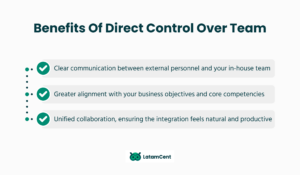
With staff augmentation, nothing about your management structure changes. Augmented staff receive tasks from your leads, follow your review process, and produce work that goes through your QA. There is no intermediary between your team and the output.
Companies that have tried outsourcing before, lost visibility into how the work gets done, and found out at delivery tend to find this structure worth the extra management overhead.
Your technical standards, architectural decisions, and code-review norms remain intact. External hires adapt to your environment, not the other way around.
Scale Your Workforce Fast Without Long-Term Hiring Commitments
Headcount requirements change. A product roadmap changes, a funding round closes, a client contract ends. Building a team entirely on permanent hires is a liability when the plan keeps moving.
Staff augmentation lets companies:
- Add headcount within weeks, not months
- Resource time-bound projects without creating permanent roles
- Wind down engagements when scope changes, without severance or notice periods
- Test a role before converting it to a full-time hire
For growth-stage SaaS teams, that flexibility is practical, not optional. A six-month product build doesn’t need a six-year employee.
Cut Hiring Costs Without Sacrificing Quality
Staff augmentation operates on a simple cost structure: a fixed rate per role, with no benefits, equity, or extended recruiting fees added. You know the number before anyone starts.
When those roles are filled nearshore, the savings are meaningful. LATAM engineers and operations professionals cost 40–60% less than equivalent US hires in major markets. A senior backend engineer in San Francisco can run $220K to $300K fully loaded. The same caliber hire through a nearshore partner lands significantly below that.
The cost difference comes from market access, not a lower bar. Vetting standards, technical depth, and English fluency don’t change. The geography does.
Staff Augmentation Challenges: What to Know Before You Hire
Staff augmentation puts control in your hands. That’s the point, and also the challenge. The model requires your team to be ready to manage, direct, and integrate external hires from day one.
You’re Still Responsible for Day-to-Day Team Management
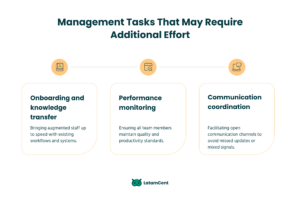
Augmented staff doesn’t self-manage. Someone on your side has to assign work, review output, give feedback, and keep the hire aligned with project priorities.
For lean teams already stretched thin, that responsibility lands hard. Adding two engineers without a clear internal owner for their work means you’ve added bodies, not capacity.
Before you bring in augmented staff, one question is worth answering first: who internally owns this person’s day-to-day? If there’s no clear answer, the engagement will drift.
Onboarding External Talent Takes Time. Your Team Doesn’t Always Have
New hires, even experienced ones, need time to get up to speed. Your tools, your codebase, your documentation style, your communication norms. None of that transfers on day one.
Realistic ramp-up time for an augmented technical hire: two to four weeks before they’re operating at full capacity.
For companies bringing in external talent close to a hard deadline, that window matters. Build it into the project timeline. Teams that ignore it tend to blame the hire for a problem the timeline created.
Keeping Augmented Staff Engaged & Committed to Your Project
Contractors have options. If they feel disconnected from the team or unclear about the project’s direction, their attention wanders, and output quality suffers.
What keeps augmented staff committed:
- Regular inclusion in team standups and planning sessions
- Clear scope and expectations from the start
- Feedback that treats them as part of the team, not as a vendor resource
- Access to the context they need to do the work well
Companies that treat external hires as interchangeable get interchangeable results. The ones that invest in integration get something much closer to a full-time employee.
When Do Companies Need Staff Augmentation?
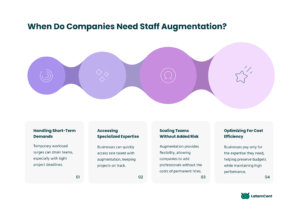
Staff augmentation is appropriate in specific circumstances. The model works when the company has the management capacity to direct external talent and a clear need that doesn’t justify a permanent hire.
These are the situations where it makes the most sense:
- The local market doesn’t have what you need. Certain roles are genuinely hard to fill in specific geographies. Senior AI/ML engineers, experienced DevOps engineers, niche full-stack software engineers, when the local pipeline is thin, and timelines are real, waiting on a traditional recruitment cycle isn’t viable. Staff augmentation gives companies access to skilled professionals outside their immediate market without building a new legal entity to employ them.
- A project has a defined scope and endpoint. Short-term projects with a clear deliverable don’t need permanent headcount. A compliance audit, a platform migration, a product launch, these have start and end dates. Augmented staff members can be resourced to a particular project and transitioned off when the scope closes.
- The in-house team has the direction but not the bandwidth. When the internal team knows what needs to be done but doesn’t have the hours to do it, augmentation adds capacity without adding management complexity. The project manager stays internal. The execution scales outward.
- Hiring full-time employees would take too long. The average US technical hire takes six to twelve weeks from job post to start date. When a company needs to move in two to three weeks, that timeline doesn’t work. Staff augmentation typically involves a faster sourcing and placement process, the infrastructure already exists.
- A new function needs to be tested before being built permanently. Some companies use augmented staff to validate whether a role is worth hiring full-time. Running a function with external personnel for a quarter provides enough signal to make that decision based on real data.
Staff augmentation is less suited to situations where the company needs full ownership transferred, lacks internal leadership to direct the work, or seeks to reduce management overhead entirely. In those cases, the outsourcing model is better suited.
What is Outsourcing?
Outsourcing means transferring a function, process, or entire project to an external team. The outsourcing provider takes ownership of the deliverable. Your company defines the outcome, the vendor figures out how to get there.
The relationship is fundamentally different from staff augmentation. With outsourcing, you are not managing day-to-day work. You are managing a contract, a set of milestones, and a vendor relationship.
Outsourcing arrangements come in several forms:
- Project outsourcing: A defined scope of work is handed to an external team with a fixed timeline and deliverables. Common in software development, where a company contracts an outside firm to build a product or feature set.
- Function outsourcing: An entire business function, customer support, accounting, IT helpdesk, is transferred to an outsourcing company that manages it on an ongoing basis.
- Managed services: A managed services provider takes responsibility for a defined operational area, typically under an SLA. Common in IT infrastructure, security monitoring, and payroll processing.
- Outsourcing non-core tasks: Companies delegate administrative or back-office functions to an outsourcing agency, allowing internal teams to focus on higher-priority work.
In most cases, the outsourced team operates in a different location, usually a different country, and the outsourcing provider manages its own staff, tools, and internal processes. Your company sees inputs and outputs. What happens in between belongs to the vendor.
That separation is the feature, not a flaw. Companies that outsource do so precisely because they don’t want to own the process. The tradeoff is visibility and control.
Outsourcing Benefits: When Handing Off Work Makes Business Sense
Outsourcing makes practical sense when a company has work that needs to get done but lacks the internal resources, expertise, or appetite to build the capability from scratch. The business case rests on three things.
Reduce Management Overhead by Delegating to a Specialist Provider
When a company outsources a function, the day-to-day management of that work moves with it.
The outsourcing provider handles staffing, scheduling, quality control, and delivery. Your team interacts with a point of contact and reviews outcomes.
For founders and operators already wearing too many hats, that reduction in management load is the primary reason to outsource. Trying to run a customer support queue, an IT helpdesk, or a payroll function without dedicated internal leadership is time-consuming, even when the cost per transaction looks manageable.
Outsourcing tasks that fall outside the company’s core business functions lets internal teams redirect their attention toward work that directly drives revenue or product.
Access Specialized Skills Without Building Them In-House
Some functions require deep, domain-specific knowledge that a company would take years to develop internally. Cybersecurity operations, financial compliance, enterprise software integration, specialized legal work, and building an in-house team with that level of external expertise takes time and capital that most growth-stage companies can’t justify.
Before signing with any provider, knowing how to evaluate a nearshoring agency saves companies from committing to a vendor that can’t deliver at the level the contract promises.
An outsourcing company specializing in financial compliance already has the processes, certifications, and trained staff in place. The client gets access to that capability without the hiring, training, and infrastructure investment required to replicate it.
This is particularly relevant in the IT industry, where the pace of specialization means internal teams often can’t keep up with every technical domain the business touches.
Lower Operational Costs on Repetitive, Back-Office Business Functions
Outsourcing often presents a more consolidated cost structure than building equivalent capacity in-house. Outsourcing vendors operating at scale can absorb costs across multiple clients, including infrastructure, management overhead, training, and compliance, and pass some of that efficiency on to the client.
For repetitive, process-driven work: data entry, payroll administration, tier-one customer support, basic bookkeeping, the cost per unit of output is reliably lower through an established outsourcing provider than through internal headcount.
The savings are most significant when the function is high-volume and rules-based. Significant cost savings from outsourcing stem from lower labor costs and the provider’s ability to run the process more efficiently than a company building it from scratch for the first time.
The caveat: those cost advantages depend on the work being clearly defined. A vague scope handed to an outsourcing agency produces unpredictable results and, often, higher costs than expected.
Outsourcing Risks: What You Give Up When You Hand Over Control
Outsourcing removes management overhead. That’s the benefit.
The risk is that it removes visibility along with it. Before delegating entire projects to an external team, the tradeoffs are worth understanding clearly.
Limited Visibility Into How the Work Gets Done
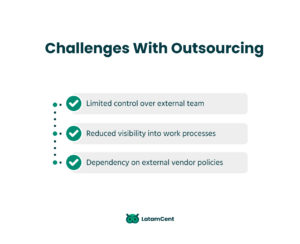
When you outsource a function or project, the outsourced team operates inside the vendor’s processes, not yours. You see deliverables. You don’t see the decisions, the shortcuts, or the quality control happening in between.
For work tied directly to your product, your customer data, or your compliance obligations, that opacity carries real risk.
A managed services provider running your IT infrastructure may resolve tickets on time while accumulating technical debt that your team will inherit later. An outsourcing company handling customer support may hit response SLAs while undermining your brand voice with every interaction.
The further the work sits from your core competencies, the harder it is to evaluate whether the output meets your actual standards, not just the ones written into the contract.
Communication Delays That Slow Down Fast-Moving Teams
Outsourcing arrangements introduce a layer of coordination that internal teams don’t have. Requests go through account managers. Clarifications wait for scheduled calls. Change requests require contract review.
For companies running fast product cycles, that friction compounds quickly. A development team that needs a decision made today doesn’t benefit from a vendor process built around weekly check-ins.
The problem is sharper when the outsourcing provider operates in a different time zone. Offshore outsourcing arrangements, particularly those spanning a 10- to 14-hour time difference, can add a full business day to any back-and-forth exchange.
Over a six-month project, those delays accumulate into real schedule risk.
Knowledge transfer is also harder than it looks. When a project moves from your internal team to an outsourced team, context doesn’t travel with the task. Assumptions get lost. Business objectives that seemed obvious in an internal meeting become ambiguous once the work sits with a vendor who wasn’t in the room.
Vendor Lock-In & Dependency on External Policies & Timelines
Outsourcing relationships are built on contracts. Once a function or project is fully embedded with an outsourcing agency, switching carries real cost: transition time, renegotiation, retraining, and potential service differences.
Vendors know this. Pricing often reflects it, not at signing, but at renewal.
Beyond cost, dependency on an external provider means the company’s timelines are partly subject to the vendor’s capacity, staffing decisions, and internal priorities. If the outsourcing provider loses key staff on your account or deprioritizes your project in favor of a larger client, your business objectives get delayed through no decision of your own.
Outsourcing may also require significant time upfront, vendor selection, contract negotiation, and onboarding, before a single deliverable is produced. For companies expecting to move fast, that setup phase is often an unbudgeted cost.
When Do Companies Need Outsourcing?
Outsourcing is a good fit when a company lacks the internal resources to own a function or project, and doesn’t need to. The right question isn’t whether outsourcing is cheaper. It’s whether the company genuinely needs to build this capability in-house.
Outsourcing makes sense in these situations:
- The work falls outside the company’s main business functions. Payroll processing, IT helpdesk, basic bookkeeping, data entry, these functions need to get done reliably, but building an in-house team to run them isn’t a strategic priority for most SaaS companies. An established outsourcing provider can run them at a lower cost and without internal management overhead.
- The project requires external expertise that the company can’t hire quickly. Certain projects, such as a security audit, a regulatory compliance review, or a legacy system migration, require deep, domain-specific knowledge. Outsourcing tasks like these to a specialist provider gives the company access to that expertise for the duration of the project without the cost of a permanent hire.
- The scope is fully defined and doesn’t require daily management. Outsourcing works best when project requirements are clear, success criteria are measurable, and the company can evaluate the output without observing the process. Handing off work that’s still being figured out to an external team tends to end badly.
- The company wants to free up internal capacity for strategic initiatives. When internal teams are stretched across too many functions, outsourcing non-core tasks creates room. The goal isn’t just cost savings, it’s resource allocation. Letting skilled engineers or senior operators focus on the work that drives growth, rather than maintaining back-office functions, is the real business case.
Outsourcing is the wrong model when the work is closely tied to the product, requires rapid iteration, or depends on day-to-day alignment with the internal team. For those situations, staff augmentation and outsourcing aren’t interchangeable; the wrong choice creates more problems than it solves.
Staff Augmentation vs Outsourcing: Key Differences Side-by-Side
Comparing staff augmentation vs outsourcing comes down to one question: how much control do you need over the work?
The two models solve different problems. Staff augmentation extends your team. Outsourcing transfers a function. Treating them as variations of the same solution is where most companies go wrong.
| Factor | Staff Augmentation | Outsourcing |
|---|---|---|
| Control | Full, you manage the work daily | Limited, vendor manages delivery |
| Cost structure | Hours worked or fixed contract rate | Project fee, retainer, or per-output pricing |
| Flexibility | High, scale up or down as the project needs change | Low, scope changes require contract renegotiation |
| Hiring speed | Fast, roles filled in days to weeks | Slower, vendor selection and onboarding take time |
| Oversight | Direct, augmented staff report to your team | Indirect, you review outputs, not process |
| Cultural fit | High, augmented staff integrate into your team | Variable, external team operates independently |
| Best for | Filling skill gaps, scaling a development team, and short-term projects with internal direction | Delegating entire projects, back-office functions, and work outside core competencies |
Comparing staff augmentation vs software outsourcing helps companies select the right model before committing resources to either. The table above gives the framework. The sections below work through the cost and decision logic in more detail.
Is Staff Augmentation Cheaper Than Outsourcing?
Neither model is categorically cheaper. Cost depends on the type of work, the duration, and what the company is actually comparing.
Both have simple cost structures on the surface and hidden costs underneath.
Short-Term Projects: Where Staff Augmentation Wins on Cost
For short-term projects with a defined scope and internal management capacity, staff augmentation typically runs leaner. The cost structure is straightforward: a rate per role, per hour, or per month.
No project management markup, no vendor margin on a full delivery team, no retainer for capacity you may not use.
When those roles are filled nearshore, leveraging external expertise from Latin America, the cost advantage grows. Latam professionals with strong technical backgrounds cost 40–60% less than equivalent US hires, without the quality trade-off or time zone disruption that comes with offshore outsourcing.
For a company needing two skilled engineers for a four-month build, staff augmentation through a nearshore partner is almost always more cost-effective than engaging an outsourcing vendor to deliver the same scope.
Long-Term or Delegable Work: Where Outsourcing Can Save More
Outsourcing often offers a more consolidated cost structure for high-volume, repetitive, and fully delegable work. An outsourcing provider running a customer support function or back-office process at scale can deliver cost efficiency that a company can’t replicate with direct headcount, internal, or augmented.
The savings come from the vendor’s ability to distribute overhead across multiple clients: infrastructure, management, training, and compliance. For functions such as payroll administration or tier-one IT support, that structure yields reliable cost savings over a multi-year horizon.
The comparison only holds when the scope stays stable. Outsourcing variable or growing work quickly drives up costs through change orders and renegotiations.
Hidden Costs in Both Models That Most Companies Miss
Both models carry costs that don’t appear in the initial rate.
Staff augmentation hidden costs:
- Onboarding time before augmented staff members reach full productivity
- Internal management hours required to direct and review external personnel
- Knowledge transfer when the engagement ends and the hire exits
Outsourcing hidden costs:
- Vendor selection and contract negotiation before work begins
- Scope creep penalties and change order fees
- Transition costs when switching outsourcing providers
- Quality remediation when deliverables miss the mark
Neither model removes cost. Both change where the cost lands. The company that maps out the total cost of engagement, not just the headline rate, makes a better decision.
Staff Augmentation vs Outsourcing: How to Choose the Right Model for Your Business
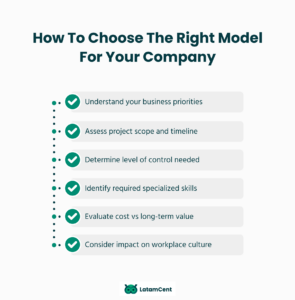
The decision between staff augmentation and outsourcing hinges on project requirements, business goals, and the level of ownership the company wants to retain. There is no universal right answer. There is a right answer for each situation.
If you want augmented engineers who work US hours, here’s how a nearshore development team works with LatamCent.
Choose Staff Augmentation When You Need Control and Speed
Staff augmentation is the right model when:
- The work needs to integrate with an existing team and codebase
- You have a project manager or technical lead available to direct the hire
- The scope will change, and the team needs to respond quickly
- Cultural fit and alignment with the company’s values matter to the output
- You need to fill a skill gap fast without committing to a permanent role
- The project goals require daily collaboration and real-time iteration
In these conditions, augmented staff working inside your team will outperform an outsourced team operating at arm’s length. Direct oversight, shared context, and integration with your existing team produce better results than a handoff model.
Choose Outsourcing When the Scope Is Defined & Hands-Off Delivery Works
Outsourcing fits when:
- Project requirements are fully documented, and success criteria are measurable
- The function sits outside your core competencies and doesn’t need internal ownership
- Your team genuinely cannot resource the work, not just doesn’t want to
- You can evaluate output quality without observing the process
- The business strategy calls for concentrating internal capacity on higher-priority work
Outsourcing non-core tasks to a specialist provider makes business sense when the alternative is building internal capability for a function that will never be a competitive differentiator.
When a Hybrid Approach Makes More Sense Than Picking One Model
Some companies don’t need to choose. A hybrid model uses staff augmentation for work requiring direct oversight and active iteration, while outsourcing handles stable, delegable functions in parallel.
A SaaS company might augment its development team with nearshore Java full-stack engineers for a product build, while outsourcing its payroll processing and IT helpdesk to managed services providers. The two arrangements don’t conflict. They serve different parts of the business operating under different requirements.
The logic: apply direct oversight where the work is variable, strategic, or tied to the product. Delegate entire projects or functions where the scope is fixed and the company doesn’t need to own the process.
Successful implementation of both models in parallel, each applied to the right function, gives companies the cost efficiency of outsourcing and the control of augmentation, without forcing a choice that doesn’t fit the actual situation.
Why US SaaS Companies Choose Nearshore Staff Augmentation Over Offshore Outsourcing
US SaaS companies that have tried offshore outsourcing and found it lacking aren’t swearing off external talent. They’re moving to a different model.
Nearshore staff augmentation through Latin America solves the specific problems offshore arrangements create, without giving up the cost savings that made offshore attractive in the first place.
The Time Zone Problem With Offshore Outsourcing
Offshore outsourcing arrangements built around teams in India, Eastern Europe, or Southeast Asia typically span 10 to 14 hours of time difference relative to US business hours. In practice, that means one overlap window per day, if the schedules align at all.
For a software development team running daily standups, async code reviews, and real-time product decisions, that window is too narrow. A question asked at 2 pm EST gets answered the following morning. A blocker raised on a Friday doesn’t get resolved until Monday.
Over a six-month project, those delays compound into real schedule risk.
Staff augmentation with nearshore talent eliminates the problem. LATAM professionals in countries like Colombia, Argentina, Mexico, and Brazil operate in US-compatible time zones, typically 1 to 3 hours off EST. Standups happen live. Feedback moves the same day. The entire team works in real time, not in relay.
For IT team collaboration and product-tied software development work, time zone alignment is a functional requirement, not a preference.
Cultural Fit and English Fluency: Why Latin America Outperforms Asia & the Middle East
Time zone is one part of the equation. Communication quality is the other.
Augmented staff members who integrate into a US company’s existing team need more than technical skills. They need to communicate clearly in English, understand US business norms, participate in planning sessions, and align with the company’s culture and values.
Those requirements rule out a large portion of offshore talent pools where English fluency and cultural overlap are inconsistent.
Latin America produces skilled professionals with strong English proficiency, familiarity with US business practices, and educational backgrounds in engineering, finance, and operations that match what US SaaS companies need. Countries like Argentina, Colombia, and Mexico have deep talent pipelines in software development, GTM, and finance, built in part through long-standing professional and academic ties to the US market.
The result is augmented staff who function as genuine members of the team. They ask the right questions in standups, write documentation that your team can read, and operate with the same professional norms your internal employees bring.
Offshore outsourcing arrangements rarely produce that level of integration.
The outsourced team runs its own processes, communicates through designated liaisons, and operates on its own schedule. The specialized expertise may be there. The collaboration usually isn’t.
Nearshore Staff Augmentation in Latin America: Cost, Speed, and Quality Combined
The case for nearshore staff augmentation in Latin America rests on three variables working together.
- Cost. Nearshore staff augmentation is cost-effective in a way that offshore outsourcing services rarely match on a like-for-like basis. LATAM professionals cost 40 to 60% less than equivalent US hires in major markets. A senior software engineer in San Francisco carries a fully loaded cost of $220K to $300K annually. The same caliber of skilled engineer placed nearshore lands between $80K and $120K. For a SaaS company scaling an entire development team, that difference extends the runway without reducing output quality.
- Speed. The staff augmentation model in Latin America operates through established sourcing infrastructure, vetted candidate pipelines, and regional expertise tailored to US company project requirements. Roles that take six to twelve weeks to fill through traditional US recruiting get filled in a fraction of that time. For companies with open requisitions sitting unfilled for months, that speed is the deciding factor in achieving project success on schedule.
- Quality. Skilled professionals placed through nearshore staff augmentation go through multi-step technical screening before a single candidate reaches the client. Project goals stay on track because the hire is ready to contribute from the start, with the specialized expertise the role demands and the cultural alignment the team requires.
For US SaaS companies working through the augmentation vs outsourcing decision, nearshore staff augmentation through
Latin America delivers the cost efficiency of the outsourcing model without surrendering direct oversight, company culture alignment, and project management integration that the augmentation vs outsourcing comparison consistently shows matters most for product-tied work.
Ready to Scale With Staff Augmentation? Here’s How LatamCent Can Help
LatamCent is a nearshore hiring partner built for US SaaS companies that need to scale fast without the cost or timeline of traditional US recruiting.
The model is straightforward. LatamCent sources, vets, and places pre-screened LATAM professionals into full-time remote roles across engineering, GTM, finance, and operations. Clients maintain direct oversight of the work. LatamCent handles contracts, payroll, and compliance through its contractor-on-record infrastructure, with legal entities in every South American country.
Companies already working with IT recruiting companies to fill technical roles use LatamCent to expand that approach into sales, customer success, and finance, scaling the entire team under one partner rather than managing multiple outsourcing vendors across functions.
The companies that get the most from this model share a few traits.
They have a clear role to fill. They have an internal owner ready to direct the hire. And they have decided that waiting months for a US search is not a viable path to achieving their business objectives.
If that describes your situation, explore LatamCent’s nearshore staffing services to see how the placement process works and which roles are available to hire in Latin America today.
Conclusion
Staff augmentation and outsourcing are not competing answers to the same question. They solve different problems for different operating conditions.
Staff augmentation fits companies that need to move fast, maintain direct oversight, and keep external talent aligned with the company’s culture and project goals.
The augmentation vs outsourcing comparison consistently shows that for IT team expansion, software development, and product-tied work, augmentation produces better outcomes when internal leadership is available to direct the hire.
Outsourcing fits companies that need to delegate entire projects or back-office functions to outsourcing partners with specialist capability, and can define success criteria clearly enough to evaluate output without observing the process. Managed and outsourced services work when the scope is stable and the function sits outside what the company needs to own.
For US SaaS companies that have already decided nearshore talent is the right direction, the staff augmentation model through Latin America offers the control of augmentation at a cost structure that competes with offshore outsourcing, without the time zone, communication, and project management trade-offs that make offshore arrangements difficult to sustain.
The right model depends on what you’re building, who will direct the work, and how much of the process your team needs to own. Map those three variables honestly, and the choice between staff augmentation vs outsourcing becomes clear.
If you’re ready to hire talent from Latin America, get in touch with us today!