


Nearshore staffing is a hiring model where a partner in a nearby region, for US companies usually Latin America, finds, vets and places professionals who work in your time zone as part of your team.
You direct the work. The partner handles sourcing and screening and, depending on the model, contracts and payroll.
This guide covers how nearshore staffing works, which models exist, what it costs, the roles filled most often, the best countries to hire in and how to choose a provider.
Updated for 2026. Disclosure: LatamCent is a nearshore hiring partner, so we have a view on this topic. We describe the options as fairly as we can.
Key Takeaways:
Nearshore staffing means a partner in a nearby country finds and places professionals who work your hours as part of your team.
Nearshore sits between onshore (highest cost) and offshore (large time gap). Latin America shares most of the US workday.
You usually pay the professional’s compensation plus the partner’s fee. Compare quotes on the same scope.
Common structures: direct hire through an EOR, a dedicated team, a co-managed team, and project-based or role-based placements.
Mexico, Colombia, Argentina, Brazil and Chile are the usual first stops. Time zone fit differs by country.
Ask every provider four things: who employs the hire, how long to a first shortlist, what happens if a hire leaves, and which time zones the candidates work in.
Staff augmentation adds capacity under your direction, anywhere. Nearshore staffing is location-led.
What is Nearshore Staffing?
Nearshore staffing is a way to hire professionals through a partner in a nearby country, so they work in or close to your time zone. It combines access to a wider talent pool with real-time collaboration, and it is widely used in software development, business process outsourcing, and project-based work.
You will see it sold as nearshore staffing services, nearshore staffing solutions, nearshore recruitment or nearshore IT staffing. The label varies, so check what each provider actually does.
Key benefits of nearshore staffing:
- Time zone compatibility for standups, sprint reviews, and daily syncs
- Cultural alignment that eases communication
- Lower compensation costs than many US markets
- Access to specialized talent in engineering, data, and IT operations
- Flexible capacity for staff shortages or a particular project
Companies turn to nearshore staff augmentation when internal teams cannot cover critical roles or when scaling requires quick access to qualified candidates.
How Nearshore Staffing Works
The steps are similar across providers. The timing depends on the role, the seniority and the provider, so ask for an estimate before you commit.
- Define the role. Write down the scope, the stack, the seniority and the hours you need covered.
- Brief the partner. Share your team setup, your tools and how you run standups, so the search matches how you work.
- The partner sources and screens. Expect technical screening, an English check and a review of work history before anyone reaches you.
- You interview a shortlist. You make the final call, the same as with any hire.
- Contract and onboard. The person is engaged as a contractor, through an Employer of Record, or by the partner. Confirm which, and who handles payroll.
- Ramp up with support. The hire joins your standups and tools. Ask what happens if the fit is wrong, including any replacement period.
Nearshore vs Offshore vs Onshore Staffing
Where your team sits relative to you decides how much of the workday you share. Here is how the three compare. See also our glossary entry on offshore hiring.
| Factor | Onshore | Nearshore (Latin America) | Offshore |
|---|---|---|---|
| Location | Same country | Nearby countries, in the Americas for US companies | Distant regions, such as Eastern Europe or Asia |
| Time overlap with US hours | Full | Most or all of the workday, depending on the country | Small or none |
| Communication | Live | Live standups and same-day feedback | Often asynchronous handoffs |
| Compensation | Highest | Typically lower than US rates | Often lowest on paper |
| Travel | Easy | Short flights to many US cities | Long-haul |
| Best for | Roles that must be local | Work that needs daily collaboration | Work that runs well asynchronously |
Eastern Europe sits roughly 6 to 8 hours ahead of US Eastern Time. India and Southeast Asia sit roughly 10 to 13 hours ahead. Latin America sits within about two hours of US Eastern Time.
What is Staff Augmentation?
Staff augmentation is a hiring model where companies bring in external talent to work with in-house employees for a set time. The setup allows teams to access skilled professionals without committing to full-time contracts.
SaaS companies rely on it when deadlines are tight, staff shortages appear, or complex projects demand specialized talent not available internally.
It can be a cost-effective part of a wider staffing plan. For a full comparison with outsourcing, see staff augmentation vs outsourcing.
Nearshore Staffing vs Staff Augmentation: What’s the Difference?
Nearshore staffing is defined by where the talent is. Staff augmentation is defined by how you use it. Many nearshore engagements are staff augmentation, so the two overlap.
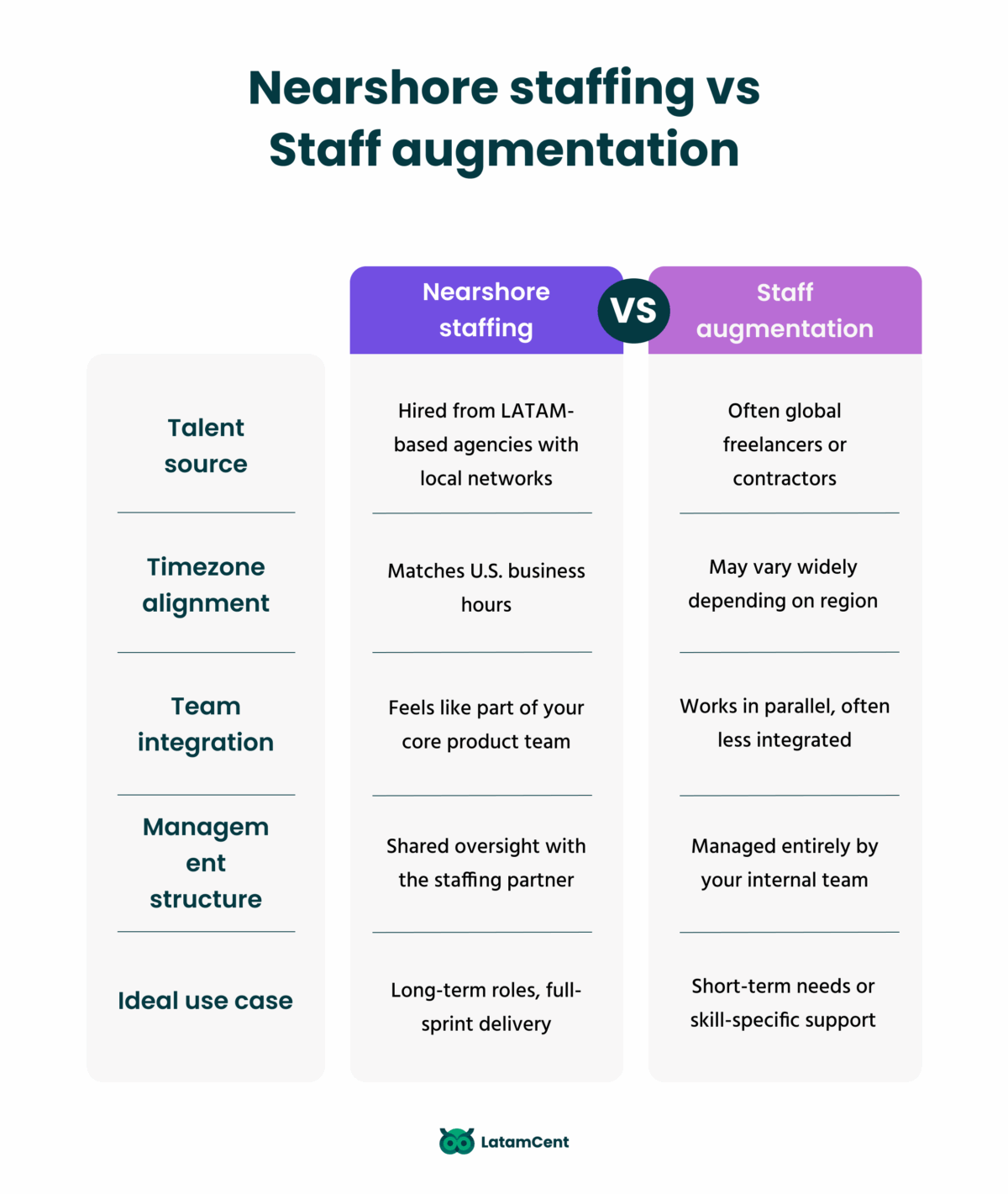
Nearshore providers run nearshore staffing services, sourcing highly skilled professionals, handling cross‑border admin, and building a dedicated team that stays embedded with in-house teams for ongoing work.
Staff augmentation adds external teams or individual specialists to an existing team to cover specific skills or extra capacity. Geography is flexible: local talent, nearshore staff augmentation, or even offshore teams. The client directs daily work.
| Factor | Nearshore staffing | Staff augmentation |
|---|---|---|
| Scope | Location-driven: talent in nearby countries | Capacity-driven: added skills, anywhere |
| Ownership | The provider assembles a steady talent pod | You plug professionals into your own managers |
| Rhythm | Longer horizon and continuity | Elastic headcount for spikes, experiments or critical roles |
| Main levers | Time zone fit, cultural compatibility, lower cost | Speed, niche skills, easy scale |
| Typical use | Product squads and ongoing roadmaps | Migrations, audits or complex projects |
Choose nearshore staffing when real-time collaboration, cost effectiveness, and steady teams matter most.
Choose staff augmentation when speed, niche expertise, and flexible capacity make all the difference.
Benefits of Nearshore Staffing for US Companies
Time Zone Alignment & Real-Time Communication
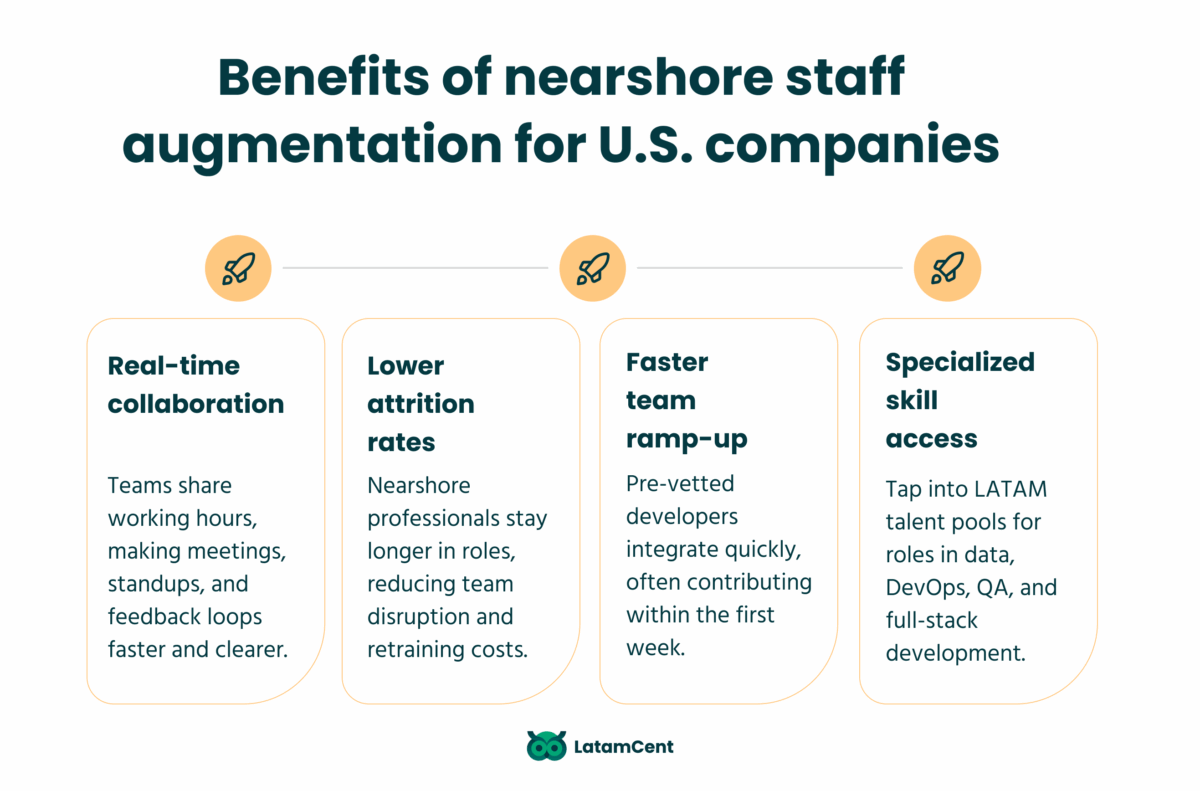
Time zones don’t sound like a big deal until you’ve lost a full day waiting for answers. Offshore teams stretch conversations across continents, so one quick question can become a day-long exchange.
In SaaS, that kind of delay slows product velocity. Nearshore staffing reduces that lag. Developers in Latin America work within a few hours of US time zones, so standups, sprint planning, and product reviews happen in real time.
Questions get answered the same day, and blockers are cleared before they derail a sprint.
Nearshore staffing services also provide access to quality talent who are comfortable with agile workflows. Instead of forcing in-house teams to adjust their schedules, nearshore teams work within your hours, so collaboration feels natural rather than forced.
For companies under pressure to move quickly, time zone alignment is one of the simpler ways to keep projects on track.
Retention and Continuity
Turnover is one of the biggest hidden costs in tech hiring.
Every time an engineer leaves, the team loses context, projects slow down, and managers spend weeks filling the gap. Distance, cultural differences and misaligned expectations can make this worse in offshore setups.
Nearshore placements can support continuity. Engineers work in a schedule and culture close to yours, which helps them settle into the team. Retention still depends on the role, the pay and the management. Ask any partner how it handles a hire who leaves, and whether a replacement period applies.
For companies scaling quickly, stability is worth as much as speed. Compare providers on both.
Faster Onboarding & Stronger Collaboration
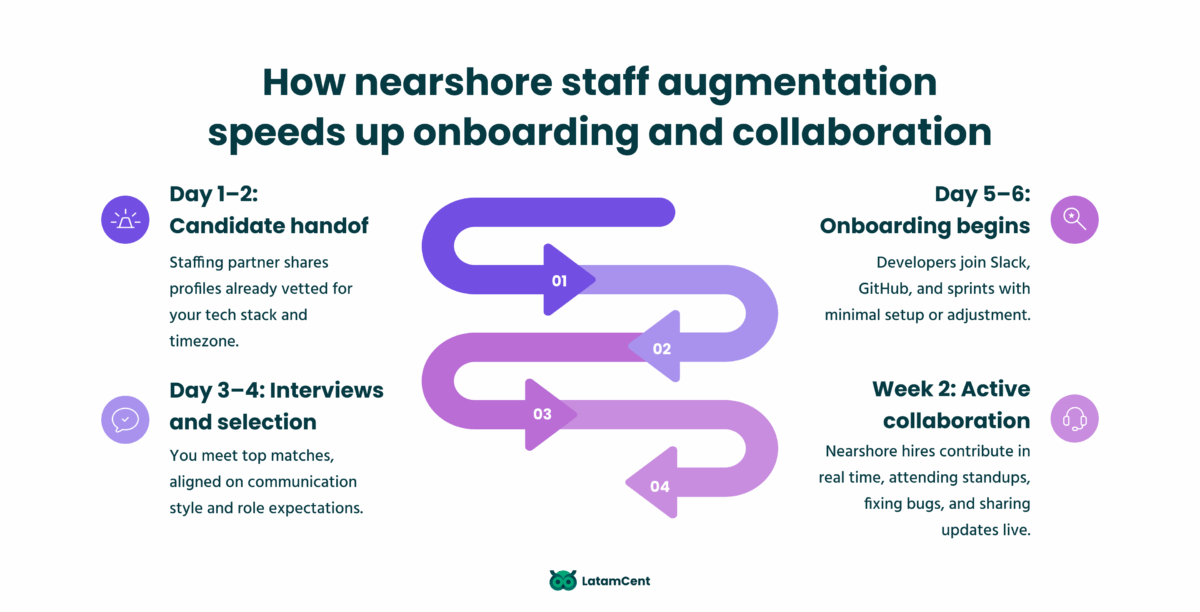
Hiring delays can stall entire roadmaps. Every week spent sourcing candidates or negotiating contracts is a week lost on product delivery. Slow vetting cycles and long adjustment periods add to the delay.
Nearshore staffing can speed up that process. Good partners keep pipelines of vetted engineers, QA specialists and product roles, so the search does not start from zero.
Ask each provider for its typical time to a first shortlist, and compare it against your own recruiting cycle.
The benefit doesn’t end at the start date. Once onboard, nearshore teams work in a close time zone and cultural context, so collaboration with US managers and in-house engineers feels natural. Instead of working around mismatched schedules, teams can move straight into building features, fixing bugs, and shipping together.
For SaaS companies under pressure to release quickly, faster onboarding and easier collaboration can help hit milestones.
Access to Specialized Remote Talent
Certain roles are difficult to fill in the US market. Data scientists, DevOps specialists, and AI/ML experts are in high demand, and competition pushes salaries and timelines beyond reach. Relying only on local hiring often leaves critical seats unfilled for months.
Nearshore staffing opens that talent pool. Latin America has a large supply of skilled professionals trained in modern frameworks, cloud platforms, and emerging technologies. Nearshore staffing services connect US companies with this specialized talent, which helps projects avoid delays from local shortages.
The model also makes it easy to scale for complex projects. Businesses can partner with nearshore teams to add external specialists while keeping in-house employees focused on core priorities. That flexibility gives SaaS companies more depth of expertise without growing the permanent team.
Nearshore Hiring Models Explained
Direct Hire via Employer of Record (EOR)
Expanding into Latin America usually means dealing with payroll, contracts, and compliance in a new jurisdiction. For most US startups, setting up a legal entity just to hire a few engineers isn’t realistic.
That’s where the Employer of Record model comes in. An EOR is the legal employer on paper, handling everything from tax filings to benefits administration, while the US company directs the day-to-day work.
The advantage is speed. Companies can secure talent in a nearby country without months of legal setup. It’s a straightforward way to bring in skilled professionals while complying with local labor laws.
Dedicated Remote Teams Under Your Management
Some companies prefer a more hands-on model. Instead of hiring one or two individuals, they assemble a full dedicated team sourced through a nearshore partner but managed directly by their own leads.
In practice, that might look like a five-person product squad, engineers, a QA lead, and a designer, all based in Latin America, working US hours, and reporting into the client’s product manager.
The benefit is control. You’re not just tapping external talent for a project; you’re building an extension of your in-house team. Daily communication happens in real time, processes mirror what you already run, and collaboration feels smooth.
Hybrid: Staffed but Co-managed Teams
Not every company wants to own team management fully, but also doesn’t want to hand everything over to a provider. A hybrid model combines that middle ground.
In this setup, the nearshore partner handles recruiting, HR support, and day-to-day logistics, while the client manages technical direction and priorities. Think of it as shared responsibility: the provider keeps the team stable, and the company keeps the roadmap aligned.
Project-Based Nearshoring vs Role-Based Nearshoring
The distinction here comes down to scope. Project-based nearshoring involves bringing in a full external team to deliver a defined outcome, such as a new product feature or a data migration. Once the project ends, the engagement often wraps up as well.
Role-based nearshoring, on the other hand, focuses on filling individual positions. Companies add one or two engineers, a QA specialist, or a product designer who join existing squads and work as if they were in-house employees.
Nearshore Hiring Models Compared
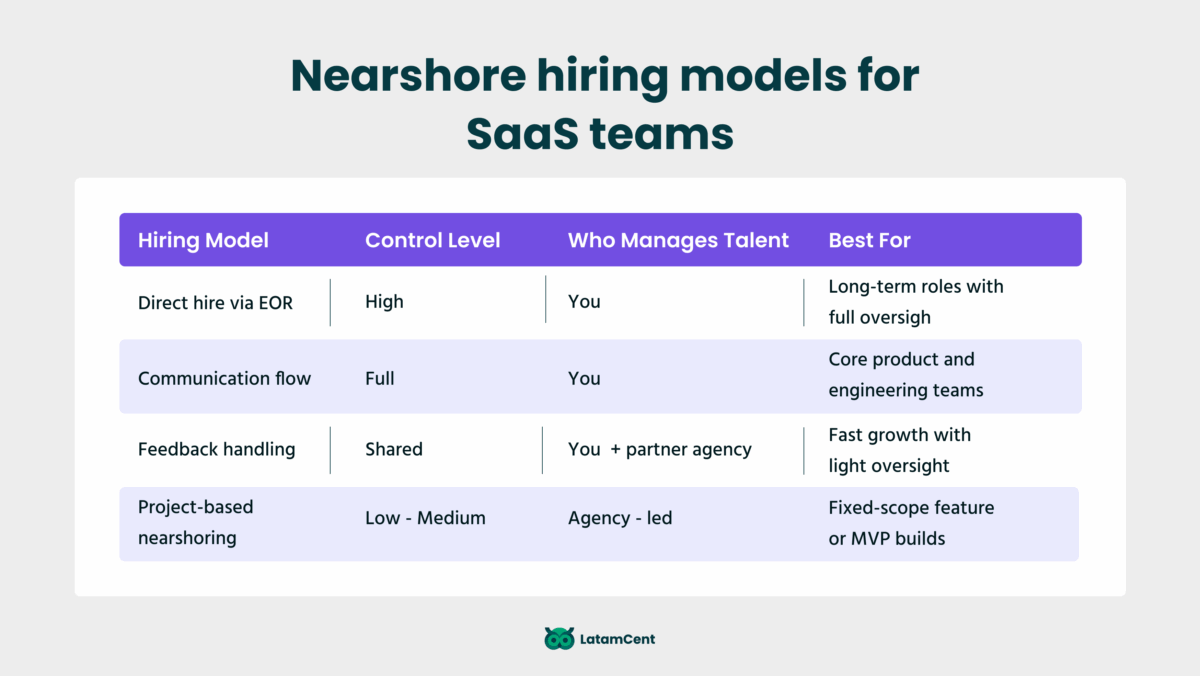
| Model | Who employs the hire | Who manages the work | Best for |
|---|---|---|---|
| Direct hire via EOR | The Employer of Record | You | Hiring one or a few people without a local entity |
| Dedicated team | The partner | You | A full squad that works as an extension of your team |
| Co-managed team | The partner | Shared: partner handles logistics, you set priorities | Teams with limited management capacity |
| Project-based | The partner | The partner owns delivery | A defined outcome with a fixed timeline |
| Role-based | Partner or EOR, depending on the contract | You | Long-term capacity inside existing squads |
General patterns. Contracts vary by provider, so confirm who employs the hire in writing.
Nearshore Staffing Costs and Pricing Models
A nearshore hire has two cost parts. The first is the professional’s compensation. The second is the partner’s fee. Published rates vary widely between providers, so compare quotes on the same scope, not headline numbers.
| Pricing model | How you pay | Best for | Watch for |
|---|---|---|---|
| Monthly rate per person | One recurring invoice per hire, often covering compensation and the partner’s fee | Dedicated or augmented team members | Ask what the rate includes and what is billed on top |
| Placement fee | A one-time fee after the hire starts, often calculated from annual compensation | Permanent roles you will employ yourself | Ask about the replacement period and who handles payroll |
| EOR fee | A recurring fee per employee for contracts, payroll and compliance | Hiring someone you already found | The EOR does not search for candidates |
| Project fee | A fixed fee for an agreed deliverable | Defined, delegable scope | Change orders when scope moves |
What Drives the Price
- Seniority and how scarce the skill is
- Country and city
- English level the role requires
- Contract type: contractor or employee
- Benefits, equipment and hours covered
- How much of the search the partner runs
What to Ask For in a Quote
- The compensation the professional receives
- The partner’s fee, itemized
- What is billed on top, such as equipment or benefits
- The notice period and any replacement terms
- Who owns the code and the work product
At LatamCent, you pay the professional’s compensation plus a service fee, quoted per role.
For employment structures in more detail, see our guide to Employer of Record providers in Latin America.
Need a quote for a specific role?
Tell LatamCent the role you need to fill. You pay the professional’s compensation plus a service fee, quoted per role.
What Roles Are Most Commonly Hired Through Nearshore Staffing Companies?
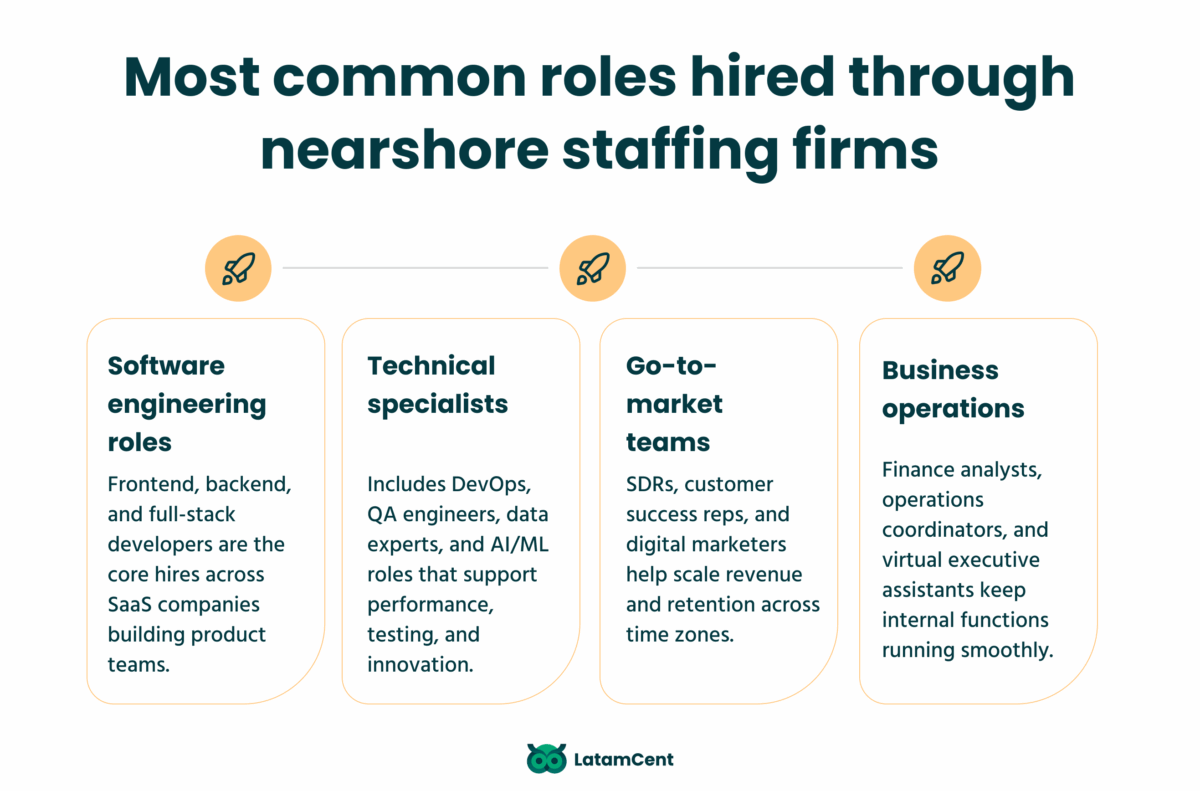
Software Engineers: Frontend, Backend, & Full Stack
Software engineers are usually the largest category of placements. Front-end developers build interfaces in React or Angular. Back-end developers skilled in Node.js, Python, or Java keep products stable and scalable.
Startups often hire full-stack application engineers, professionals who can handle both sides of the stack and shift tasks as priorities change. That flexibility makes them a popular choice for early-stage SaaS teams.
Key areas of focus include:
- Front-end frameworks for responsive UIs
- Backend logic, APIs, and integrations
- Full-stack roles for companies needing one hire to cover both ends
Technical Specialists: DevOps, QA, Data, & AI Engineers
Software doesn’t run smoothly without specialists behind the scenes. DevOps engineers automate deployments and keep infrastructure efficient. Data engineers build pipelines that make analytics reliable. AI/ML engineers design models that power automation and smarter features.
Nearshore staffing services source these specialists because they’re hard to find quickly in the US market. LATAM provides a large pool of professionals with these niche skills, which can be easier to source than in many US markets.
Companies rely on specialists for:
- DevOps automation and cloud infrastructure
- QA testing across platforms
- Data pipelines and analytics readiness
- AI/ML model development for new features
GTM Teams: SDRs, Customer Success, & Digital Marketing
Nearshore staffing isn’t only for engineers. Many SaaS companies expand their go-to-market teams through LATAM partners. SDRs handle prospecting and outreach, keeping sales pipelines full. Customer success (CS) managers support retention, answering questions and driving adoption. Digital marketers manage campaigns across channels to drive growth.
GTM roles most frequently placed:
- Sales Development Representatives (SDRs) for outbound outreach
- Customer Success managers for renewals and upsells
- Digital marketing specialists for paid media and content campaigns
Finance, Operations, & Executive Virtual Support
As SaaS companies scale, back-office support becomes just as critical as product development.
Nearshore staffing firms place professionals in finance, operations, and executive support to cover back-office needs. Controllers, analysts, and staff accountants manage reporting, while operations staff keep processes on track.
Virtual assistants provide executives with day-to-day leverage across scheduling, communication, and admin tasks.
Common placements include:
- Accountants, analysts, and controllers in finance
- Operations coordinators to keep teams running smoothly
- Executive assistants providing remote, high-level support
Top Countries for Nearshore Staffing in Latin America
Time zone fit is the first filter. Here is how the main hubs compare with US Eastern Time.
| Country | Main hubs | Offset vs US Eastern | Note |
|---|---|---|---|
| Mexico | Mexico City, Guadalajara, Monterrey | 1 to 2 hours behind | Most of Mexico no longer uses daylight saving |
| Colombia | Bogotá, Medellín, Cali | 0 to 1 hour behind | No daylight saving, matches Eastern in winter |
| Argentina | Buenos Aires, Córdoba | 1 to 2 hours ahead | No daylight saving |
| Brazil | São Paulo, Curitiba, Florianópolis | 1 to 2 hours ahead | Brasília time, no daylight saving |
| Chile | Santiago, Valparaíso | 0 to 2 hours ahead | Shifts with Chile’s daylight saving |
Approximate. Offsets shift when the US changes its clocks. Confirm the exact overlap for your team.
Mexico: Large Talent Pool & Strong US Alignment
Mexico has long been the first stop for US companies exploring nearshore staffing. It has a large engineering talent pool across development, design, and operations.
Teams in Monterrey, Guadalajara, or Mexico City work in Central time, one to two hours behind US Eastern, which keeps collaboration natural instead of forced. Flights to many US cities are short, which makes in-person visits easier. That combination of scale and accessibility makes Mexico one of the most common sources of nearshore teams.
Key advantages of nearshore hiring in Mexico:
- Large pipeline of engineering talent
- Strong overlap with US time zones
- Short flights to many US cities
Colombia: Growing Tech Hubs & Bilingual Talent
Colombia has built up its tech scene over the last decade. Medellín, Bogotá and Cali are the main hubs, each with a growing startup community.
Nearshore staffing agencies highlight Colombia for more than cost. Bilingual talent is available, and the time zone matches US Eastern in winter and sits one hour behind in summer. There is also a cultural affinity that makes US collaboration easier.
Why Colombia stands out:
- Established tech hubs in Medellín, Bogotá and Cali
- Bilingual professionals available across many roles
- Time zone close to US Eastern
Argentina: Highly Skilled, Product-Minded Remote Talent
Many developers think about how software should work and scale, not only how to code it. That mindset suits SaaS companies that need more than task execution.
Many Argentine engineers already work remotely for US and international teams, so distributed workflows are familiar, which can mean less onboarding friction for startups. Argentina sits one to two hours ahead of US Eastern.
Why companies hire in Argentina:
- Engineers who think about product, not only code
- English is common in tech roles
- Many engineers experienced in remote work for international teams
Brazil: High Volume & Diverse Role Availability
Brazil has one of the largest talent pools in Latin America, and the region’s largest economy. With a large population and tech hubs like São Paulo, Curitiba, and Florianópolis, companies can source many specialties, from front-end developers to AI/ML specialists and finance professionals.
The main hubs run on Brasília time, one to two hours ahead of US Eastern. Portuguese is the local language, so confirm English level for each hire.
It’s also a country where scale works in your favor. Large recruiting networks and local staffing firms can give quicker access to candidates, which helps when a SaaS company needs to fill several roles at once.
Why companies hire in Brazil:
- Deep and diverse talent pool across industries
- Large tech hubs
- Ability to fill niche and high-volume roles
Chile: Stable Economy With Strong Engineering Education
Chile stands out less for size and more for stability. It is known for a stable business climate and a long tradition of investing in higher education. Universities in Santiago and Valparaíso graduate engineers with software, data, and infrastructure skills.
Chile’s offset from US Eastern shifts between zero and two hours ahead with daylight saving.
For US companies, Chile offers predictability. The business climate is steady, and many professionals are used to working with international firms. While the talent pool is smaller than Brazil or Mexico, its engineering education makes it a strategic option.
Why companies hire in Chile:
- Stable economic and business environment
- Engineering programs in Santiago and Valparaíso
- Many professionals familiar with international clients
Types of Nearshore Staffing Providers
Providers use different labels for similar work: nearshore staffing agency, nearshore recruitment services, nearshore IT staffing, nearshore staffing solutions. Start by knowing what you are buying.
| Type | What they do | Who employs the hire | Best for |
|---|---|---|---|
| Nearshore recruitment agency (placement partner) | Finds and vets candidates for you to hire | You or an EOR | One or a few specific roles |
| Staff augmentation firm | Supplies professionals who work inside your team | Usually the firm | Adding capacity quickly |
| Dedicated team provider | Builds and employs a team you direct | The provider | Larger squads |
| Employer of Record | Employs the person legally while you direct the work | The EOR | Hiring someone you already found |
| Outsourcing or software house | Owns delivery of a project | The provider | Fixed-scope builds |
Many providers combine two or more of these. Check each provider’s own definitions.
Compare Nearshore Staffing Companies
We keep ranked lists of nearshore staffing agencies and companies, each with a different focus.
- Best nearshoring agencies: a ranked overview of agencies.
- Top nearshoring staffing agencies for building teams in Latin America.
- Nearshoring companies for B2B SaaS startups.
- Nearshore outsourcing companies for US businesses.
- IT staff augmentation companies for US startups.
- Top IT recruiting companies.
How to Choose a Nearshore Staffing Company
Compare providers on the same questions. Proof beats promises, so ask for sourcing methods, screening steps and how they handle exits.
Questions to Ask Every Provider
- Who employs the hire, and who handles payroll and benefits?
- How long until the first shortlist, for a role like mine?
- How do you vet candidates, technically and for English?
- What happens if a hire leaves or the fit is wrong? Is there a replacement period?
- Which time zones do your candidates work in?
- How are IP and code ownership assigned?
- What is the full fee, itemized?
- Can I speak with the recruiters who would run my search, and with a reference client?
Is Nearshore Staffing Safe? Red Flags to Check
The risks are mostly contractual: who employs the person, who owns the work, and who is responsible for compliance. Check them in writing before work starts.
- Vague answers about who the legal employer is
- No written IP assignment or data protection terms
- A headline rate with no breakdown
- No explanation of how candidates are vetted
- Long minimum terms with no exit conditions
- No named person you can reach
General guidance, not legal advice.
Large LATAM Staff Augmentation Firm vs Startup-Focused Provider
| Factor | Large staff augmentation firm | Startup-focused nearshore partner |
|---|---|---|
| Best fit | Many roles at once, multi-team programs | One to a few hires, growing teams |
| Bench and pool | Large internal bench across many skills | Curated pool, searched per role |
| Process | Standardized, often more layers between you and the people sourcing | Fewer layers, direct contact with the recruiters |
| Contracts | Often master agreements and longer terms | Often per-role terms, varies by provider |
General patterns. Compare each provider on the same questions.
Dedicated Nearshore Talent Partner vs Traditional Staff Augmentation
A dedicated talent partner places full-time professionals who work only for you. It often employs them, runs payroll and sends one monthly invoice. Traditional staff augmentation tends to supply people for a set period or a defined need, sometimes from a shared bench. Ask both types who employs the person and how long the engagement runs.
Talent Acquisition Strategies That Work
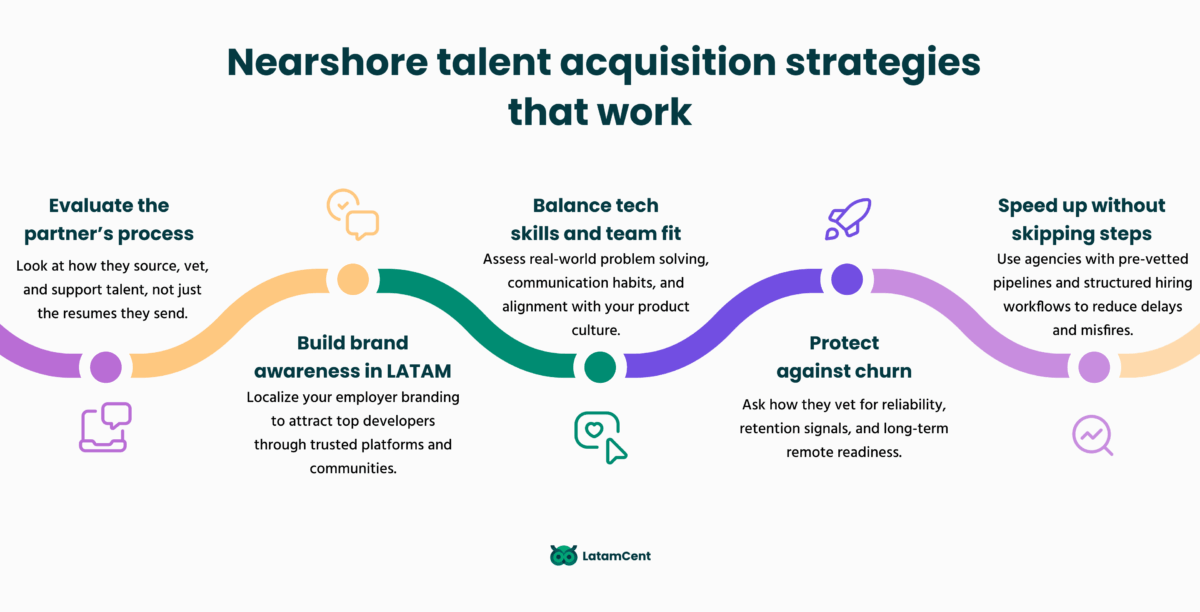
Strong providers show proof: sourcing methods, screening steps and retention results. Transparency separates reliable providers from résumé pushers.
Hiring managers also weigh communication, teamwork and long-term retention risk next to technical tests, since a well-built feature does not help if collaboration breaks down. Many teams use pre-vetted candidate pools to shorten the search without lowering the bar.
Conclusion
Nearshore staffing is a practical option for SaaS companies that want speed, stability, and quality talent without overspending. With strong talent pools across Mexico, Colombia, Argentina, Brazil, and Chile, US companies have several good options to fill critical roles while staying close to home.
The key is choosing the right partner. A staffing company should provide access to vetted professionals, ensure cultural compatibility, and help your internal team move faster with the right people in place.
Ready to build your nearshore team?
LatamCent recruits vetted engineering, GTM and finance talent in Latin America for US B2B SaaS teams. Tell us about the role you need to fill.
Frequently Asked Questions
What is nearshore staffing?
Nearshore staffing is a hiring model where a partner in a nearby country finds, vets and places professionals who work in your time zone as part of your team. For US companies that usually means Latin America.
What does a nearshore staffing company do?
A nearshore staffing company sources, screens and places professionals in a nearby country. Depending on the model, it also handles contracts, payroll and compliance. You direct the day-to-day work.
What is the difference between nearshore and offshore staffing?
Nearshore staffing uses talent in nearby countries with a similar time zone. Offshore staffing uses talent in distant regions, often with little or no overlap with US hours. Nearshore supports live collaboration. Offshore often relies on asynchronous handoffs.
What is the difference between nearshore staffing and staff augmentation?
Nearshore staffing is defined by location: talent in nearby countries with shared working hours. Staff augmentation is defined by how you use the talent: external specialists join your team under your direction, anywhere in the world. Many nearshore engagements are staff augmentation.
Nearshore staffing vs EOR: what is the difference?
A nearshore staffing company finds and vets people for you. An Employer of Record is the legal employer for someone you already found, and handles contracts, payroll and compliance. Some providers offer both.
How much does nearshore staffing cost?
It depends on the role, seniority, country and pricing model. You usually pay the professional’s compensation plus the partner’s fee, either as a monthly rate per person or as a placement fee. Published rates vary widely, so compare itemized quotes on the same scope.
Is nearshore staffing safe?
It can be, if the contract is clear. Check who the legal employer is, how IP and code ownership are assigned, what data protection terms apply and what the exit conditions are. Ask for references and get every term in writing.
How do I check that a nearshore staffing company is legitimate?
Ask who employs the hire, how candidates are vetted, and for a reference client. Review the contract for IP assignment, notice periods and replacement terms. Be cautious about vague answers and rates with no breakdown.
How long does it take to hire through a nearshore staffing company?
It depends on the role, the seniority and the provider. Ask each provider for its typical time to a first shortlist and compare that with your own recruiting cycle.
Which roles are most commonly hired through nearshore staffing?
Software engineers come first, followed by specialists such as DevOps, QA, data and AI/ML engineers. Companies also fill go-to-market roles such as SDRs and customer success managers, and finance and operations roles.
Which countries are best for nearshore staffing?
Mexico, Colombia, Argentina, Brazil and Chile are the usual first stops for US companies. Mexico and Colombia sit closest to US Eastern time. Brazil and Argentina sit one to two hours ahead. The best choice depends on the role, the hours you need covered and the English level required.
Which nearshore staffing companies provide full-time dedicated employees?
Several providers place full-time professionals who work only for one client. Compare them on who employs the hire, how long until a first shortlist, and what happens if a hire leaves. LatamCent places full-time remote professionals for US B2B SaaS teams, and our provider lists compare other options.