

LATAM placements show 1.8× longer tenure than the industry average for equivalent US roles. At a replacement cost of 50-200% of salary per departure (SHRM, Gallup), every extra month of tenure is money that stays in your budget instead of walking out the door.
Retention | Based on 1,200+ LatamCent placements, benchmarked against SHRM, Gallup, BLS, SaaStr, and Ravio workforce data | Last updated July 2026
Key findings
- LATAM placements show 1.8× longer tenure than the US industry average.
- Engineering placements trend past 40 months; US SaaS engineering tenure sits near 24 months.
- Replacement cost runs 50-200% of salary: about 80% for technical roles, 200% for managers.
- SDR seats turn in 8-12 months, but with a promotion path the person often stays for years.
- Cost per productive year: about $280k (US) versus about $125k (nearshore).
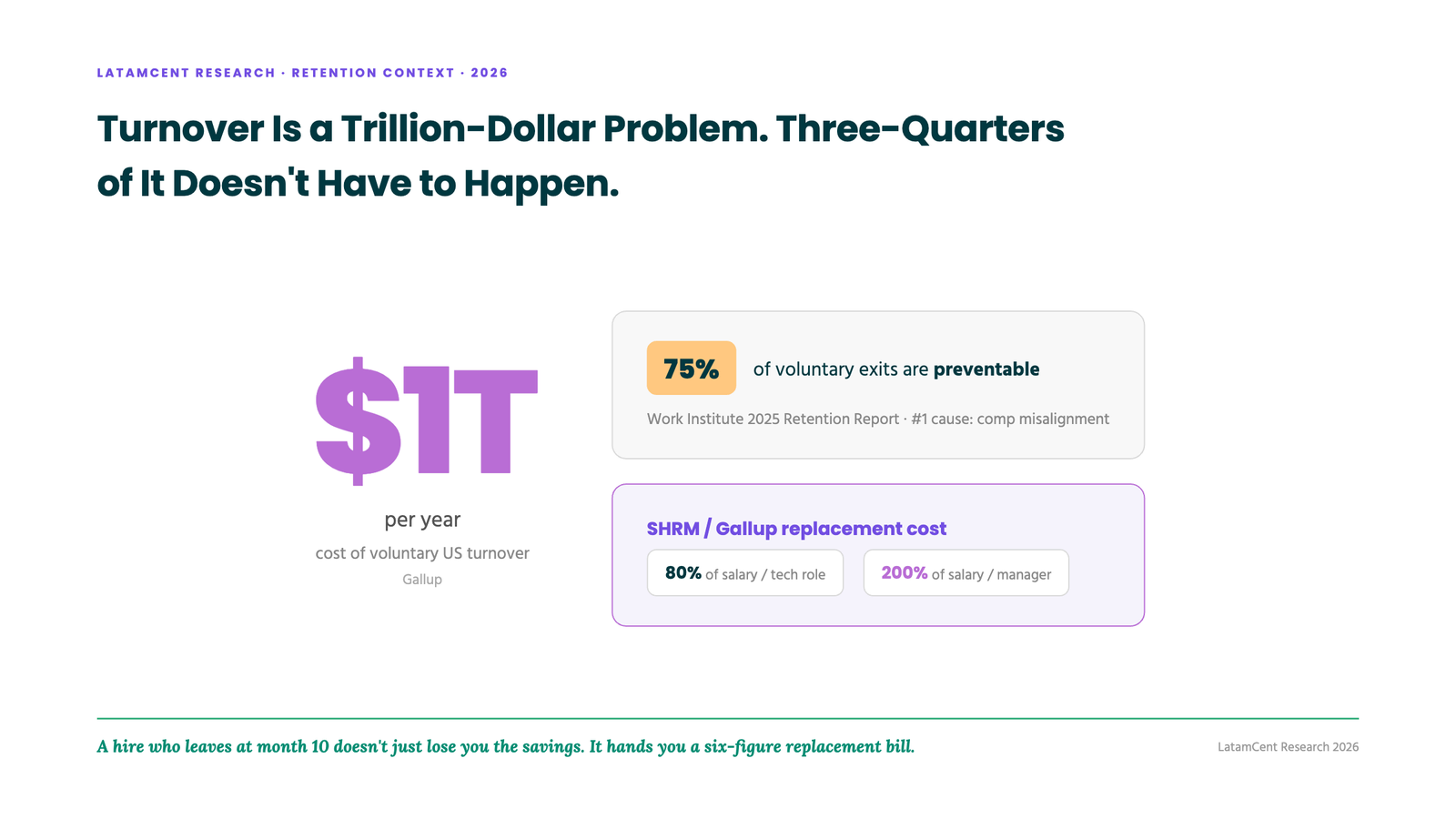
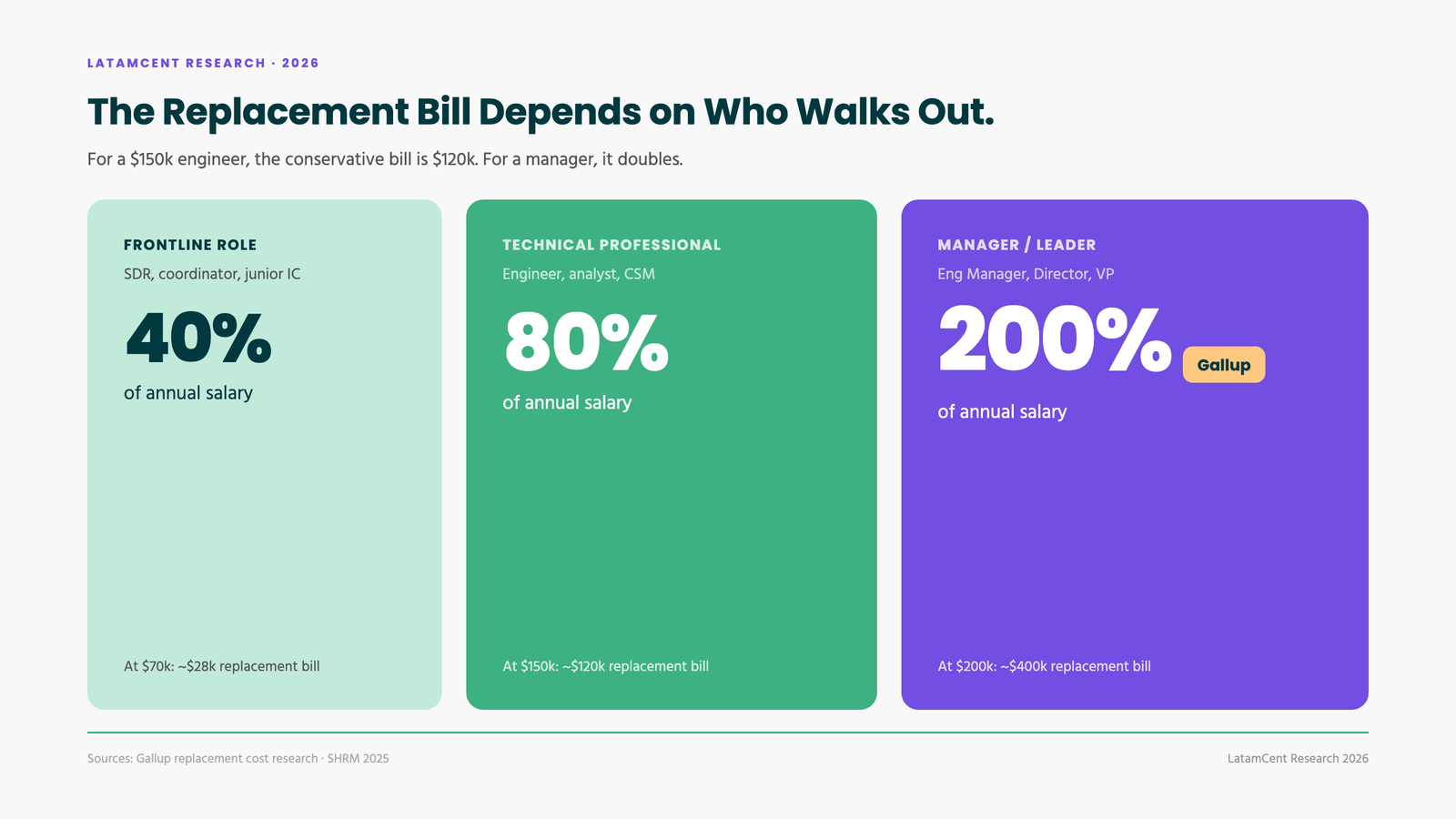
The objection comes up on almost every first call: “Sure, it’s cheaper. But will they stay?” Fair question. Gallup estimates voluntary turnover costs US businesses roughly $1 trillion per year. SHRM and Gallup both put replacement cost at 50-200% of annual salary depending on the role: 80% for technical professionals, 200% for managers and leaders. A hire who leaves at month 10 does not just lose you the salary savings. It hands you a six-figure replacement bill.
So we looked at our own retention data instead of guessing. The blended answer: nearshore hires stay 1.8× longer than their US counterparts. But blended numbers hide the truth, and the truth is more useful.
Tenure by function
| Function | US benchmark (sourced) | LatamCent placement tenure | Multiple | The honest caveat |
|---|---|---|---|---|
| Engineering | 2-3 years at US SaaS companies (BLS, Ravio); BLS private-sector median at a 20-year low | 40+ months trending | ~1.8× | Strongest retention we have, with a new comp dynamic (below) |
| Finance / Ops | ~26 months industry average | 44+ months trending | ~1.7× | Lowest voluntary churn of any function |
| Customer Success | ~22 months | 38+ months trending | ~1.7× | High role satisfaction, CS-to-AM promotion paths help |
| GTM / Sales (AE) | 2.2 years, down from stable since 2010; 32% annual attrition rate (20% voluntary), per Jiminny/Bridge Group | 24-28 months | ~1.1-1.3× | The gap narrows because GTM churns everywhere |
| GTM / Sales (SDR) | ~14 months median; 52% do not last 12 months (SaaStr survey) | 8-12 months in seat, then a fork | See below | The seat turns over. The person often does not |
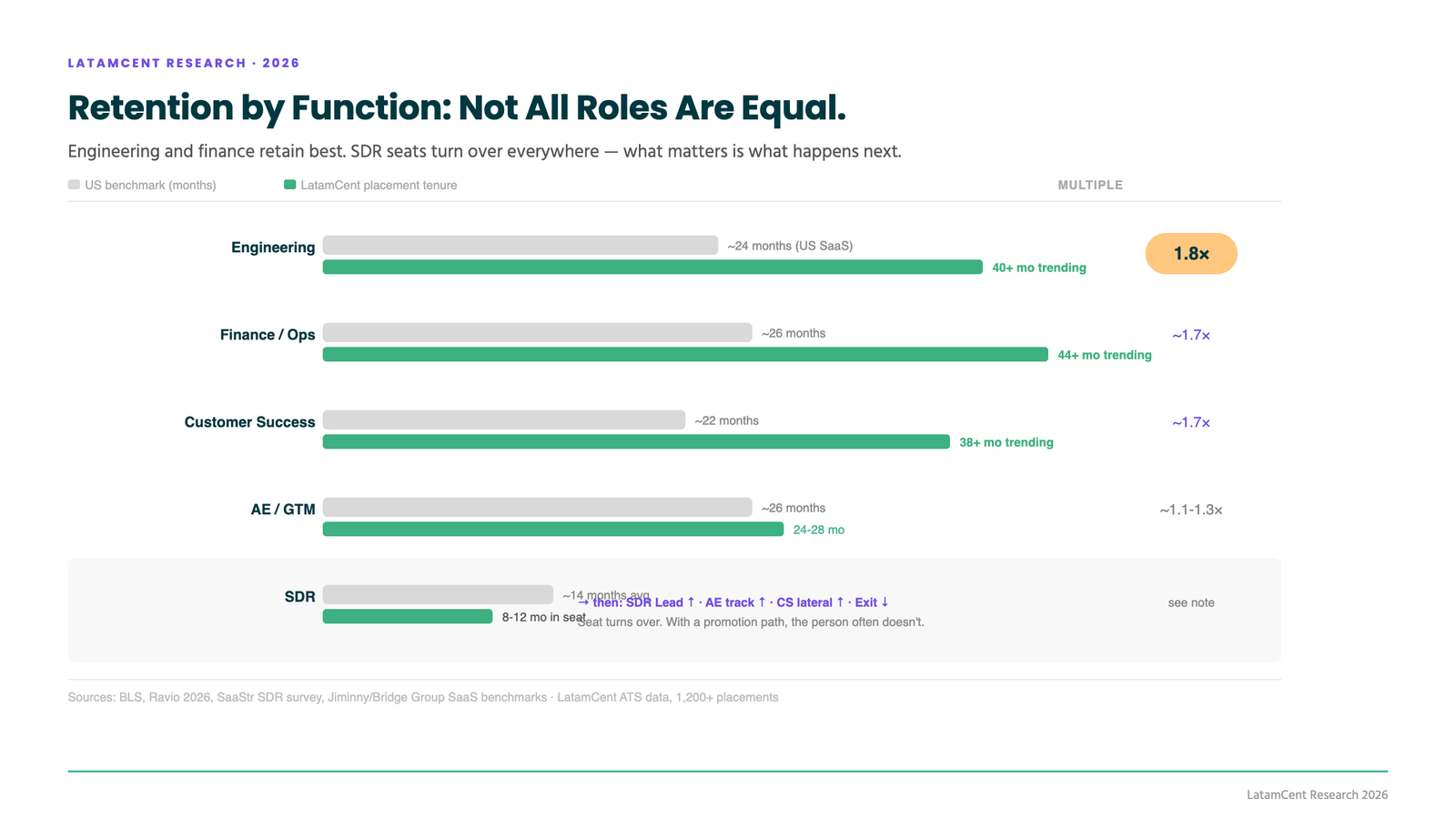
Blended across functions: 1.8× the tenure of equivalent US hires.
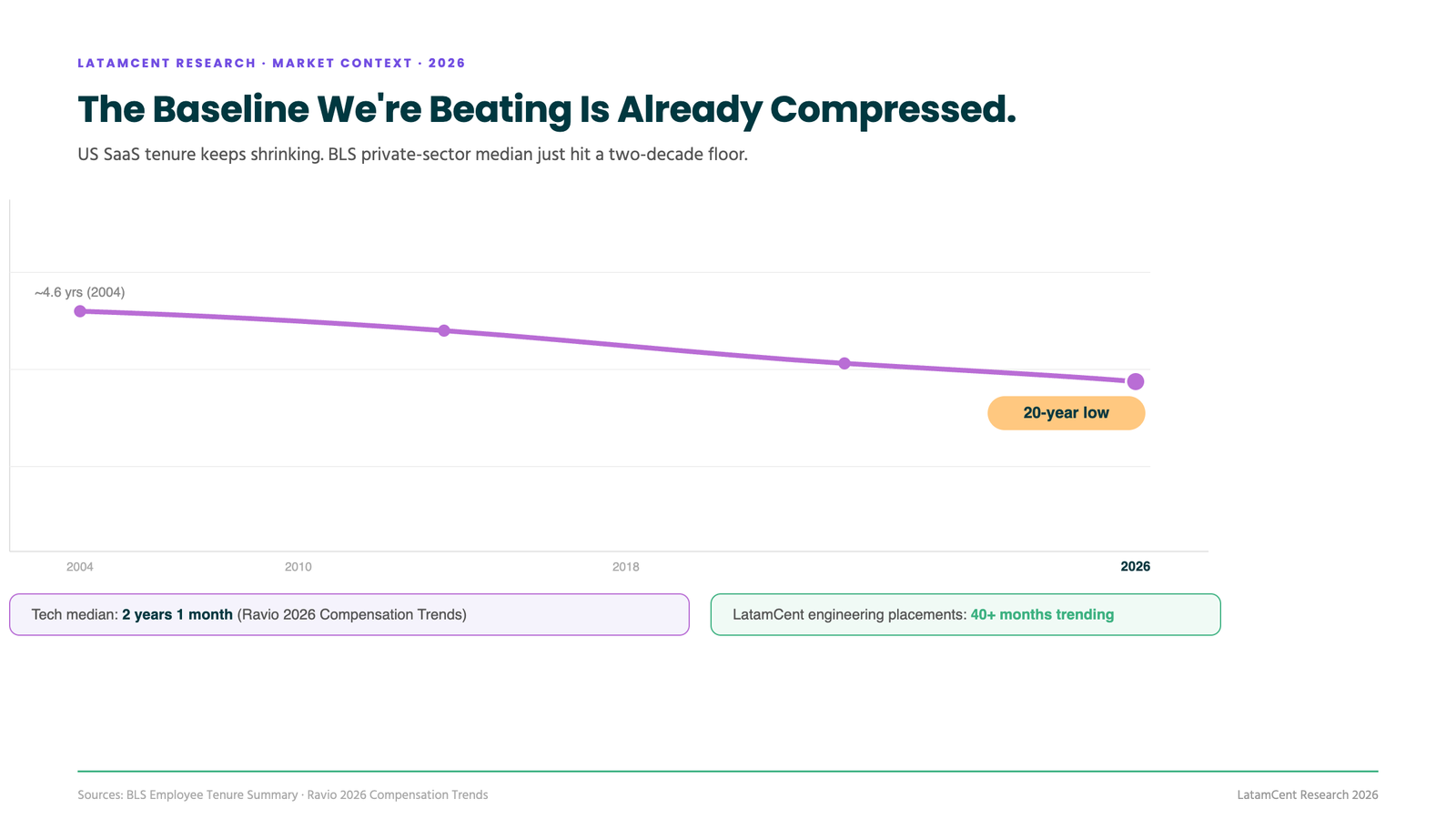
And US tenure is moving in the wrong direction. BLS reports that private-sector median tenure recently hit a 20-year low. Ravio’s 2026 Compensation Trends data shows tech employee tenure at 2 years and 1 month in 2025, up slightly from 1 year 9 months in 2023, but still historically short. The baseline our placements are beating is already compressed.
The SDR row deserves its own section
SDR (sales development representative) is the highest-churn seat in every company on the planet, and nearshore does not repeal that law. SaaStr’s data is stark: average SDR tenure is 14 months, and 52% do not even last a year. In our placement data, SDRs spend 8-12 months in the seat. What happens next is the part nobody measures:
A meaningful share get promoted: SDR lead, Senior SDR, or the AE track. Others make the lateral move into customer success, where the skills transfer and the retention curve flattens out. The remainder wash out through layoffs or quitting, same as any SDR team anywhere.
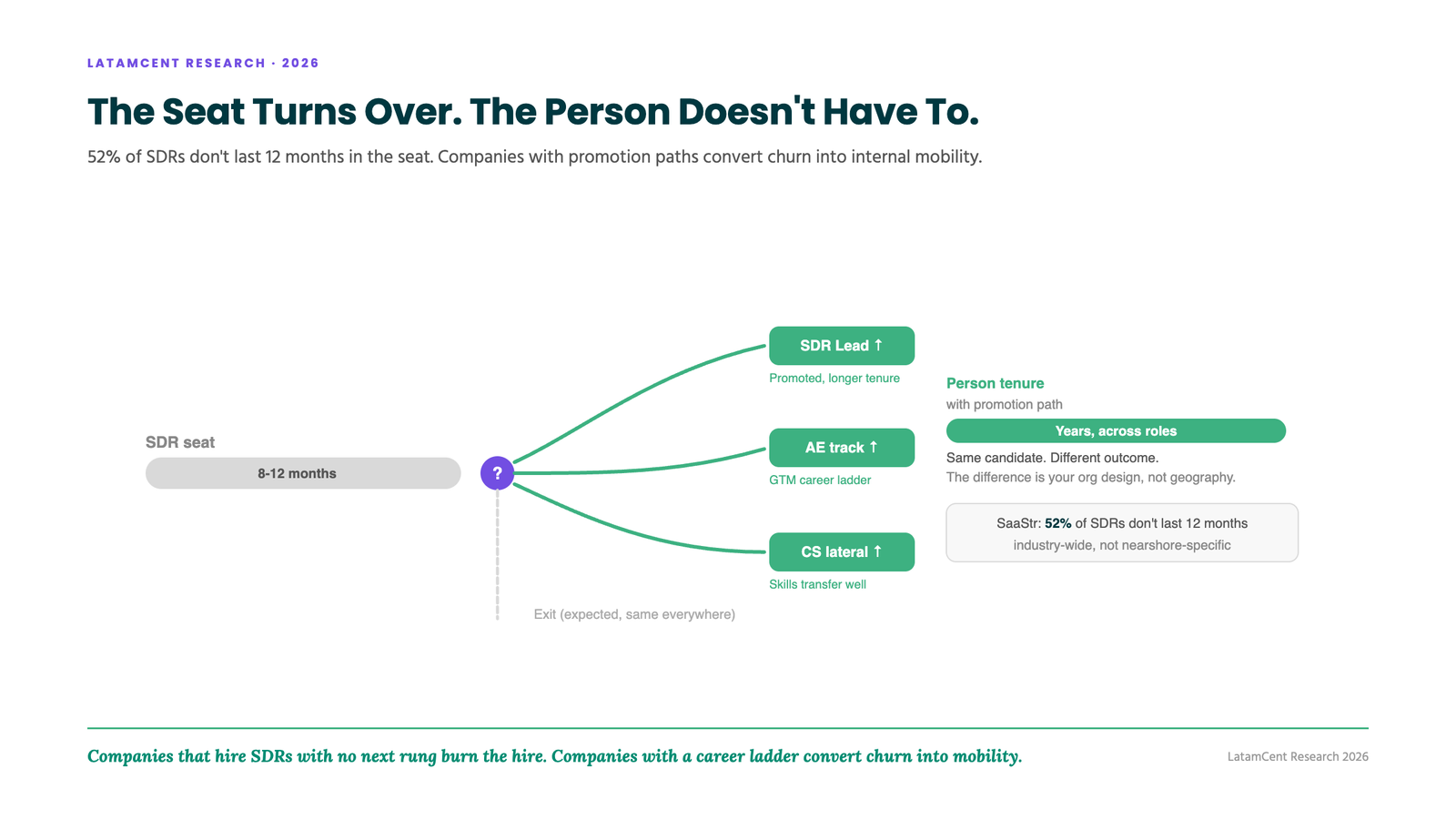
The distinction matters for how you budget the role. The seat has 8-12 month tenure. The person, when the company builds a promotion path, often stays with the company for years across roles. Companies that hire SDRs with no next rung burn the hire. Companies that hire SDRs as the entry point of a GTM career ladder convert churn into internal mobility. Same candidate, different outcome, and the difference is your org design, not the talent’s geography.
The new engineering retention dynamic: the 6-month comp review
Engineers are staying. But the deal underneath the tenure is changing, and we see it across our placement base: annual review cycles with automatic 10% raises are gone. What replaced them is comp reviews at the 6-month mark, tied to output.
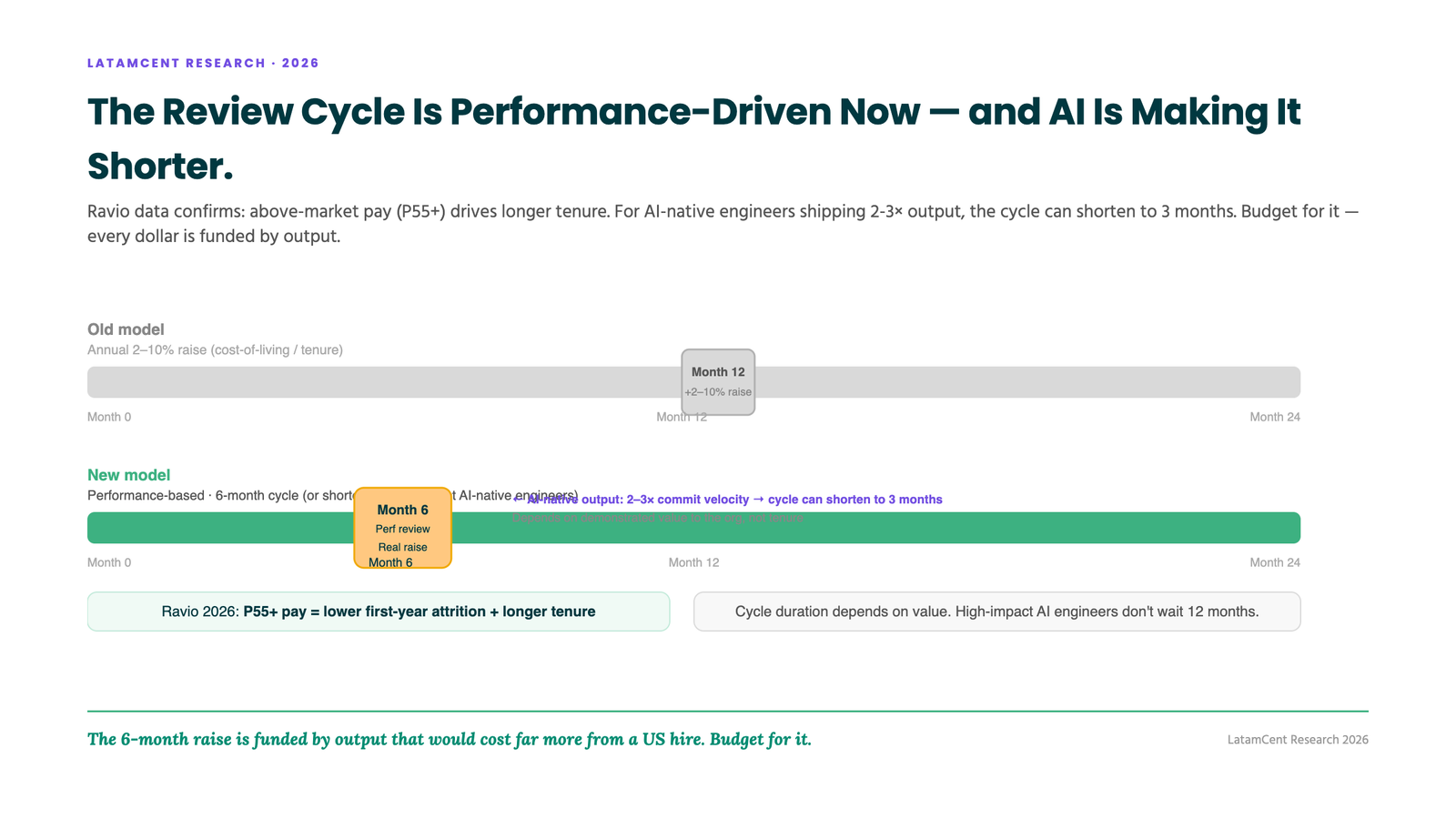
The engineers commanding substantial increases are the ones shipping the most code, and increasingly they are the ones producing most of that code with AI tools like Claude Code. The productivity gap between an AI-native engineer and a traditional one is now visible in commit velocity, and clients are pricing it. A LATAM engineer who ships 2-3× the output of a peer does not wait 12 months for a cost-of-living bump. They get a real raise at month 6, and they earn it.
This is good news dressed as a cost increase. Ravio’s 2026 data confirms the link: employees paid above the 55th percentile of market stay longer and are less likely to leave in their first year. Retention through performance-based comp is cheaper than replacement. Every dollar of that 6-month raise is funded by output that would cost far more from a US hire. Budget for it. The flat-salary-for-two-years model is dead for top engineering talent, nearshore included.
Why they stay: the three structural advantages
This is not loyalty as a personality trait. It is incentive design, and each advantage has data behind it.
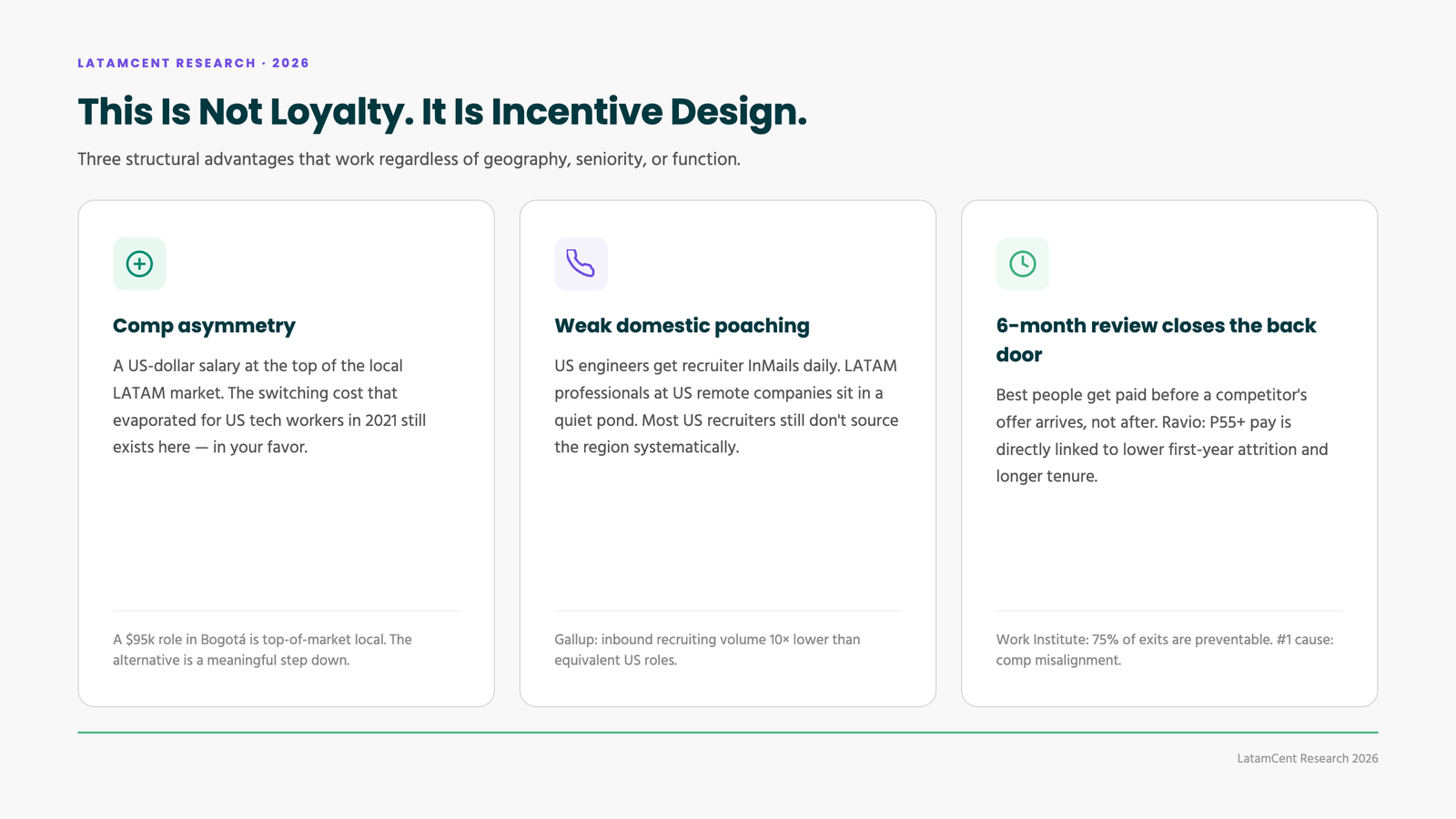
The compensation asymmetry. A senior engineer earning $95k from a US SaaS company in Bogota is in the top tier of her local market. Her alternative is not another $95k US remote job around the corner. It is a meaningful step down at a local employer. The switching cost that evaporated for US tech workers in 2021 still exists in LATAM, in your favor.
Domestic poaching is weaker. US engineers get recruiter InMails daily. Gallup data shows that managers account for 70% of the variance in team engagement, but even engaged US employees face 10× the inbound recruiting volume that LATAM professionals at US companies see. Most US recruiters still do not source the region systematically, so your hire sits in a quiet pond.
Performance comp closes the back door. Ravio found that above-market pay (55th+ percentile) is directly linked to longer tenure and lower first-year attrition. The 6-month review cycle means your best people get paid before a competitor’s offer arrives, not after. That is exactly the mechanism Work Institute’s 2025 data flags: 75% of voluntary exits are preventable, and comp misalignment is the #1 preventable driver.
The math: what 1.8× tenure does to total talent cost
SHRM puts replacement at 6-9 months of salary for most professional roles. Gallup puts it at 50-200%, with technical roles averaging 80% and managers at 200%. Use the conservative end: 80% for a senior engineer.
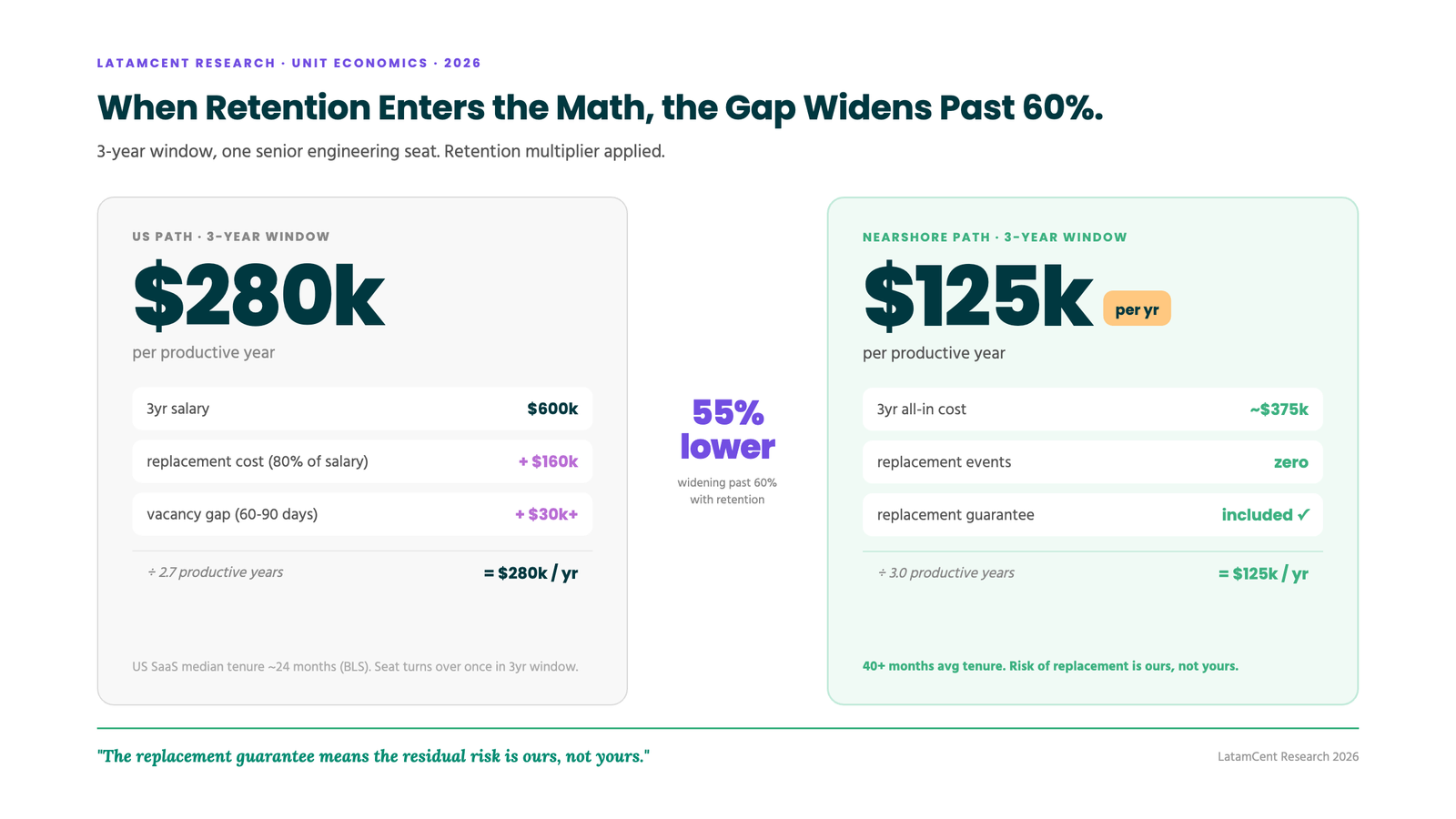
US path, 3-year window. $200k fully loaded per year. US SaaS engineering tenure ~24 months (BLS), so the seat turns over once: add replacement cost of $160k (80% of salary), plus 60-90 days of lost output at $1,000+ per day. Total: ~$760k for about 2.7 productive years. ~$280k per productive year.
Nearshore path, 3-year window. ~$115-125k per year all-in through LatamCent, with performance raises. Our placements trend past 40 months, so the seat does not turn over. Total: ~$375k for three full productive years. ~$125k per productive year.
That is a 55% reduction on cost alone, widening past 60% once retention eliminates the replacement tax. And the replacement guarantee means the residual risk is ours, not yours.
Methodology
LatamCent tenure figures drawn from placement records across 1,200+ analyzed placements at US AI & B2B SaaS companies, measuring active tenure and completed tenures at client companies. SDR figures reported as in-seat tenure with outcome tracking (promotion, lateral move, exit) rather than a single multiple, because a blended SDR number misleads in both directions. Trending figures reflect placements still active at time of analysis. US benchmarks: BLS Employee Tenure Summary (private-sector median at 20-year low); Ravio 2026 Compensation Trends Report (tech median tenure 2 years 1 month, above-market pay linked to retention); SaaStr SDR tenure survey (14-month average, 52% sub-12 months); Jiminny/Bridge Group SaaS Sales Benchmarks (AE tenure 2.2 years, 32% attrition); SHRM replacement cost guidance (6-9 months salary / 50-200%); Gallup replacement cost (50-200%, technical 80%, leaders 200%, $1 trillion annual US cost); Work Institute 2025 Retention Report (75% of voluntary exits preventable).
Retention is the hidden line item in your hiring plan. We will show you tenure data for the exact roles you are hiring, and every placement is backed by a replacement guarantee, so the 50-200% replacement tax is our risk, not yours. Book a free hiring call at latamcent.com.
This study is part of our Research & Insights series.
Cite this research
Found this useful? You are welcome to cite or link this study. Suggested citation:
LatamCent. "Do Nearshore Hires Stick Around? Retention Data by Function" Research & Insights, LatamCent, 2026, https://latamcent.com/research-insights/nearshore-hire-retention-data/.