


You hired a senior engineer in Bogotá. The references were glowing. The interview was sharp. Three months in, the work is solid but something feels off. They go quiet in the meetings where your US engineers happily push back. They say “yes, no problem” to a timeline you already know is impossible. You give feedback the way you give it to everyone on your team, and they nod, thank you, and then the energy drops for a week. You start quietly wondering if you hired the wrong person.
You didn’t. You’re managing a Latin American teammate with a US operating manual, and the manual does not translate.
We place talent across nearly every country in Latin America into US B2B SaaS companies, and I will tell you the pattern that holds across all of them: the hires who struggle almost never struggle on talent. They struggle on management translation. The manager keeps running the US playbook, the teammate keeps responding to a different set of cultural defaults, and both sides decide the other one is the problem. Nobody is the problem. The map is wrong.
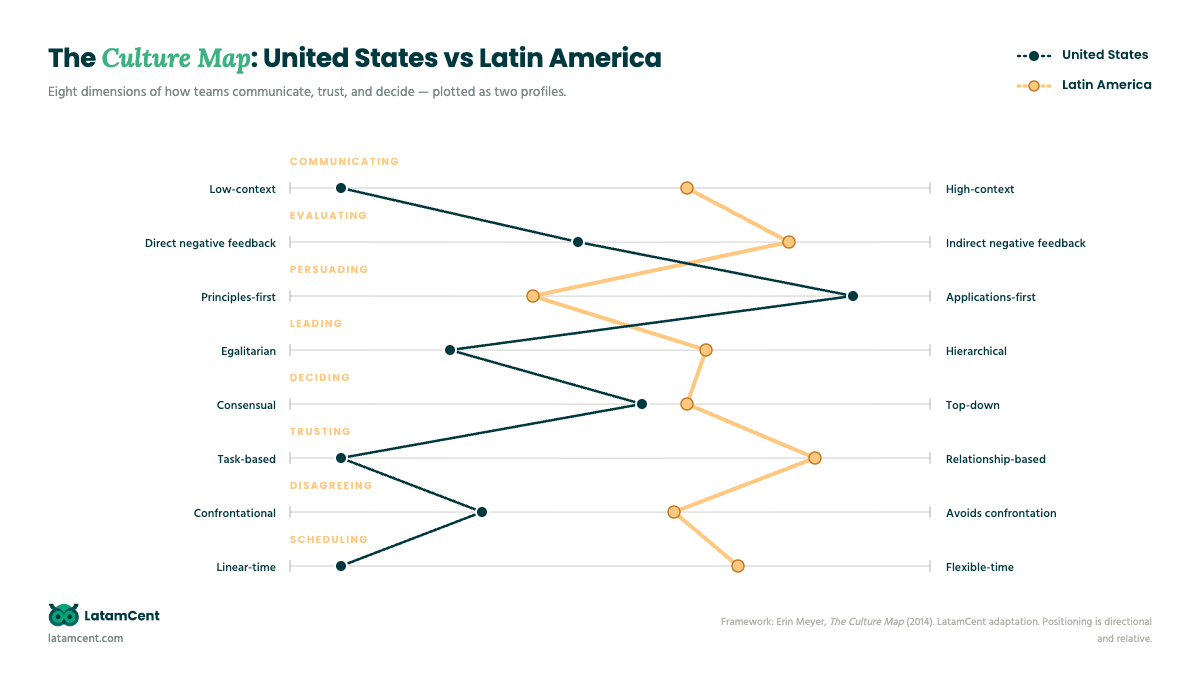
The best map I know for fixing this is Erin Meyer’s The Culture Map. Meyer is a professor at INSEAD who spent years building a framework for how culture shapes the way people actually work together, and she boils it down to eight scales where teams from different countries predictably collide. This is not a personality test or a vibes exercise. It is a field-tested model for decoding why your Brazilian developer and your German PM read the same Slack message two completely different ways.
This guide takes all eight scales and translates them into a working playbook for the exact situation most of our clients are in: a US manager leading Latin American talent for the first time. Here is the whole thread in one sentence. Your LATAM hire is excellent. Your defaults are US defaults. The gap between those two things is predictable, it is mappable, and once you can see it you can close it in a week.
Why this is a retention problem, not a soft-skills problem
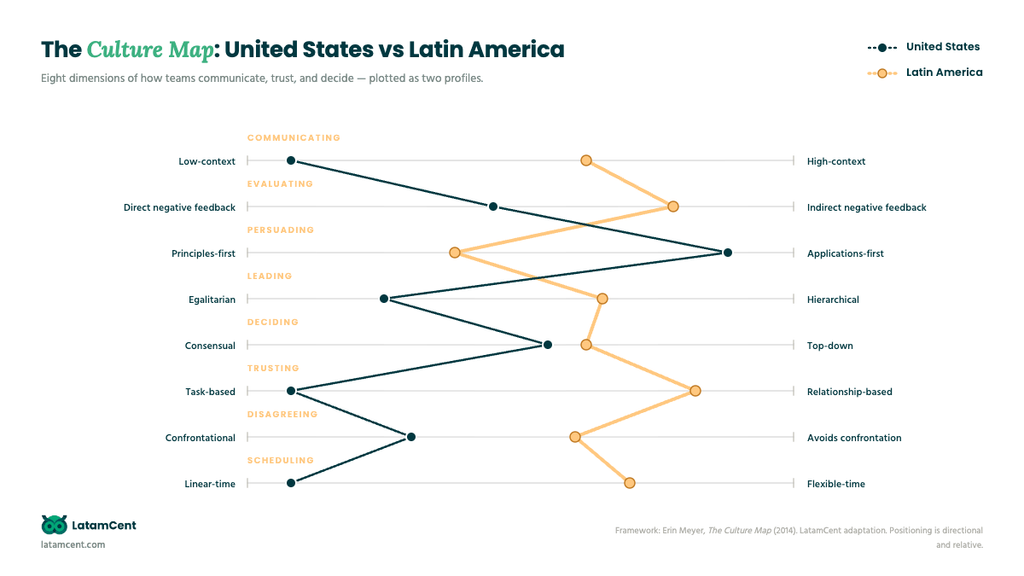
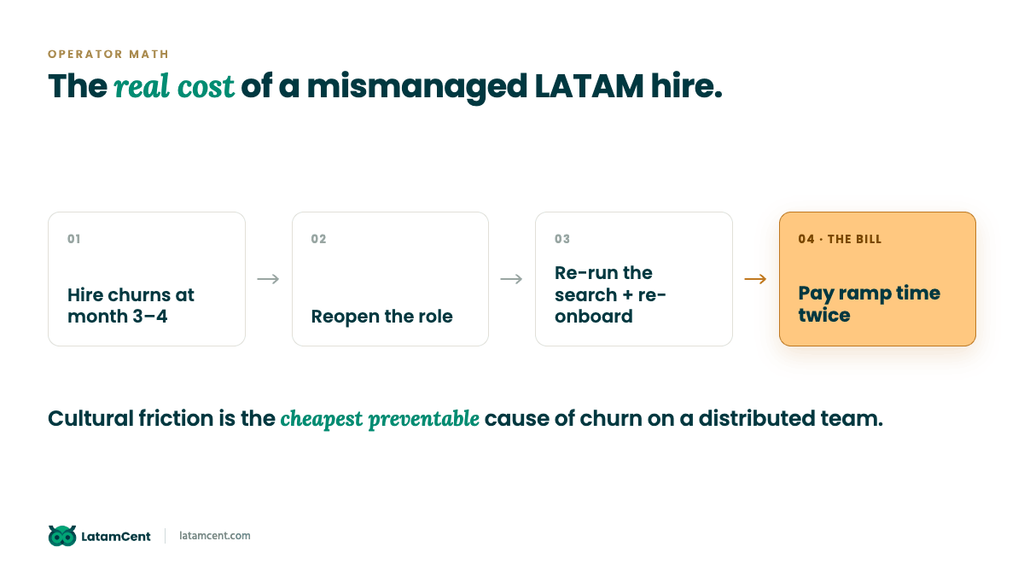
Before the scales, the money. A role that sits open costs a US SaaS company real output, and the longer it stays open the more it bleeds. When you finally fill it and then lose that person three or four months in because the working relationship quietly fell apart, you don’t just lose the hire. You reopen the role, you re-run the search, you re-onboard, and you eat the ramp time twice. Misreading culture is not a feelings issue. It is one of the cheapest preventable causes of churn on a distributed team.
The good news: cultural friction is the most fixable kind of friction, because it is systematic. You are not guessing at one person’s mood. You are adjusting to a pattern that Meyer already mapped. Here are the eight scales, US default versus Latin American default, and what to actually do about each one.
1. Communicating: low-context vs high-context
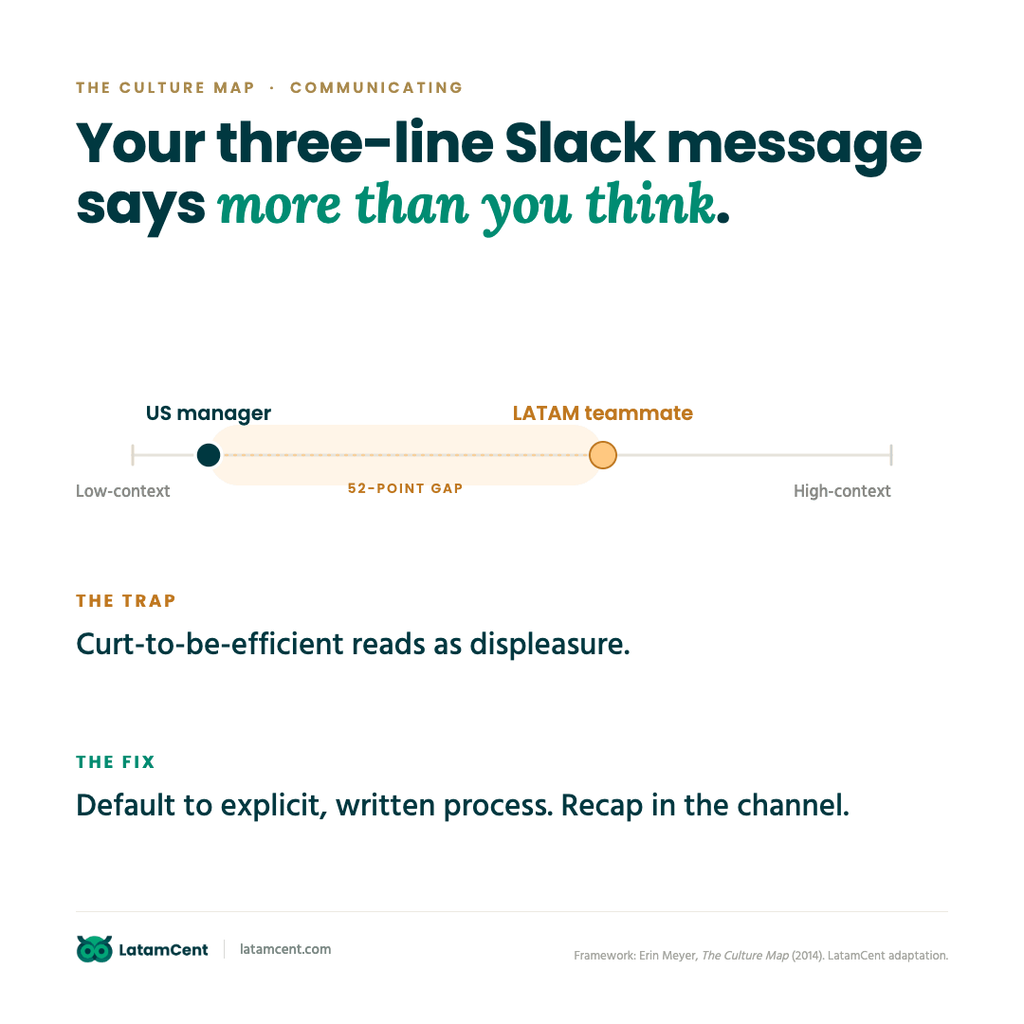
Meyer’s first scale measures how much meaning lives in the words themselves versus in the context around them. The US sits at the far low-context end, alongside Australia, the Netherlands, and Germany. In a low-context culture good communication is explicit, precise, and repeated for clarity, and a message is taken at face value. Latin American cultures sit further toward the high-context end, where more of the meaning is carried by tone, relationship, and what goes unsaid. Within that cluster the countries are not identical: Meyer places Brazil as the lowest-context of the Latin American group, with Mexico and others reading higher.
What this looks like in practice: you send a three-line Slack message that says exactly what you mean. Your US teammate reads three lines. Your LATAM teammate reads three lines plus your tone plus whether you said good morning first plus what your silence on the last message meant. When you are curt to save time, a low-context teammate sees efficiency and a high-context teammate may see displeasure.
The fix is not to become high-context. On a multicultural team Meyer’s advice runs the other way: default to explicit, low-context process so nothing depends on shared subtext that half the team does not have. Put decisions in writing. Recap verbally and then in the channel. Be clear that direct, written clarity is a team norm and not a sign that anything is wrong. The bonus: this also makes you a better manager of your US team.
2. Evaluating: direct vs indirect negative feedback
This is the scale that wrecks the most relationships, and it is the one almost everyone confuses with communication. They are different. Meyer’s evaluating scale measures how frank or diplomatic a culture is specifically when delivering negative feedback. Her favorite illustration: the French are more high-context than Americans, yet far more direct with criticism. Spaniards and Mexicans communicate at a similar context level, but the Spanish are much franker with negative feedback than Mexicans are.
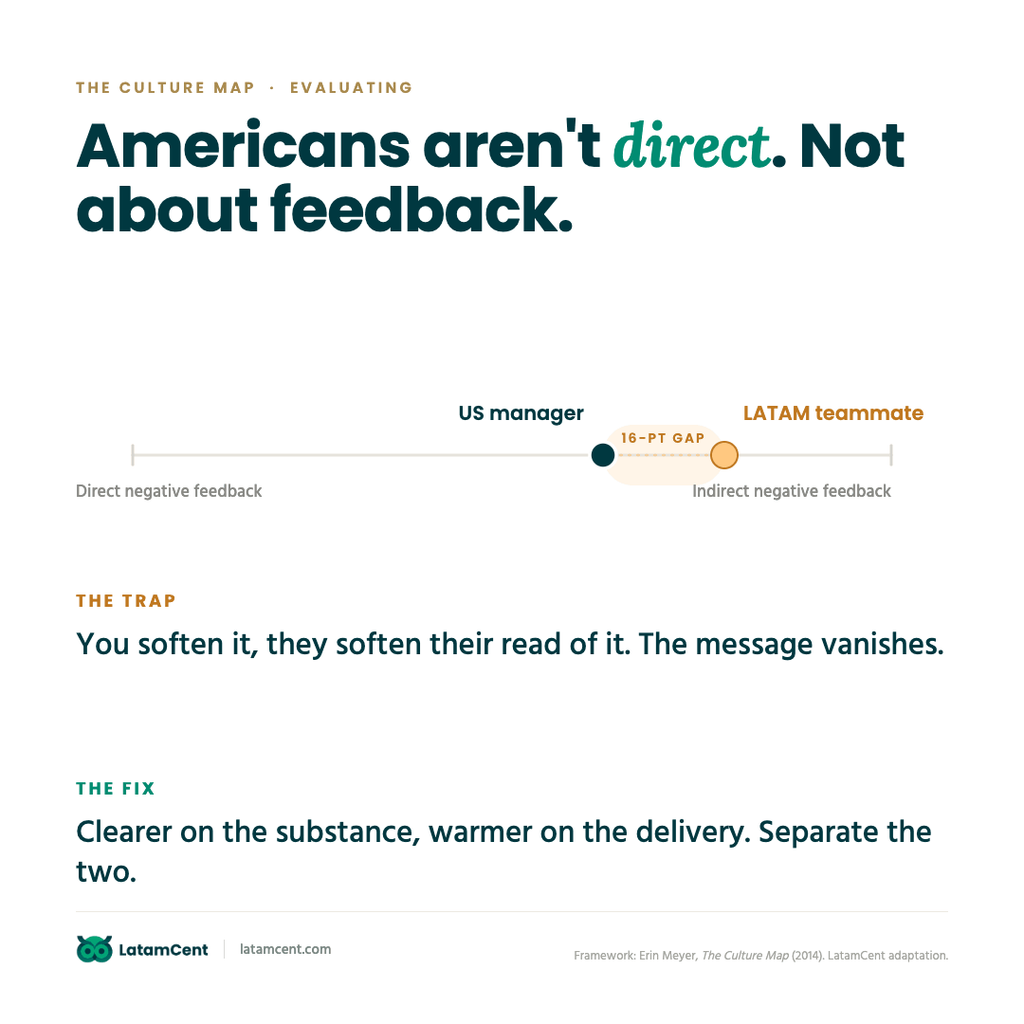
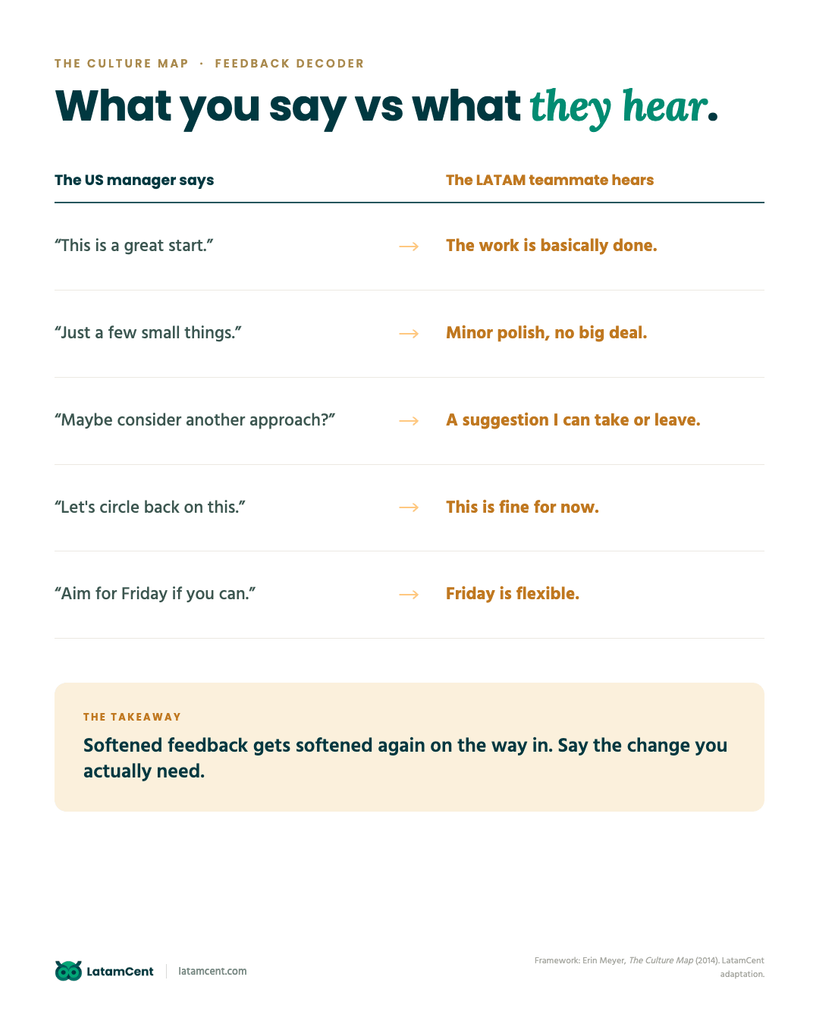
Here is the trap for US managers. Americans communicate directly about almost everything, so US managers assume they are direct people. But the US is actually quite indirect with negative feedback. The classic US move is to wrap criticism in praise, soften it, and lead with three positives. Meyer’s term for the words Americans pile on to cushion a critique is upgraders and downgraders, and an American “this is a great start, just a few small things” often means “this needs serious rework.”
Now run that into a Mexican or Brazilian teammate who is even more diplomatic with negatives than you are. You soften your feedback. They soften their read of it. The actual problem gets lost twice. They walk away thinking the work was basically fine. You walk away thinking you delivered the message. Two weeks later nothing has changed and you are frustrated.
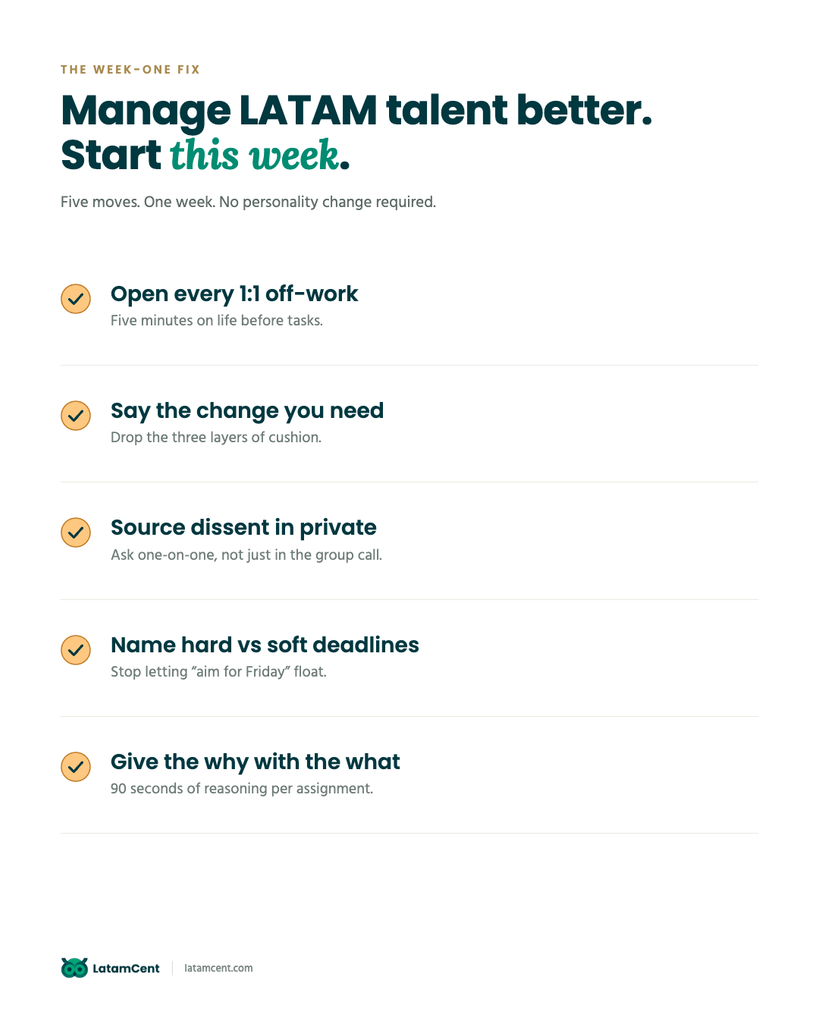
The fix: be clearer than feels comfortable about the substance, and warmer than feels necessary about the delivery. Separate the two. State the specific change you need without three layers of cushion, then invest in the relationship around it so the directness lands as respect, not attack. Never deliver hard feedback cold over text to someone in a relationship-first culture. And do not mistake a polite “yes, understood” for agreement that the work needs to change.
3. Persuading: principles-first vs applications-first
Meyer’s persuading scale is about how people are convinced: do you build the argument from underlying principles down to the conclusion, or do you start with the practical recommendation and back into the theory only if asked? She places Americans and the British toward the applications-first, get-to-the-point end, while Southern European and Germanic thinkers lean principles-first, wanting the reasoning before the recommendation.
Latin American professionals, shaped by education systems closer to the European model, often want more of the why than a US manager instinctively provides. The US default is “here is what we are doing, go.” A teammate who expects the reasoning first can read that as arbitrary or under-baked, and may execute with less conviction because they were never sold on the logic.
The fix is cheap: spend the extra ninety seconds on the why. When you assign work, give the reasoning behind the priority, not just the task. You will get better judgment calls when you are not in the room, because the person understands the principle and not only the instruction.
4. Leading: egalitarian vs hierarchical
This scale measures how much deference a culture shows to authority. The US leans egalitarian: flat-ish structures, managers who want to be challenged, junior people expected to speak up. Latin American cultures lean more hierarchical, where the title carries weight and the boss is expected to lead more visibly.
What breaks: a US manager says “I’m not going to micromanage, run with it, push back on me anytime,” genuinely meaning it as empowerment. A teammate from a more hierarchical context can hear that as absence of leadership, or be reluctant to openly contradict the boss in a group setting even when they see a problem. The manager reads the silence as agreement or as passivity. Neither is true.
The fix: invite challenge explicitly and repeatedly, and make it safe in private before you expect it in public. Ask direct questions one-on-one rather than waiting for someone to volunteer dissent in a group call. Be comfortable actually deciding and directing. Wanting to be “just one of the team” can read as a leader who will not lead. You can be warm and still own the call.
5. Deciding: consensual vs top-down
Closely related but, as Meyer is careful to point out, not the same thing. The deciding scale is about whether decisions get made by group consensus or by an individual, usually the boss. The counterintuitive part of her research is that hierarchical and top-down do not always travel together. Japan, for example, is both strongly hierarchical and deeply consensual. So you cannot assume that because a culture is more hierarchical it wants the boss to decide everything alone.
For US managers leading LATAM teams the practical risk is a mismatch in expectations about what “decided” means and how fast it should happen. The American model often makes a decision quickly, then adjusts it as new information arrives, treating the first call as a draft. If your teammate expects more buy-in up front, a fast unilateral call followed by three reversals can feel chaotic and erode trust in your judgment.
The fix: be explicit about your decision-making style. Tell people when something is a fast reversible call versus a settled direction. Name when you want input and when you are simply informing. Ambiguity about who decides is where remote teams stall.
6. Trusting: task-based vs relationship-based
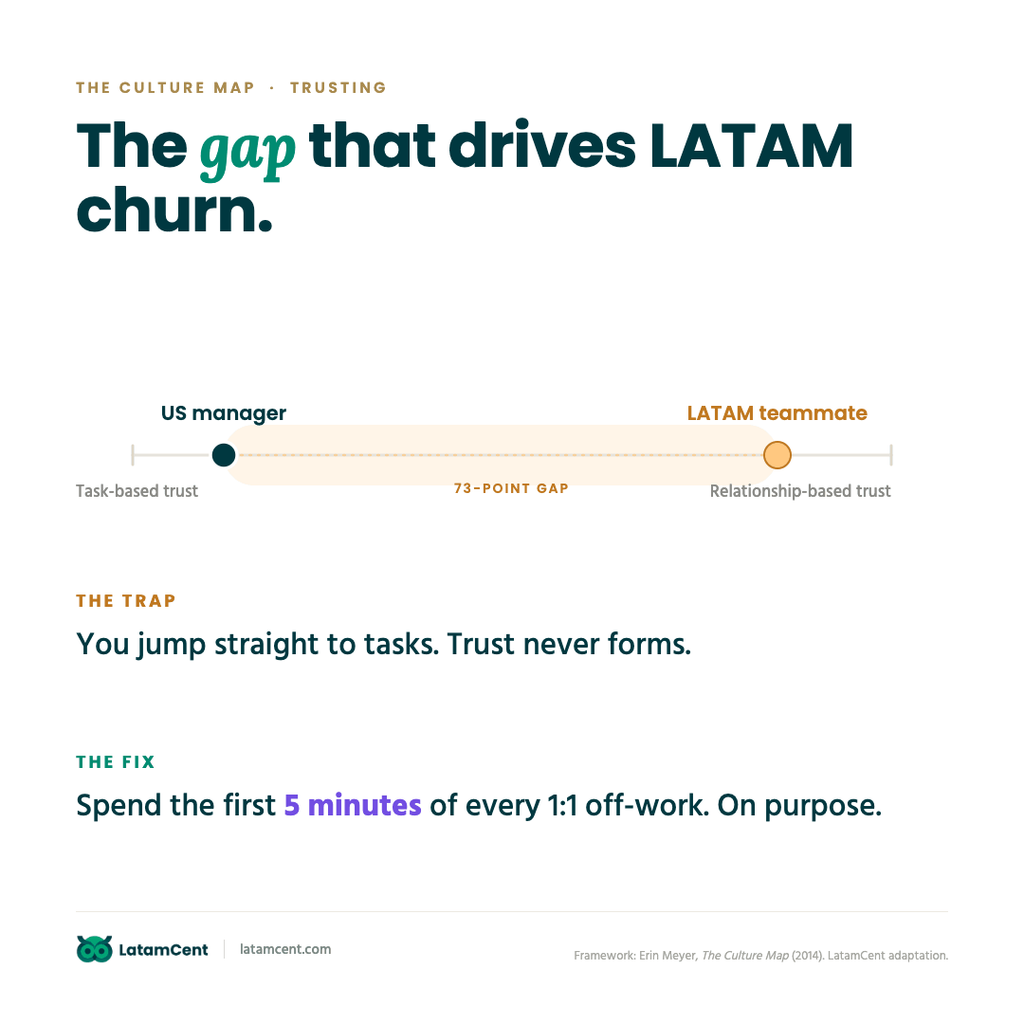
If you only fix one scale, fix this one. Meyer’s trusting scale separates cognitive trust, built from the head through good work, from affective trust, built from the heart through personal connection. The US is one of the most task-based cultures on earth: trust is a function of competence, it builds fast, and it can be rebuilt fast. We work well together, your work is good, therefore I trust you. Latin American cultures are strongly relationship-based: trust grows through personal connection, shared time, and knowing who you actually are.
Meyer’s relativity warning matters here, because it is easy to oversimplify. She uses Spain as the example: ask whether Spain is task-based or relationship-based and most people say relationship-based, but the honest answer is “compared to whom.” Spain is relationship-based next to the US and very task-based next to China. Latin America is the same. It is more relationship-based than your US office and not a different species.
What breaks: the US manager jumps straight into tasks, tickets, and throughput from day one, because that is how Americans build trust. The LATAM teammate experiences a boss who does not seem to care who they are, and the relationship never forms the foundation that everything else is supposed to sit on. Engagement quietly drops. The work is transactional. When something goes wrong there is no reservoir of goodwill to draw on.
The fix is the highest-ROI management move you can make with LATAM talent and it costs you almost nothing: invest in the relationship on purpose. Start one-on-ones with five minutes that are not about work. Learn about the family, the city, the weekend. Turn the camera on. Do the occasional non-agenda call. This is not a tax on the “real” work. For a relationship-based teammate it is the substrate the real work grows out of, and it is the single biggest lever on whether they stay.
7. Disagreeing: confrontational vs avoids confrontation
This scale measures whether a culture sees open disagreement as healthy and productive or as damaging to relationships and group harmony. The US, France, and the Netherlands are relatively comfortable with spirited, confrontational debate. Much of Latin America leans toward preserving harmony and avoiding open public confrontation, though the region varies and some cultures within it are more comfortable with directness than others.
What breaks: a US manager runs a meeting like a debate, expecting people to challenge each other in real time because that is how good ideas surface in American business culture. A teammate from a confrontation-avoiding context stays quiet, not because they have nothing to say but because openly contradicting a colleague, especially a senior one, in front of the group feels corrosive. The manager concludes the LATAM teammate lacks opinions or initiative. Wrong conclusion, every time.
The fix: stop sourcing dissent only in the live group setting. Ask for input in writing ahead of the meeting. Solicit disagreement one-on-one. Frame challenge as a contribution to the shared goal rather than a personal contest. You will discover the opinions were there the whole time.
8. Scheduling: linear-time vs flexible-time
Meyer’s last scale measures how cultures treat time and structure. Linear-time cultures, with Germany, Switzerland, and the US near that end, treat the schedule as close to sacred: one task at a time, deadlines are commitments, punctuality is respect. Flexible-time cultures treat the schedule more as a living plan that adapts as reality changes. She places Brazil, India, and Italy toward the flexible end, and her standard illustration is that in some cultures people treat the agenda as a strong suggestion.
This is the scale most likely to generate cheap stereotypes, so handle it with care. It does not mean LATAM professionals miss deadlines. The ones we place hit deadlines on US SaaS teams every day. It means the underlying cultural relationship to time and rigid sequencing can differ, and on a remote team that surfaces in small ways: how firmly a soft internal deadline is treated, how meetings start, how rigidly a plan is followed when circumstances shift.
The fix is not suspicion, it is specificity. Distinguish hard deadlines from soft ones out loud, because a US manager’s casual “let’s aim for Friday” is genuinely ambiguous across this scale. Confirm commitments explicitly. And extend the same flexibility back: this is a two-way scale, and the adaptability that comes with flexible-time cultures is often exactly what you want when priorities change mid-sprint.
The gap at a glance
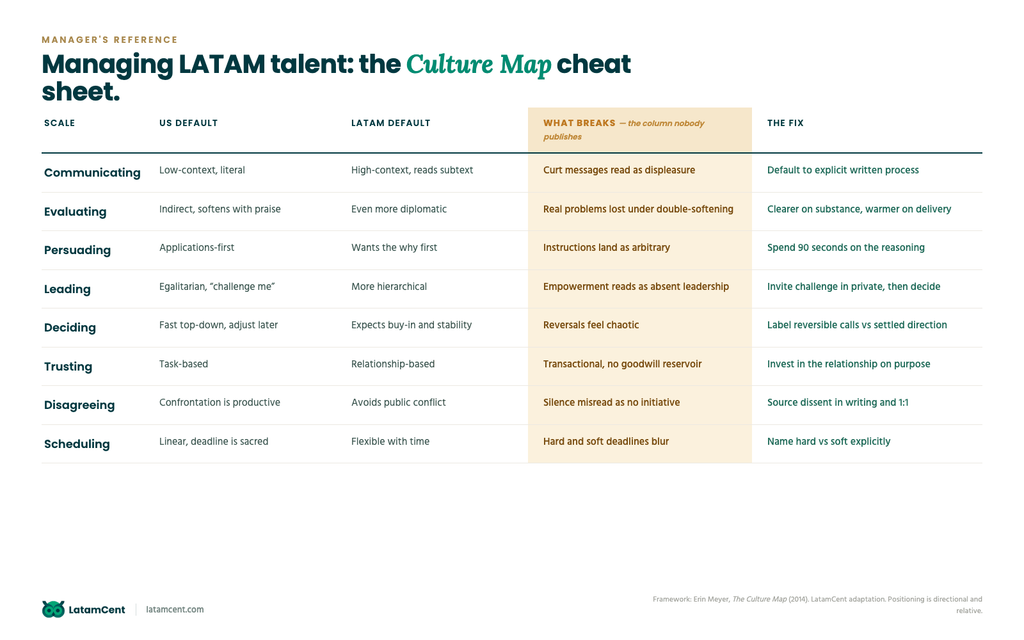
| Culture Map scale | US manager default | LATAM teammate default | What breaks when you ignore it | The manager move |
|---|---|---|---|---|
| Communicating | Low-context, explicit, literal | Higher-context, reads tone and subtext | Curt messages read as displeasure; subtext gets missed | Default to explicit written process, recap in writing |
| Evaluating | Indirect on negatives, softens with praise | Even more diplomatic with negatives | Real problems get lost under double-softening | Be clearer on substance, warmer on delivery, separate the two |
| Persuading | Applications-first, “here’s the what” | Wants more of the why first | Instructions land as arbitrary; weaker independent judgment | Spend 90 seconds on the reasoning behind the task |
| Leading | Egalitarian, “challenge me” | More hierarchical, title carries weight | Empowerment reads as absent leadership; silence misread as agreement | Invite challenge in private first, then own the decision |
| Deciding | Fast top-down call, adjust later | Expects clearer buy-in and stability | Rapid reversals feel chaotic, erode trust in judgment | Label reversible calls vs settled direction |
| Trusting | Task-based, trust from competence | Relationship-based, trust from connection | Transactional bond, no goodwill reservoir, quiet disengagement | Invest in the relationship on purpose, every one-on-one |
| Disagreeing | Confrontation is productive | Preserves harmony, avoids public conflict | Silence misread as no opinions or no initiative | Source dissent in writing and one-on-one, not just live |
| Scheduling | Linear time, deadline is sacred | More flexible relationship to time | Soft deadlines and hard deadlines blur | Name hard vs soft explicitly, confirm commitments |
The column that matters most there is the fourth one. Every item in it is a real, recurring, expensive failure mode, and every one of them gets blamed on the individual hire when the actual cause is an unadjusted management default.
The one rule that keeps this from becoming a stereotype machine
Meyer is emphatic about something, and so am I: this is a map of cultural tendencies, not a cage for individuals. She warns directly that people vary enormously within any culture. Not every Brazilian is relaxed about time. Not every Mexican softens feedback. A given teammate might sit at the opposite end of a scale from where their country lands, shaped by their own company background, their education, the global teams they have already worked on, or just who they are.
Two more nuances that keep you honest. First, everything on these scales is relative, never absolute. Latin America is more relationship-based than the US and more task-based than parts of Asia. The position only means anything compared to your own starting point. Second, the region is not a monolith. Meyer’s own data shows the gap between two Latin American countries can be as large as the gap between either one and the US, and that Brazil and Mexico and Argentina do not occupy identical positions. Brazil reads lower-context than its neighbors. Comfort with directness varies across the region.
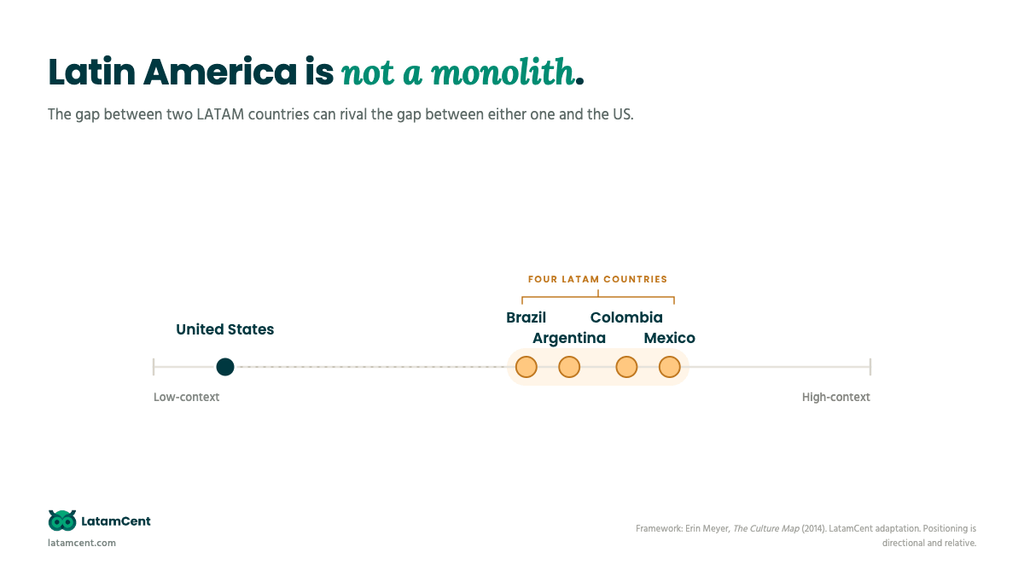
So use the map to form better questions, not faster conclusions. The point is not to manage “a Colombian” or “a Mexican.” The point is to stop assuming your US defaults are universal, notice where a specific teammate actually sits, and adjust to the person in front of you. The Culture Map tells you which dials exist. The individual tells you where to set them.
Where this leaves you
The companies that win with Latin American talent are not the ones that found magically different people. They are the ones whose managers stopped exporting their defaults and started adjusting. The talent pool is exceptional, the time zone overlap means you can manage them like real-time teammates instead of an offshore handoff, and the cost is a fraction of a US hire. The only variable left is whether the manager translates.
That is also the variable that decides retention. A LATAM hire who feels misread, under-led, and transactionally managed will leave, and you will pay to fill the role all over again. A LATAM hire whose manager invested in the relationship, gave clear feedback warmly, led with conviction, and named the deadlines that actually mattered will stay and compound. Same person. Different manager.
We place pre-vetted senior talent across engineering, GTM, and finance into US SaaS companies in 21 days or less, with payroll, compliance, and a replacement guarantee handled. But placement is the start. If you want the talent to stay, the management has to translate. That is what this map is for. Want help building a LATAM team and managing it so it sticks? Talk to us at latamcent.com.
Frequently asked questions
How do you manage Latin American remote workers differently from US employees?
The biggest shifts are around trust and feedback. US managers build trust through competence and tasks; Latin American teammates build it through relationship and personal connection, so invest in the relationship on purpose. And because US managers actually soften negative feedback while LATAM cultures soften it even more, you have to be clearer on the substance of feedback while staying warm in delivery. Erin Meyer’s Culture Map maps the full set of differences across eight scales.
Is the Culture Map accurate for Latin America?
It is a useful framework as long as you treat it as a map of tendencies, not a rulebook for individuals. Meyer herself stresses that people vary enormously within any culture and that the scales are relative to your own starting point. Latin America is also not a monolith: Brazil, Mexico, Argentina, and others land in different places, and the gap between two LATAM countries can rival the gap between either and the US.
Why does my Latin American team member say yes but not push back?
Two scales explain it. Many Latin American cultures lean more hierarchical, so openly contradicting a senior person in a group feels disrespectful, and they lean toward avoiding public confrontation to protect harmony. The opinions exist. Source them one-on-one and in writing instead of expecting live debate, and a polite “yes” stops being your only signal.
What is the hardest cultural gap for US managers leading LATAM talent?
Feedback, because it hides. Americans assume they are direct, but the US is indirect about negative feedback specifically, and several LATAM cultures are even more diplomatic. The criticism gets double-softened until the actual message disappears. Be specific about the change you need, then protect the relationship around it.
Does managing across these cultural differences actually affect retention?
Yes, and it is one of the cheapest levers you have. Cultural friction is systematic and preventable, unlike most causes of churn. A misread, transactionally managed hire disengages and leaves, and you pay to reopen and refill the role. A teammate whose manager adjusted to relationship-based trust and clear-but-warm feedback stays and compounds.
How long does it take to adjust my management style?
Faster than you think, because these are conscious dials, not personality changes. Most of the moves in this guide, starting one-on-ones with five non-work minutes, separating hard deadlines from soft ones, sourcing dissent in private, take a single week to adopt and pay back almost immediately in engagement.