


A good machine learning engineer interview covers five things: ML fundamentals, model evaluation, coding, system design and production work, plus how the person communicates. Below are 50 questions across those areas, grouped the way most interview loops run. Each one comes with what it actually tests and what a strong answer sounds like, so hiring managers can use the list to build and score interviews and candidates can use it to prepare.
We screen ML engineers for US SaaS teams who hire machine learning engineers from Latin America, and the questions follow the same areas our screening looks at: technical depth, clear English and real production experience. That last one matters most. Plenty of candidates can explain gradient descent; far fewer can tell you what broke the last time they shipped a model and how they fixed it.
If you’re hiring, start with the sample four-round plan further down and pick questions for each round. If you’re preparing for an interview, work through the sections in order and practice saying the strong answers out loud in your own words.
Key takeaways
- Cover six areas: fundamentals, evaluation, coding, system design, MLOps and behavioral. Don’t skip MLOps: it’s where ML engineers differ most from data scientists.
- Four rounds is enough for most SaaS teams, as long as each round has one clear job.
- The strongest signal is production experience: what they deployed, how they monitored it and what broke.
- Use the filter below to pull the questions for the area and seniority you’re hiring for, then copy them into your interview notes.
- Preparing for an interview? Answer the questions out loud with examples from your own projects, and have at least one production story ready.
How to Use These Questions
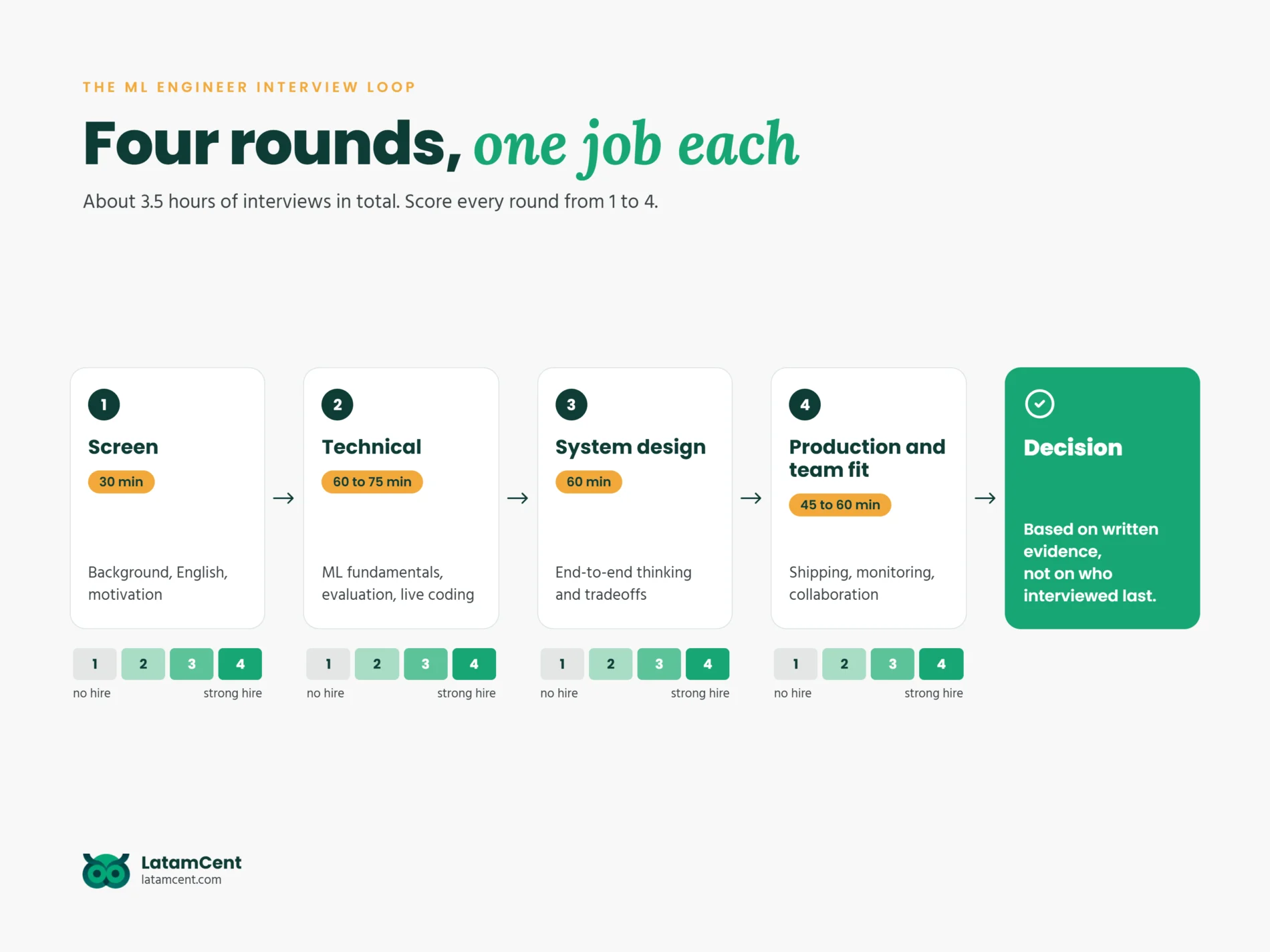
The questions are grouped by the interview round they fit best. Most SaaS teams can cover everything in four rounds, and running more than that mostly slows the process down and loses good candidates to faster offers.
| Round | What it tests | Question sections to draw from | Typical length |
|---|---|---|---|
| 1. Screen | Background, communication, motivation | Behavioral, plus two or three fundamentals | 30 minutes |
| 2. Technical | ML knowledge and coding | Fundamentals, evaluation, coding | 60 to 75 minutes |
| 3. System design | End-to-end thinking and tradeoffs | System design | 60 minutes |
| 4. Production and team fit | Shipping, monitoring, collaboration | MLOps, behavioral | 45 to 60 minutes |
Each question is tagged by level. “All levels” questions work for anyone, including junior hires. “Mid and senior” questions assume a few years of shipping models. “Senior” questions are the ones you’d use to tell a senior engineer from a strong mid-level one.
Filter the 50 questions
Junior shows the questions tagged “All levels”. Mid-level adds the ones tagged “Mid and senior”. Senior shows all 50, since senior candidates should handle every question.
50 of 50 questions shown
Machine Learning Fundamentals Questions
These check whether the candidate understands why models behave the way they do. Every ML engineer should handle them, whatever their level.
1. Explain the bias-variance tradeoff.
All levels
What it tests: Whether they understand why models fail to generalize, not just the definitions.
What a strong answer covers: Bias is error from assumptions that are too simple, which shows up as underfitting. Variance is how much the model changes with the training data, which shows up as overfitting. Good candidates explain that you trade one against the other through model complexity, regularization, more data or ensembling, and they tie it to a model they actually tuned.
2. How do you detect and prevent overfitting?
All levels
What it tests: Practical habits, beyond the textbook answer.
What a strong answer covers: They watch the gap between training and validation scores and read learning curves. To fix it they reach for more or better data, regularization, early stopping, a simpler model, dropout for neural networks and proper cross-validation. The best answers mention checking the validation setup itself, because a leaky split can hide overfitting completely.
3. What’s the difference between L1 and L2 regularization?
All levels
What it tests: Whether they know what each penalty does to the weights and when it matters.
What a strong answer covers: L1 penalizes the absolute size of the weights and pushes some of them to exactly zero, so it doubles as feature selection. L2 penalizes squared weights and shrinks them smoothly, which behaves better when features are correlated. A strong candidate adds that elastic net combines both and that features need to be scaled first, or the penalty hits them unevenly.
4. How do you handle a heavily imbalanced dataset?
Mid and senior
What it tests: Whether they start from the business cost of errors or jump straight to a technique.
What a strong answer covers: They ask first what a missed positive costs compared with a false alarm. Then they pick from class weights, resampling on the training set only, threshold tuning and metrics that respect imbalance, such as recall at a fixed precision or PR-AUC. Resampling the validation or test data is a warning sign.
5. Compare bagging and boosting.
All levels
What it tests: Understanding of the two main ensemble families and their tradeoffs.
What a strong answer covers: Bagging trains many models in parallel on bootstrap samples and averages them, which mainly reduces variance. Random forests are the classic example. Boosting trains models one after another, each correcting the last one’s errors, which mainly reduces bias. Gradient-boosted trees usually win on tabular data but need more careful tuning and can overfit noisy labels.
6. How does gradient descent work, and what do the learning rate and batch size change?
All levels
What it tests: Whether they can reason about training behavior, not just call an optimizer.
What a strong answer covers: The model updates its parameters a small step against the gradient of the loss. Too high a learning rate makes training oscillate or diverge, and too low makes it crawl. Smaller batches add noise that can help generalization but cost more steps. Strong answers mention adaptive optimizers like Adam and learning rate schedules, and how they’d diagnose a loss curve that won’t go down.
7. What is data leakage, and tell me about a time you caught it.
Mid and senior
What it tests: Real-world experience. Almost everyone who has shipped models has been burned by leakage.
What a strong answer covers: Leakage is information in the features that wouldn’t be available at prediction time, like a field filled in after the outcome, future data in a time series, or scaling fit on the full dataset. The strong candidate tells a specific story: a score that looked too good, how they traced it to a feature, and how they changed the pipeline so it couldn’t happen again.
8. How do you choose features and handle missing values?
All levels
What it tests: Data judgment and care with preprocessing.
What a strong answer covers: They start from domain knowledge, then use importance scores and ablation tests to prune. For missing values they first ask why the data is missing, then impute with the median or a model, add a missing-value indicator when the missingness itself carries signal, or use tree models that handle it natively. Imputers and scalers get fit on training data only.
9. When would you choose a simple model over a deep neural network?
Mid and senior
What it tests: Pragmatism, and whether they build baselines.
What a strong answer covers: For tabular data with a few thousand to a few million rows, gradient-boosted trees or even logistic regression often match or beat deep learning at a fraction of the cost. Simple models are also easier to explain, cheaper to serve and faster to iterate on. The best candidates say they always start with a baseline and only add complexity when it earns its keep.
10. Explain how attention and transformers work, the way you’d explain it to a product manager.
Mid and senior
What it tests: Technical depth and the ability to communicate it plainly.
What a strong answer covers: Attention lets each word in a sentence weigh how relevant every other word is when building its representation, instead of reading strictly left to right. Transformers stack many attention layers, which makes them fast to train in parallel. Models are pretrained on huge amounts of text and then fine-tuned or prompted for a task. Watch for whether they drop the jargon when asked.
Model Evaluation and Metrics Questions
Choosing the wrong metric is one of the most expensive mistakes in applied ML. These questions show whether a candidate connects numbers to business outcomes.
11. What’s the difference between precision and recall, and when does each matter more?
All levels
What it tests: Whether they connect metrics to business consequences.
What a strong answer covers: Precision is the share of predicted positives that are right. Recall is the share of real positives the model finds. Fraud screening or medical triage usually favors recall, because a miss is expensive. A spam filter or an automated account ban favors precision, because false alarms hurt users. Moving the decision threshold trades one for the other.
12. When would you use PR-AUC instead of ROC-AUC?
Mid and senior
What it tests: Understanding of metric behavior on imbalanced data.
What a strong answer covers: ROC-AUC can look great on heavily imbalanced data because the false positive rate is diluted by a huge number of negatives. PR-AUC focuses on how well the model does on the rare positive class, so it’s the more honest metric when positives are, say, 1% of the data. Strong candidates also say which point on the curve the business will actually operate at.
13. How would you set up validation for time-series or user-level data?
Mid and senior
What it tests: Whether their offline results will hold up in production.
What a strong answer covers: For time series they split by time, using rolling or expanding windows, and never shuffle future rows into training. For user data they group by user so the same person never lands in both training and test. The principle behind both: the validation setup should mimic how the model will see data in production.
14. Your offline metric improved, but the business metric didn’t move. What happened?
Senior
What it tests: Senior judgment and experience with real launches.
What a strong answer covers: Good candidates list likely causes: the offline metric was the wrong proxy, the data shifted between training and launch, leakage inflated offline scores, latency or UI changes masked the gain, or the improvement only helped a segment nobody uses. Then they explain how they’d investigate with segment analysis and a properly powered A/B test.
15. How do you design an A/B test for a new model?
Mid and senior
What it tests: Experimentation discipline.
What a strong answer covers: They define one primary metric and a few guardrail metrics up front, estimate sample size and duration so the test has enough power, choose the randomization unit, run through full weekly cycles and avoid peeking at results early. Many start with a shadow deployment to check the new model’s behavior before exposing users to it.
16. How do you evaluate a regression model?
All levels
What it tests: Whether they choose error metrics deliberately.
What a strong answer covers: MAE is easy to explain and treats all errors equally. RMSE punishes large errors harder, which matters when big misses are costly. MAPE breaks down when actual values are near zero. Strong candidates look at residual plots by segment rather than trusting one number, and they choose the metric based on what a bad prediction costs the business.
17. How would you evaluate an LLM feature, such as an AI-drafted support reply?
Senior
What it tests: Whether they can bring rigor to generative AI, where there’s no single accuracy number.
What a strong answer covers: They build an evaluation set from real examples, score outputs against a rubric with human reviewers, add automated checks for grounding, format and safety, and use an LLM judge only after checking it agrees with humans. Online they track things like resolution rate and how often agents edit the draft. Every prompt or model change runs against the eval set before shipping.
18. How do you explain a model’s predictions to a non-technical stakeholder?
All levels
What it tests: Communication and honesty about limits.
What a strong answer covers: They separate global explanations (which features matter overall) from local ones (why this customer got this score), using tools like feature importance and SHAP values, plus a few concrete examples. The best answers tailor the explanation to the decision the stakeholder has to make and are upfront about what the model can’t tell them.
Python, SQL and Coding Questions
ML engineers write production code, so test it. These are practical exercises rather than puzzle questions, and most can run as live coding or as a review of a take-home task.
19. Write a function that computes precision and recall from two lists of labels, without libraries.
All levels
What it tests: Basic Python fluency, clean code and edge cases.
What a strong answer covers: A strong solution counts true positives, false positives and false negatives in one pass, returns both metrics and handles division by zero when there are no predicted or actual positives. Look for clear variable names and whether they write a quick test case without being asked.
20. Implement k-means clustering from scratch.
Mid and senior
What it tests: Algorithm understanding and NumPy skills.
What a strong answer covers: They initialize centroids (k-means++ is a plus), assign each point to its nearest centroid, recompute centroids as cluster means and repeat until assignments stop changing. Strong candidates vectorize the distance calculation with NumPy, handle empty clusters and can explain the time complexity and why results depend on initialization.
21. Given a table of user events, build per-user features for a churn model.
All levels
What it tests: Practical feature engineering and avoiding leakage in code.
What a strong answer covers: Using pandas or SQL, they aggregate counts, recency, frequency and trends per user within a time window that ends at a cutoff date, so no event after the prediction date leaks into the features. Good code uses vectorized group-by operations instead of row-by-row loops and makes the cutoff date a parameter.
22. Write a SQL query that returns each customer’s first purchase date, latest purchase date and total spend.
All levels
What it tests: SQL, which ML engineers use daily even if interviews skip it.
What a strong answer covers: A GROUP BY with MIN, MAX and SUM covers it, and window functions work too. Strong candidates ask about refunds, null values and time zones before writing, and mention indexes or partitioning if the table is large.
23. This preprocessing script takes three hours. How would you speed it up?
Mid and senior
What it tests: Performance instincts and whether they measure before optimizing.
What a strong answer covers: They profile first to find the actual bottleneck. Common fixes: replace row-wise apply calls with vectorized operations, use proper data types, read only the needed columns, cache intermediate results, push heavy joins into the database or warehouse, and parallelize with multiprocessing or a distributed engine when the data is truly large.
24. Implement logistic regression training with gradient descent in NumPy.
Mid and senior
What it tests: Whether they understand what the library does under the hood.
What a strong answer covers: They write the sigmoid, the log loss and its gradient, then an update loop with a learning rate. Extra credit for clipping probabilities to avoid log(0), adding an L2 penalty, checking the loss decreases and comparing results against a library implementation.
25. How do you write tests for machine learning code?
Mid and senior
What it tests: Engineering maturity, which separates ML engineers from notebook-only modelers.
What a strong answer covers: They unit test data transforms and feature functions, validate input schemas, run training end to end on a tiny sample in CI, fix random seeds for reproducibility, and set minimum quality thresholds a new model must pass. They also test the serving layer: input validation, output format and behavior on bad input.
26. Walk me through a pull request you’re proud of.
All levels
What it tests: Code quality and engineering judgment: how they structure a change, explain their technical decisions and handle review.
What a strong answer covers: A strong answer covers the problem, the options they considered, why they picked one, how they responded to review comments and what changed as a result. Vague answers, or ones where nobody else was ever involved, tell you something too.
ML System Design Interview Questions
This is where senior candidates separate themselves. There’s no single right answer, so judge how they clarify the problem, weigh tradeoffs and plan for failure.
27. Design a recommendation system for a B2B SaaS product, such as suggesting templates or content.
Senior
What it tests: End-to-end ML system design, the core of a senior ML interview.
What a strong answer covers: They clarify the goal and success metric first. Then they propose candidate generation (collaborative filtering, content similarity, popularity for new users) followed by a ranking model, the features each needs, offline evaluation and an A/B test, latency and caching, feedback loops and how often to retrain. Asking questions before drawing boxes is a good sign.
28. Design a fraud detection system for payments.
Senior
What it tests: Handling imbalanced, delayed labels and adversarial behavior.
What a strong answer covers: They cover real-time scoring at checkout, features like transaction velocity and device history, labels that arrive weeks later through chargebacks, thresholds set by the cost of each error type, a human review queue for borderline cases and monitoring for drift, because fraudsters adapt as soon as a model starts catching them.
29. How would you serve a model within a 50-millisecond latency budget?
Mid and senior
What it tests: Production awareness and performance tradeoffs.
What a strong answer covers: They consider a smaller or distilled model, quantization, precomputed features read from a fast cache or feature store, request batching and the right hardware. They load test and track p95 and p99 latency, not the average, because slow tail requests are what users notice.
30. How do you choose between batch and real-time predictions?
Mid and senior
What it tests: Whether they avoid overengineering.
What a strong answer covers: Batch scoring is simpler and cheaper and works when predictions can be a few hours old, like a daily churn score. Real-time is needed when the prediction depends on what’s happening right now, like fraud at checkout or search ranking. Many systems mix both: precompute what you can and add a few real-time features at request time.
31. Design a churn prediction pipeline from raw data to action in the product.
Mid and senior
What it tests: Whether they think past the model to the outcome.
What a strong answer covers: They define churn and the prediction horizon, build features with point-in-time correctness, train and validate, score customers on a schedule, write scores to the CRM or product where the customer success team will see them, and monitor. The best answers point out that the intervention matters more than a slightly higher AUC.
32. How would you build a retrieval-augmented generation (RAG) feature over company documents?
Senior
What it tests: Current, practical LLM engineering.
What a strong answer covers: They cover chunking strategy, embeddings, a vector index, retrieval plus reranking, prompts that cite sources, per-user access control so people only see documents they’re allowed to, an evaluation set, keeping the index fresh as documents change, and the cost and latency of each call. Strong candidates name hallucination and stale content as failure modes and explain how they’d catch them.
33. Do you need a feature store? How would you decide?
Senior
What it tests: Judgment about infrastructure, not just knowledge of tools.
What a strong answer covers: A feature store keeps training and serving features consistent, supports point-in-time joins and lets teams reuse features. Many teams don’t need one at first: shared feature code and warehouse tables go a long way. A good answer names the signals that justify one, such as several models sharing features or strict online latency needs.
34. The training data no longer fits on one machine. What do you do?
Senior
What it tests: Scaling instincts and cost awareness.
What a strong answer covers: First they ask whether a sample would do the job. If not: columnar file formats, streaming data loaders, data-parallel training across GPUs or nodes, model parallelism only for very large models, checkpointing so failures don’t cost days, and watching the cloud bill as closely as the loss curve.
MLOps and Production Questions
The difference between a data scientist and an ML engineer usually shows up here. Look for real stories about deploying, monitoring and fixing models.
35. How do you deploy a model to production?
All levels
What it tests: Whether they have shipped models, not just trained them.
What a strong answer covers: They package the model together with its preprocessing, version the artifact, containerize it, run it through CI/CD and a staging environment, release it gradually with a canary or shadow deployment and keep a rollback path. Monitoring is set up on day one, not after the first incident.
36. What’s the difference between data drift and concept drift, and how do you monitor them?
Mid and senior
What it tests: Production monitoring knowledge.
What a strong answer covers: Data drift is a change in the input distribution. Concept drift is a change in the relationship between inputs and the outcome, so the same inputs now mean something different. They monitor feature statistics and prediction distributions continuously and model performance once labels arrive, with alert thresholds and a named owner for each alert.
37. When and how do you retrain a model?
Mid and senior
What it tests: Lifecycle thinking.
What a strong answer covers: Retraining runs on a schedule, on a trigger such as drift or a performance drop, or both. The pipeline is automated, and a new model only replaces the current one after it beats it on a holdout set and passes checks. Every model is traceable back to the data and code that produced it.
38. How do you version data, code and models?
Mid and senior
What it tests: Reproducibility and auditability.
What a strong answer covers: Code lives in git, data is versioned through snapshots or a data versioning tool, and models go into a registry with their training data version, parameters and metrics. The test of a good setup: can you rebuild the model that was in production three months ago?
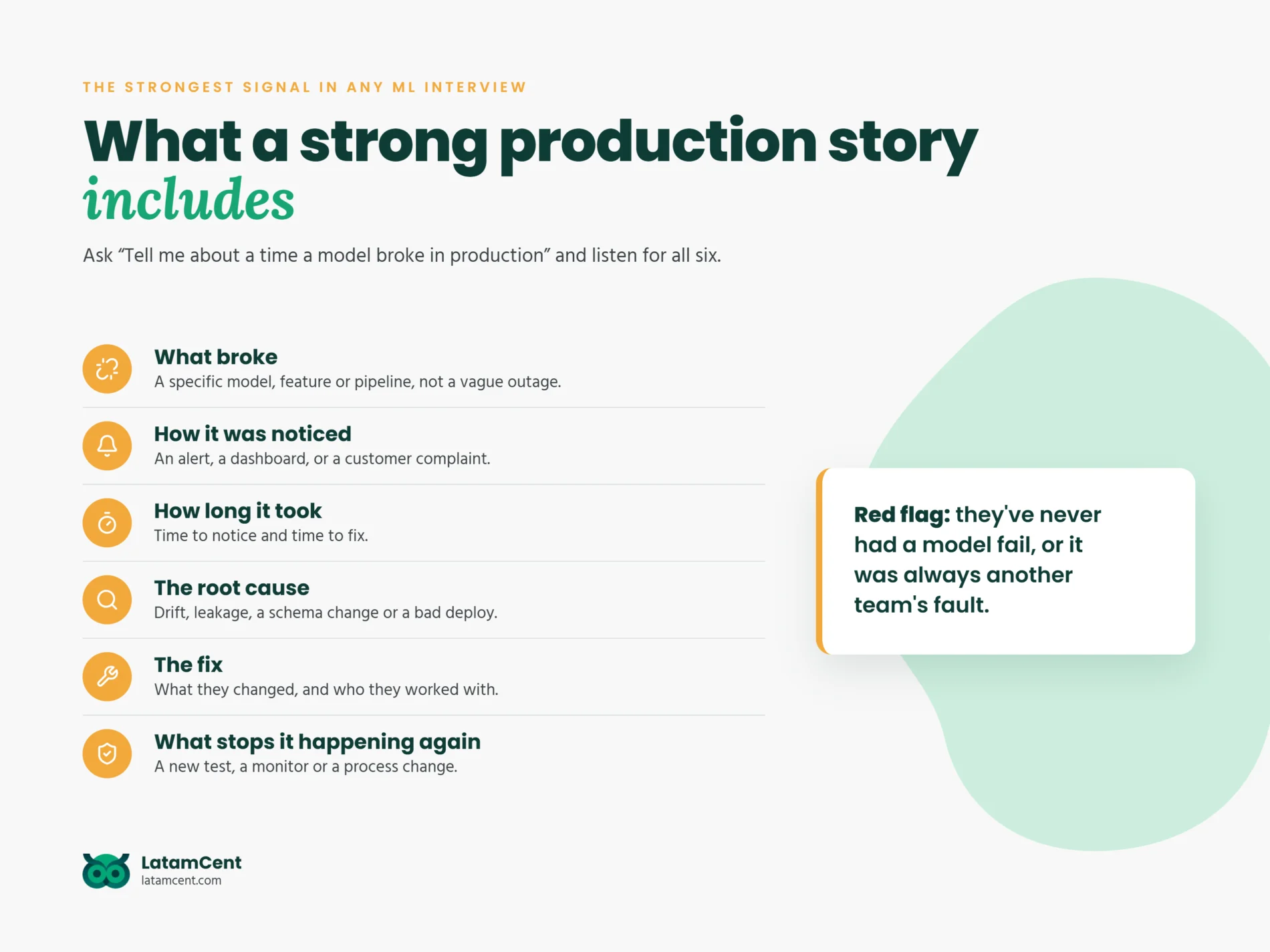
39. Tell me about a time a model broke in production.
Mid and senior
What it tests: Real experience and ownership.
What a strong answer covers: The strong answer is specific: what broke, how it was noticed, how long it took, the root cause, the fix and what they changed so it couldn’t happen again. Candidates who have never had a model fail in production, or who blame another team, have probably not owned one.
40. How do you make an ML experiment reproducible?
All levels
What it tests: Scientific discipline in day-to-day work.
What a strong answer covers: Fixed random seeds, pinned library versions or containers, versioned data and code, and an experiment tracker that logs parameters, metrics and artifacts for every run. Someone else on the team should be able to rerun the experiment and get the same result.
41. How do you keep inference costs under control, especially for LLM features?
Senior
What it tests: Cost awareness, which matters a lot to a SaaS budget.
What a strong answer covers: They pick the smallest model that meets the quality bar, cache repeated requests, batch where possible, quantize, trim prompts, route easy requests to cheaper models and track cost per feature and per customer. They set a budget and alert on it before finance does.
42. What would you put on a monitoring dashboard for a production model?
Mid and senior
What it tests: Whether they monitor the system as well as the model.
What a strong answer covers: Input health (missing values, out-of-range features), the prediction distribution, latency and error rates, data freshness, model performance once labels arrive, and the business metric the model is supposed to move. Each chart has an owner and a threshold that triggers an alert.
Behavioral and Remote Work Questions
Technical skill gets a model built. These questions show whether the person will get it adopted, work well with your team and stay productive if they’re remote.
43. Tell me about an ML project that didn’t work. What did you learn?
All levels
What it tests: Honesty, self-awareness and learning.
What a strong answer covers: A strong answer is specific, owns the decisions that went wrong, explains what the data showed and what they’d do differently now. Watch out for stories where the failure was always someone else’s fault.
44. A product manager wants 99% accuracy. How do you respond?
All levels
What it tests: Translating ML tradeoffs into business terms.
What a strong answer covers: They explain what accuracy hides, especially on imbalanced data, then reframe the goal around the errors that matter: how many good customers get flagged, how many bad cases slip through. They offer two or three threshold options with the expected cost of each and let the business choose.
45. How do you decide what not to build?
Senior
What it tests: Prioritization and product sense.
What a strong answer covers: They estimate impact against effort, check whether a simple rule or heuristic would already solve most of the problem and set an early checkpoint to kill projects that aren’t working. Senior engineers can name a project they stopped and why.
46. How do you work with data engineers and backend engineers on the same feature?
All levels
What it tests: Collaboration across the team the ML engineer will actually sit in.
What a strong answer covers: They agree on interfaces early (data schemas, API contracts, who owns which pipeline), document them and involve the other engineers before the model is finished, not after. Good answers include a time they adjusted their own approach to fit the rest of the system.
47. How do you stay productive and visible on a remote team, possibly in another country?
All levels
What it tests: Remote and async work habits, essential for nearshore and distributed hires.
What a strong answer covers: Written updates that say what’s done, what’s next and what’s blocked, attendance at standups during overlapping hours, decisions documented where the team can find them and asking questions early instead of going quiet. Specific tools and routines are better than general promises.
48. How do you get up to speed on a new codebase and dataset?
All levels
What it tests: Self-direction and how fast they’ll contribute.
What a strong answer covers: They read the docs, run the pipeline end to end, map the data sources and their owners, ask targeted questions and ship a small first change within days. Strong candidates describe a concrete first week from a past job.
49. A stakeholder disagrees with your model’s results. What do you do?
Mid and senior
What it tests: Maturity and openness to being wrong.
What a strong answer covers: They listen to the specific concern, check it against the data (often a segment analysis shows the stakeholder has a point), share what they find openly and either fix the model or explain the result with evidence. Defensiveness is the red flag here.
50. What’s a recent ML paper or tool you tried, and would you use it in production?
All levels
What it tests: Curiosity balanced with judgment.
What a strong answer covers: The best answers describe something they actually tried, what they measured and an honest view on whether it’s ready for production. Enthusiasm without any testing, or dismissing everything new, are both weaker signals.
No questions match that combination. System design questions, for example, are meant for mid-level and senior hires. Try a different area or level.
Red Flags to Watch For
Some answers tell you more than the question was designed to. These patterns come up again and again in ML interviews, and each one is worth probing before you make an offer.
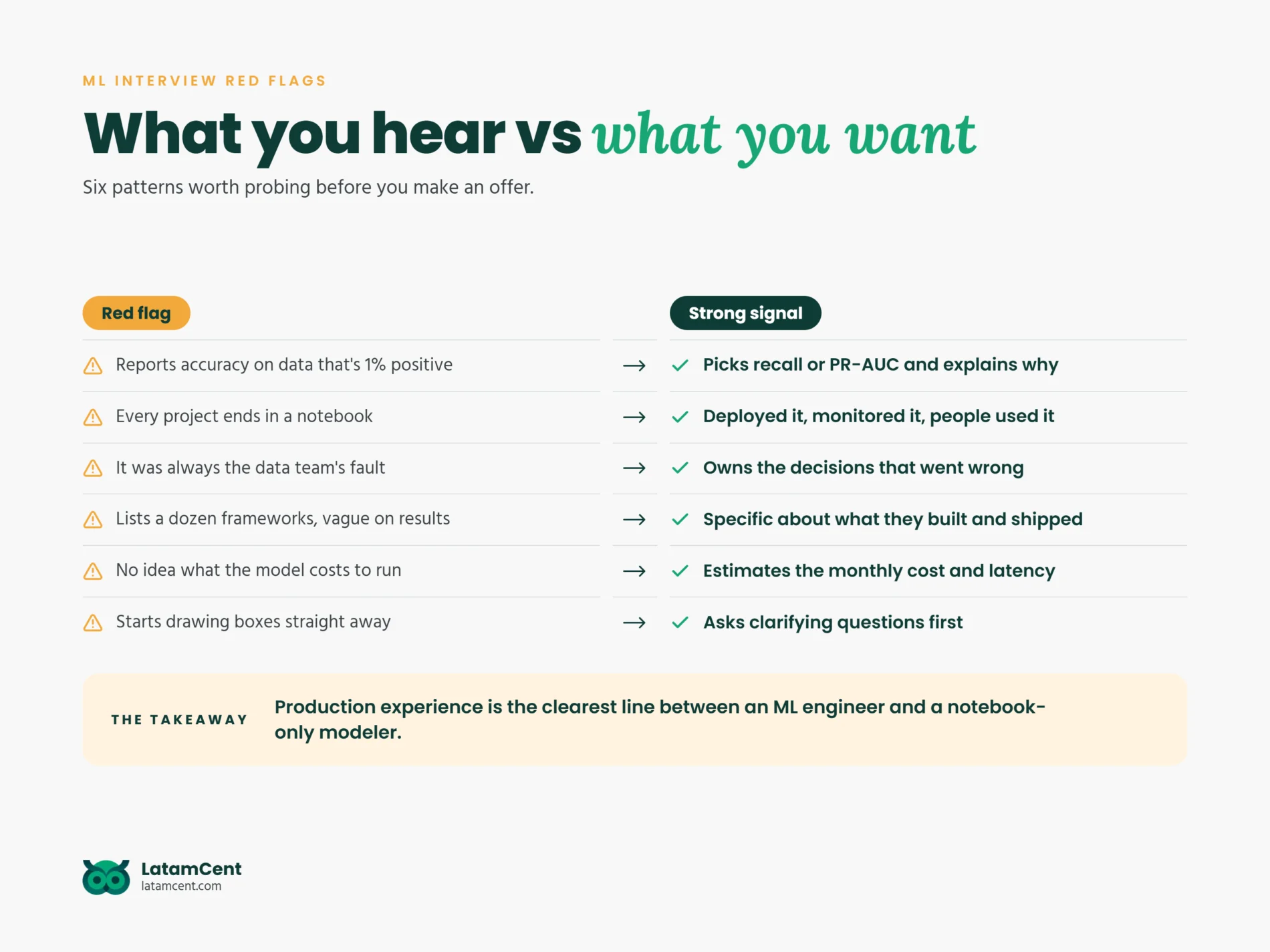
- They can’t explain why they chose the metric on their own last project, or they report accuracy on a dataset where 1% of cases are positive.
- Every project ends in a notebook. Nothing was deployed, monitored or used by anyone.
- When something went wrong, it was always the data team’s fault, or the product manager’s.
- They list a dozen frameworks but go vague when you ask what they built with any of them.
- They have no feel for cost or latency and can’t estimate what their model would cost to run per month.
- They never ask a clarifying question in the system design round and start drawing boxes straight away.
A Sample Four-Round ML Engineer Interview Plan
Here’s how the rounds from the table above look in practice, with suggested questions from this list. Use a simple 1 to 4 score per round (1 = no hire, 4 = strong hire) and write down the evidence behind each score while it’s fresh, so the final decision isn’t based on whoever interviewed last.
| Round | Who runs it | Suggested questions | A pass looks like |
|---|---|---|---|
| 1. Screen (30 min) | Hiring manager or recruiter | 43, 47, 1, 11 | Clear, specific stories in fluent English and a real reason for wanting the role |
| 2. Technical (60 to 75 min) | Senior ML engineer | 2, 4, 12, 13, then 19 or 21 as live coding | Sound reasoning, working code and good questions about the data |
| 3. System design (60 min) | Senior or staff engineer | 27 or 31, with 29 as a follow-up | Clarifies the goal first, covers data, model, serving and monitoring, weighs tradeoffs |
| 4. Production and team fit (45 to 60 min) | Engineering manager and a future teammate | 35, 36, 39, 46 | A specific production incident they owned and a collaborative way of working |
If you’d rather use a take-home task than live coding, keep it to three or four hours, base it on a small realistic dataset and review it together in round two. Long unpaid take-homes filter out exactly the experienced engineers who already have jobs.
LatamCent by the numbers
How hiring an ML engineer works when you go through us:
When you hire through LatamCent, the first round is largely done before you meet anyone. Our talent partners source 1,100 to 1,700 candidates per search, then run English tests, personality assessments, technical checks and interviews on past work, so the vetted ML engineers on your shortlist are ready for rounds two to four. Your own team still runs the technical interviews and makes the final call.
“We definitely noticed the difference in the level of the candidates that we get just organically from the candidates that we get from LatamCent.”
What to Do Next
If you’re hiring, pick your questions with the filter above, assign one interviewer per round and agree on the scoring before the first candidate walks in. It’s also worth settling the budget early, since salary expectations shape who you can close. Our breakdown of what a machine learning engineer costs in the US and Latin America, with a calculator, covers that side.
If you’re preparing for an interview, don’t memorize the answers. Take the questions for your level, answer them out loud using examples from your own projects and spend extra time on production stories. That’s where most candidates are thinnest, and where interviewers learn the most.
Skip the first round: meet pre-vetted ML engineers
Tell us your stack and the seniority you need. Our talent partners start the search, you interview a shortlist of Latin American ML engineers who have already passed English, technical and personality screening, and the hire is done in 21 days or less.
- Engineers across model development, NLP, computer vision, MLOps and generative AI
- Your team keeps control of the technical interviews and the final decision
- Payroll, contracts and US-standard IP transfer handled for you
“LatamCent made hiring engineers simple. Every candidate we received was highly qualified and aligned with what we needed.”
Trusted by B2B SaaS teams at






FAQ
How many interview rounds should an ML engineer interview have?
Four is enough for most SaaS teams: a screen, a technical round covering fundamentals and coding, a system design round and a final round on production work and team fit. More rounds rarely add signal, and they slow the process down enough to lose candidates to faster offers.
What’s the difference between an ML engineer and a data scientist interview?
ML engineer interviews lean harder on coding, system design and production topics like deployment, monitoring and drift. Data scientist interviews spend more time on statistics, experimentation and turning analysis into business recommendations. Fundamentals and evaluation questions overlap heavily between the two.
Do ML engineers get LeetCode-style coding questions?
Some companies still use them, but practical ML coding tells you more for most SaaS roles: manipulating data with pandas or SQL, implementing a simple algorithm, writing tests or speeding up a slow pipeline. Those tasks look like the job the engineer will actually do.
How long does it take to hire a machine learning engineer?
An internal US search for an ML specialist typically takes 98 to 154+ days, and going through an agency cuts that to 49 to 77 days. LatamCent delivers pre-vetted candidates, with the hire done in 21 days or less.
What should an ML engineer take-home test include?
A small, realistic dataset, a clear task such as training and evaluating a model and explaining the choices, and a time limit of three to four hours. Review it together in a follow-up conversation, where the discussion about tradeoffs usually tells you more than the code itself.