


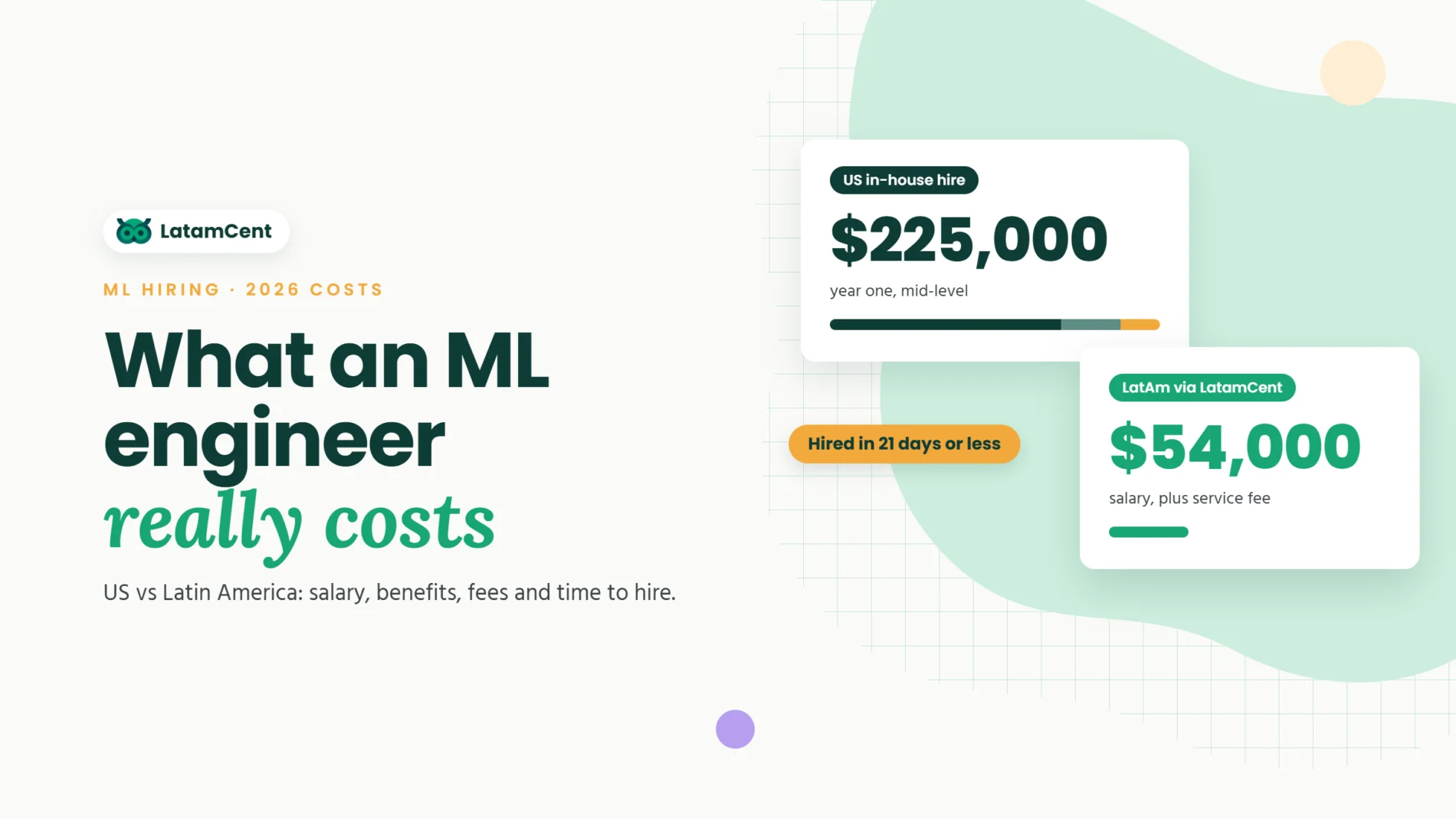
How much will a machine learning engineer actually cost you? In the US, the average salary sits between $165,000 and $186,000, and a mid-level hire can pass $225,000 in the first year once you add benefits, payroll taxes and a recruiting fee. Hire an engineer at the same level remotely in Latin America and the salary falls to somewhere between $42,000 and $86,000, depending on seniority and the country you hire in.
Cost isn’t the only reason US teams look south (time-zone overlap and faster hiring count for a lot too), but for most SaaS companies deciding whether to hire machine learning engineers from Latin America, it’s where the conversation starts.
The salary is only one line of the budget. Benefits, agency fees, the months a role sits open and the hiring model you pick can move the final number by six figures. This guide goes through each of them, with current figures for both markets and a worked example, so you can decide whether your next ML hire should be in-house in the US or remote in Latin America.
Key takeaways
- A US ML engineer averages $165,000 to $186,000 in salary. With benefits and taxes, a mid-level hire costs about $195,000 a year, plus a one-time recruiting fee.
- US companies hiring remotely in Latin America pay about $42,000 for entry-level ML engineers and $86,000 for senior ones.
- An internal US search for an ML specialist takes 98 to 154+ days.
- In our worked example, hiring through LatamCent costs about $171,000 less in salary and US overhead in year one, before our service fee, and the engineer is hired about three months sooner.
LatamCent by the numbers
How hiring an ML engineer works when you go through us:
Machine Learning Engineer Cost at a Glance
A machine learning engineer costs $109,000 to $221,000 a year in the US, depending on seniority, with benefits adding roughly 30% on top. In Latin America, US companies pay about $42,000 to $86,000 a year for remote ML engineers at the same levels.
Based on 2026 US salary surveys and job posting data, and on what US companies pay remote ML engineers in Latin America. Savings compare the LatAm figure with the midpoint of the US range.
We see the same pattern at LatamCent. The average salary across the ML engineers we place is about $54,000. Set against a mid-level US salary of $149,000 or more, that’s roughly 60% less, before our service fee.
Those headline figures hide a fair amount of variation, so before you set a budget it helps to look at each market on its own, starting with the US.
What a Machine Learning Engineer Costs in the US
Base Salary by Seniority
US salary estimates differ because they measure different things. Job posting data, which captures advertised base pay, puts the national average at about $186,000. Salary surveys, which rely on what engineers report earning, come in closer to $165,000 in total pay, partly because postings lean toward well-funded companies in expensive cities. Location skews both numbers: in San Francisco and San Mateo, averages run from roughly $224,000 to $266,000.
Broken down by level, engineers with less than a year of experience start around $109,000, and those with one to three years earn near $129,000. Mid-level engineers make $149,000 to $192,000 and senior engineers $168,000 to $221,000, while remote senior roles can reach $227,000.
If you set your ML budget a year ago, it’s likely already short. Mid-level ML salaries went up about 9% over the past year, which puts the role among the fastest-rising in tech.
The Fully Loaded Cost
Whatever the offer letter says, your finance team pays more. According to the Bureau of Labor Statistics, benefits made up 30% of total compensation for US private-industry workers in June 2026 ($14.07 of every $46.89 an hour). In other words, employers paid about 43 cents in benefits on top of every dollar of wages.
Because that figure averages every private-sector job, treat it as a starting point rather than a rule. Health insurance and a few other benefits cost about the same whether someone earns $90,000 or $190,000, so for a well-paid ML engineer the percentage is usually lower, and adding 30% to base salary is a reasonable, slightly conservative number to plan with.
Equipment and software licenses come on top of that. So does compute, since training and serving models usually takes far more GPU time than a typical developer’s work.
Recruiting Fees and Time to Hire
Most US tech recruiting agencies charge between 15% and 30% of first-year salary, so a 20% fee on a $170,000 engineer comes to $34,000 for a single hire.
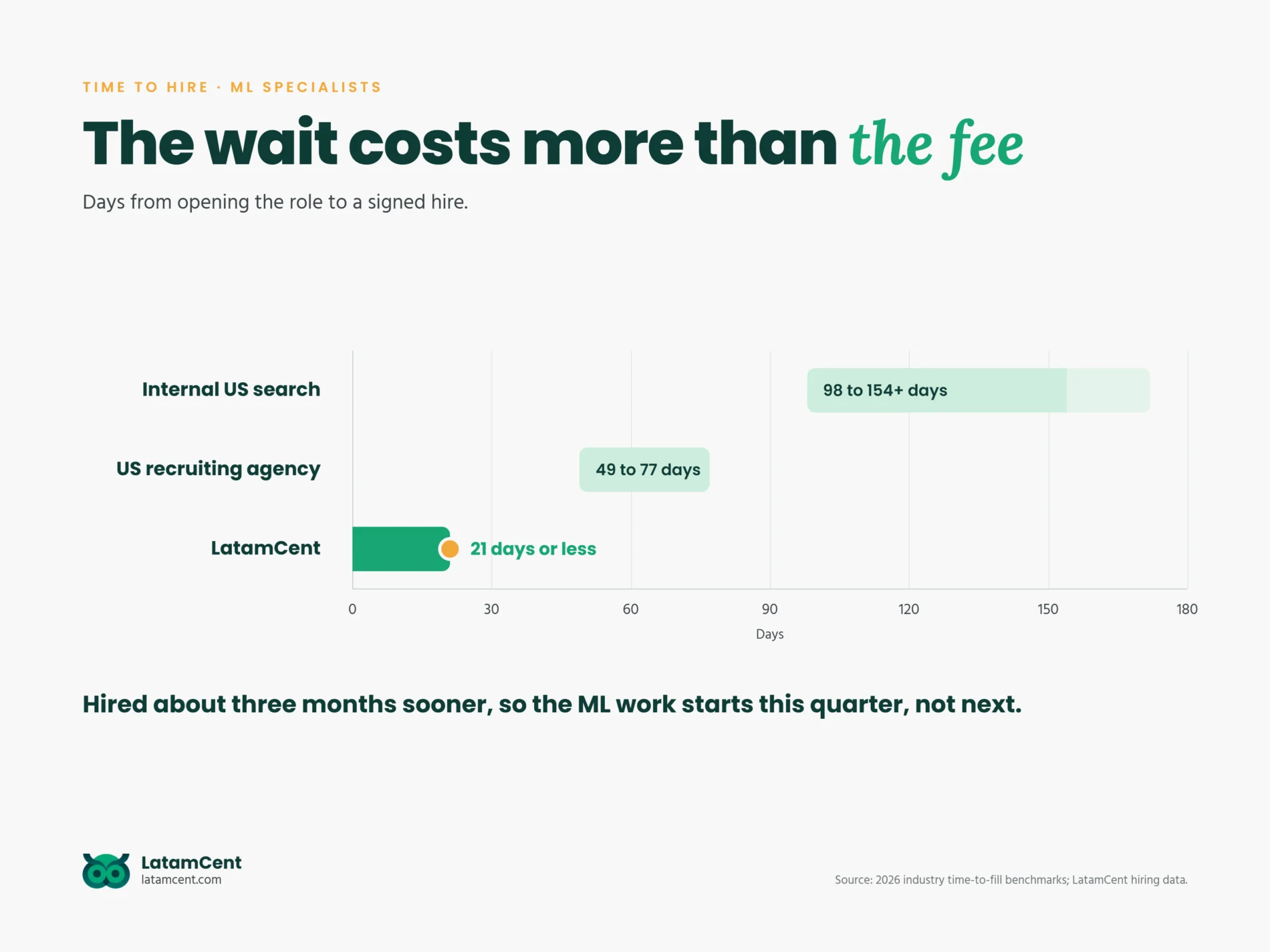
The time a search takes can cost you more than the fee. Industry benchmarks put ML and platform specialist roles at 98 to 154+ days to fill through an internal search, and 49 to 77 days through an agency. If the ML feature is already on the roadmap you showed customers or your board, three to five months of waiting is hard to absorb.
What a Machine Learning Engineer Costs in Latin America
Latin American ML engineers who work for US companies are usually paid in dollars, at rates well above local salaries and well below US ones. Across 19 countries in the region, remote ML engineers working for US employers average about $42,000 at entry level (up to 3 years), $64,000 at mid level (3 to 6 years) and $86,000 at senior level (6+ years).
A regional average covers a lot of ground, and pay in Mexico looks quite different from pay in Colombia or Argentina. Here is how 2026 salary data breaks down for the main markets, at mid level and at lead level (a step above senior), converted to annual figures:
Bars show the mid-to-lead pay range on a $0 to $110,000 scale. Colombia and Chile are reported together in the data.
Brazil
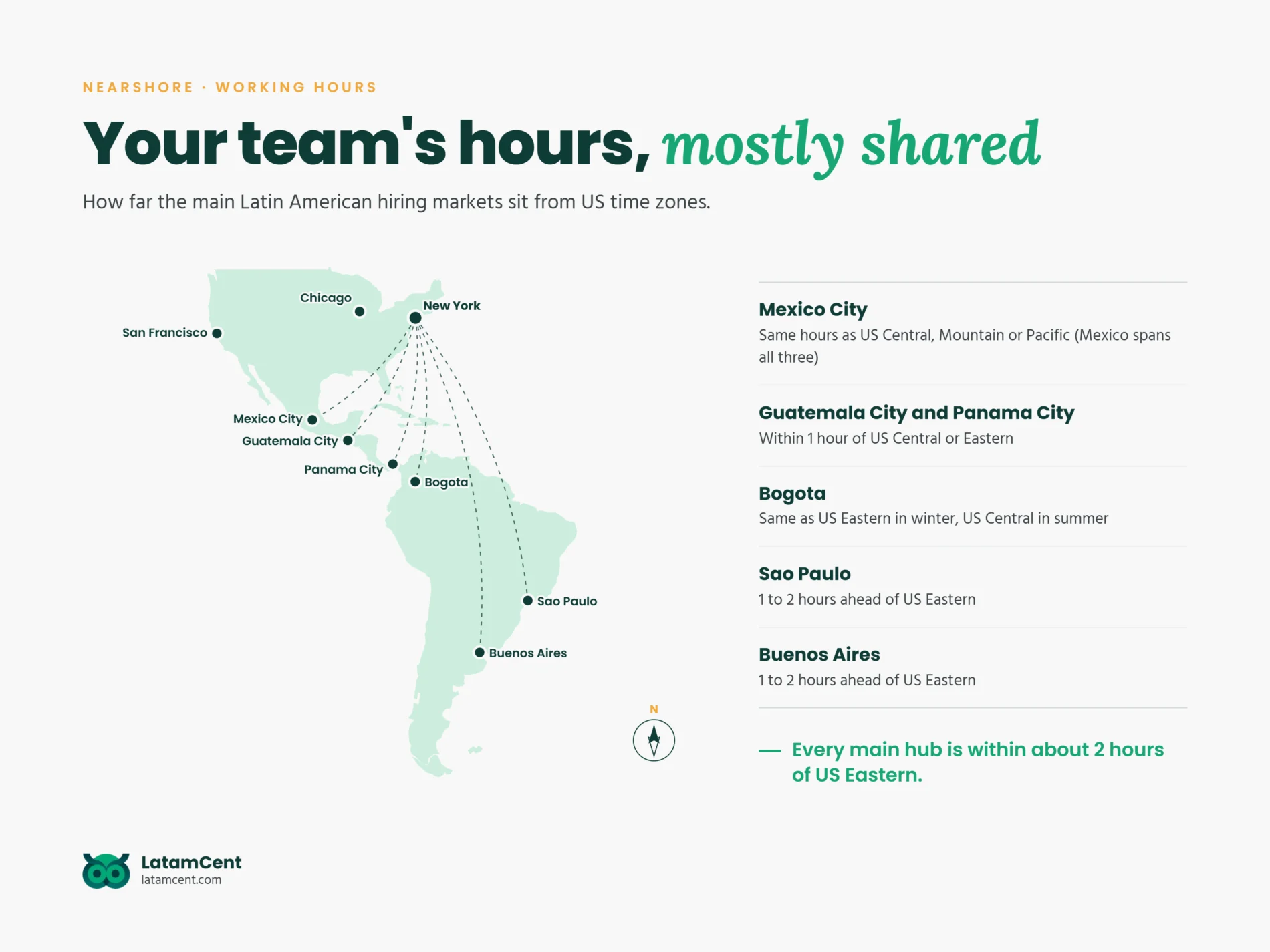
In Brazil, mid-level ML engineers earn around $44,000 a year and leads approach $95,000. Sao Paulo runs one hour ahead of US Eastern time in summer and two hours ahead in winter, which gives a New York team nearly its entire working day in common.
Mexico
Mexico pays the most of the four, at about $54,600 for mid-level engineers and $99,600 for leads. The extra cost buys you working hours. Because Mexico covers the US Central, Mountain and Pacific time zones, it’s the one large LatAm market where an engineer can keep exactly the same schedule as a team in Seattle or San Francisco.
Argentina
Argentina has the lowest top end of the four, with mid-level engineers at around $42,000 and leads at $84,000. Buenos Aires is one to two hours ahead of US Eastern time depending on the season, which is close enough for daily standups and live code reviews.
Colombia
Colombian pay spans a wide range, from about $36,600 to $94,200 depending on level. Chile falls in the same range in the data. The country stays on UTC-5 all year, so it matches US Eastern time in winter and US Central time in summer.
It’s worth looking past the largest markets as well. Smaller markets such as Guatemala and Panama stay within an hour of US Central or Eastern time year round.
What Pushes the Price Up or Down
Two ML engineers with the same title can be $100,000 apart, and most of that gap comes down to four things.
The biggest is seniority. Moving from entry level to senior adds $60,000 to $90,000 a year in the US but only about $44,000 in Latin America, so the dollar savings get larger the more senior the hire.
Specialty is close behind. Engineers who have put LLM features, computer vision systems or MLOps pipelines into production are scarcer than those who mainly train classic models, and their rates reflect that. Our ML engineers work across model development, NLP, computer vision, MLOps, deep learning and generative AI, and the narrower specialties usually sit toward the top of each range.
On the US side, company size and city play a big part. Larger companies pay about 34% more than smaller ones, and a San Mateo salary sits far above the national average.
In Latin America, the premium goes to fluent English and full overlap with your working day. You’ll pay more for both in every country, but for someone who joins your standups and model reviews every day, the extra cost tends to pay for itself.
The Hidden Costs of Hiring an ML Engineer
Salary, benefits and fees are the costs you can put in a spreadsheet. The ones below rarely make it onto the offer letter, and they add up quickly.
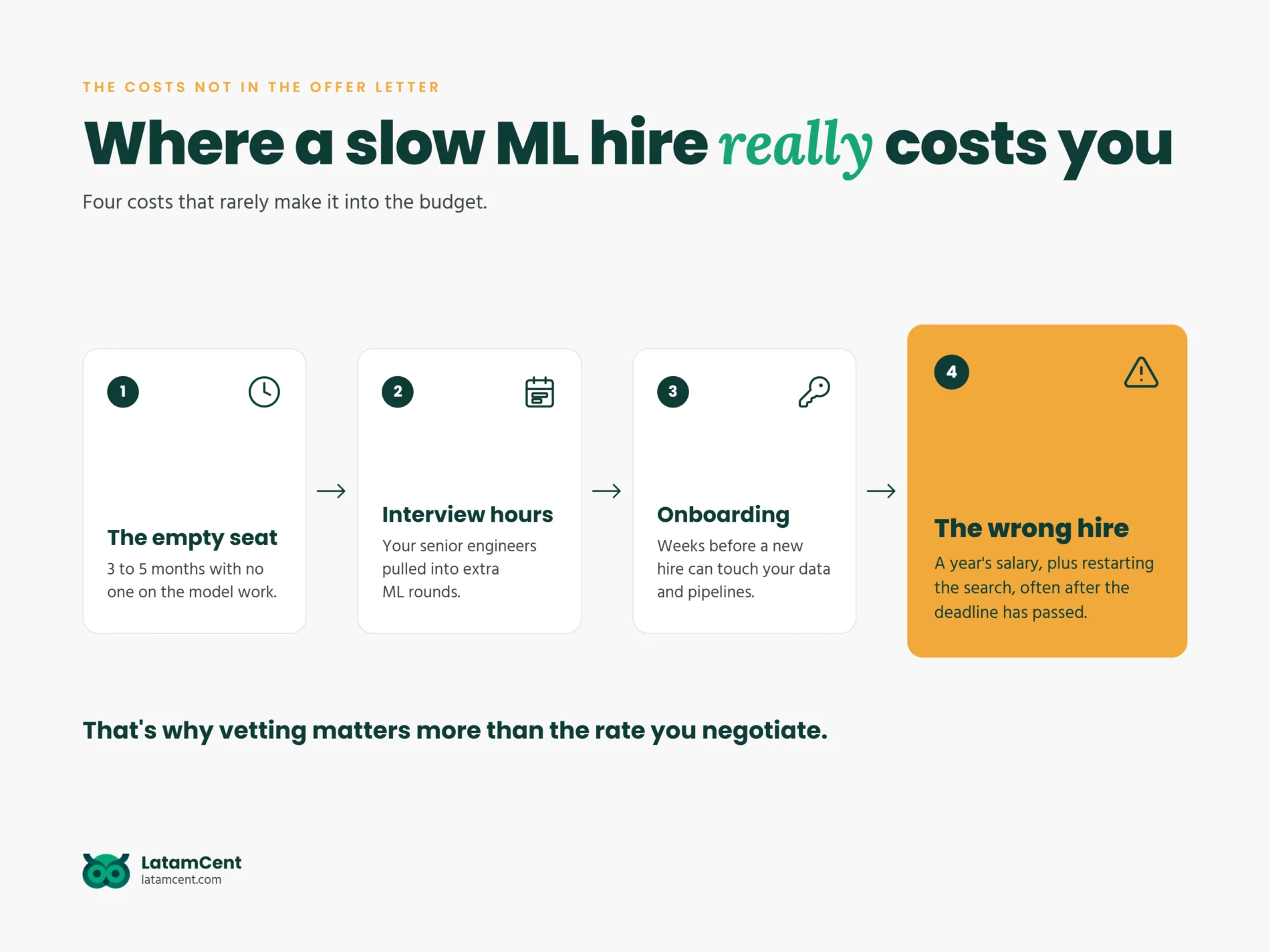
Start with the empty seat. A role that takes four months to fill means four months in which your model work either stalls or lands on engineers who were hired to do something else.
The hiring process has its own price. On top of agency fees and job board spend, every interview round takes your most expensive engineers away from their own work, and ML interviews tend to have more rounds than most because modeling, coding and system design each need testing.
Onboarding takes longer, too. An ML engineer can’t contribute much until they have access to your data, pipelines and infrastructure, so budget a few weeks before you see real output.
All of these are small next to the cost of hiring the wrong person. An engineer who builds impressive models in a notebook but can’t deploy or monitor them costs you a full year’s salary, every month it takes to notice, and the time to restart the search, often with the original deadline already gone. That’s why the quality of vetting matters more than the rate you negotiate, and why a good process tests deployment, monitoring and data pipelines as well as modeling.
Hiring Models Compared: In-House, Freelance, Nearshore Staffing and EOR
Where you hire changes the cost, and so does the way you hire.
In-house US hire
- What you pay
- Salary, about 30% for benefits and taxes, and a recruiting fee
- Time to start
- 3 to 5 months for ML specialists
- Who manages
- You
- Main risk
- Highest cost, slowest to fill
Freelancer
- What you pay
- Hourly or project rate
- Time to start
- Days to weeks
- Who manages
- You, loosely
- Main risk
- Availability, IP ownership, no long-term commitment
Nearshore staffing partner
How LatamCent works- What you pay
- The engineer’s salary plus a service fee
- Time to start
- 21 days or less with LatamCent
- Who manages
- You, as part of your team
- Main risk
- Depends on the partner’s vetting
Employer of record (EOR)
- What you pay
- Salary plus the EOR’s fee
- Time to start
- As long as your own search takes
- Who manages
- You
- Main risk
- You still have to find and vet the engineer
Freelancers suit short, well-defined projects such as a proof of concept. They’re a poor fit for a model that needs to run in production for years, since you’ll want the person who built it to still be around when it starts to drift.
An employer of record takes care of payroll and compliance but doesn’t find anyone for you. You’re still running the search yourself, and that puts you back on the 98-to-154-day timeline.
With a nearshore staffing partner, the engineer works full-time on your team, in your sprints and reporting to your managers, while the partner handles sourcing, vetting, payroll and IP agreements. That’s how LatamCent works: we headhunt 1,100 to 1,700 candidates per search to deliver vetted nearshore ML engineers in 21 days or less.
“We needed to scale our engineering and delivery teams fast without sacrificing quality. LatamCent brought us strong, technically capable candidates who fit right in with our culture and workflow.”
Does a Lower Cost Mean a Riskier Hire?
Not by itself. Most of the price gap between US and Latin American engineers comes from differences in cost of living and currency, not skill. The real risks are practical ones, and you can check each of them before you hire.
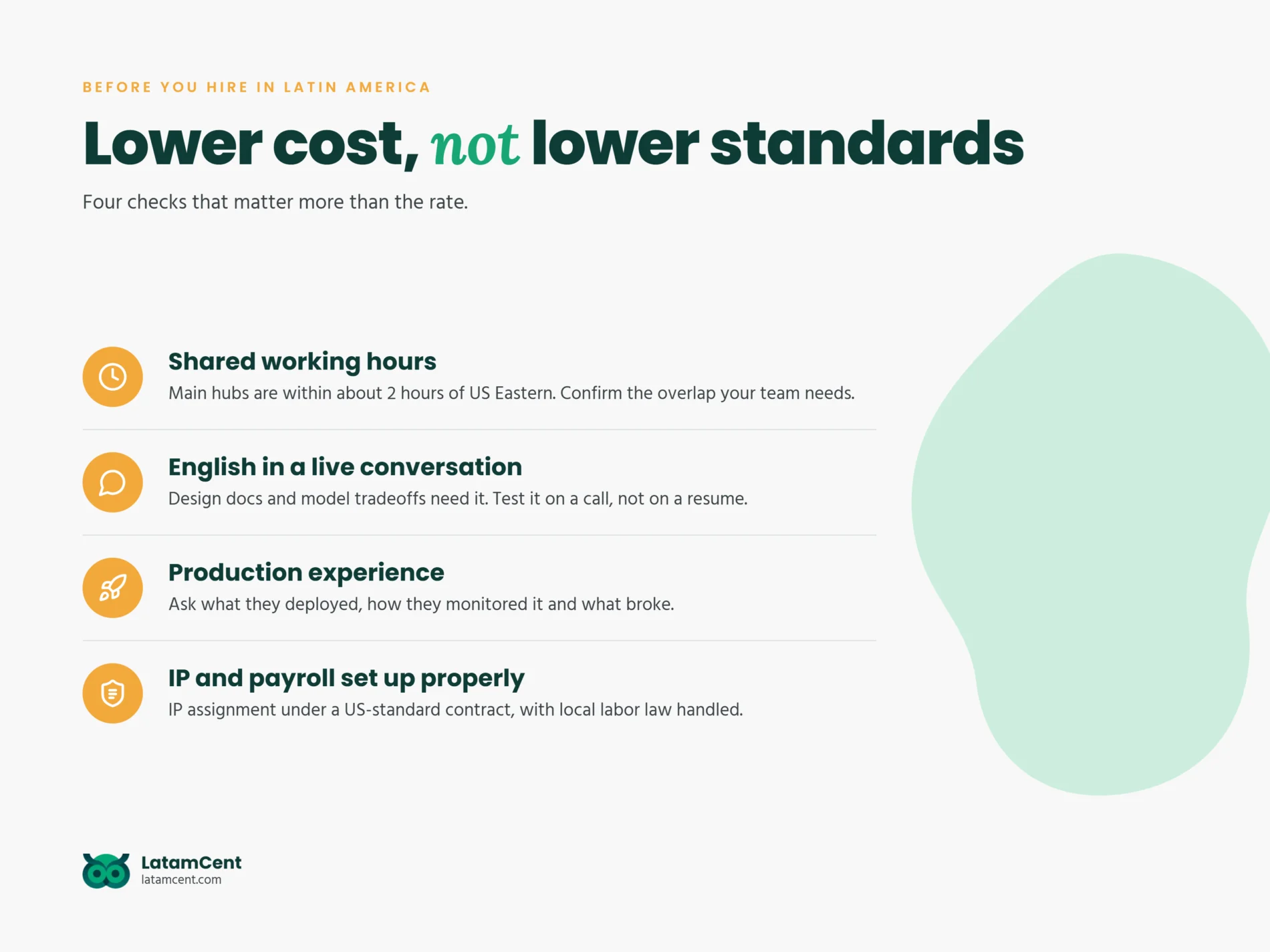
Time zones are the first thing to look at. The main Latin American tech hubs are within about two hours of US Eastern time, and Mexico and Central America line up with US Central, whereas a US team working with Eastern Europe or India may get only two or three shared hours a day.
English matters more for ML engineers than for many other roles, because so much of the job involves writing design docs, explaining model tradeoffs and debating metrics in meetings. Test it in a live conversation, not just from a resume.
Ask about production experience directly: what they’ve deployed, how they monitored it and what went wrong. Someone who has dealt with model drift in a live system is worth more than someone with a longer list of frameworks.
Finally, check the legal setup. You need IP assignment under a contract that holds up to US standards, and payroll and local labor law have to be handled properly. A staffing partner should take this off your plate. At LatamCent, IP transfers to you under legally binding agreements aligned with US standards.
How LatamCent vets ML engineers
- 1SearchOur talent partners headhunt 1,100 to 1,700 candidates who match your stack, seniority and time-zone needs.
- 2ScreeningCandidates go through English tests, personality assessments and technical checks, then interviews on past work and communication.
- 3SelectionYou interview the shortlist and pick. We handle reference checks, contracts, IP transfer and payroll, all within 21 days or less.
“We definitely noticed the difference in the level of the candidates that we get just organically from the candidates that we get from LatamCent.”
Worked Example: Budgeting for Your First ML Engineer
Say you run engineering at a 60-person SaaS company. Your data scientist has built a churn model that works in a notebook, and now it needs to run in production, retrain every week and push scores into the product. You need one mid-level ML engineer.
US salary is the low end of the 2026 mid-level range. The LatAm figure is the average salary of the ML engineers LatamCent places, before our service fee.
In year one the difference comes to $171,000 before our service fee. If you’d hire in the US without an agency, or from year two onward, it’s still $141,000 a year. The LatAm engineer is also hired about three months earlier. If the churn model is meant to reduce cancellations this quarter, that head start may be worth more than the savings.
Your own numbers will differ: a senior engineer in San Francisco costs more, and a junior engineer in Argentina costs less. The pattern holds, though: a comparable Latin American ML engineer usually costs about 60% less on salary alone, and up to 75% less once US benefits and fees are counted, before our service fee.
ML Engineer Cost Calculator
Change any number and the results update. The defaults match the worked example.
- Salary
- Benefits and payroll taxes $45,000
- Recruiting fee $30,000
Want to see who fits this budget? Tell us your stack and we’ll send matching ML engineer profiles.
Get ML engineer profiles at this budgetEstimates only. US time to hire for ML specialists is typically 98 to 154+ days with an internal search. LatAm figures are salaries and don’t include LatamCent’s service fee, which is quoted per role.
What to Do Next
If you’re deciding where your next ML engineer should come from, run your own numbers in the calculator above first. After that, the decision usually comes down to how soon you need the engineer, how many shared hours your team needs each day, and whether you have the interviewers and the patience for a four-month search. If you need someone within a month and your team works US hours, a vetted nearshore hire will usually get you the same skills for over $100,000 less a year in salary and US overhead.