


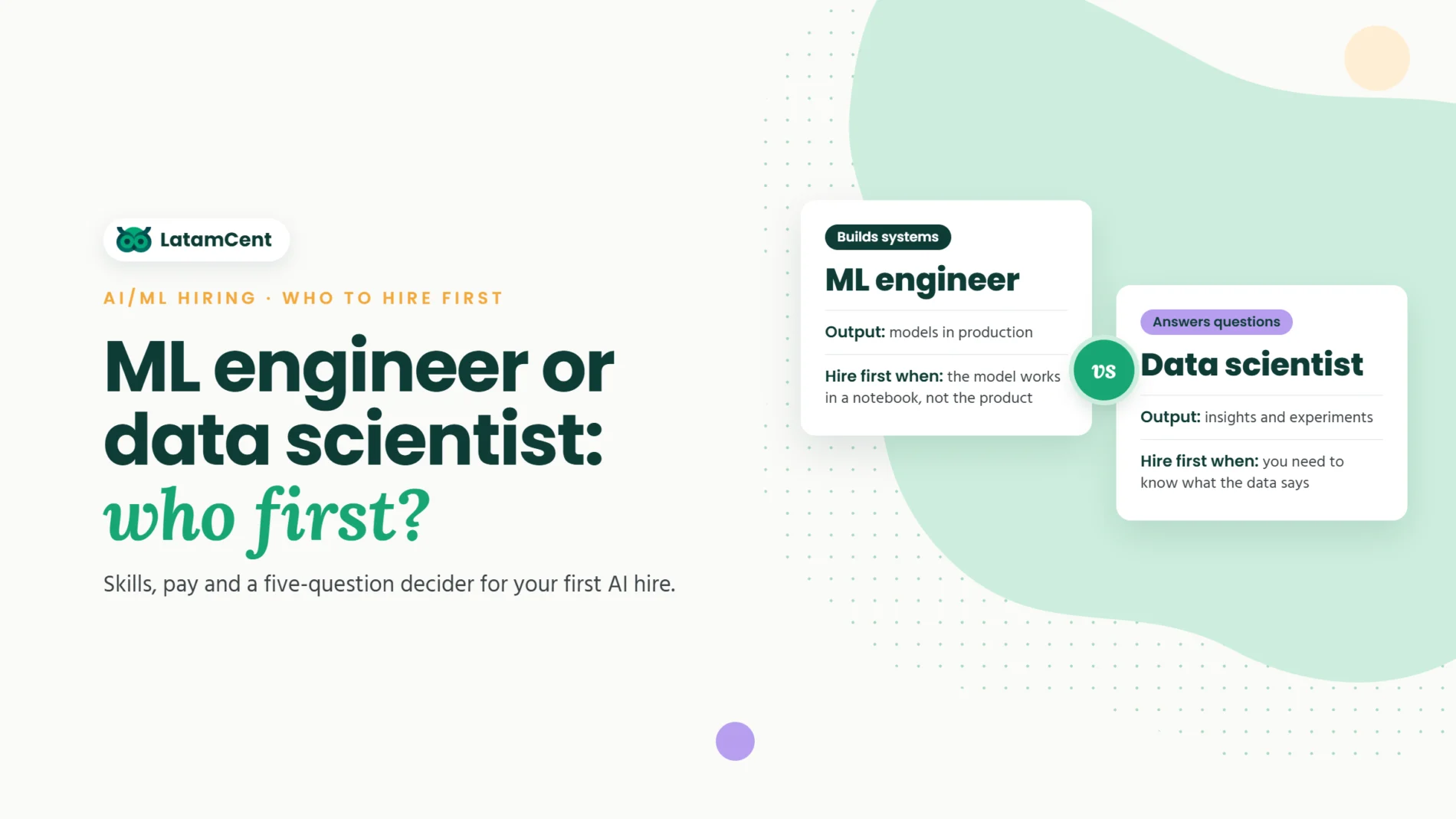
Most comparisons of machine learning engineers and data scientists are written for people choosing a career. This one is for the person signing the offer letter. If your company has data, a product and a vague plan to “do something with AI,” you’ve probably asked which of the two to bring on first. The short version: data scientists figure out what the data can tell you, and machine learning engineers turn that into software that runs inside your product. Which one you need first depends on where you are today, not on which title sounds more advanced.
Below you’ll find a side-by-side comparison, what each role does day to day, how their skills and pay differ, and a five-question decider that recommends where to start. If you already know you need someone to put models into production, you can hire ML engineers from Latin America through LatamCent.
Key takeaways
- Data scientists answer questions with data: what’s happening, why, and what might work. Their output is insight and prototype models.
- ML engineers build and run the systems that serve models to users. Their output is production software.
- No clean data yet? Neither role is your first hire. Start with someone who can build the pipeline.
- A model that works in a notebook but not in the product is the clearest sign you need an ML engineer.
- US pay for the two roles is within about 10% at the same level. In Latin America, both cost roughly 50 to 75% less.
The Short Answer
A data scientist works on questions. A machine learning engineer works on systems. The data scientist explores your data, runs experiments and builds a first model to prove an idea. The ML engineer takes a proven model and makes it reliable, fast and cheap enough to run for every user, every day. On a mature team they sit next to each other and hand work back and forth.
| Machine learning engineer | Data scientist | |
|---|---|---|
| Main focus | Building, deploying and maintaining ML systems | Analyzing data and testing ideas |
| Main output | Models running in production, APIs, pipelines | Insights, experiments, dashboards, prototype models |
| Core skills | Software engineering, MLOps, system design | Statistics, experiment design, communication |
| Typical tools | Python, PyTorch or TensorFlow, Docker, Kubernetes, MLflow, Airflow | Python or R, SQL, pandas, scikit-learn, notebooks, BI tools |
| Typical background | Computer science or software engineering | Statistics, math, economics or a quantitative science |
| Success looks like | The model stays accurate and online under real traffic | The business makes a better decision because of the analysis |
What a Machine Learning Engineer Does
An ML engineer is a software engineer who specializes in models. They turn a prototype into a service your product can call. That means rewriting research code so it runs reliably, building training pipelines that retrain on fresh data, serving predictions at the speed your users expect, and watching for the slow slide in accuracy that happens when real-world data drifts away from the training set.
A typical week might include packaging a recommendation model behind an API, making it fast enough that pages don’t stall while it thinks, setting up alerts for when prediction quality drops, and working with the backend team on how the product should behave when the model is unsure. They care about latency, cost per prediction, test coverage and on-call runbooks as much as they care about accuracy.
The role has grown fast because the gap between “we have a model” and “customers use the model” turned out to be wide. On many teams, getting a model into production takes more engineering than building it did.
What a Data Scientist Does
A data scientist turns raw data into answers. The Bureau of Labor Statistics describes the job as using analytical tools and techniques to extract meaningful insights from data, and that’s a fair summary. In a SaaS company, that often means working out why customers churn, which features drive upgrades, whether a pricing test worked, or how many support tickets to plan for next quarter.
Their week looks different from an ML engineer’s. They spend more time in SQL and notebooks, less in production code. They design A/B tests, build forecasting and churn models, present findings to product and leadership, and decide which questions are worth a model at all. A good data scientist will sometimes tell you that the model you wanted isn’t needed and a well-built dashboard will do. When you hire a data scientist, look for that judgment as much as for technical depth.
“We had large client contracts on the line, and LatamCent helped us deliver quality work without stretching our team too thin.”
Skills and Tools Compared
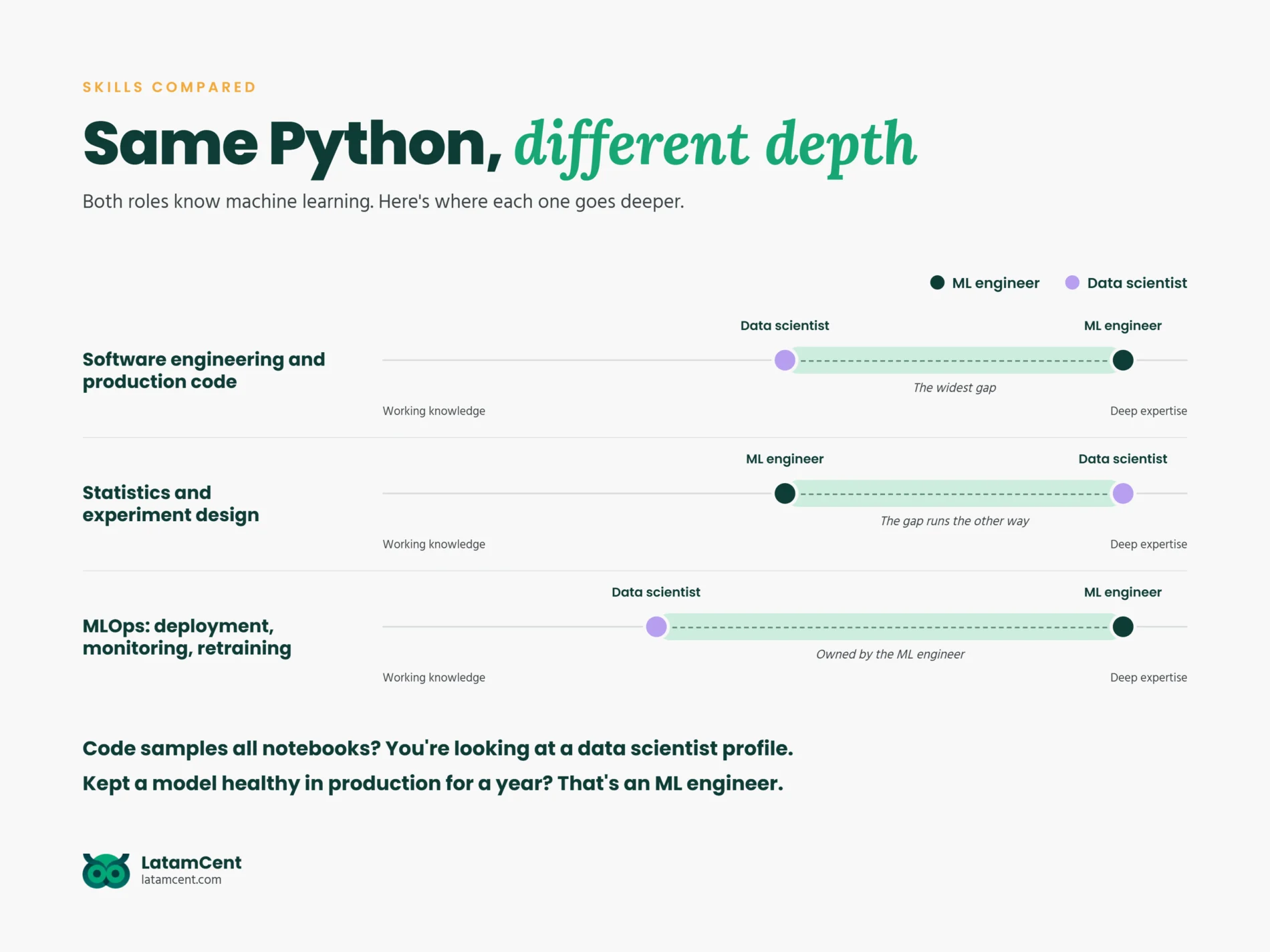
Both roles write Python and both understand machine learning. The difference is where each one goes deep.
Programming and Software Engineering
This is the widest gap. ML engineers write production code: modular, tested, version-controlled and reviewed. They know data structures, APIs, concurrency and how to profile slow code. Data scientists write code to answer a question, and a lot of it lives in notebooks that nobody else runs. Many data scientists are strong programmers, but it’s rarely what they’re hired for. If a candidate’s code samples are all notebooks, you’re looking at a data scientist profile.
Statistics and Modeling
Here the gap runs the other way. Data scientists go deeper on experiment design, hypothesis testing, causal inference, regression and choosing the right metric. They’re the ones who notice that your A/B test didn’t run long enough or that a spike in sign-ups came from a single campaign. ML engineers know modeling well, especially deep learning and the practical side of training, but they tend to treat statistics as a tool rather than the main craft.
Production, MLOps and Infrastructure
This belongs to the ML engineer. Containers, orchestration, CI/CD for models, feature stores, model registries, monitoring and retraining schedules are all part of the job. It’s also the skill set that’s hardest to hire for, which is why the ML engineer interview puts so much weight on system design and production stories. Most data scientists have deployed something at some point. Few have kept a model healthy in production for a year.
Salary and Cost Compared
In the US, the two roles are paid close to each other at the same level. 2026 salary surveys put mid-level ML engineers at $149,000 to $192,000 and mid-level data scientists at $138,000 to $175,000. At senior level the ranges are $168,000 to $221,000 and $157,000 to $194,000. The Bureau of Labor Statistics puts the median data scientist salary at $120,230, a figure that covers all levels and industries, and projects 35% job growth over the next decade.
Job posting averages show a wider gap (about $186,000 for ML engineers against $131,000 for data scientists), likely because ML engineer postings lean senior and cluster in high-cost cities. At the same level, expect a difference of around 10%.
| Level | ML engineer, US | Data scientist, US | ML engineer, LatAm | Data scientist, LatAm |
|---|---|---|---|---|
| Mid level | $149,000 to $192,000 | $138,000 to $175,000 | About $64,000 | About $38,000 |
| Senior | $168,000 to $221,000 | $157,000 to $194,000 | About $86,000 | About $52,000 |
US figures from 2026 salary surveys. LatAm figures are what US companies pay remote engineers and data scientists in Latin America. Salaries only, before benefits or fees.
Hiring in Latin America changes the math for both roles. Remote ML engineers working for US companies earn about $64,000 at mid level, and the ML engineers LatamCent places average about $54,000. Salary data shows a wider gap between the two roles in Latin America than in the US, so treat the data scientist figures as a floor: senior data scientists with strong ML or production skills are paid much closer to ML engineer rates. For budgets, benefits and recruiting fees, see our full ML engineer cost breakdown.
Where the Two Roles Overlap
The line between the roles is blurry, and titles don’t help. Some companies call their ML engineers “data scientists, machine learning.” Others post “ML engineer” roles that are mostly analytics. Read the responsibilities, not the title.
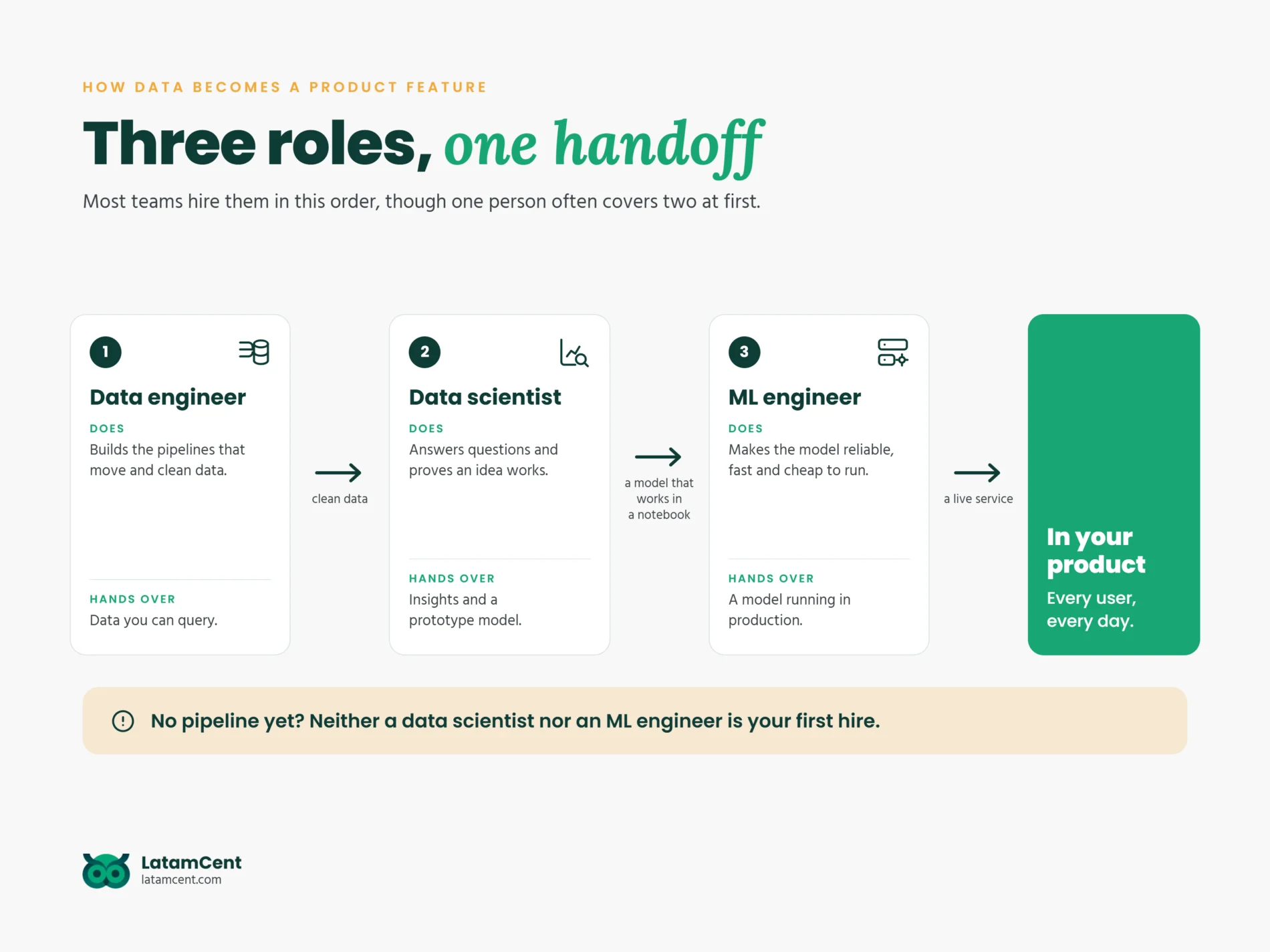
The shared ground is real: both roles clean data, engineer features, train and evaluate models, and explain results to non-technical people. Both need to understand your business well enough to pick the right problem. And both work with a third role you shouldn’t forget, the data engineer, who builds the pipelines that feed everyone else.
You’ll also see “AI engineer” in job posts. It usually means an engineer who builds products on top of large language models and third-party model APIs: prompts, retrieval, evaluation and guardrails. It overlaps heavily with ML engineering on the production side and needs less classic model training. If your roadmap is mostly LLM features, an ML engineer with that experience is often the right fit. Our AI and machine learning hiring page covers the other specialist roles we hire for.
Which One Should You Hire First?
Start from the problem you have today. The table below is based on the situations we run into most often when hiring for SaaS teams, and the decider after it gives you a recommendation in about a minute.
| Your situation | Hire first | Why |
|---|---|---|
| No data pipeline yet. Data sits in app databases and spreadsheets. | Data engineer (or a data scientist who can build pipelines) | Neither analysis nor models work without reliable data. |
| You have data but don’t know what it can tell you. | Data scientist | You need questions answered before anything gets built. |
| Leadership wants metrics, forecasts and test results. | Data scientist | That’s analysis and decision support, not a production system. |
| A model works in a notebook but not in the product. | ML engineer | The missing piece is engineering: serving, pipelines and monitoring. |
| You’re shipping an ML or LLM feature to customers. | ML engineer | Latency, uptime and cost now matter as much as accuracy. |
| A model is live but getting worse, and nobody owns it. | ML engineer | Drift, retraining and alerts are core MLOps work. |
| Early-stage team, one ML use case, small budget. | Full-stack ML engineer | One person who can prototype and ship covers both jobs for a while. |
Hire-first decider
Which role should you hire first?
Answer five quick questions. Your recommendation appears as soon as all five are answered.
Our recommendation
Hire an ML engineer first
You have the data and a clear product use case, and what’s missing is someone to build and run it in production. An ML engineer will turn the prototype into a service, set up retraining and monitoring, and own the model once it’s live. If you have a data scientist already, this is the hire that lets their work reach customers.
Get ML engineer profilesOpens our contact form. Mention this result and what you’re building, and we’ll come back with profiles that fit.
Our recommendation
Hire a data scientist first
Your most valuable next step is understanding what your data says, not shipping a model. A data scientist will answer the questions leadership keeps asking, design your experiments and tell you which ML ideas are worth building. When one of those ideas needs to run in the product, that’s the moment to add an ML engineer.
Get data scientist profilesOpens our contact form. Mention this result and what you’re building, and we’ll come back with profiles that fit.
Our recommendation
Fix the data foundation first
Without a reliable pipeline, a data scientist will spend most of their time cleaning data and an ML engineer will have nothing stable to build on. Start with a data engineer, or a data scientist with strong data engineering skills, who can get your data into one place you can query. The analysis and models come after.
Talk through your data setupOpens our contact form. Mention this result and where your data lives today, and we’ll talk through where to start.
Our recommendation
Start with a full-stack ML engineer
You need a bit of everything and don’t have the team yet to split the work. A full-stack ML engineer with solid data science skills can explore the data, build a first model and ship it. Plan to add a specialist on either side once the first use case proves its value.
Get full-stack ML profilesOpens our contact form. Mention this result and what you’re building, and we’ll come back with profiles that fit.
Whichever way the decider points, write down what the person should deliver in their first 90 days before you write the job post. It’s the fastest way to find out whether you’re describing a data scientist, an ML engineer or two different jobs squeezed into one.
Can One Person Do Both?
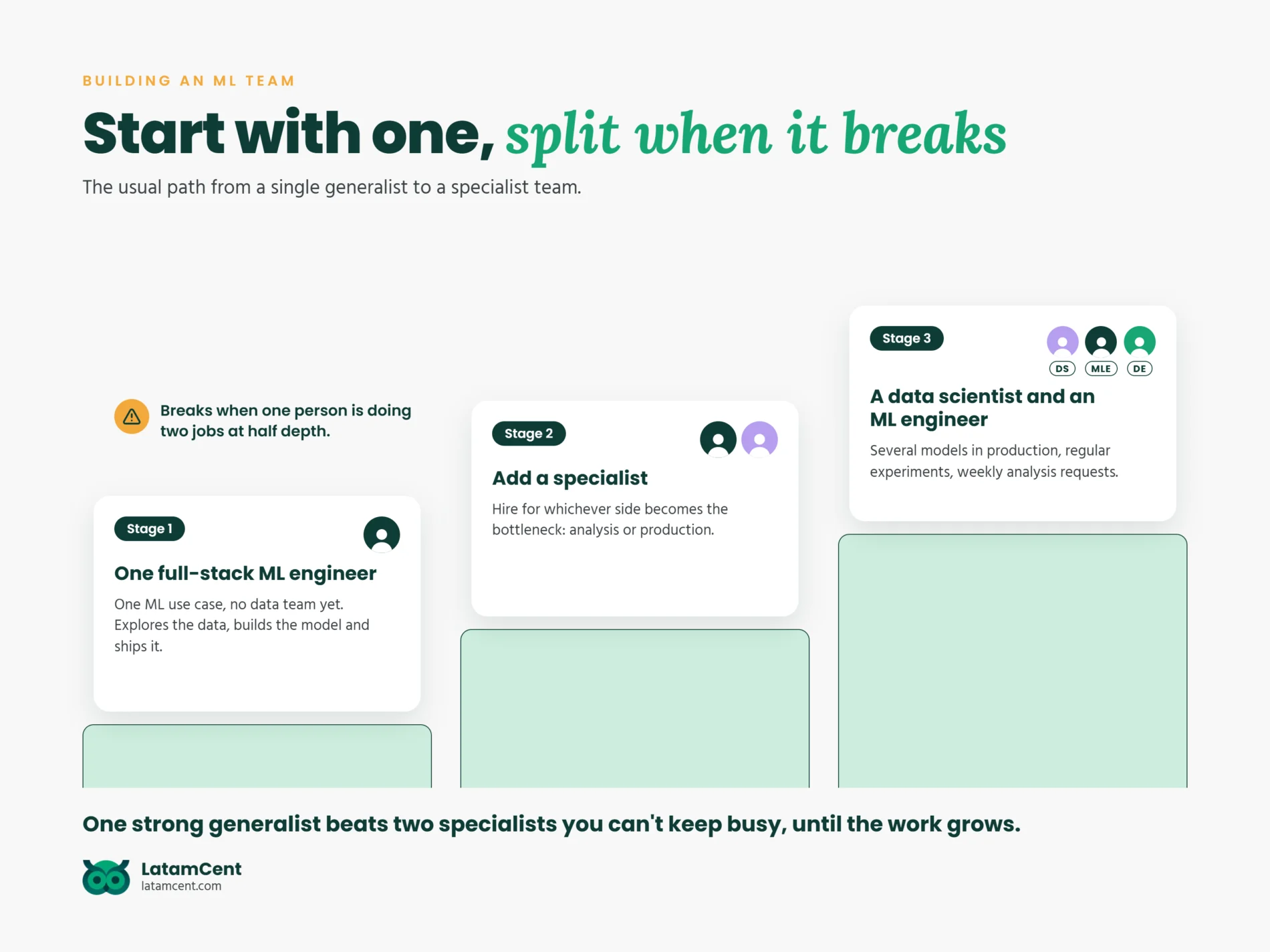
Sometimes, and at an early-stage company it’s often the smart move. A full-stack ML engineer can explore data, build a model and deploy it well enough for a first use case. For a startup with one ML feature and no data team, one strong generalist beats two specialists you can’t keep busy.
The setup breaks down as the work grows. Once you have several models in production, a real experimentation program and leadership asking for analysis every week, one person ends up doing two jobs at half depth. The usual pattern is to start with a generalist, then add a specialist for whichever side becomes the bottleneck: a data scientist for the analysis side, or a second ML engineer for production. If you’re at that point, it’s worth talking to vetted machine learning engineers who can cover both sides while the team grows.
LatamCent by the numbers
How hiring an ML engineer or data scientist works when you go through us:
What to Do Next
Run the decider above with the person who owns your data roadmap, and write down the 90-day outcomes for the role it points to. If it’s an ML engineer, our ML engineer interview questions will help you build the loop. If you’re still unsure after that, tell us what you’re building and we’ll tell you which profile we’d look for.
Not sure which role you need? Start with a conversation
Tell us what you’re building and where your data stands. We’ll help you define the role, then our talent partners start the search. You interview a shortlist of pre-vetted Latin American ML engineers or data scientists who work your hours, and the hire is done in 21 days or less.
- ML engineers across model development, NLP, computer vision, MLOps and generative AI
- Data scientists for analytics, experimentation, forecasting and predictive modeling
- Payroll, contracts and US-standard IP transfer handled for you
“Every candidate we got was pre-vetted, relevant, and ready to go.”
Trusted by B2B SaaS teams at






FAQ
Is a machine learning engineer a data scientist?
No, though the roles overlap. Both understand machine learning, but a data scientist focuses on analysis, experiments and prototype models, while an ML engineer focuses on building and running models in production. Think of the data scientist as the person who proves an idea works and the ML engineer as the person who makes it work for every user.
Who earns more, ML engineers or data scientists?
ML engineers, by a small margin. At the same level, US salary surveys put them about 10% ahead: $149,000 to $192,000 for mid-level ML engineers against $138,000 to $175,000 for mid-level data scientists. Job posting averages show a bigger gap because ML engineer roles skew senior.
Does a startup need an ML engineer or a data scientist?
It depends on what the startup needs to deliver. If the goal is an ML feature in the product, hire an ML engineer, ideally a full-stack one who can also prototype. If the goal is understanding customers, pricing or growth, hire a data scientist. If there’s no reliable data pipeline yet, fix that first.
Can a data scientist become an ML engineer?
Yes, and it’s a common move. The gap to close is software engineering and MLOps: production code, testing, containers, deployment and monitoring. For a hiring manager, that means a data scientist who has shipped and maintained models in production can be a strong ML engineer candidate. One who has only worked in notebooks usually isn’t ready yet.
What’s the difference between a data engineer, a data scientist and an ML engineer?
The data engineer builds the pipelines that move and clean data. The data scientist uses that data to answer questions and build prototype models. The ML engineer turns those models into production systems. Most teams hire them in that order, though a small team often starts with one person covering two of the three.