

English in the LATAM tech pool splits into three tiers. Conversational English (B1-B2) is common across the region’s 2.6+ million engineers. Business-fluent C1/C2 English is concentrated in specific countries and tech hubs, and it commands a 20-30% salary premium. The gap between the two tiers is where most nearshore hiring goes wrong.
Talent quality | Based on the EF English Proficiency Index 2025 (2.2M test takers, 123 countries), localized job posting analysis, and LATAM compensation data | Last updated July 2026
Key findings
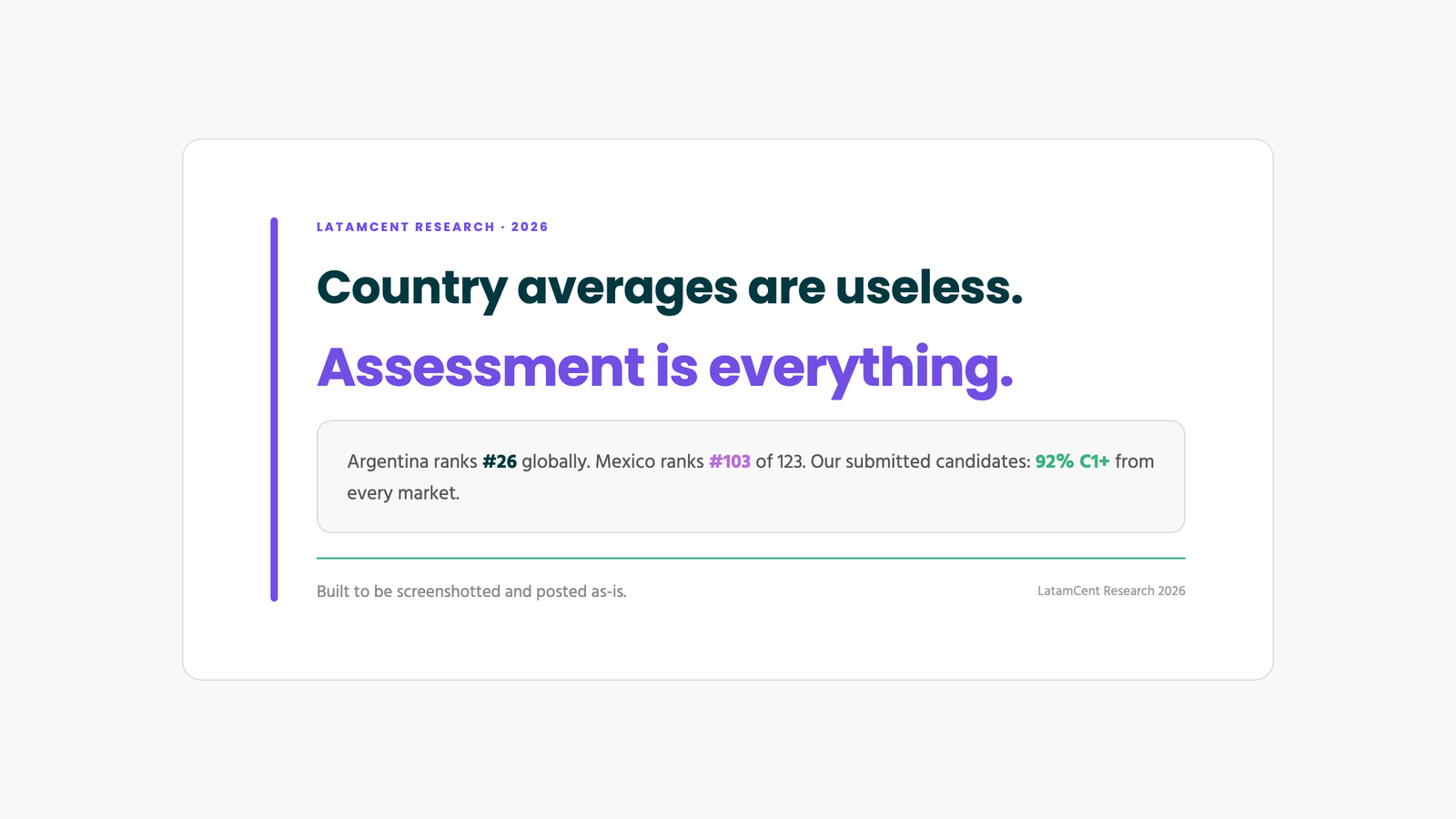
- 92% of candidates LatamCent submits score C1+ business English.
- English splits into three tiers; C1/C2 commands a 20-30% salary premium.
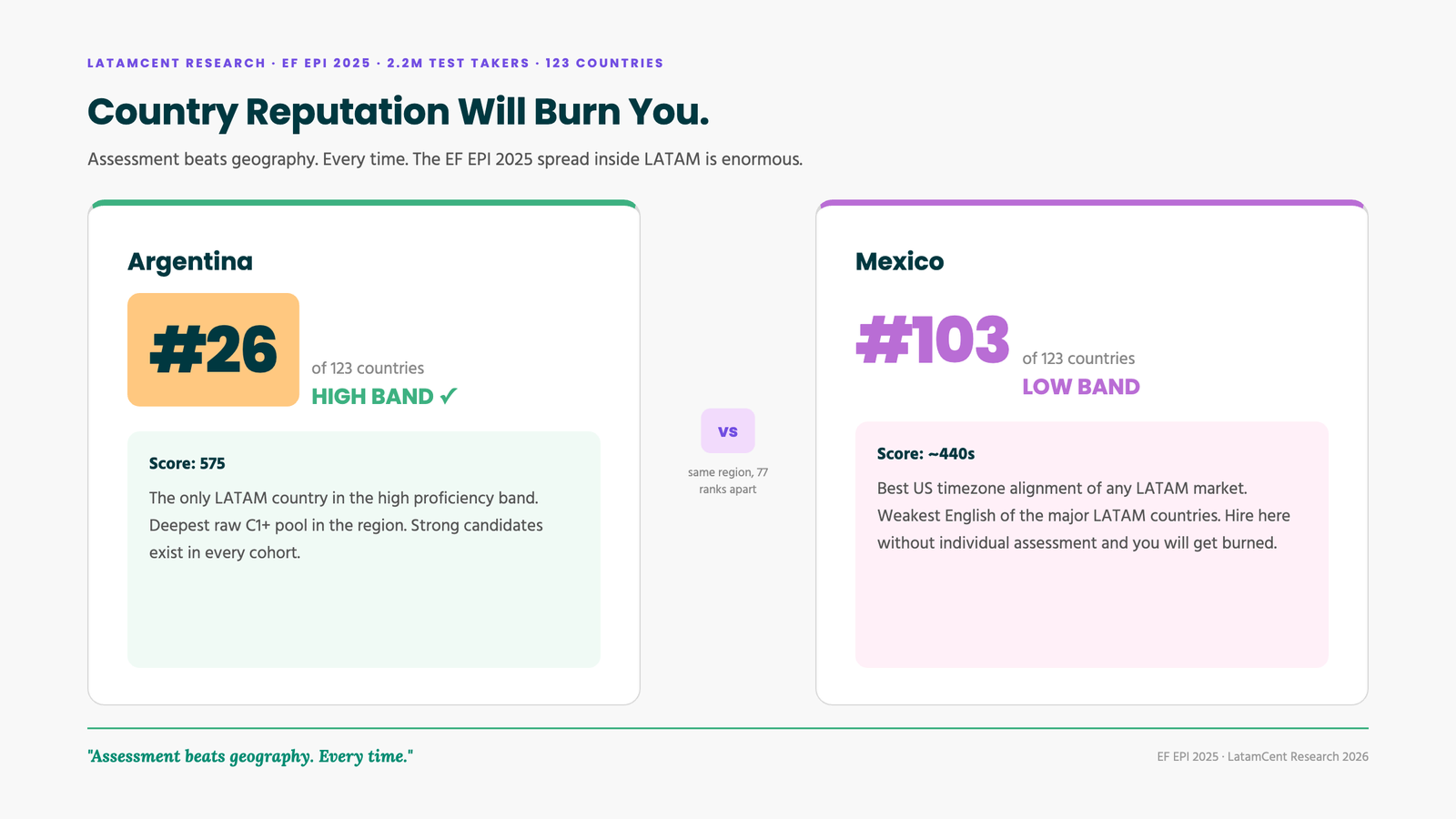
- Argentina ranks #26 globally on the EF EPI 2025; Mexico ranks #103.
- 65% of Argentine tech postings require English, versus 22% in Brazil.
- Comprehension and speaking diverge, so live assessment beats certificates.
The most common fear in nearshore hiring is not skill. It is the Wednesday standup. Will this person hold their own in a fast product debate? Push back on a bad spec? Get on a call with your biggest customer without you sweating through the call?
Here is what most agencies will not tell you: the answer depends entirely on which tier of English you are hiring for, and most companies do not know the tiers exist until the first awkward client call.
The three tiers of English in LATAM tech
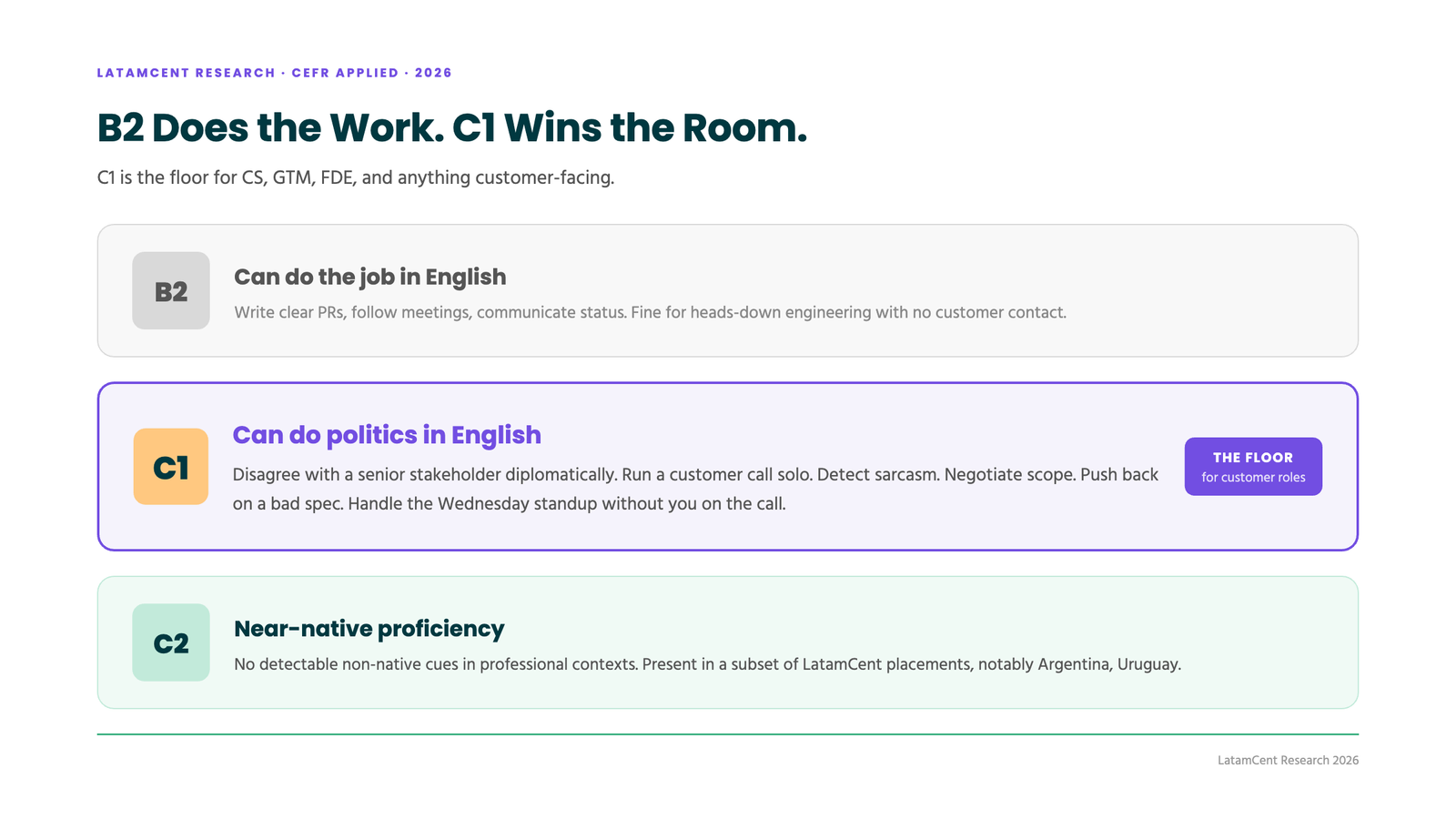
Tier 1: Conversational English (B1-B2). The candidate can follow meetings, write workable PRs, and communicate status. This is common across the region’s tech workforce, especially in tech hubs where working with US and European clients has been standard practice for a decade. Most mid-to-senior LATAM developers seeking international roles can operate at this level. For heads-down engineering roles that never touch a customer, B2 performs fine.
Tier 2: Business-fluent English (C1). The candidate can do politics in English: disagree with a senior stakeholder diplomatically, run a customer call solo, detect sarcasm, negotiate scope, and lead a meeting. This tier is significantly smaller than B2 and concentrates in specific countries and cities. It is the minimum bar for CS, GTM, FDE, and any role that touches a customer or a board.
Tier 3: Near-native English (C2). Functionally indistinguishable from a native speaker. Rare everywhere, including the US. Not a reasonable screening bar for most roles, but the candidates who reach it command top-of-market rates.
The salary data proves the market knows these tiers are different: a developer with C1/C2 English earns 20-30% more than a technically identical peer with B1 English, because they can integrate directly into US leadership meetings and strategic decision-making. That premium is the market pricing the scarcity of Tier 2 relative to Tier 1.
The country map: where fluent English actually lives
The EF English Proficiency Index 2025, built from 2.2 million test takers across 123 countries and now including AI-assessed speaking and writing for the first time, gives the clearest external picture of where English proficiency concentrates:
| Country | EF EPI 2025 global rank (of 123) | Score | Band | What it means for hiring |
|---|---|---|---|---|
| Argentina | #26 | 575 | High | The only LATAM country in the high band. Deepest raw C1+ pool. 65% of tech job postings require English |
| Uruguay | #34 | 542 | Moderate | Small market, strong proficiency. Punches above its size |
| Chile | #54 | 517 | Moderate | Solid professional-class English, smaller tech pool. Top 20 globally for overall tech skills |
| Costa Rica | #55 | 516 | Moderate | Long BPO history built real business English |
| Brazil | #75 | 482 | Moderate-Low | Largest talent pool in LATAM (540k+ engineers), but only 22% of tech job postings require English. Vetting is mandatory |
| Colombia | #76 | 480 | Moderate-Low | Huge tech scenes in Medellin and Bogota. B2-C1 bilingual rates strong among developers, uneven in the general market |
| Mexico | #103 | ~440s | Low | The shocker. 800k+ engineers, best US timezone, weakest English of the major markets |
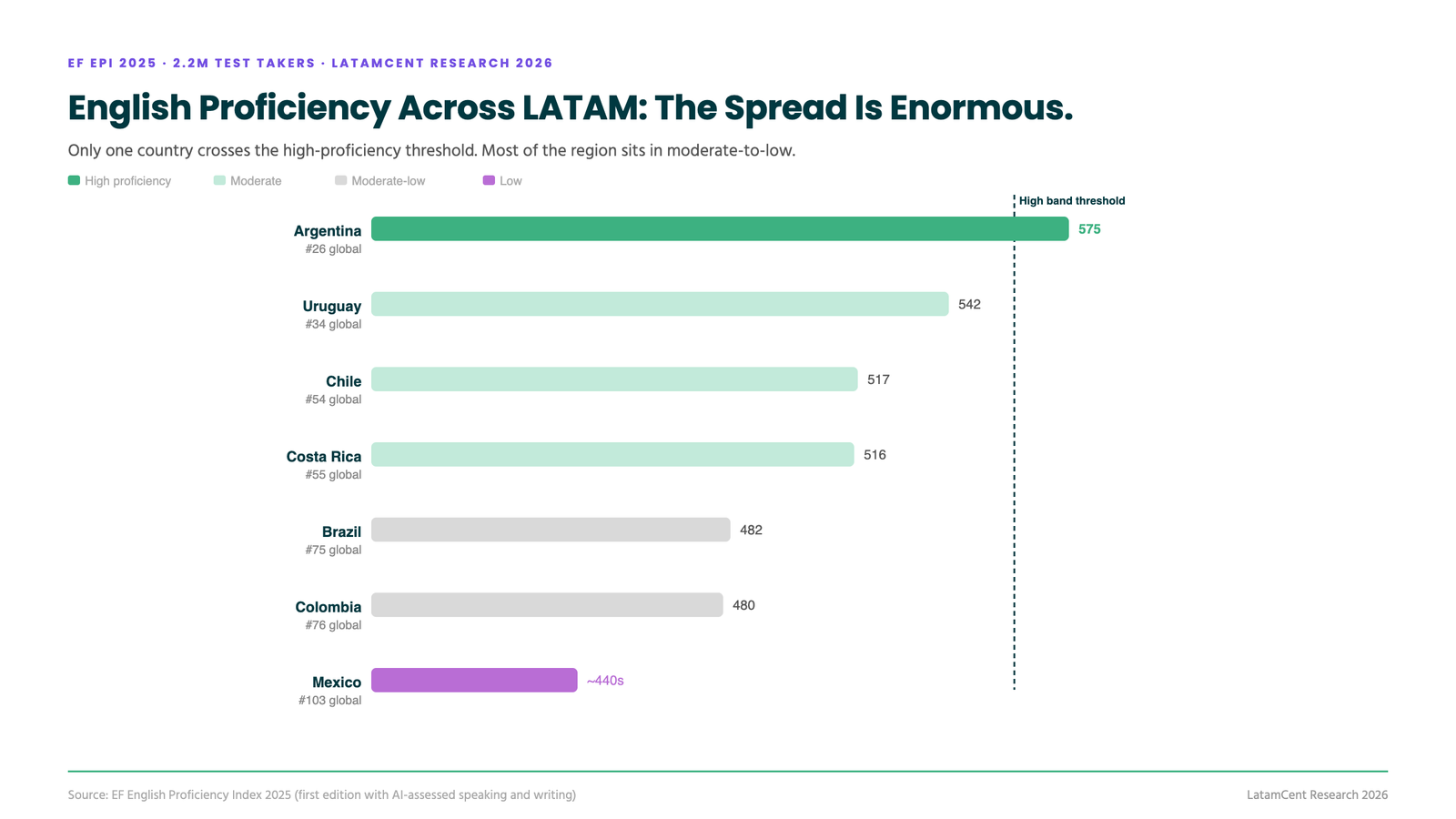
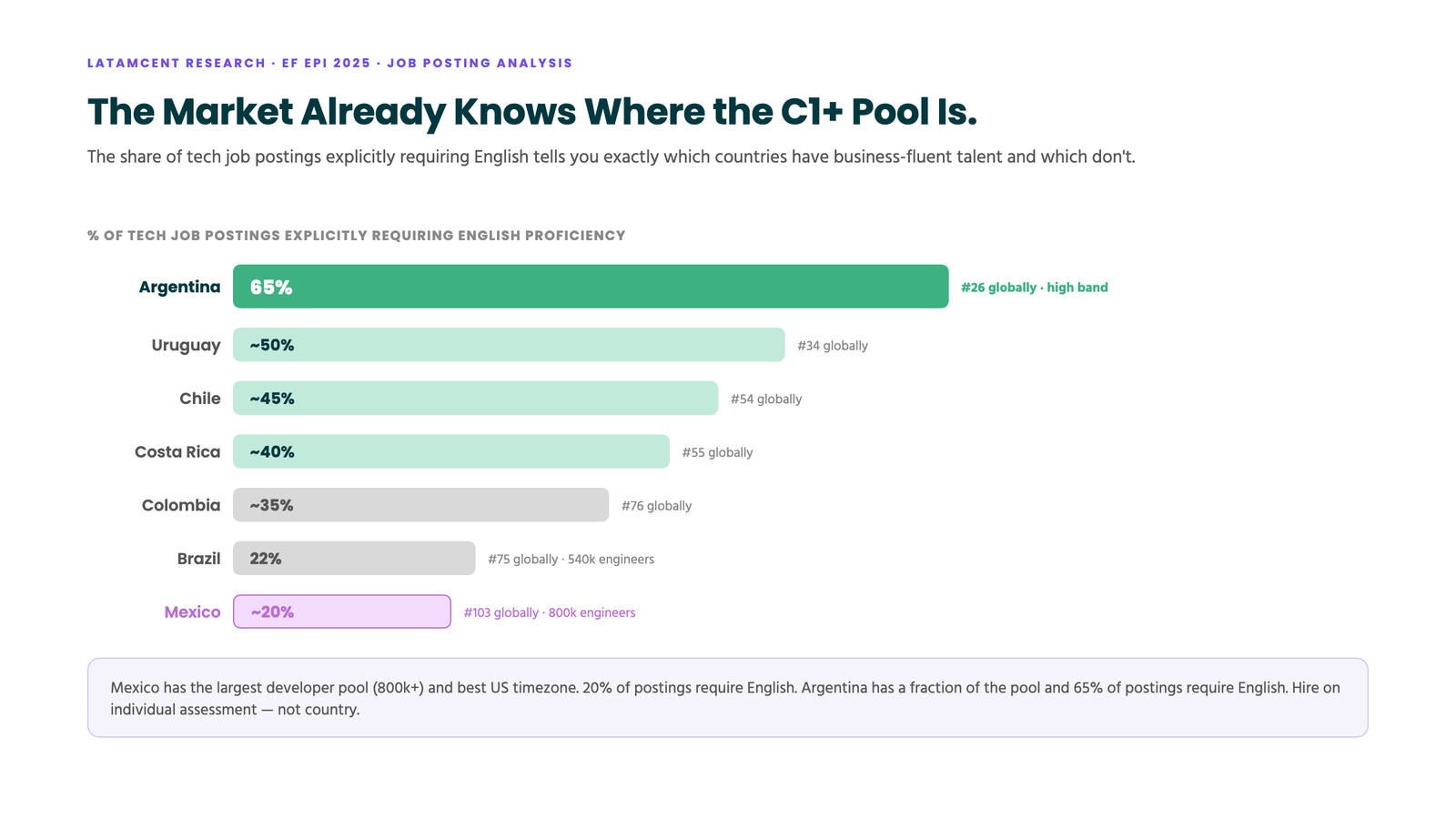
Read that table twice. Mexico, the country with the best timezone alignment to the US and the largest raw developer pool (800k+), ranks #103 of 123 globally on English. Brazil, LATAM’s second-largest tech market, sits at #75. Meanwhile Argentina, with roughly 150k developers, leads the entire region at #26.
The job-posting analysis tells the same story from the demand side: across 1,000+ software developer postings reviewed on LATAM job boards, 65% of Argentine postings explicitly required English proficiency. In Brazil, that number was 22%. The gap is not subtle.
If you hire on country reputation or timezone convenience, you will get burned. If you hire on individual assessment, the country stops mattering, because strong C1+ candidates exist in every one of these markets. They are just a much smaller share of the raw pool in some countries than others.
The age advantage working in your favor
One finding from the EF EPI 2025 that directly impacts tech hiring: Latin America shows the widest age disparity in English proficiency of any region, meaning younger professionals dramatically outperform older cohorts. The tech workforce skews young. The people you are hiring from are the strongest English cohort their countries have ever produced.
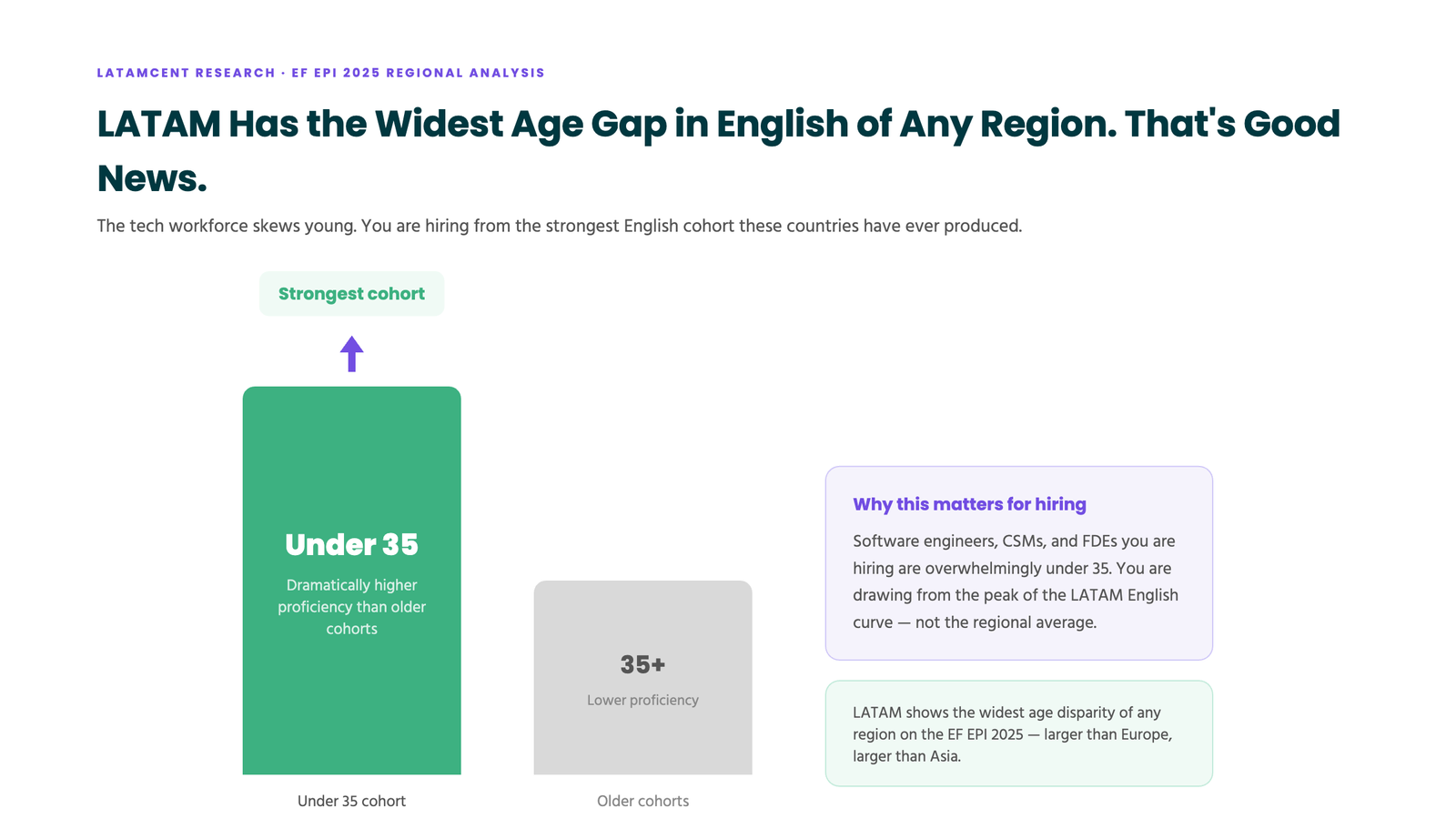
This is not an accident. It is the compounding result of English-medium tech education expanding across the region, US-company remote work becoming a career path instead of a curiosity, and AI/ML adoption (87% of LATAM startups now use AI solutions) requiring English-language documentation, tools, and collaboration.
Why grammar tests lie and live assessment is the only thing that works
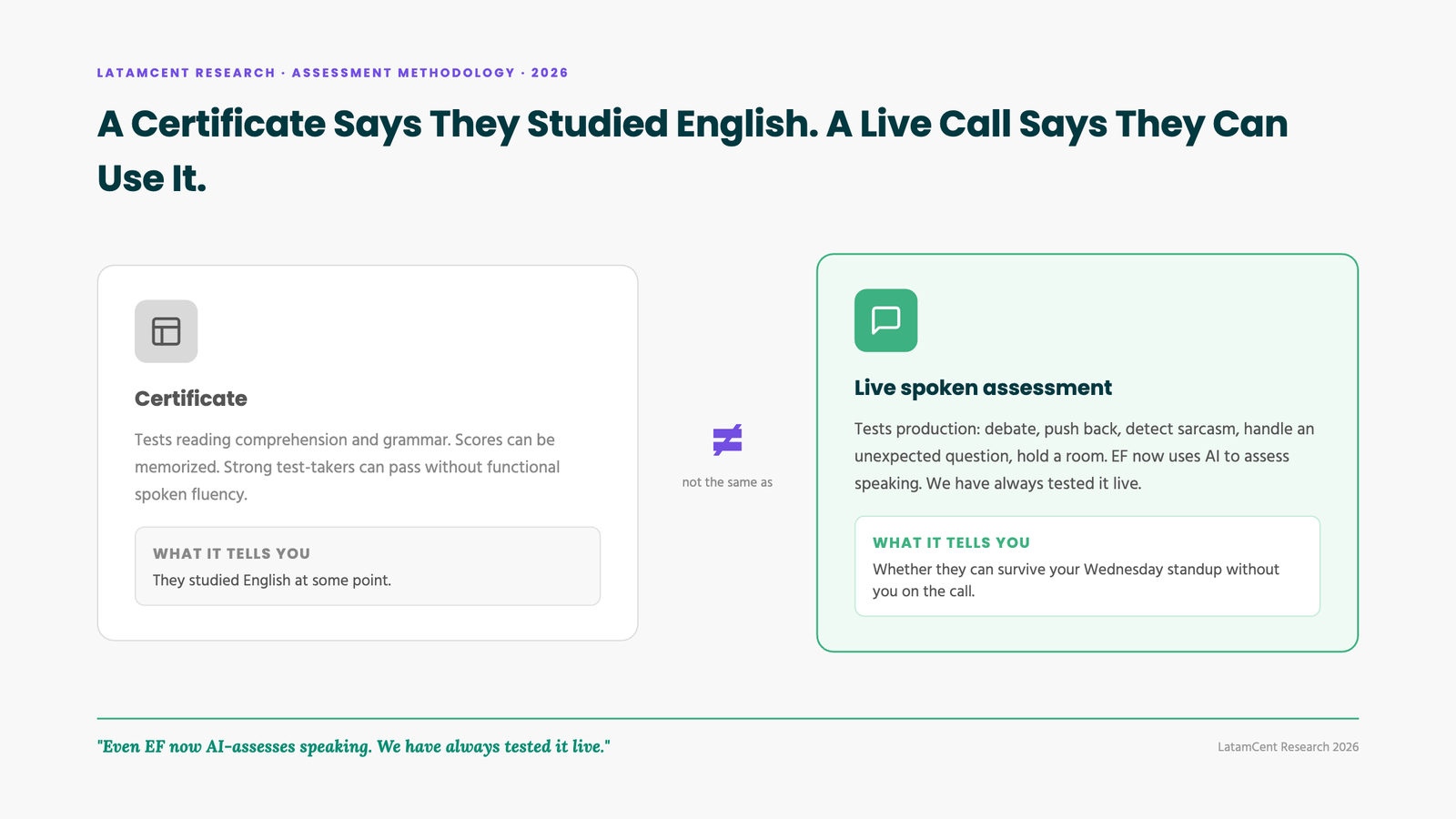
EF’s 2025 index made a methodological change worth understanding: for the first time, it assessed speaking and writing with AI evaluation, not just reading and listening comprehension. The reason matters for hiring. Comprehension skills and production skills diverge sharply across most countries. A candidate can score B2+ on a multiple-choice test and freeze on a live customer call.
This is the core failure mode of English screening in nearshore hiring. Companies that screen with written tests or certificates get a false sense of security. The candidate “passed English” but cannot hold the Wednesday standup. What you actually need to test is whether someone can debate, push back, and hold a room in real time. Certificates test the first thing. Live spoken assessment tests the second thing. We test the second thing.
LatamCent’s own AI-powered English screening data, including inbound rejection rates and conversational vs. fluent pass rates by country, will be added here as the dataset matures.
What this means for your hiring bar
Set two bars, not one.
For heads-down engineering, data, and back-end roles that operate inside the codebase and communicate through PRs and Slack: B2 is the floor. The pool at this level is deep across the region. Screen for it, confirm it on a live call, but do not over-index on it when the role is fundamentally about shipping code.
For customer success, GTM, FDE, finance, leadership, and anything that touches a customer, a board, or a prospect: C1 is the floor. The pool at this level is narrower, concentrated in Argentina, Uruguay, Chile, and the tech-hub cohorts of Colombia and Mexico, and it commands a 20-30% salary premium. Do not try to save money by hiring a B2 candidate into a C1 seat. The first client call will cost you more than the premium.
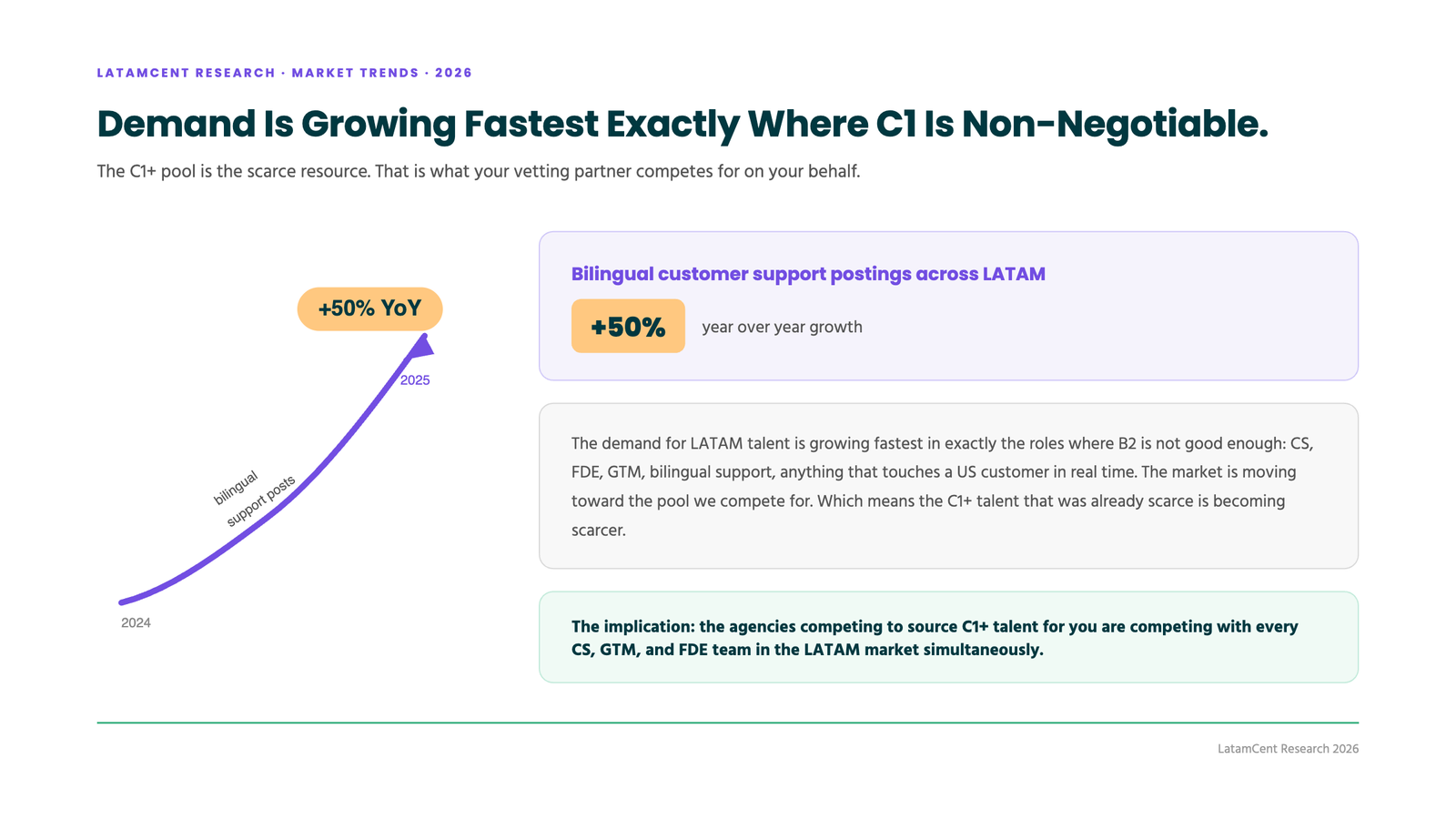
The market is moving toward C1 as the default expectation: bilingual customer support job postings across LATAM grew 50% year over year, meaning demand is expanding fastest in exactly the roles where conversational English is not enough.
Methodology
Country-level data from the EF English Proficiency Index 2025 (2.2 million test takers, 123 countries and territories, first edition with AI-assessed speaking and writing): Argentina #26 (575), Uruguay #34 (542), Chile #54 (517), Costa Rica #55 (516), Brazil #75 (482), Colombia #76 (480), Mexico #103. Regional averages: Latin America ~510, Europe ~590. Age disparity finding from EF EPI 2025 regional analysis. Job-posting English-requirement data from Next Idea Tech analysis of 1,000+ software developer postings across Computrabajo and Bumeran (65% English-required in Argentina, 22% in Brazil). C1/C2 salary premium (20-30%) from Teilur Talent 2026 LATAM Developer Salary Report. AI adoption (87% of LATAM startups) from Randstad Digital 2025. Bilingual support posting growth (50% YoY) from published LATAM hiring market analyses. Developer pool sizes from Athyna 2026 (2.6M+ region-wide, Mexico 800k+, Brazil 540k+, Colombia 200k+, Argentina 115-150k, Chile 60-100k).
Your next hire’s English should be verified before the first interview, not discovered during it. Every LatamCent candidate gets a live English assessment before reaching your calendar. Book a free hiring call at latamcent.com.
This study is part of our Research & Insights series.
Cite this research
Found this useful? You are welcome to cite or link this study. Suggested citation:
LatamCent. "How Strong Is English Across LATAM Tech Talent? (Real Data)" Research & Insights, LatamCent, 2026, https://latamcent.com/research-insights/latam-english-proficiency-data/.