

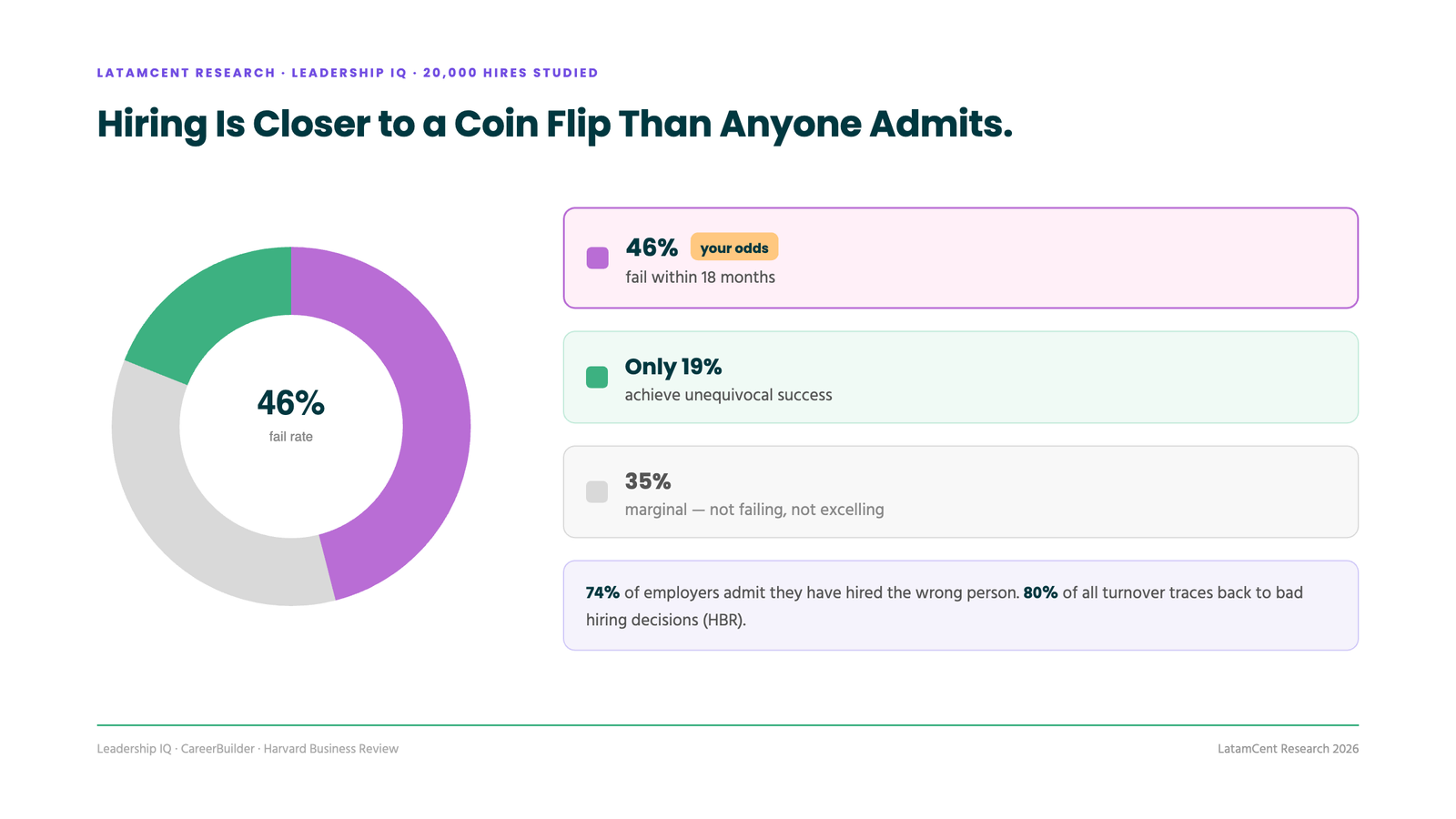
A mis-hire costs roughly 1.5× the role’s annual salary once you count replacement, ramp, and lost output. The published range runs from the US Department of Labor‘s conservative 30% floor to CoderPad’s 3× estimate for failed engineers. And it happens constantly: 46% of new hires fail within 18 months, and 74% of employers admit to hiring the wrong person.
Cost | Based on LatamCent replacement data, benchmarked against US Department of Labor, SHRM, CareerBuilder, Leadership IQ, and Gallup research | Last updated July 2026
Key findings
- A mis-hire costs roughly 1.5× annual salary: a $225k mistake on a $150k role.
- 46% of new hires fail within 18 months; 74% of employers admit a bad hire.
- 89% of hiring failures are attitudinal, not technical (Leadership IQ).
- Underperformers consume 10-12 hours of manager time per week.
- Expected loss on one unstructured senior hire: ~$100k (0.46 × $225k).
Nobody budgets for the bad hire. The hiring plan has a salary line, a benefits line, maybe a recruiting fee. It does not have a line for “engineer who interviewed brilliantly, shipped nothing for seven months, and demoralized the two people who had to cover for him.”
The research says that line item should exist, because the bad hire is not an edge case. It is close to a coin flip. Leadership IQ’s landmark study found that 46% of new hires fail within 18 months, and only 19% achieve unequivocal success. CareerBuilder found 74% of employers admit to having hired the wrong person. Harvard Business Review attributes 80% of all employee turnover to bad hiring decisions.
We see the aftermath constantly, because a meaningful share of our new clients arrive immediately after a mis-hire. They come to us with precise, painful math about what it cost them. We started tracking it, and the published research brackets our numbers exactly.
What the research says a bad hire costs
| Source | Estimate | What it covers |
|---|---|---|
| US Department of Labor | 30% of first-year earnings | The conservative floor: direct replacement costs only |
| CareerBuilder | $17,000 average per bad hire; $240,000+ for executives | Reported direct losses across surveyed employers |
| SHRM | 50-75% of salary (entry), 100-150% (mid-level technical), 200-213% (C-suite) | Full replacement cycle including productivity loss |
| Gallup | 50-200% of annual salary | Recruiting, training, lost productivity, morale |
| CoderPad | ~3× annual salary (~$300k) for a failed engineer | The engineering-specific worst case |
| Center for Creative Leadership | $750k-$2.7M per failed executive; 40% of executives fail within 18 months | The executive tier |
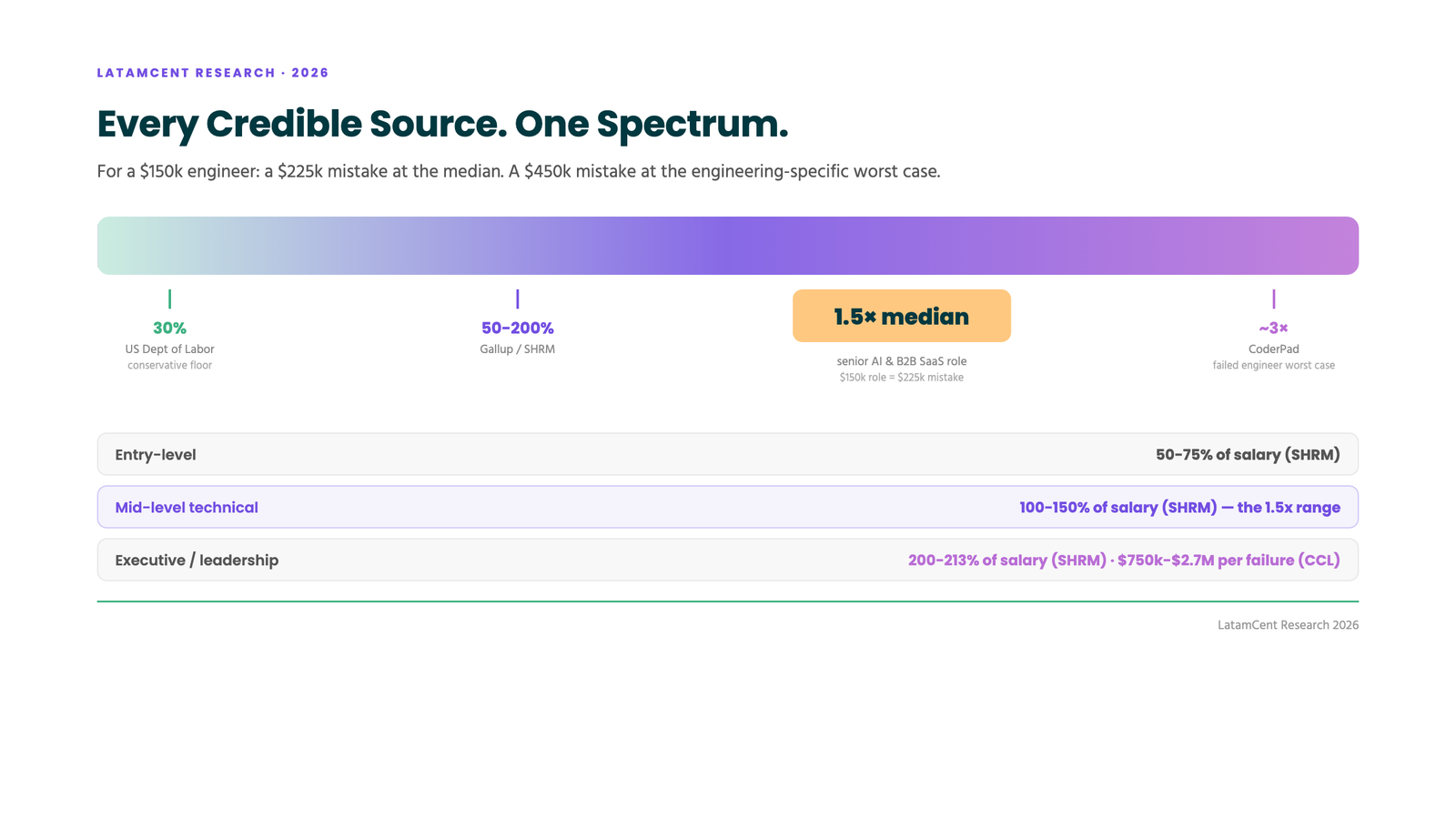
Our 1.5× figure for a senior role at an AI & B2B SaaS company sits in the middle of that bracket, and the SHRM mid-level technical band (100-150%) lands directly on it. For a $150k engineer, that is a $225k mistake. For the executive tier, multiply.
The anatomy of 1.5×
| Cost component | Typical hit (share of annual salary) | The part nobody counts |
|---|---|---|
| Salary and benefits paid before exit | 40-60% | Most mis-hires take 5-7 months to exit. Nobody fires at month two |
| Recruiting and restart cost | 15-25% | You pay for the search twice, plus the reopened-role vacancy clock |
| Onboarding and ramp, burned twice | 20-30% | Engineers take 3-12 months to reach full productivity. A month-9 failure means you paid the entire ramp and got nothing |
| Lost output and delayed roadmap | 30-50% | The feature that slipped a quarter, the deal that needed the SE who wasn’t there |
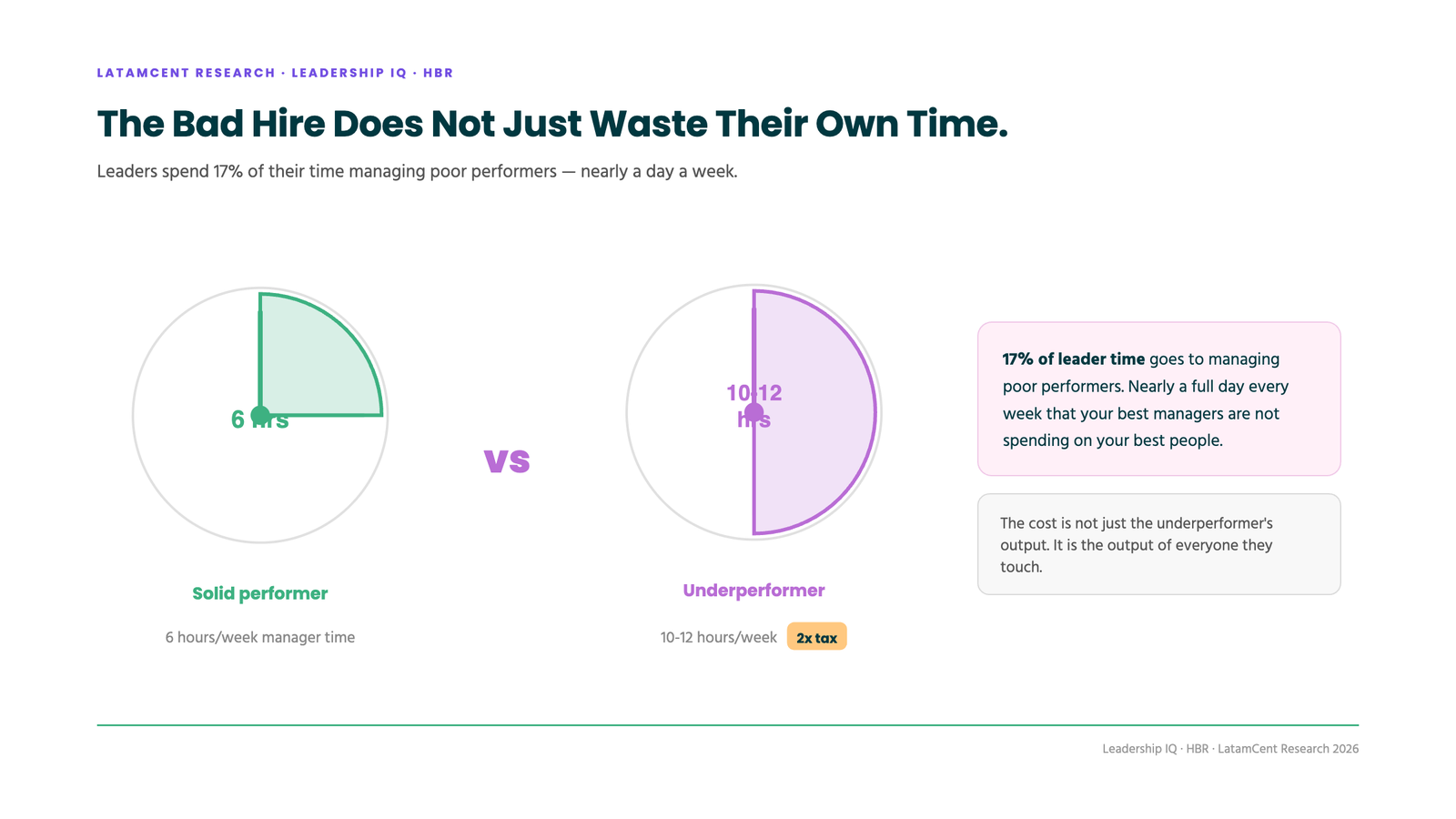
| Team drag and manager tax | 10-20% | Underperformers consume 10-12 hours of manager time per week vs 6 for a solid performer. Leaders spend 17% of their time managing poor performers: nearly a day a week |
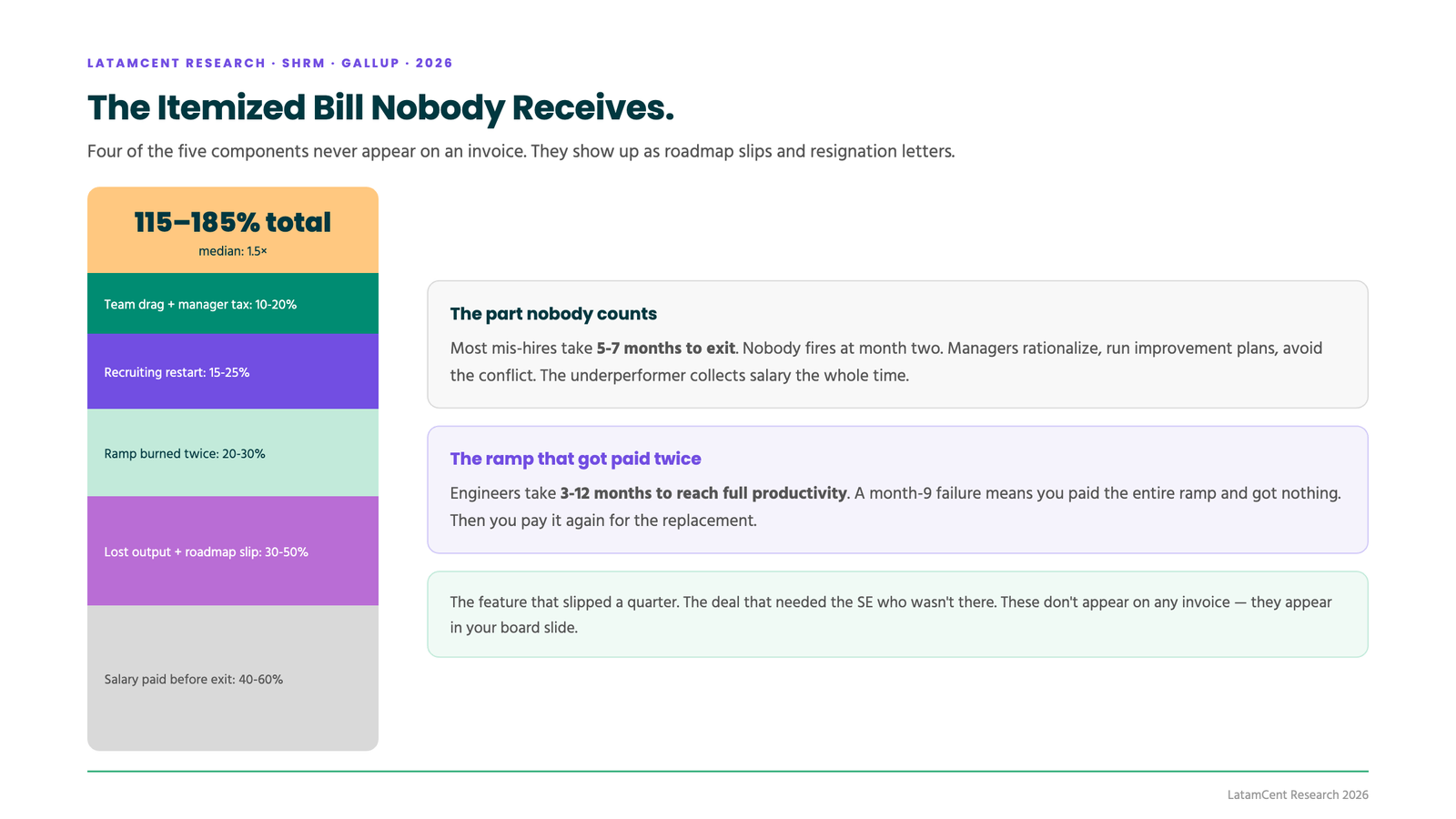
Total: 115-185% of annual salary. Call it 1.5× at the median.
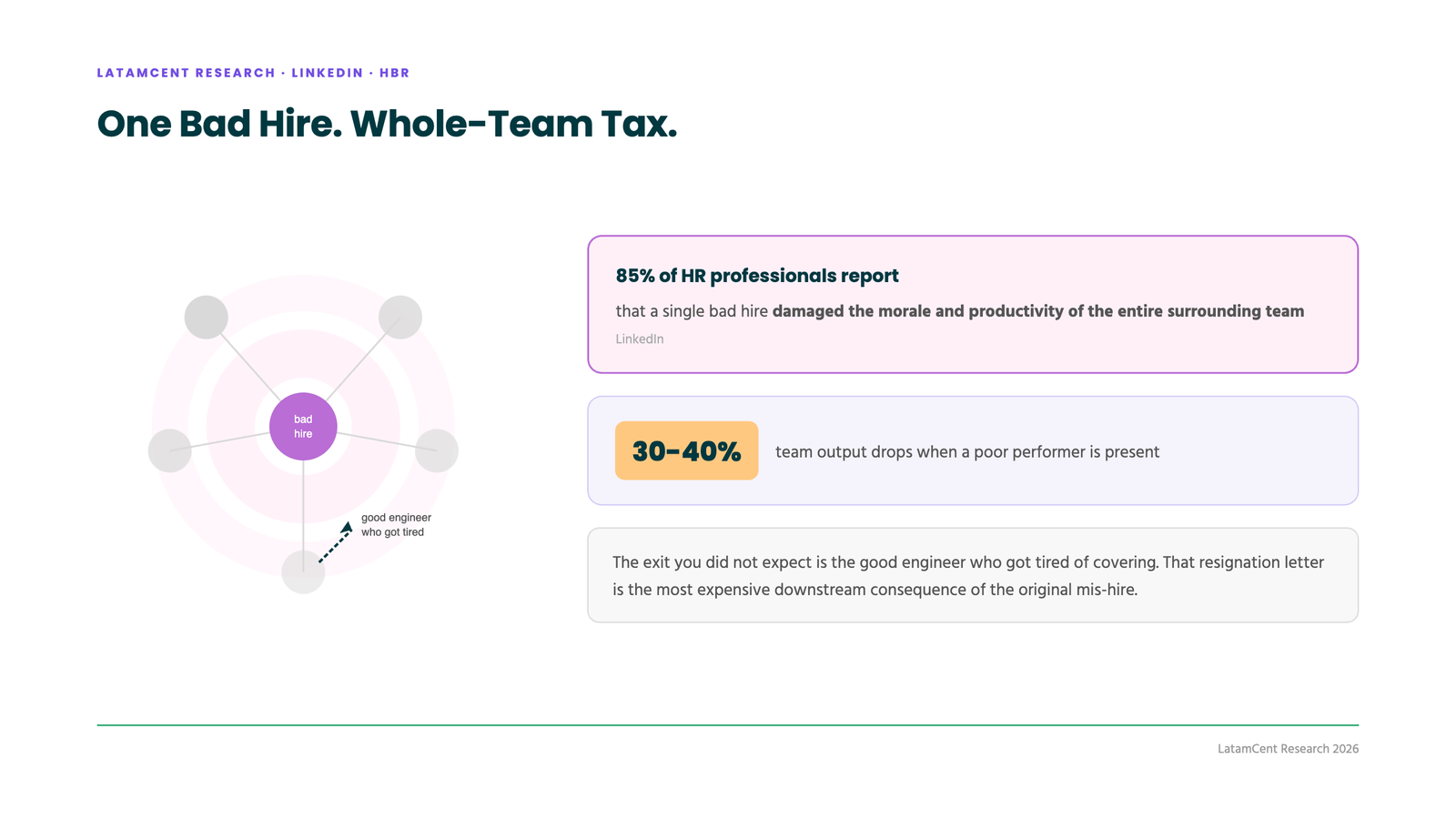
The last column is why finance never sees this number. Four of the five components never appear on an invoice. They show up as a roadmap slip, a manager working Saturdays, and a resignation letter from the good engineer who got tired of compensating. LinkedIn’s data makes the contagion explicit: 85% of HR professionals report that a single bad hire damaged the morale and productivity of the entire surrounding team, and poor performers drag team output down 30-40%.
The part that should change your interview process: it is almost never skills
Here is the most useful finding in the entire bad-hire literature, from Leadership IQ’s study of 20,000 hires: 89% of hiring failures are attitudinal, not technical. Coachability, emotional intelligence, motivation, temperament. Only 11% of failures come from a lack of skill.
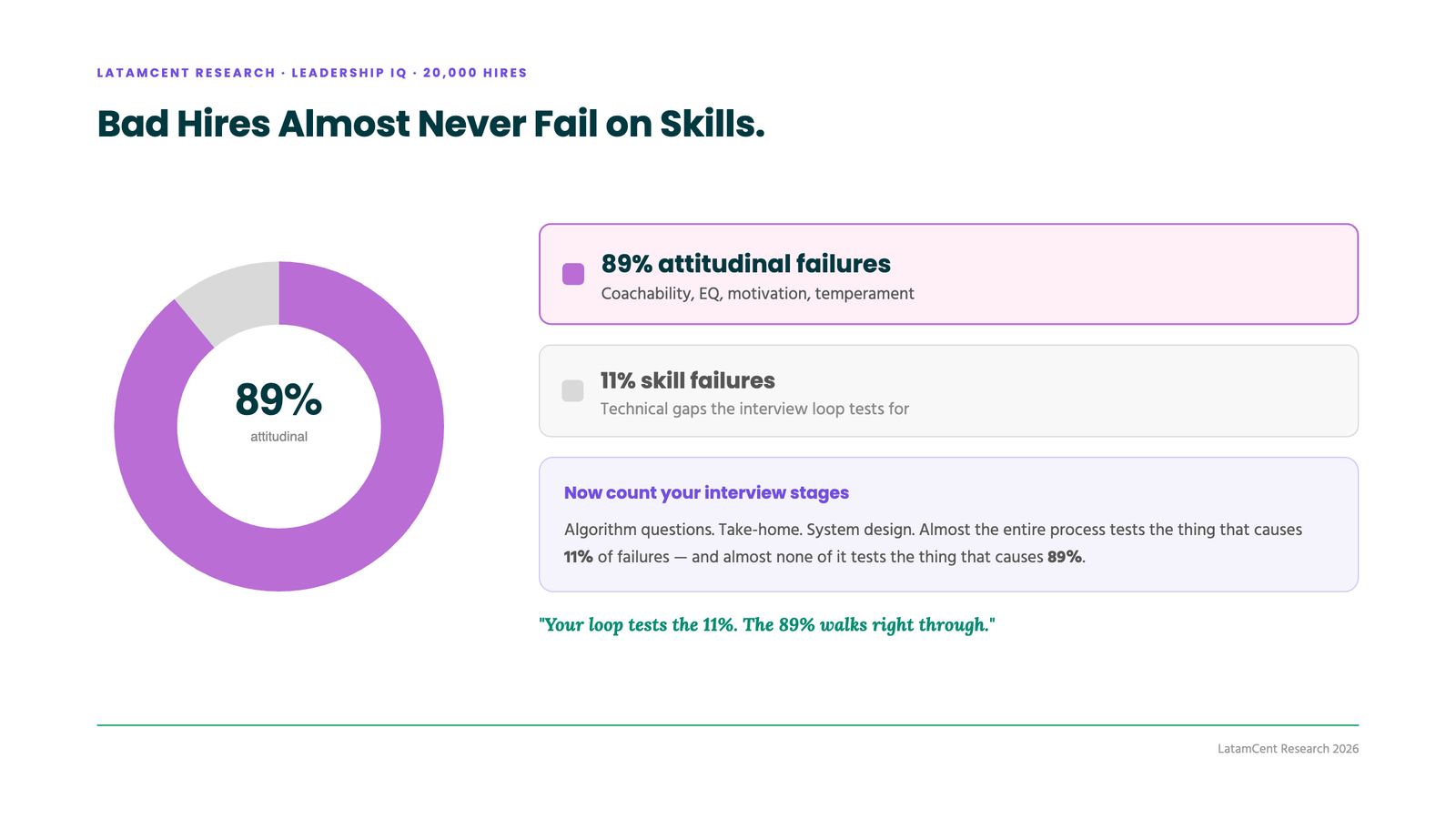
Now look at how most AI & B2B SaaS companies interview: algorithm questions, take-home projects, system design. Almost the entire process tests the thing that causes 11% of failures, and almost none of it tests the thing that causes 89%. The candidate who interviews brilliantly and fails at month seven did not get worse at coding. He was never going to survive ambiguity, feedback, or a fast-moving team, and nothing in the loop checked.
The fix is boring and proven: structured interviews, work-sample assessments, live communication evaluation, and reference checks that ask real questions. This is the actual argument for pre-vetted hiring, and it is stronger than the cost argument. Every candidate we submit has been interviewed live (communication and temperament, not just skills), English tested, assessed when the client requires it, and guided through a structured 4-5 step client process. The vetting does not just save screening hours. It attacks the 89%.
The asymmetric bet
Run the expected-value math on two paths for one $150k-equivalent senior role.
Path A: US hire, standard unstructured process. Base rate of failure within 18 months: 46%. Expected cost of the mis-hire branch: 0.46 × $225k ≈ $100k of expected loss per hire, before the salary premium. That is the invisible tax on every unstructured hiring loop, and it is why 80% of turnover traces back to the hiring decision itself.
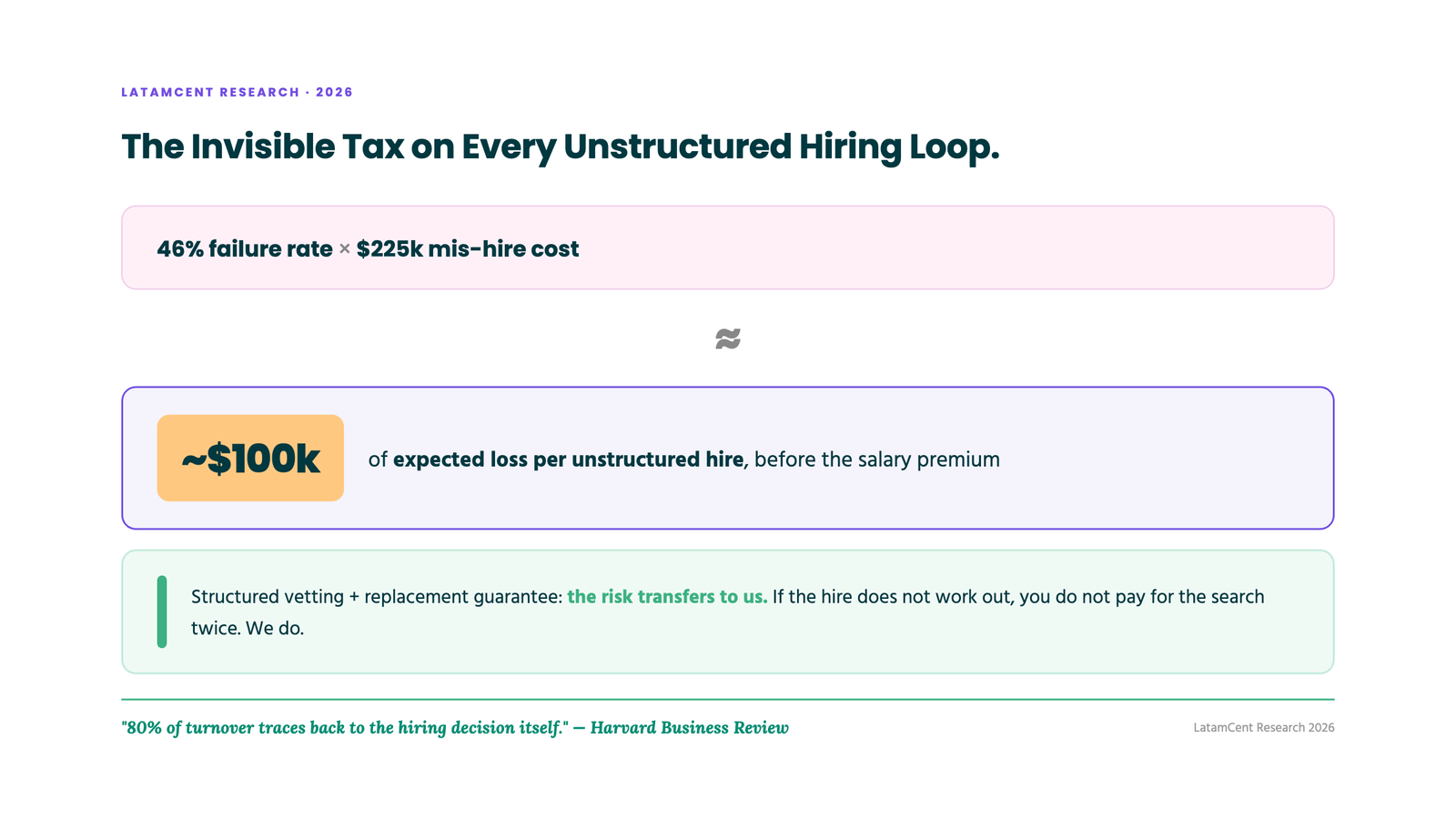
Path B: nearshore hire at ~55% of the cost, structured vetting done before you interview, and a replacement guarantee that transfers the mis-hire risk to us. If the hire does not work out, you do not pay for the search twice. We do.
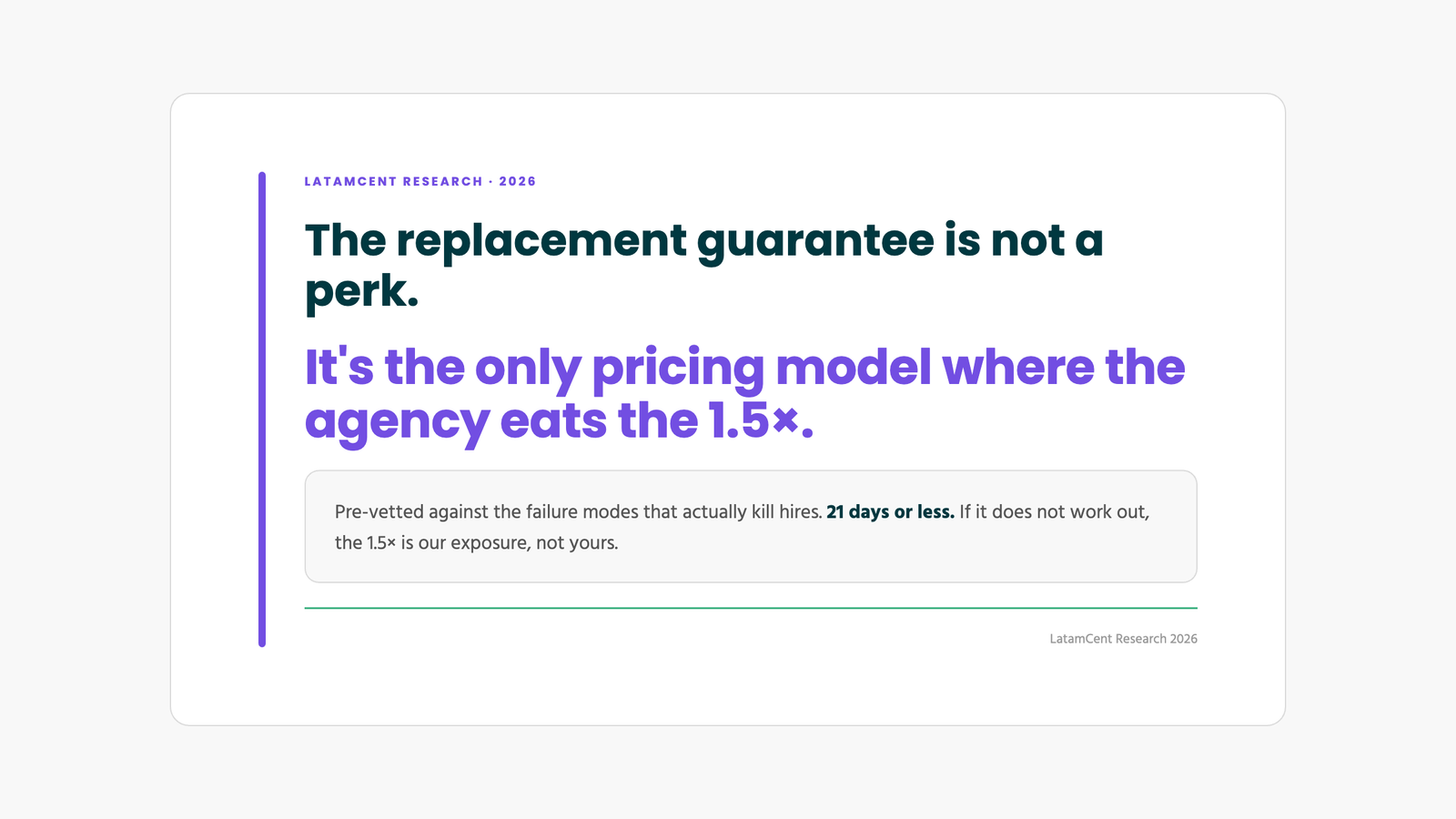
The replacement guarantee is not a perk. It is the only pricing model where the agency eats the 1.5× instead of the client.
Methodology
Cost components modeled from LatamCent client intake and replacement data across US AI & B2B SaaS companies, cross-referenced against published research: US Department of Labor (30% of first-year earnings, conservative floor); CareerBuilder ($17,000 average reported loss, 74% of employers admitting a bad hire, $240,000+ executive-level losses); SHRM (50-75% entry-level, 100-150% mid-level technical, 200-213% C-suite); Gallup (50-200% of salary); CoderPad (~3× salary for failed engineers); Center for Creative Leadership (40% executive failure rate within 18 months, $750k-$2.7M per failure); Leadership IQ (46% of new hires fail within 18 months, 19% unequivocal success, 89% attitudinal failure causes, 10-12 manager hours/week per underperformer); Harvard Business Review (80% of turnover from bad hiring, 17% of leader time on poor performers); LinkedIn (85% of HR professionals reporting team-wide morale damage). Engineer ramp time (3-12 months to full productivity) from published engineering productivity research. The 1.5× figure represents the median senior role at an AI & B2B SaaS company blending direct and indirect costs.
The most expensive hire is the wrong one, and the odds are worse than you think. LatamCent placements are pre-vetted against the failure modes that actually kill hires, placed in 21 days or less, and backed by a replacement guarantee. Book a free hiring call at latamcent.com.
This study is part of our Research & Insights series.
Cite this research
Found this useful? You are welcome to cite or link this study. Suggested citation:
LatamCent. "What Does a Bad Hire Really Cost an AI & B2B SaaS Company? (1.5x Salary Breakdown)" Research & Insights, LatamCent, 2026, https://latamcent.com/research-insights/cost-of-a-bad-saas-hire/.