


SaaS teams don’t struggle to hire engineers because there are no applicants. They struggle because weak hiring signals turn recruiting into calendar chaos.
The result: lots of interviews, few hires, and even fewer hires who ship reliably.
Weeks of interviews don’t close, engineering time gets burned on bad candidates, and roles stay open while your roadmap slips. General recruiting rarely has the depth to screen engineering work, so the process causes pain rather than hires.
Specialized technical recruiters reduce that drag by building pipelines that filter for real ability, not just keywords, so hiring managers stop living in interviews.
Key Takeaways
- SaaS teams struggle with hiring signal. High application volume does not equal high-quality hires.
- Weak screening creates interview overload. Engineering time gets consumed by low-relevance conversations.
- Specialized technical recruiters focus on real ability. They filter for production experience, ownership, and judgment under pressure to deliver.
- General recruiters often screen for keywords. Specialized recruiters screen for contributions in live product environments.
- SaaS roles shift quickly. Engineers often handle delivery maintenance incidents and product discussions in the same role.
- Standard technical interviews often miss practical judgment. Solving puzzles does not guarantee strong production performance.
- Experienced SaaS engineers remain in short supply. High demand increases time to fill and pressure to compromise.
- Fast hiring without a strong signal creates rework. Replacing a weak hire costs time, money, and delivery momentum.
- International hiring adds payroll and compliance complexity. Specialized recruiters reduce administrative drag.
- Nearshore technical recruiters maintain vetted pipelines. Shortlists reflect SaaS exposure and distributed team experience.
- Structured screening improves the prediction of job performance. Practical assessments and communication clarity matter more than credentials.
- Agencies manage sourcing, evaluation, and onboarding. That reduces the time between offer and meaningful output.
- SaaS hiring requires depth in technical evaluation and context awareness. Specialized recruiters protect roadmap velocity.
- If interviews are constant but delivery feels slow, the issue is hiring signal, not effort.
What is a Technical Recruiter?
A technical recruiter specializes in hiring engineers, product managers, and other technical professionals for tech companies.
The job is practical: build a qualified pipeline, screen for engineering judgment, and protect hiring managers from spending half their week in low-signal interviews.
Unlike generalist recruiters who cover many roles and industries, technical recruiters build industry knowledge about what “good” looks like in engineering work.
They look for evidence of ownership, problem-solving under conditions, and communication that works when decisions move fast.
They build sourcing depth through developer communities and engineering networks. Screening covers technical skill and the ability to collaborate in distributed teams. In product teams with frequent releases, evaluation focuses on whether candidates can operate in fast release cycles, rather than only matching keywords on a job spec.
The role also requires understanding how engineering work maps to business outcomes. A specialized recruiter assesses whether a backend engineer can handle production constraints under growth, not just sound confident on a Zoom call.
What is The Role Of Technical Recruiters in IT Hiring?
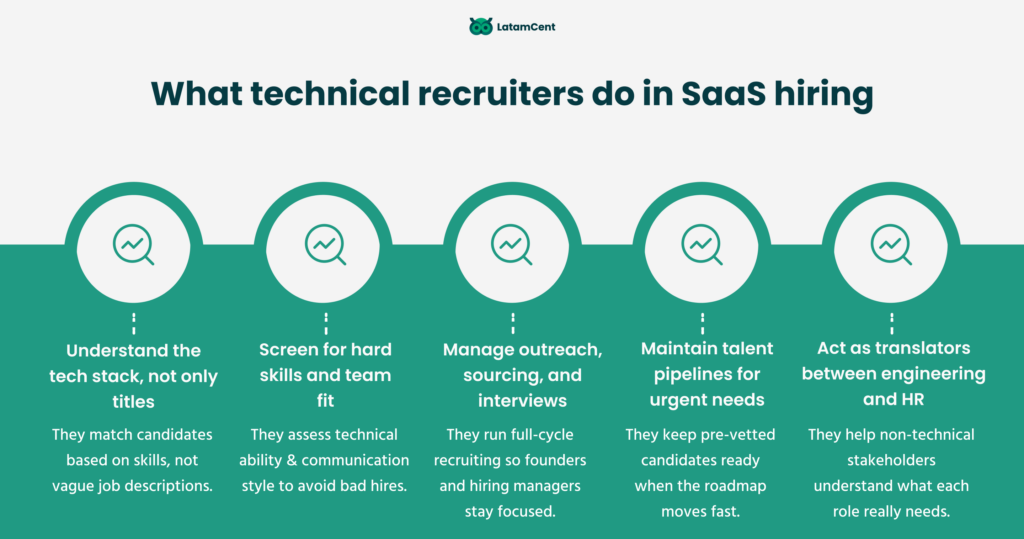
Technical recruiters support IT hiring in three ways: sourcing qualified candidates, structuring screening, and coordinating closely with hiring managers so the process remains consistent.
During sourcing, they identify passive candidates through direct outreach rather than relying only on job board applications. The focus stays on professionals who aren’t actively job searching but have a proven track record in similar systems or teams.
Most hiring processes either signal or lose it during screening.
Structured interviews tend to correlate more strongly with job performance than unstructured interviews. Loose conversation or puzzle prompts often create false confidence. When interviews rely on loose conversation or puzzle prompts, signal breaks.
Coordination is the unglamorous part that keeps hiring from dragging. Recruiters translate requirements into evaluation criteria, manage scheduling across time zones, and keep feedback loops tight so decisions don’t slow.
Challenges in SaaS Recruitment
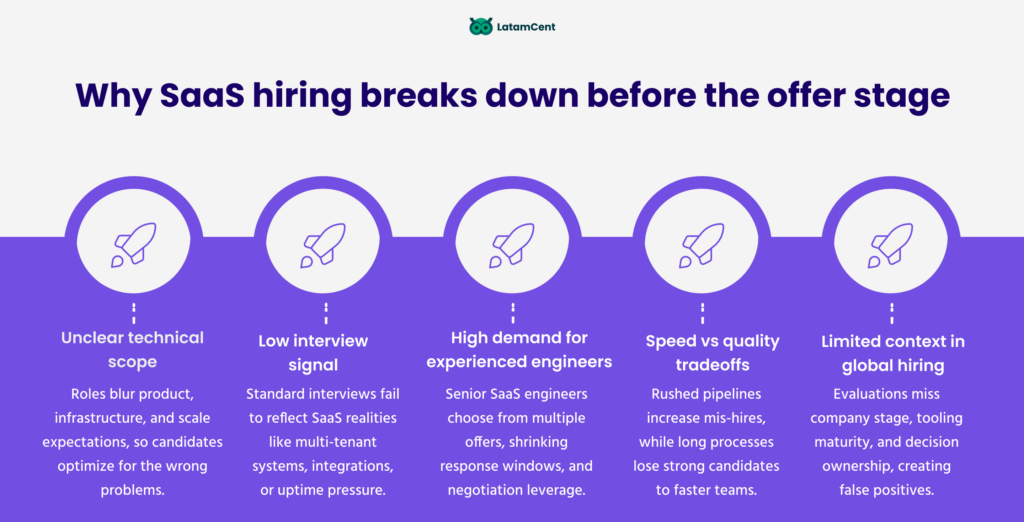
SaaS hiring gets hard in repeatable ways. The scope changes, the interview signal is noisy, and the market makes “just hire someone” an expensive fantasy.
Unclear Technical Scope in SaaS Roles
Role scope changes week to week in SaaS, as the main roles SaaS companies should hire.
Engineering work blends product delivery, system ownership, and continuous iteration, often simultaneously within the same role.
A backend engineer might make decisions that affect scalability, maintain production systems that can’t go down, and adjust work as customer needs grow.
Incidents and roadmap changes are the role’s responsibility. You hired an API developer to build the API. Three months later, they’re also fixing database queries, troubleshooting production alerts, and explaining technical decisions to the sales team. The title stays stable. The job doesn’t.
That moving scope makes hiring harder to evaluate. Teams think they are hiring for one shape of the job, only to have the role quietly mutate after onboarding.
Limited Signal From Standard Technical Interviews
Standard technical interviews often fail to predict contribution in SaaS teams because interview performance doesn’t always map to real output in live product conditions.
A consensus algorithm developer might solve algorithmic problems and still struggle to debug production systems, prioritize under pressure, communicate trade-offs to non-technical stakeholders, and work well with the team’s collaboration style. SaaS work rewards judgment, clarity, and ownership in messy conditions.
Casual technical conversations and puzzle prompts are easy to run, so teams default to them. Interview performance looks meaningful.
On-the-job performance tells a different story.
More applications only magnify the problem. Volume adds noise, then teams spend more time filtering than building.
High Demand for Experienced SaaS Engineers
The market for experienced SaaS predictive analytics engineers is structurally constrained. Tech roles can attract a high volume of applicants, but qualified candidates remain scarce. Hiring benchmarks show that tech roles can attract high applicant volume.
Many applicants come from environments with slower release cycles and narrower ownership. SaaS teams need people who have already operated in fast feedback loops and live systems.
The pattern is consistent: longer time-to-fill, more drop-offs, and more pressure to compromise.
Tradeoffs Between Speed & Hire Quality
Roadmap pressure makes “good enough” tempting. It also makes “good enough” expensive.
Hiring quickly can reduce short-term pain, but a weak hire creates drag, more review overhead, more rework, and more management time spent patching gaps instead of supporting delivery. Re-hiring also has a real cost.
Replacing an employee can cost at least one-third of their salary, including recruiting costs, lost productivity, and team disruption.
Fast hiring is not the enemy. Low-signal hiring is. (One fills seats. The other fills your week with “quick sync?” meetings.)
Lack of Context in International Hiring
International hiring adds complexity that most SaaS teams aren’t staffed to handle. Payroll, classification risk, benefits, and contracts vary by country, and mistakes can cause delays and legal exposure.
Even when the candidate is strong, the administration can slow down onboarding and create risk. Teams that hire only domestically often underestimate this until it affects finance and ops workflows.
Benefits of Working With Nearshore Tech Recruiting Agencies in Latin America
Tech recruiting agencies can help when you need a stronger signal, faster shortlists, and access to the right talent without building all of that capability in-house.
Access to Vetted Tech Talent With Proven Experience
Recruiting firms maintain active candidate pools and screening notes from recent searches, enabling them to identify candidates who already match SaaS requirements.
Instead of starting from zero with each search, agencies draw from engineers assessed for technical depth, communication, and evidence of prior delivery.
This reduces the filtering burden from dozens of random applicants to a smaller set of candidates who match the role’s actual needs. Agencies continually evaluate talent, not only when a company opens a role.
Shortlisted candidates tend to have experience in similar environments and team patterns, proven ability to work in distributed teams, and references from relevant projects.
Faster Hiring Timelines Through Established Recruiting Networks
Specialized recruiters reduce time-to-fill by maintaining relationships with passive candidates who aren’t actively job searching but remain open to the right opportunity.
Speed comes from an active pipeline and front-loaded screening. Hiring managers interview fewer candidates, and each interview has higher odds of being relevant.
Cost Control Through Nearshore Hiring Models
Nearshore hiring can improve cost planning because pricing and payroll logistics are clearer upfront, especially when teams are hiring multiple roles.
Cost control is not only about salary. It also means fewer hiring cycles, fewer stalled searches, and fewer weeks of missed deliveries while the role remains open.
Legal & Contract Support for Cross-Border Hiring
Recruiting agencies often provide Employer of Record (EOR) services that handle payroll coordination, benefits administration, and contract management for international hires.
That support reduces administrative load and lowers classification risk. It also helps teams onboard hires faster without building internal expertise for every country’s rules.
Scalable Hiring Options for Growing SaaS Teams
Agencies help teams adjust recruiting efforts as hiring volume changes. You can push harder during a hiring sprint, then scale back without carrying permanent recruiting overhead.
This flexibility matters when headcount plans change in response to revenue targets, runway, or product priorities.
How Nearshore Agencies in Latin America Manage the Hiring Process
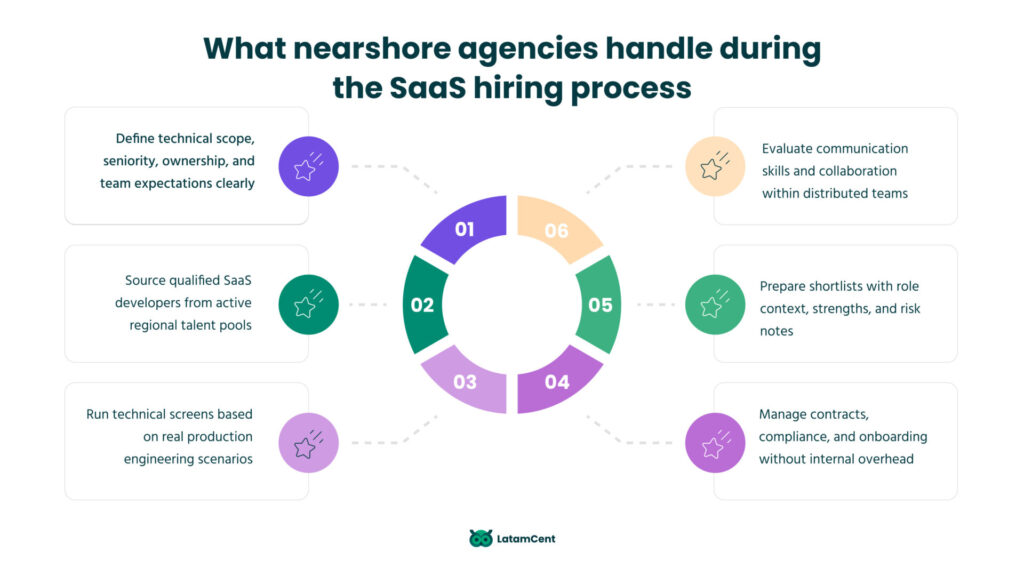
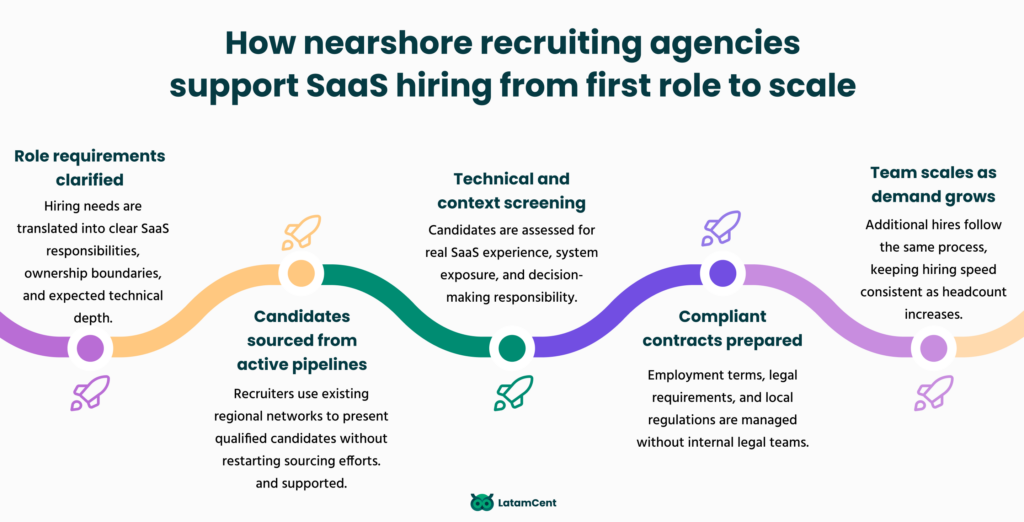
Step 1: Define Technical & Hiring Requirements
Nearshore agencies in Latin America don’t start with resumes. They start with precision.
Technical recruiters work directly with hiring managers to define what success actually looks like in your environment. That means clarifying the tech stack, release cadence, level of ownership, and how this role interacts with product and revenue goals. “Senior” in a seed-stage SaaS is different from “senior” in a post-Series B company with a multi-team architecture. Agencies pressure-test those definitions early.
This step also separates must-haves from nice-to-haves. Without that distinction, teams over-filter and lose strong candidates. Specialized recruiters bring deep domain knowledge of engineers, data professionals, and SaaS marketing talent, enabling them to map skill clusters to real production needs rather than relying on generic job descriptions.
In 2026, skills-based hiring dominates. Agencies focus on practical ability, recent portfolios, and hands-on impact rather than degree pedigree. That clarity reduces mismatches and shortens hiring cycles.
When done properly, this stage prevents scope drift and confusion about hiring later.
Step 2: Source Qualified Developers From Regional Talent Pools
Once the role is scoped, sourcing begins, and this is where specialized nearshore agencies create leverage.
Instead of relying on standard job boards, technical recruiters use niche platforms such as GitHub and Stack Overflow, along with curated regional communities and proprietary networks built over years of SaaS placements. These networks include engineers and marketers who are not actively applying but are open to the right opportunity.
Specialized recruiters in Latin America maintain strong industry relationships, giving them access to a broader and more qualified talent pool. For SaaS companies, this matters. General agencies often lack the nuance required to identify professionals who understand both technical systems and customer engagement, particularly in growth marketing and revenue roles.
Modern agencies also use AI-assisted resume screening; nearly 87% of talent teams now rely on it for early evaluations. However, experienced recruiters don’t depend on automation alone. They combine technology with human judgment to evaluate relevance, production experience, and environment fit.
The result is a candidate slate that reflects real SaaS exposure, not just keyword alignment.
Step 3: Assess Technical Skills & Communication Fit
Screening is where weak processes collapse. Strong nearshore agencies apply structured assessments tied to your constraints, not abstract puzzles.
Technical recruiters with solid knowledge of programming languages and tech stacks can evaluate whether a candidate truly understands distributed systems, CI/CD workflows, or data modeling, not just interview theory. In 2026, practical assessments and portfolio reviews carry more weight than traditional credentials.
High-signal evaluation methods often include:
- Short, scoped take-home exercises aligned with real tasks
- Live debugging sessions
- System design prompts based on your architecture
- Review of recent production work
Communication fit is assessed in parallel. For managing remote SaaS teams, clarity matters as much as code quality. Recruiters evaluate async writing skills, time-zone collaboration, and how candidates explain trade-offs.
Candidates today also prioritize stability and clarity of career paths. Recruiters act as advocates, discussing growth opportunities and company culture early to ensure alignment on both sides.
This dual focus, technical rigor plus communication signal, reduces false positives and early attrition.
Step 4: Present Shortlisted Candidates for Client Interviews
A disciplined agency doesn’t send volume. It sends context.
Shortlists typically include 3–5 candidates, each presented with structured notes: what was tested, performance observations, compensation expectations, and potential risk areas to probe further. This shifts client interviews from basic screening to decision-making.
Recruiting agencies work closely with hiring managers to ensure that each candidate meets the defined skill thresholds. Because specialized recruiters understand SaaS growth stages and engineering structures, they can identify which candidates fit a scaling environment and which fit a stabilization phase.
For marketing roles in SaaS, this context is especially important. Companies need professionals who blend technical fluency with customer engagement strategy. Agencies clarify whether the candidate has driven measurable growth or simply supported campaigns.
By the time interviews begin, most filtering is complete. That preserves executive time and accelerates final selection.
Step 5: Finalize Contracts & Support Onboarding
Selection is only half the process. Execution matters.
Nearshore agencies in Latin America manage contracts, Employer of Record (EOR) setups, and country-specific compliance requirements. Without this structure, cross-border hiring can slow teams down due to tax, payroll, and labor law complications.
IT recruiting agencies streamline these logistics, reducing administrative burden and helping companies avoid compliance missteps. For contract roles, agencies can also provide temporary talent at competitive rates, giving SaaS teams flexibility during workload spikes.
Modern agencies also support onboarding coordination, aligning start dates, equipment logistics, and documentation flow so managers can focus on ramping up the hire.
When the process is structured end-to-end, productivity begins faster. That is the real objective: not filling roles, but reducing the time between contract signature and meaningful output.
A well-run nearshore agency turns hiring from a reactive scramble into a repeatable operating system.
Why SaaS Hiring Needs Specialized Technical Recruiters
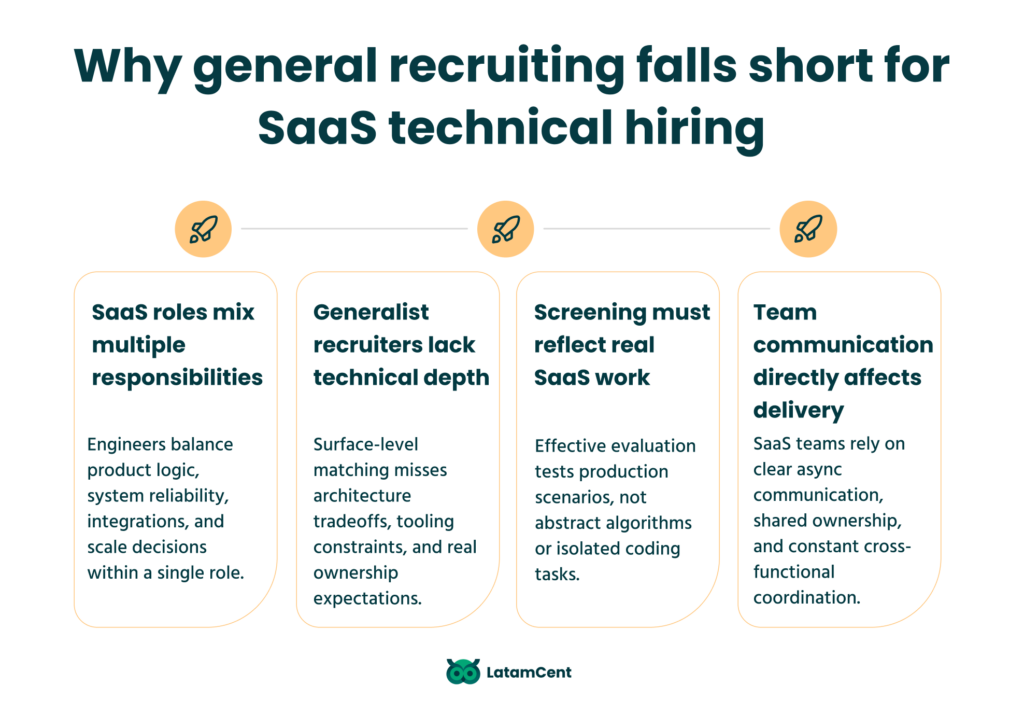
The challenges outlined above (unclear scope, weak interview signals, market constraints) all point to the same conclusion: SaaS AI/ML engineering roles combine breadth and depth in a constant state of change, and that mix is impossible to evaluate with generic recruiting patterns.
Complexity of SaaS Engineering Roles
In SaaS companies, engineers often aren’t siloed specialists. A backend engineer might own parts of system design, performance, integrations, and delivery workflows simultaneously.
That overlap increases evaluation complexity. The real question is not “can they code.” It’s “can they prioritize, own outcomes, and ship in a live system.”
Limits of Generalist Recruiting for Technical Teams
Generalist recruiters can verify keywords. They usually can’t assess technical nuance, communication under pressure, or what “good” looks like for ownership-heavy work.
Job boards generate nearly half of all applications but account for less than a quarter of successful hires.
Importance of Technical Screening & Contextual Evaluation
Technical screening needs context. SaaS teams care about production debugging, tradeoffs, and system decisions that affect delivery speed and reliability.
Specialized technical recruiters ask work-related questions, not generic prompts. They look for judgment and clarity, not only correctness in a vacuum.
Communication & Collaboration Expectations in SaaS Teams
SaaS teams ship through coordination. Engineers communicate decisions to product leaders, collaborate across time zones, and keep ownership clear as priorities change.
Strong technical skills without communication often create bottlenecks. More meetings, slower decisions, and fragile ownership.
Specialized technical recruiters screen for both technical capability and collaboration fit because SaaS delivery depends on the team operating smoothly.
Companies benefit from specialized technical recruiters when they need to fill multiple roles on a tight timeline, when in-house recruiting lacks strong screening, or when hiring internationally for the first time. Teams with mature recruiting systems and reliable referral pipelines may continue to hire internally.
Build Your Remote Engineering Team in Latin America With LatamCent
LatamCent helps SaaS companies quickly and precisely hire remote AI talent in Latin America.
Unlike general agencies, LatamCent specializes in SaaS. That means recruiters understand modern tech stacks, sprint cycles, product ownership, and what “senior” actually means in a startup versus a scaling company. Roles are carefully scoped before sourcing begins, ensuring candidates match real production needs.
LatamCent also supports cross-border hiring through Employer of Record (EOR) services. That means contracts, payroll, and country-specific compliance are handled properly, without your team having to navigate local labor laws on its own.
Engineers are sourced from vetted regional networks across Latin America, with strong English proficiency and U.S. time-zone overlap. Screening focuses on practical ability and communication clarity to reduce hiring risk.
From sourcing to contracts and onboarding, LatamCent manages the process end-to-end. The result: remote engineers who integrate quickly and contribute to your roadmap without unnecessary friction.
Conclusion
SaaS hiring is structurally complex because engineering roles require technical depth, product ownership, and collaboration that standard recruiting processes don’t screen for well.
Specialized technical recruiters improve hiring signal. They build qualified pipelines, screen with structure, and keep hiring managers focused on decisions that map to real performance.
Nearshore agencies can provide that specialization at scale, especially when teams are hiring multiple roles or adding international hires without building a full recruiting and compliance function in-house.
If your hiring process feels busy but shipping feels slow, you don’t have a motivation problem. You have a signal problem.
If you’re still wondering how to hire in Latin America, get in touch with LatamCent, and we’ll guide you through.