


Choosing the right SaaS hiring model for B2B SaaS companies depends on stage, revenue pressure, and product complexity.
Engineering and sales roles account for a large share of SaaS headcount. Hiring mistakes in those functions directly affect product delivery and recurring revenue. The challenge is not access to resumes. It is filtering for technical fluency, consultative selling ability, and alignment with a subscription-based business model.
AI-assisted hiring tools now automate resume screening and interview scheduling, reducing administrative workload and compressing time-to-hire. Data-driven metrics such as cost-per-hire and pipeline conversion rates give leadership clearer visibility into recruiting performance.
The right hiring model connects workforce structure to revenue goals.
- The right SaaS hiring model depends on company stage, revenue pressure, and product complexity. The decision is about matching team structure to how the business grows recurring revenue.
- Full-time direct hire works best for roles that need long-term ownership. Product engineering sales leadership and customer success usually fit here because context and continuity matter over time.
- Contract staffing works best for short-term execution. It helps with feature launches temporary sales support or specialized work that needs to start quickly without adding permanent headcount.
- Nearshore hiring gives B2B SaaS companies access to strong technical and commercial talent with lower total cost and better time zone overlap. It is especially useful for distributed engineering support customer success and scalable team growth.
- Hybrid structures combine stable internal ownership with flexible external capacity. Many growth-stage SaaS companies keep core leadership in-house and add nearshore or contract support when workload increases.
- The biggest differences between hiring models are cost predictability hiring speed team integration ownership and flexibility over time. A faster model is not always the best one if the role needs deep product knowledge and long-term accountability.
- Companies make better hiring decisions when the model matches their stage. Early teams need flexibility. Growth-stage teams need a mix of stability and scale. Mature SaaS companies focus more on efficiency accountability and margin protection.
What is a SaaS Hiring Model?
A SaaS hiring model defines how B2B SaaS companies structure talent acquisition to support recurring revenue, product velocity, and complex sales cycles.
Traditional recruiting fills roles. A SaaS hiring model aligns recruitment strategy with the SaaS business model. That means hiring for product development, revenue expansion, and customer retention simultaneously.
SaaS businesses operate differently from established companies in other industries. Revenue compounds monthly. Sales cycles involve multiple stakeholders. Product releases require tight coordination between full-stack software engineers, AI/ML product managers, DevOps engineers, and CTOs. Hiring cannot be reactive.
A SaaS hiring model answers four questions:
- What technical expertise supports current product offerings?
- What sales roles drive predictable SaaS sales growth?
- What customer-facing talent protects retention?
- Which profiles align with the company culture and growth trajectory?
For example, a fast-growing SaaS company may need:
- AWS developers with strong problem-solving skills
- A solutions engineer who can support complex demos
- An account managerwho understands client needs
- A product marketer aligned with the product vision
Each role supports the same business model: recurring revenue and continuous product improvement.
The model also defines how to attract candidates. That includes:
- Clear job descriptions tied to measurable outcomes
- Strong employer brand positioning
- Access to specialized SaaS talent networks
- Structured skill assessments to validate technical proficiency
In a competitive market, relying only on job boards limits access to passive candidates. High-performing SaaS recruitment requires sourcing tools, defined candidate profiles, and a hiring process that balances technical and soft skills.
A SaaS hiring model is not just about filling technical roles. It balances:
- Technical expertise
- Sales teams that understand customer needs
- Customer-centric mindset across functions
- Cultural fit within the work environment
When structured correctly, the model increases hiring precision, shortens time-to-hire through automation, and provides visibility into metrics such as cost-per-hire and pipeline conversion.
Common Hiring Models Used by B2B SaaS Teams
| Hiring Model | Best For | Speed to Deploy | Cost Structure | Control & Cultural Integration | Scalability | Risk Level |
|---|---|---|---|---|---|---|
| Full-Time Direct Hire | Core product roles, SaaS sales leadership, and customer success tied to recurring revenue | Slow–Moderate | High fixed cost (salary, benefits, overhead) | High control. Strong alignment with company culture and business model | Moderate. Scaling requires budget and time | Lower turnover risk, higher financial commitment |
| Contract Staffing | Short-term software development, temporary sales person support, and project-based needs | Fast | Variable. Pay per contract term or milestone | Moderate control. Limited long-term integration with team dynamics | High flexibility for short cycles | Knowledge gaps, weaker continuity |
| Nearshore Team Models | Engineering expansion, support roles, cost-conscious scaling | Moderate–Fast | Lower total cost relative to local full-time hiring | Strong integration when embedded in workflows | High. Teams can expand by role or capacity | Requires structured onboarding and clear performance tracking |
| Hybrid Hiring Structures | Fast-growing SaaS companies balancing stability and agility | Moderate | Mixed fixed and variable costs | Balanced control. Core roles internal, flexible layers external | High. Designed for fluctuating needs | Complexity in coordination and workforce planning |
Full-Time Direct Hire
Full-time direct hire builds internal ownership and long-term accountability.
Most B2B SaaS companies use this model for product, engineering, SaaS sales, and customer success roles tied directly to recurring revenue. Software development teams, account managers, and sales VPs typically fall into this category.
Direct hiring works best when:
- The role supports the main SaaS business model
- Product knowledge compounds over time
- Team dynamics and company culture matter deeply
- Long sales cycles require continuity
Recruitment strategy here focuses on defining strong job descriptions, clear skill requirements, and structured interviews. SaaS recruitment teams rely on employer brand strength and targeted sourcing to attract both active and passive candidates.
Internal hires usually drive a deeper understanding of SaaS products and customer needs. That matters when product feedback loops influence roadmap decisions.
The tradeoff is time and cost. Building internal teams requires a disciplined hiring process, strong screening, and patience to secure the right talent in a competitive market.
If you’re still unsure about direct hire vs. contract staffing, see this article for more information.
Contract Staffing
Contract staffing adds speed and flexibility to the hiring process.
SaaS companies use contractors when they need short-term support for specific challenges. That may include launching a new feature, expanding into a new segment, or adding temporary sales support during peak demand.
Common contract roles include:
- AI implementation specialists
- A sales development representative supporting outbound campaigns
- An executive assistant during scaling periods
Contract staffing increases efficiency when workloads fluctuate. It allows teams to test potential candidates before committing long-term. Some SaaS businesses treat this as a trial path toward full-time roles.
Risk sits in continuity. Contractors may not align deeply with the company’s mission or work environment. Knowledge transfer can become fragmented if not managed carefully.
For SaaS companies, contract staffing works best as a tactical layer, not the basis of the recruitment process.
Nearshore Team Models
Nearshore team models expand the talent pool beyond domestic markets.
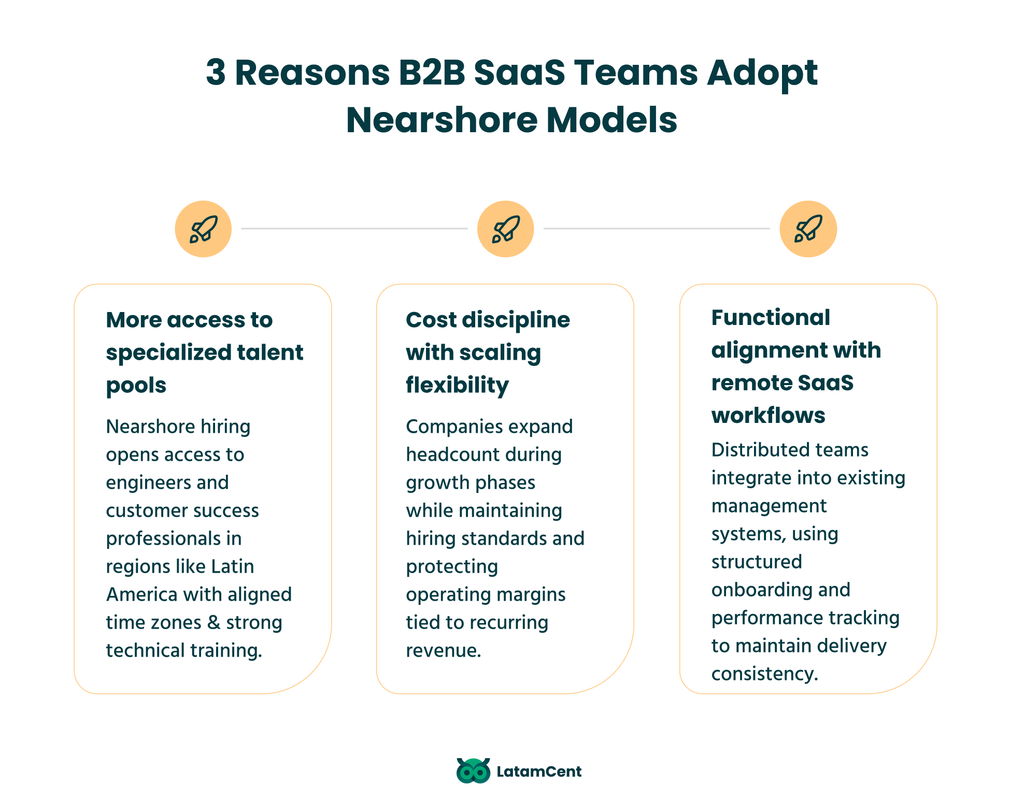
B2B SaaS companies adopt this model to access top talent in regions with strong technical skills and aligned time zones. Latin America has become a common choice for software development and customer success functions.
This structure supports:
- Cost control without lowering hiring standards
- Access to qualified candidates unavailable locally
- Faster scaling during growth phases
Nearshore hiring also supports SaaS remote management norms already common in the SaaS industry. When managed correctly, distributed teams integrate into existing workflows and contribute to SaaS products with a clear track record of delivery.
Modern SaaS hiring tools help automate coordination, interview scheduling, and candidate tracking, reducing administrative friction. Real-time metrics provide visibility into time-to-hire and sourcing channel performance.
Execution matters. Without structured onboarding and defined expectations, distributed models weaken team cohesion.
When structured carefully, nearshore teams support product velocity and revenue growth while protecting margins.
Hybrid Hiring Structures
Hybrid hiring structures combine internal hires, contractors, and nearshore talent.
Many SaaS businesses move toward this model as they mature. Core product and strategic roles stay in-house. Specialized or scalable functions operate through flexible staffing.
Example structure:
- Internal leadership for product and engineering
- Nearshore software development teams
- Contract sales support during expansion phases
- Customer success roles hired full-time for retention stability
Hybrid models require a strategic approach to workforce planning. Recruitment processes must account for different employment types, compensation structures, and onboarding workflows.
Automation and centralized hiring systems help maintain visibility across multiple pipelines. Clear ownership rules prevent overlap between current employees and external contributors.
For companies managing complex sales cycles and product iteration, hybrid hiring balances stability with agility.
No single model fits every SaaS company. The right structure depends on growth trajectory, funding stage, and the type of SaaS talent required at each phase.
Key Differences Between SaaS Hiring Models
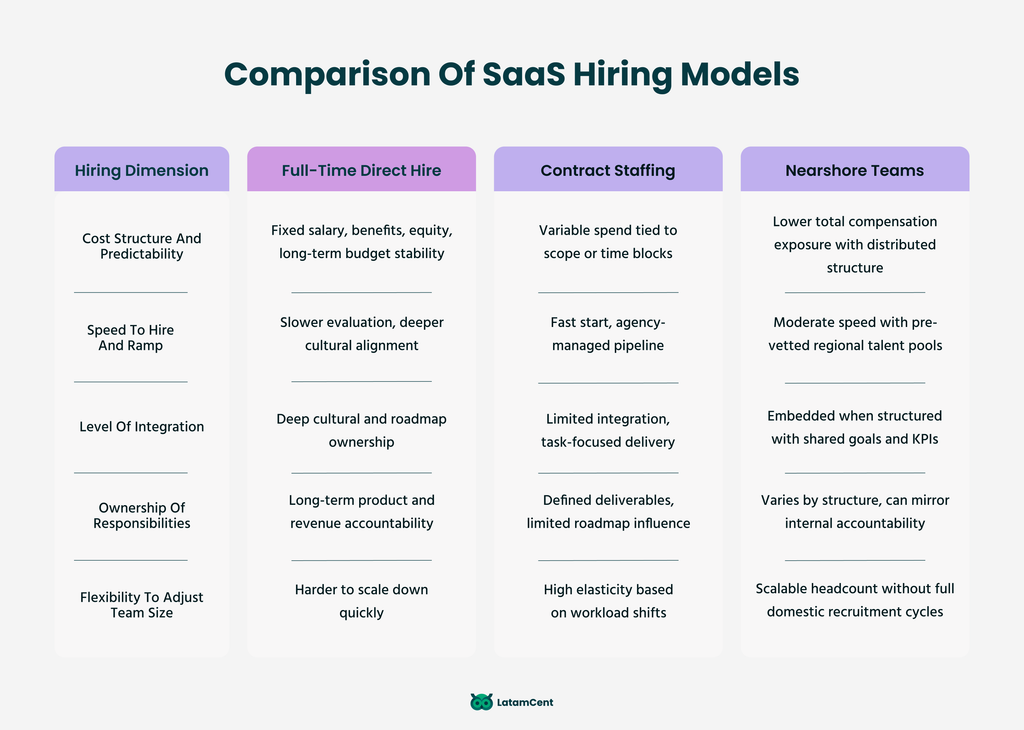
Cost Structure & Budget Predictability
Cost varies sharply by model.
Full-time direct hires create fixed expenses. Salary, benefits, equity, and onboarding costs become part of your long-term budget. Financial planning becomes predictable, but less flexible.
Contract staffing shifts costs into variable spend. You pay for defined deliverables or time blocks. That protects short-term cash flow but can rise quickly during heavy software development cycles.
Nearshore team models typically reduce total compensation costs while maintaining technical depth. Distributed hiring in regions like Latin America expands the talent pool without matching U.S. salary levels.
Hybrid structures combine fixed and variable layers. Core leadership stays stable. Execution layers scale based on workload.
Modern SaaS hiring tools also reduce administrative spend. Automated screening and scheduling reduce recruiter hours, improving visibility into cost-per-hire through real-time analytics.
Budget clarity depends on how much stability your SaaS business model requires at its current growth stage.
Speed-to-Hire & Time to Impact
Hiring speed influences product velocity and revenue targets.
Contract staffing usually wins on speed. Agencies maintain ready pipelines, which shortens sourcing cycles. Candidates can start quickly.
Full-time recruitment moves more slowly. Strong employer brand positioning and access to specialized SaaS talent networks help attract passive candidates, but the process requires deeper evaluation.
AI-powered screening tools now reduce time-to-hire by filtering resumes and automatically coordinating interviews. That matters when engineering and sales roles dominate headcount needs.
Nearshore models fall in the middle. Pre-vetted talent networks reduce sourcing friction, yet onboarding still requires integration planning.
Speed-to-hire is not the same as time to impact. A sales executive who understands consultative selling may contribute faster than a generalist hire who needs months to learn complex sales cycles.
Model selection should reflect the urgency and the speed at which new hires must influence the pipeline or product delivery.
Level of Team Integration
Integration affects product quality and client experience.
Full-time hires embed deeply into company culture. They align with the company’s mission, internal workflows, and long-term product vision. Customer success teams and sales professionals benefit from that continuity.
Contract roles integrate less tightly. Knowledge sharing depends on documentation and oversight. Team dynamics may weaken if contractors rotate frequently.
Nearshore teams can integrate effectively when treated as extensions of existing squads. Clear communication standards and shared goals prevent fragmentation. Remote collaboration is already common in the SaaS industry, so integration barriers are lower than a decade ago.
Hybrid structures require disciplined coordination. Without defined ownership boundaries, overlap creates confusion.
Integration level determines how well employees understand client needs, product positioning, and internal expectations.
Ownership of Product Responsibilities
Ownership influences accountability.
Full-time engineers, product managers, and account managers typically hold long-term responsibility for SaaS products. They drive continuous product improvement and protect recurring revenue.
Contract contributors usually focus on defined scopes. Deliverables are clear, but long-term roadmap ownership rarely sits with them.
Nearshore models vary. Some teams operate as embedded units with shared KPIs. Others function as external execution partners.
For B2B SaaS recruitment, candidates must demonstrate technical skills and problem-solving abilities aligned with product evolution. Hiring for ownership means assessing decision-making, not only coding output.
Sales teams also require ownership clarity. BDRs warm prospects. Sales executives close deals. Customer success protects retention. Structure determines who owns which stage of the revenue cycle.
Model choice directly affects who carries responsibility when product performance or revenue targets are missed.
Ability to Adjust Team Size Over Time
Growth trajectory rarely moves in straight lines.
Contract staffing provides the most flexibility. Teams expand or contract quickly in response to new feature releases or seasonal sales demand.
Nearshore hiring also supports elasticity. Distributed teams can scale seat counts without reopening full domestic recruitment cycles.
Full-time models resist rapid downsizing. Layoffs damage morale and employer brand. Hiring freezes slow product momentum.
Hybrid structures create controlled flexibility. Core product and revenue roles remain stable. Peripheral functions expand during growth and compress during slow periods.
In 2026, SaaS hiring emphasizes technical fluency and product-led growth. Companies that design scalable team structures respond faster to market changes.
Team size flexibility should align with revenue predictability, funding stage, and exposure to long sales cycles.
Direct Hire for Long-Term SaaS Team Needs
Direct hire supports stability in roles tied to product ownership and recurring revenue.
Engineering, product management, SaaS sales leadership, and customer success typically require long-term commitment. Knowledge compounds in these functions. Product context deepens. Client relationships mature over time.
B2B SaaS recruitment for direct hire must screen for more than technical skills. Candidates need a working understanding of the SaaS business model, subscription metrics, and how their role influences retention and expansion.
A GTM director, for example, must manage complex sales cycles and position the product around measurable business outcomes. A customer success lead must protect renewal revenue. Short-term staffing rarely delivers that depth.
Employer brand strength matters here. In a competitive SaaS industry, top talent evaluates culture, mission clarity, and career growth. High performers expect structure, not chaos.
Automated hiring tools can reduce administrative drag in resume screening and interview scheduling. That speeds the recruitment process without lowering evaluation standards. The real differentiator remains assessment quality. Demonstrated competencies now outweigh credentials in most hiring decisions.
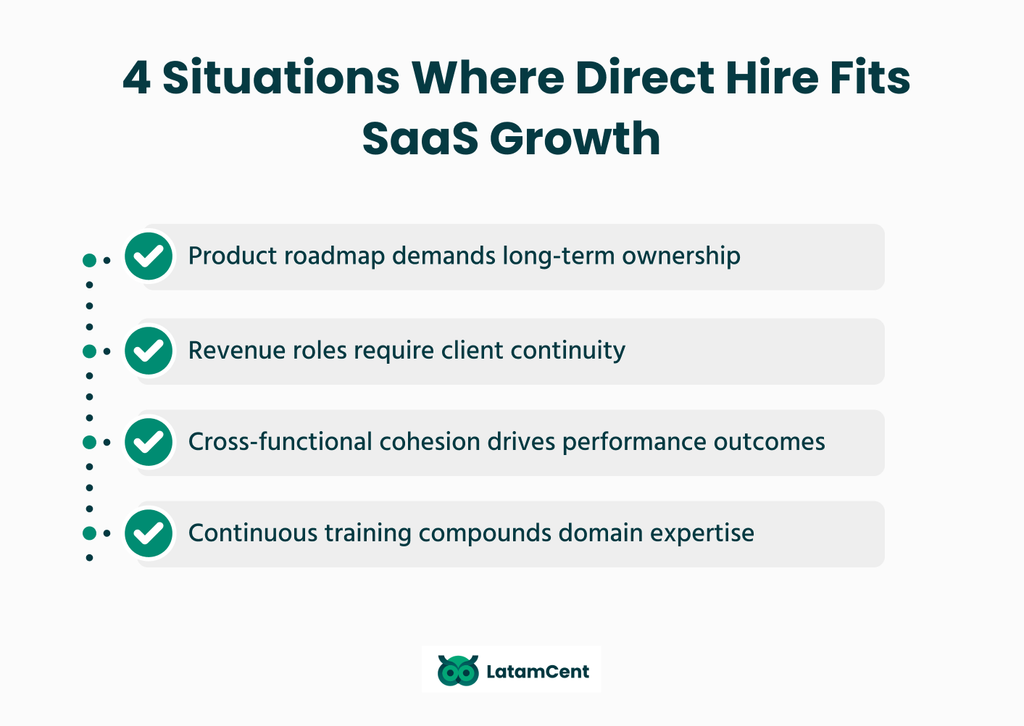
Direct hiring makes sense when:
- Product roadmap stability is critical
- Revenue roles require long-term client ownership
- Team cohesion impacts performance
- Continuous training improves sales outcomes
The tradeoff is commitment. Fixed compensation and slower replacement cycles require thoughtful workforce planning.
Contract Staffing for Short-Term SaaS Hiring Needs
Contract staffing addresses temporary execution gaps.
SaaS companies use contractors when facing product launches, backlog spikes, or short-term sales pushes. Business Development Representatives, implementation specialists, or project-based developers commonly fit this model.
Speed becomes the priority. Agencies and talent networks provide pre-qualified candidates, which reduces sourcing time. AI-powered screening tools further compress time-to-hire by filtering out underqualified applicants early.
Contract staffing works when hiring needs grow quickly. Feature builds, integrations, or outbound campaigns may not justify permanent roles.
Risk emerges when contractors lack product context. Limited exposure to the company’s work environment can reduce alignment with long-term goals. Knowledge transfer also requires structure. Without documentation and onboarding discipline, short-term gains create future inefficiencies.
Use contract staffing when:
- Workload spikes are predictable but temporary
- Specialized skills are required briefly
- Budget constraints limit permanent headcount
Avoid using it to fill core product or revenue ownership roles.
Nearshore Hiring for Distributed SaaS Teams
Nearshore hiring expands access to skilled professionals beyond domestic markets.
Engineering and sales roles dominate SaaS headcount. Competition for qualified candidates locally drives costs upward and increases hiring friction. Distributed hiring models open access to strong talent pools in regions like Latin America.
Time zone compatibility supports collaboration. Remote work norms already exist in most SaaS businesses, reducing integration barriers.
Nearshore teams can support:
- Software development expansion
- AI engineers from nearhsore agencies
- Customer success coverage
- Nearshore full-stack engineers
- Sales support roles
- Many types of financial compliance analysts
Structured onboarding and performance tracking are essential. Clear communication rhythms protect team dynamics and prevent fragmentation.
SaaS hiring systems automate tracking, interview coordination, and candidate evaluation. That reduces recruiter workload and improves hiring visibility.
Nearshore hiring works well for companies needing to scale quickly without overextending payroll. It also reduces reliance on saturated sourcing platforms with high candidate competition.
The key question is integration. When distributed teams operate as embedded contributors rather than external vendors, performance aligns closely with internal standards.
For fast-growing B2B SaaS companies, nearshore hiring offers controlled scalability with access to high-level technical and commercial talent.
How SaaS Stage Influences the Right Hiring Model
| SaaS Stage | Primary Hiring Goal | Typical Hiring Model Mix | Key Roles Prioritized | Budget Flexibility | Speed vs Stability Focus | Main Risk |
|---|---|---|---|---|---|---|
| Early-Stage SaaS Companies | Validate product and reach revenue traction | Lean direct hire + selective nearshore or contract support | Founding engineers, product lead, early sales hire, first customer success | Limited runway, high sensitivity to fixed costs | Speed and adaptability over structure | Over-hiring too early or hiring generalists without ownership mindset |
| Growth-Stage SaaS Companies | Scale revenue and product delivery | Hybrid model: internal leadership + nearshore teams + contract surge support | Software development expansion, sales executives, BDRs, and customer success managers | Expanding budget, but controlled spending required | Balance between speed and process stability | Fragmented teams or weak screening during rapid scaling |
| Mature SaaS Organizations | Protect margins and optimize performance | Strong direct hire foundation + distributed teams for efficiency | Senior engineering, product strategy, enterprise sales, retention leadership | Forecast-driven, more predictable allocation | Stability, accountability, and long-term continuity | Vendor dependency or rigid structure limiting flexibility |
Early-Stage SaaS Companies
Early-stage SaaS companies hire to survive and validate their products.
Headcount is small. Cash is tight. Every role must influence product delivery or early revenue. Founders cannot afford slow hiring cycles or misaligned talent.
Direct hires at this stage usually focus on core engineering and product roles. Ownership matters more than specialization. A developer may handle backend work, infrastructure, and support tickets in the same week.
Many early-stage startups are hiring developers from Brazil, check out our blog to know why.
Sales hiring begins cautiously. Early sales professionals need consultative selling skills and comfort with ambiguity. A BDR may test messaging before a full sales team forms.
Recruitment strategy should prioritize demonstrated competencies over credentials. In early-stage conditions, problem-solving ability and self-motivation matter more than pedigree.
Nearshore hiring can extend the runway by accessing strong technical talent at a lower total cost. Remote work options also expand the talent pool beyond local markets.
Automation in resume screening and interview scheduling reduces founder time spent on administrative tasks. That matters when leadership is balancing product, fundraising, and hiring at once.
At this stage, flexibility beats structure.
Growth-Stage SaaS Companies
Growth-stage SaaS companies hire to scale revenue and stabilize execution.
Product-market fit exists. Sales cycles become more structured. Customer success plays a measurable role in retention and expansion.
Engineering and sales roles typically account for the largest hiring volume. Sales executives must understand client needs and position the product around business outcomes. Customer success teams protect recurring revenue through proactive engagement.
In this stage, many startups are choosing to hire sales talent from Latin America, check out why.
Hybrid hiring structures often work best here. Core leadership remains internal. Nearshore teams support software development expansion. Contract staffing fills temporary gaps during feature releases or outbound campaigns.
Competition for talent intensifies at this stage. Relying solely on saturated platforms limits access to qualified candidates. Specialized SaaS talent networks and alternative sourcing channels widen reach.
AI-assisted screening can reduce time-to-hire and improve filtering accuracy. Recruiters struggle when resume volume increases; structured evaluation prevents weak fits from slipping through.
Growth-stage hiring requires data-driven metrics. Time-to-hire, cost-per-hire, and retention rates influence workforce planning decisions.
The focus goes from filling roles to building scalable systems. Check out the main roles every growth-stage startup needs.
Mature SaaS Organizations
Mature SaaS organizations hire to optimize and protect margins.
Revenue streams are established. Sales teams operate with defined quotas. Customer success processes are standardized. Headcount planning becomes forecast-driven.
Direct hire dominates leadership, architecture, and strategic product roles. Long-term accountability protects brand reputation and client trust.
Nearshore and distributed teams improve efficiency across engineering, support, and operations. At scale, distributed hiring reduces exposure to single-market wage pressure.
Vendor lock-in becomes a risk consideration. Mature organizations avoid dependence on a single staffing channel or proprietary hiring platform, which limits flexibility.
Continuous training remains critical for high-performance sales teams. Product complexity increases, and consultative selling skills become more refined.
Recruitment at this level emphasizes precision. Technical fluency, cultural alignment, and measurable track records outweigh volume hiring.
Stage determines structure.
Common Mistakes When Choosing a SaaS Hiring Model
Choosing the wrong SaaS hiring model rarely fails immediately. Problems show up in missed revenue targets, delayed releases, and rising churn.
Here are the most common mistakes B2B companies make.
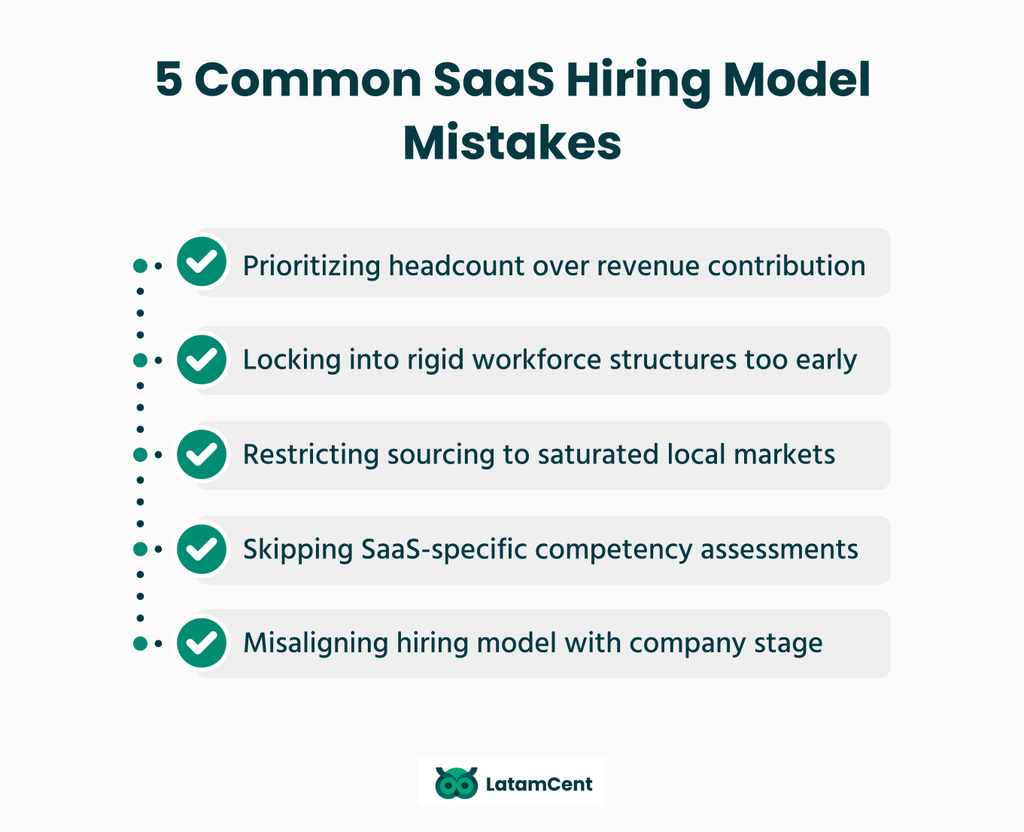
1. Hiring for Headcount, Not Revenue Impact
Engineering and sales roles represent a large share of SaaS teams. Yet companies frequently hire based on workload pressure rather than revenue influence.
A sales executive without consultative selling skills will not close complex deals. A customer success manager without retention discipline will not protect recurring revenue.
Model decisions should reflect which roles directly affect acquisition, expansion, or product delivery. Hiring volume without strategic alignment creates payroll growth without performance growth.
2. Overcommitting to One Model Too Early
Early-stage companies sometimes lock into full-time hiring before revenue stabilizes. Mature organizations sometimes rely too heavily on contract staffing to reduce fixed costs.
Both create risk.
Rigid structures limit flexibility when hiring needs shift. Vendor lock-in is also a concern when relying on a single external provider or a proprietary system.
Balanced workforce design protects adaptability.
3. Ignoring Talent Market Reality
Competition for SaaS talent remains intense. Limiting sourcing to saturated platforms reduces access to qualified candidates.
Strong recruitment strategies use specialized talent networks, alternative sourcing channels, and remote work options to expand reach. Distributed hiring opens access to regions like Latin America, where technical depth and time zone alignment support product teams.
Restricting hiring geographically shrinks your talent pool and increases pressure on compensation.
4. Weak Screening for SaaS-Specific Competencies
Recruiters struggle to filter candidates who look strong on paper but lack SaaS context.
In 2026, demonstrated competencies outweigh academic credentials. Candidates must demonstrate understanding of subscription models, customer lifecycle metrics, and product-led growth principles.
Technical fluency matters in departments. Sales enablement professionals must understand product positioning. Engineers must connect their work to client outcomes.
Without structured assessments, hiring becomes guesswork.
AI-assisted screening tools reduce resume overload and compress time-to-hire, but automation cannot replace thoughtful evaluation. Tools support judgment, not replace it.
5. Failing to Align Hiring With Company Stage
Early teams need ownership and adaptability. Growth-stage teams require scalable systems. Mature organizations demand accountability and cost control.
Applying the wrong hiring model at the wrong stage creates friction.
Hiring strategy must reflect funding stability, sales complexity, product maturity, and expansion goals. Workforce design should develop as the business evolves.
Mistakes in hiring models compound quietly. Correct structure compounds performance.
How Nearshore Partners Support SaaS Hiring Decisions
Access to Technical Recruiters With SaaS Experience
Nearshore partners bring recruiters who understand the SaaS industry, not just generic tech roles.
Engineering and sales positions account for the majority of SaaS headcount. Screening those roles requires more than keyword matching. Recruiters must evaluate technical fluency, product context, and the ability to operate within a subscription-based business model.
For example, hiring a back-end developer for a B2B SaaS platform demands awareness of scalability constraints, API integrations, and release cycles. Hiring a GTM strategist requires evaluating consultative selling ability and comfort dealing with complex client conditions.
Specialized SaaS talent networks give nearshore partners access to candidates who may not appear on saturated platforms. Competition for experienced professionals remains high, and relying on a single sourcing channel limits reach.
Automation tools support resume screening and interview scheduling, reducing time-to-hire without lowering evaluation standards. AI-assisted filtering helps recruiters focus on demonstrated competencies rather than surface-level signals.
The result is a shorter hiring cycle with stronger role alignment.
Support for Multiple Hiring Structures
Nearshore partners allow companies to move between hiring models without rebuilding internal processes.
A B2B SaaS company may need:
- Full-time distributed engineers
- Contract developers for a feature launch
- Customer success hires tied to renewal targets
- Sales support during pipeline expansion
Rather than committing to a single structure, nearshore support enables flexibility. Teams can scale up or down based on funding stage, product roadmap, or revenue goals.
Remote work options expand the available talent pool beyond domestic markets. Distributed hiring models have become standard in SaaS, particularly in regions like Latin America, where time zone alignment supports daily collaboration.
Strategic workforce planning becomes easier when partners understand how hiring needs evolve across early, growth, and mature stages.
Flexibility reduces risk. Structure remains intact.
Ongoing Hiring & Team Support
Hiring does not end at placement.
Nearshore partners often support onboarding coordination, performance tracking alignment, and long-term workforce planning. SaaS companies benefit from consistent feedback loops between hiring outcomes and team performance.
Data-driven hiring metrics provide visibility into time-to-hire, retention patterns, and sourcing effectiveness. That insight helps refine the recruitment process over time.
Continuous training also plays a role, particularly for SaaS sales teams. High-performing sales professionals require reinforcement around product positioning, customer-centric communication, and evolving market expectations.
Employer brand positioning improves when distributed teams feel integrated and supported. Clear communication about company culture, values, and mission helps attract candidates who fit the work environment.
Strong nearshore partnerships extend beyond sourcing. They contribute to structured hiring decisions, adaptable workforce models, and sustained team performance.
Build Your B2B SaaS Team With LatamCent Using Any Hiring Model
LatamCent helps U.S.-based B2B SaaS companies hire vetted talent in Latin America through flexible hiring models.
SaaS hiring requires specialized technical recruiters. Whether you need full-time nearshore engineers, contract contributors, or support scaling a distributed team, LatamCent sources and screens candidates based on your technical requirements and growth stage. You make the final hiring decision.
The focus stays on role alignment. Engineering, sales, and customer success hires are evaluated for practical experience in SaaS companies, not just resume keywords. That reduces noise in the hiring process and shortens decision cycles.
As hiring needs grow, the model can adapt. Teams expand or stay lean based on product roadmap, revenue goals, and budget constraints.
LatamCent supports the structure you choose, and help you hire in Latin America.
Conclusion
Choosing a SaaS hiring model is a structural decision, not a tactical one.
Full-time hiring builds ownership. Contract staffing adds short-term flexibility. Nearshore teams expand access to specialized talent while supporting distributed collaboration. The correct mix depends on funding stability, sales complexity, and product roadmap demands.
In 2026, SaaS hiring prioritizes demonstrated competencies over credentials and emphasizes technical fluency across departments. Sales professionals must understand client outcomes. Engineers must build with scalability in mind. Customer success teams must protect retention.
Clear hiring metrics, structured screening, and access to broader talent pools strengthen decision-making.
Align your hiring model with how your SaaS business actually generates revenue. The structure you choose will influence growth, cost control, and long-term stability.
Get in touch with LatamCent today to get started.