


The choice between direct hire vs contract staffing is not “cheaper vs faster.” It’s ownership vs. speed, under constraints such as a release date, a backlog spike, or a platform area that cannot be orphaned.
Direct hire builds long-term accountability across your roadmap. Contract staffing buys time, capacity, or a specific skill for a defined window. The right call depends on four factors: stage, timeline to ship, budget predictability, and the need for long-term ownership.
Pick the wrong model, and you pay in missed releases, rework, and planning chaos. In SaaS, chaos has a sprint cadence. Choose the right one, and you get capacity aligned with your product’s shipping schedule.
Key Takeaways
- Direct hire builds long-term ownership inside your team. It fits core product areas that require ongoing accountability and retention of context.
- Contract staffing provides defined capacity for a specific window. It fits short-term delivery pressure or niche expertise needs.
- Direct hire usually involves slower hiring and a higher upfront cost. It creates stable planning and predictable engineering capacity over time.
- Contract staffing usually starts faster and scales up or down more easily. It carries less long-term commitment.
- Direct hire supports durable systems, including payment data architecture, infrastructure, and core platform logic.
- Contract staffing supports bounded initiatives such as migrations, integrations, compliance work, or release spikes.
- Stage matters. Early teams often use contracts to stay flexible. Growth stage teams shift critical roles into permanent ownership.
- Timeline matters. Tight release deadlines favor contract support. Multi-quarter roadmap expansion favors direct hire.
- Budget stability matters. Predictable runway supports full-time hiring. Variable runway favors contract flexibility.
- Hybrid models combine both. Permanent staff own foundations. Contractors support specialized or temporary initiatives.
- The right model matches the constraint you cannot change. Ownership needs point to direct hire. Speed and defined scope point to contract staffing.
What is Direct Hire?
Direct hire means bringing someone into your company as a full-time employee in a permanent role. They’re on your payroll in a full-time employment setup, receive company benefits, and are onboarded as part of the internal team.
Direct-hire roles are best suited to core leadership and strategic positions, promoting long-term stability.
In B2B SaaS, direct hire employees typically own durable product areas across releases, with job duties that include maintenance, roadmap work, and technical decisions tied to platform ownership. Advantages of direct hire include higher engagement and loyalty, stability in team culture, and long-term cost-effectiveness.
Whether the direct hire process runs in-house or through a recruiting agency for direct placement, the point is the same: long-term commitment and accountability.
What is Contract Staffing?
Contract staffing means hiring someone for a contract position on a defined scope, contract period, or project-based need.
This often happens through a staffing agency, staffing firm, or recruiting agency, sometimes with an independent contractor. It’s common when you need extra capacity for a feature launch, a backlog spike, or a short-term skill gap, especially when contract hire roles need to start quickly.
A contract-to-hire arrangement can include a trial period to assess a good fit and the candidate’s performance before moving to a permanent position.
Many workers have realized that permanent jobs are not as secure as they once thought, leading them to prefer contract work. Contract staffing allows workers to prepare for upcoming work by keeping their resumes up to date, which can lead to more consistent communication with employers.
What’s The Difference Between Direct Hire & Contract Staffing?
| Area | Direct hire | Contract staffing |
|---|---|---|
| Employment structure | Hired as full-time employee with benefits and equity | Engaged through agency or vendor, no employment relationship |
| Contract length & engagement type | Permanent, long-term roles | Short-term, project-based, or flexible contracts |
| Cost structure | Salary + benefits + taxes + overhead | Flat monthly/hourly fee, no extra overhead |
| Hiring speed | Slower, with multiple interview rounds and offer steps | Faster, talent often available immediately |
| Team integration level | Full integration into team culture and strategy | Partial integration, focused on deliverables or output |
Employment Structure
With direct hire, the person is a full-time employee in a permanent position, paid through your payroll. That means you own the end-to-end hiring process, payroll, taxes, and company benefits such as health insurance, vision insurance, paid time, and retirement plans.
So owning the end-to-end hiring process, payroll, taxes, and company benefits like health insurance, vision insurance, paid time, and retirement plans.
With contract staffing, you fill a contract position on a contract basis, often through a staffing agency. The contractor is engaged for defined job duties and a clear job description, and benefits administration usually sits with the agency or contractor, even though your team still owns access, security, and day-to-day delivery expectations.
Contract Length & Engagement Type
Direct hire positions are open-ended. You are hiring for a permanent position with a career path inside the company, not a fixed end date.
Contract roles run for a defined contract period or a project-based scope, like shipping a feature, supporting a platform upgrade, or covering a temporary gap. If the work remains relevant, you extend it. If scope changes, the contract ends or gets renegotiated.
Cost Structure
Direct hire costs are easier to predict because salary costs are tied to full-time positions on a steady schedule. Contract hires usually do not receive company benefits, making them a more affordable option for companies.
But the catch is that full-time employment includes more than base salary. Employer costs include taxes and benefits, and company benefits such as health insurance, health care coverage, retirement plans, paid time, and sometimes vision insurance appear as ongoing budget lines.
Disadvantages of direct hire are higher upfront costs, slower hiring processes, and less flexibility in scaling. Upfront costs for direct hire include recruitment fees, benefits, and equipment; these become more cost-effective over time.
Contract staffing moves cost into a contract basis rate or a project-based fee. You pay for capacity during the contract period, and you can stop paying when the contract work ends. Hourly rates may appear higher, but you pay only during the contract period.
Your spreadsheet will look calmer with a direct hire. Your roadmap might not.
The trade planning horizon. Direct hire is a long-term investment with more predictability. Contract staffing is easier to resize when priorities move.
Hiring Speed
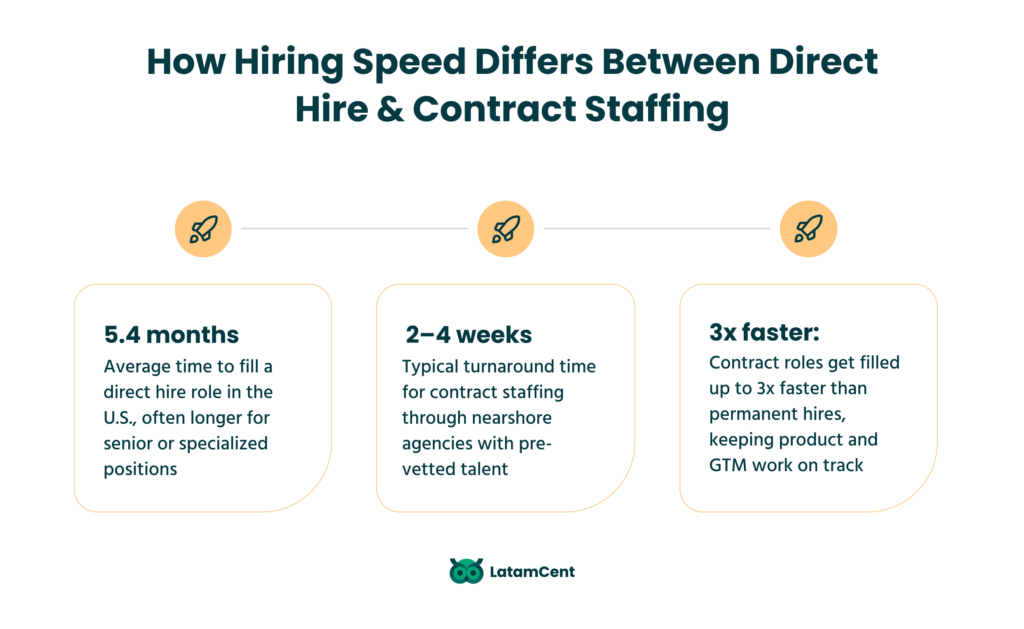
Tech hiring often takes weeks. The direct hire process includes sourcing, screening, interviews, offer negotiation, and onboarding to fill positions and evaluate direct hire candidates. iCIMS reports an average time to fill in tech around 51 days, from posting to accepted offer.
After the offer, ramp time still matters. APQC benchmarks time-to-productivity, and even a strong onboarding process takes time before a full-time hire contributes at a steady pace. That is the key difference.
Time-to-fill is slow. Time-to-panic is instant.
Direct hire takes longer to get started, but it builds ownership.
Contract hire is usually faster because a staffing agency draws from a pool of candidates, including passive candidates who are not actively seeking full-time employment.
You still need interviews and onboarding, and the contractor still needs product context, but the scope is narrower, and the contract role is clearer, so the time to impact is often shorter. If your shipping timeline is tight and you have an urgent need, that difference can determine which model you choose.
Team Integration Level
Direct hires attend every sprint planning meeting.
They know why you built feature X before feature Y. When clients ask for a change, they understand which parts of the codebase will break.
They contribute to roadmap planning and understand the full product context. They make decisions that balance short-term delivery with long-term maintainability because their success ties to the company’s multi-year trajectory.
Contractors prioritize delivery within their contract timeline. They focus on scoped work rather than broad platform ownership. Integration depth varies by contract length and role definition, but contractors typically have less context about adjacent systems or the long-term product strategy.
Direct hires carry context. Contractors carry a scope.
Benefits of Direct Hire for B2B SaaS Companies
Stronger Product Ownership Over Time
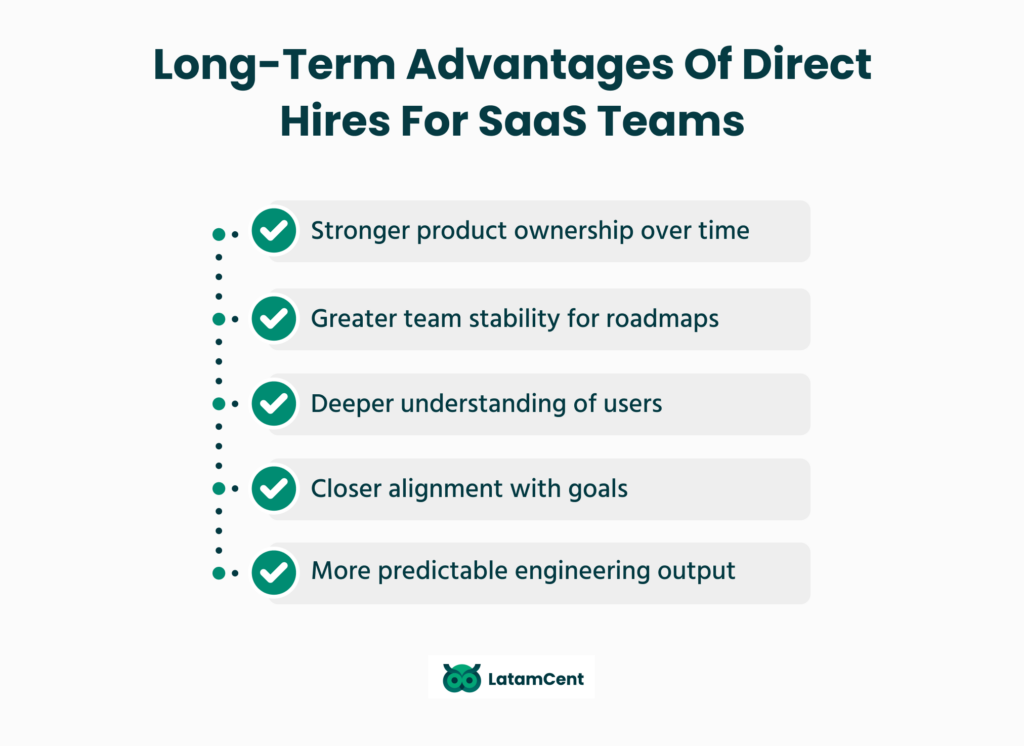
Permanent employees take long-term accountability for features, systems, and technical decisions. They live with the consequences of their architectural choices for years.
This creates an incentive to build maintainable systems rather than ship fast and move on. Product ownership prevents the “works on my machine” problem, in which code works but no one understands why.
Greater Team Stability for Long-Term Roadmaps
Lower turnover keeps planning stable across multiple quarters. Fewer handoffs mean less rework and fewer surprises mid-migration.
Permanent employment provides job security, which helps maintain stability when building complex SaaS products with multi-quarter roadmaps. A senior platform engineer is less likely to leave during a migration or right before a customer launch.
Stability is not soft. It is a hard cost.
Team stability prevents constant onboarding churn. Every departure pulls senior engineers into reviews, handoffs, and re-explaining decisions that were never written down. That is how rework grows and why long roadmaps get shaky.
Replacing one employee is expensive, and the cost compounds when turnover hits the same team repeatedly.
Deeper Understanding of the Product & Users
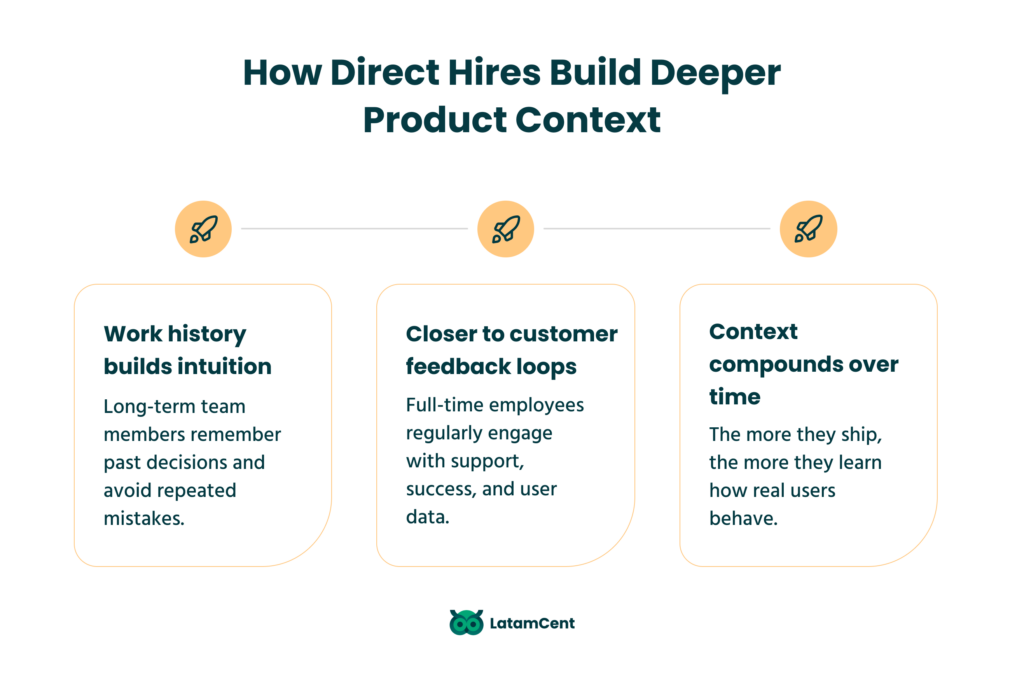
Full-time team members accumulate context over the years. They understand not just what the code does but why decisions were made, which customers requested features, and where technical debt exists. This context improves decision-making quality.
When proposing changes, direct hires weigh impact across the entire platform because they have seen how systems interact over time.
Your contractor built the Stripe integration fast. Then the contract ended. Later, a customer reports failed payments. Your team opens the code and finds no comments and no documentation. Fixing the issue becomes reverse engineering because no one owns the decisions behind the implementation.
Closer Alignment With Company Goals & Culture
Long-term employees align with company goals because their career trajectories and day-to-day execution are tied to recurring revenue targets and trade-offs in the roadmap. They learn how leadership roles set priorities, how incidents are handled, and how work gets approved and shipped.
Company culture shows up here as operating rules, what gets reviewed, what gets blocked, and how new team members are onboarded into the team’s standards.
Contractors can align as well, but it requires more explicit context because the contract period is shorter and decision rights are usually narrower.
More Predictable Engineering Capacity
Permanent staff provide predictable capacity for sprint planning and roadmap forecasting.
You know who will be available later this year. Workload management becomes easier when team composition stays consistent. Predictable capacity allows realistic commitments to customers and more accurate delivery estimates.
Benefits of Contract Staffing for B2B SaaS Companies
Faster Access to Specialized Engineering Skills
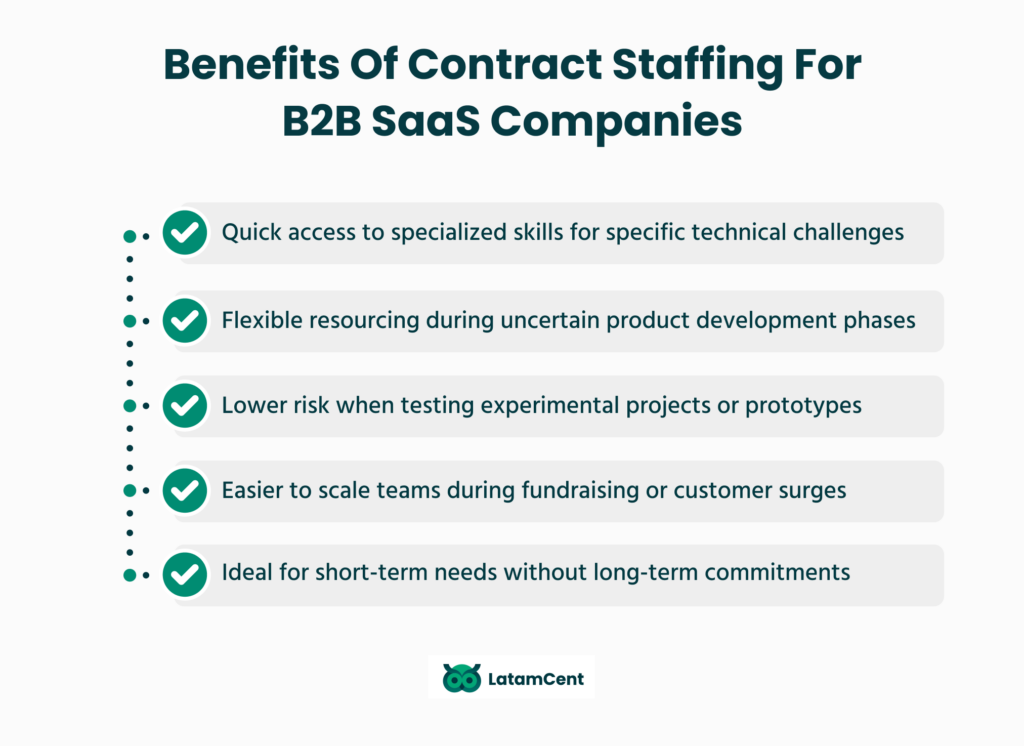
Contract staffing provides faster access to specialized candidates with niche skills your team lacks.
Staffing agencies reach passive candidates who are not actively job searching but available for contract work, expanding your talent pool beyond active applicants.
Need a cybersecurity expert for a short compliance implementation? A contractor who has done this exact work for ten other companies delivers faster than training your team or hiring full-time for a temporary need.
Contract roles usually offer flexible work location agreements, making specialized talent more accessible regardless of geography.
Greater Flexibility During Product Development Cycles
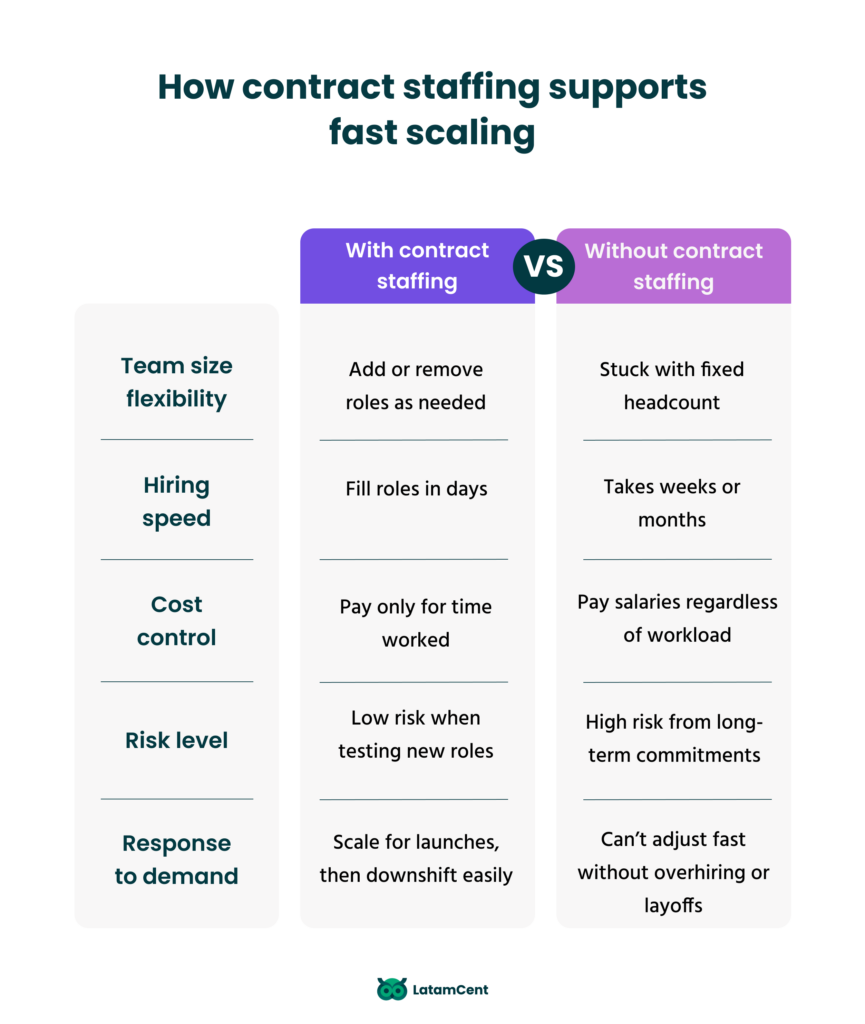
Contract staffing lets you scale capacity up or down based on workload without long-term commitments. When you ship a major release and need surge capacity for bug fixes, contractors handle volume spikes. When workload normalizes, contracts end naturally without layoffs or performance management.
Flexibility prevents over-hiring in a downturn. You get as much flexibility as your contract period allows.
Lower Commitment for Short-Term Hiring Needs
Contract staffing reduces risk when exploring new product areas or validating market demand.
Testing a feature that might not ship? Contractors let you staff the experiment without committing to permanent headcount. If the feature succeeds, you can convert to direct hire. If it fails, the contract ends.
Easier Scaling During Growth or Peak Periods
Contract staffing handles peak periods without permanent headcount growth. For SaaS companies with seasonal demand or campaign-driven workload spikes, contractors provide temporary capacity that matches revenue patterns.
You pay for capacity when you need it, not year-round.
Reduced Risk When Testing New Roles or Projects
Contract staffing validates the need for a role before committing to a permanent hire. Unsure if you need a dedicated DevOps engineer?
A trial period proves whether the job description matches the actual workload and justifies full-time headcount. Contract-to-hire arrangements let you evaluate candidates in real working conditions before converting them to permanent positions.
Contract-to-hire roles make that evaluation easier because you see the candidate’s performance in real work.
If responsibilities grow during the contract, you can adjust before making a permanent hire.
How to Choose the Right SaaS Model Hiring For Your Startup
Stage of Your SaaS Product
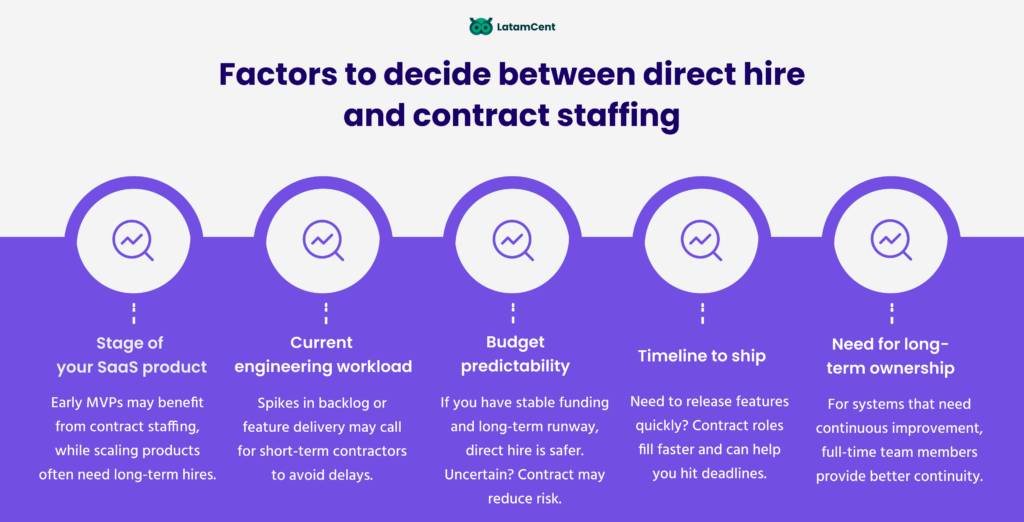
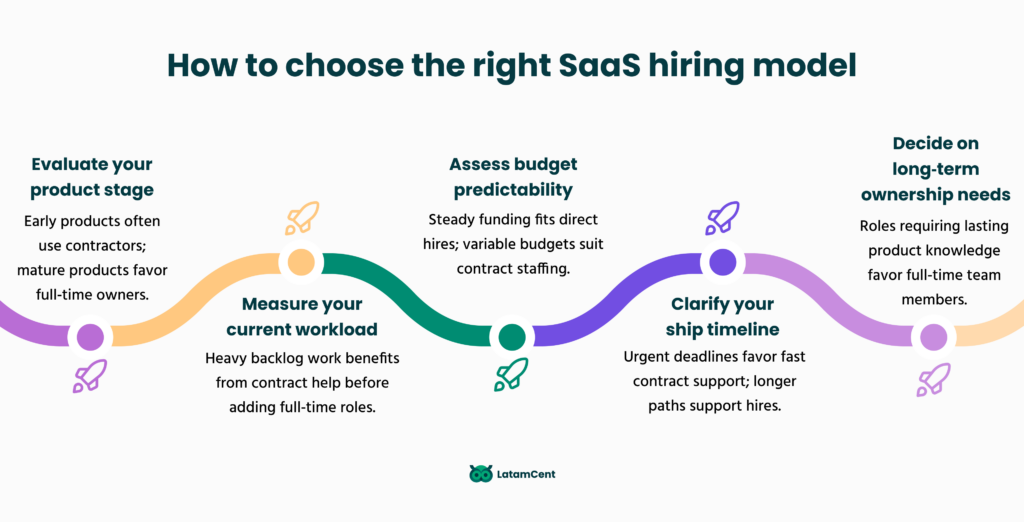
Early-stage teams often lean on contract staffing because the roadmap is still moving, and the long-term commitment of full-time employment can be hard to justify. Contract work lets you validate a project, a role, or a new area without committing to a permanent role too early.
Growth-stage teams with recurring revenue and a clearer roadmap usually move key roles into direct-hire positions.
When you are adding new team members and the backlog is steady, direct-hire employees compound context and reduce rework, especially for platform-related software developer roles.
Current Engineering Workload
Assess whether the existing workload comes from sustained platform development or temporary surge capacity. A sustained workload indicates the need for permanent capacity.
A surge in workload indicates a need for temporary support.
If your team consistently ships features every sprint and backlog grows faster than capacity, you need a direct hire. If your team handles steady-state maintenance but occasionally needs extra hands for migrations or integrations, you need contractors.
Miss this distinction, and you pay for underutilized full-time staff during low periods or accumulate technical debt during high periods because contractors lack context to maintain quality.
Budget Predictability
A full-time hire requires a predictable budget with a runway to support a year or more of salary and benefits. If funding is uncertain or the burn rate fluctuates, contractors provide budget flexibility. You pay only for hours worked, with no long-term salary commitments.
If your budget is predictable and the runway extends multiple quarters, direct hire provides better long-term cost efficiency. You avoid contractor premium rates and build compounding value through retained knowledge.
Timeline to Ship
Your timeline determines everything.
If your shipping timeline is measured in weeks rather than months, contractors are usually the only realistic option.
Direct hires rarely arrive fast enough to change a near-term release, especially once you factor in onboarding and ramp time.
Certain positions, like specialized compliance roles or temporary project leads, work particularly well for short-notice contractor engagements.
When the work is ongoing, direct hire tends to fit better. When you need surge capacity or a niche skill quickly, contract staffing tends to be a better fit. Contract-to-hire can bridge both models, allowing contractors to start as contractors with the option to convert based on performance and business needs.
If you are building sustained capacity over a longer horizon, direct hire usually makes more sense.
Need for Long-Term Ownership
Platform foundation work usually belongs to direct-hire employees.
Authentication, payments, data architecture, and infrastructure need long-term ownership and clear accountability after launch.
Bounded projects fit contract staffing better. Third-party integrations, migrations, and project-based work with clear edges can be handled by a contractor under a tight job description and defined job duties.
When a Hybrid Hiring Model Makes Sense for SaaS Teams
Hybrid models combine the stability of direct hire with the flexibility of contractors. Permanent team members own critical systems long-term through direct placement.
Contractors handle specialized projects and workload spikes.
This structure works when there is a clear delineation between platform foundation work and tactical projects. Hybrid models prevent over-committing to permanent headcount while maintaining platform ownership. You scale contractor capacity up and down based on project needs without affecting team stability.
The ratio depends on your stage and the predictability of your roadmap. More mature companies with stable roadmaps lean heavily on direct hire, with the vast majority of leadership roles and senior positions filled through permanent employment. Earlier companies with evolving products lean heavily on contractors for flexibility while building their permanent team.
How Nearshore Hiring Supports Both Models for SaaS Companies
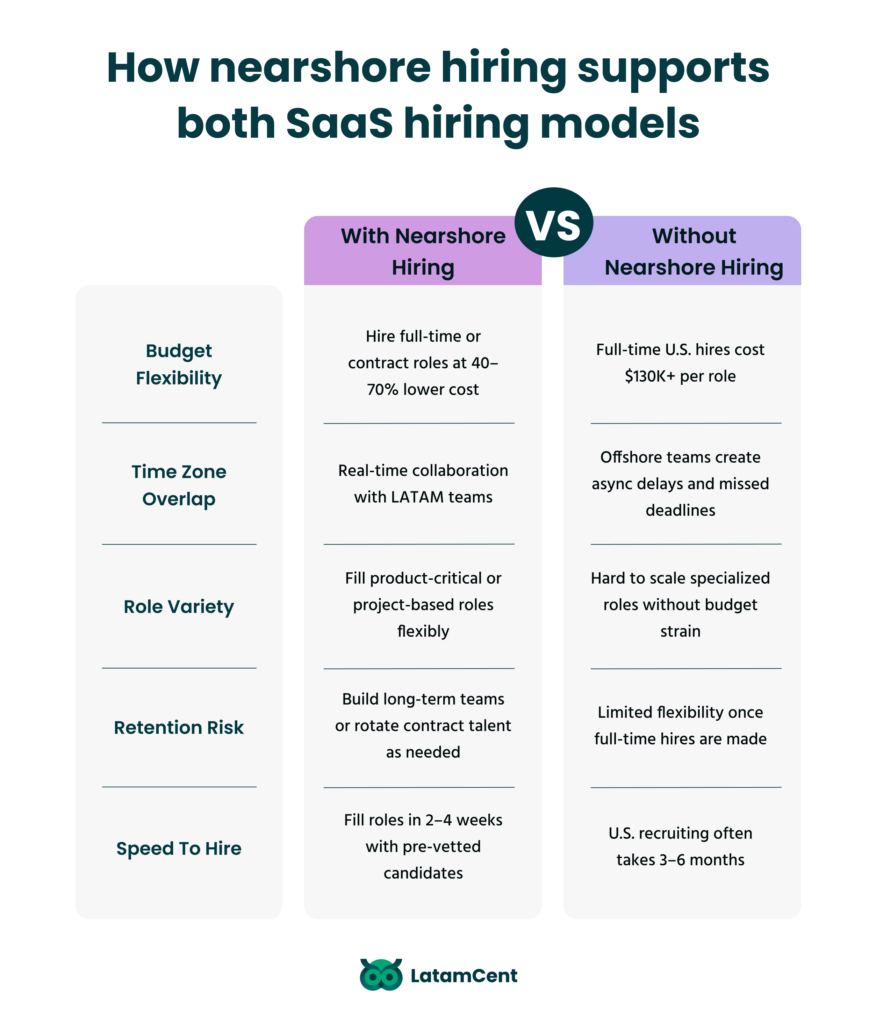
Nearshore hiring from Latin America supports both direct hire and contract staffing for remote SaaS teams, with work locations that overlap, making real-time collaboration easier. Time zones align closely with U.S. business hours, which helps daily engineering rituals and faster feedback loops.
For direct hire, nearshore provides access to experienced engineers who integrate into your team.
For contract work, nearshore agencies manage compliance, payroll, and administration across multiple countries, reducing your operational burden.
How LatamCent Helps B2B SaaS Teams Choose the Right Model
For B2B SaaS teams, choosing between direct hire and contract staffing isn’t about preference; it’s about growth stage, budget, and urgency. LatamCent helps companies make that decision with clarity.
If a team needs speed and flexibility, contract talent can help launch initiatives or test new functions without long-term commitment. If the company is scaling and needs stability in main roles, direct hire often makes more sense. LatamCent evaluates the business goals first, then recommends the model that supports them.
Because LatamCent is a nearshoring and staffing agency focused on B2B SaaS and LATAM talent, candidates are already aligned with SaaS workflows, time zones, and communication standards. That reduces hiring risk and shortens time-to-fill.
The process is simple: match the hiring model to the company’s growth plan, not the other way around.
Conclusion
The decision between direct hire vs contract staffing comes down to four factors: stage, timeline to ship, budget predictability, and need for long-term ownership.
Direct hire is built for permanent ownership and compounding context. Contract staffing is designed for a defined contract period, project-based delivery, and targeted capacity when workload spikes. If you need a launch pushed out fast, contract hire can buy time.
If you are building systems that will last for years, direct-hire employees help ensure continuity. Pick the model that matches the constraint you cannot change, then execute it with a clean hiring process and clear job duties.
Get in touch with LatamCent today to start hiring in Latin America.