


Hiring for a growth-stage SaaS company is different.
You are not just filling seats. Instead, you are hiring employees and building a system that has to work across product, engineering, marketing, sales, customer success, and support, whether people sit in one office or work remotely.
In a recurring revenue model, every hire touches acquisition, retention, or expansion, even if their title looks internal.
Traditional tech can ship a project and move on. SaaS does not get that luxury. Once they get funding, a new challenge comes in: who to hire first. Essential roles include UX/UI designers who enhance user experience, laying the groundwork for customer satisfaction and retention.
If you ship the wrong thing, hire the wrong people, or sequence roles badly, the cost shows up every month in churn, slow delivery, and delayed growth.
You feel it when you rush to hire two sales reps, they chase anyone who will take a demo, and three months later, support is drowning in tickets from customers who never should have signed. Hiring five people at once will make it hard to onboard each new team member.
In the growth stage, hiring for SaaS is subject to different constraints than in traditional tech.
You need to know which roles matter most and how to prioritize your next key hires so you are not just adding headcount, you are building a team that can actually hit your targets.
Key Takeaways:
-
Growth stage SaaS hiring focuses on the full customer lifecycle. Every role influences acquisition retention or expansion.
-
Core hiring usually covers product engineering design sales customer success growth marketing and platform reliability.
-
Teams perform better when roles connect product delivery with revenue and customer outcomes.
-
Retention pressure shifts hiring priority toward onboarding customer success and support earlier than many founders expect.
-
Subscription metrics guide hiring decisions. Weak retention signals success and onboarding gaps. Slow payback points to marketing or revenue operations gaps. Stability issues point to platform reliability roles.
-
High impact follow on hires often include revenue operations analytics leadership and dedicated customer support.
-
Hiring works best when each new role removes the largest execution problem and builds repeatable systems that scale.
How is Hiring for SaaS Different From Traditional Tech?
In a traditional software company, the hiring process usually centers on projects. AI is becoming a key asset in the recruitment process, streamlining workflows and enhancing the hiring funnel.
You staff a project with developers and a manager, you ship, you move on. Value is tied to delivery at a point in time.
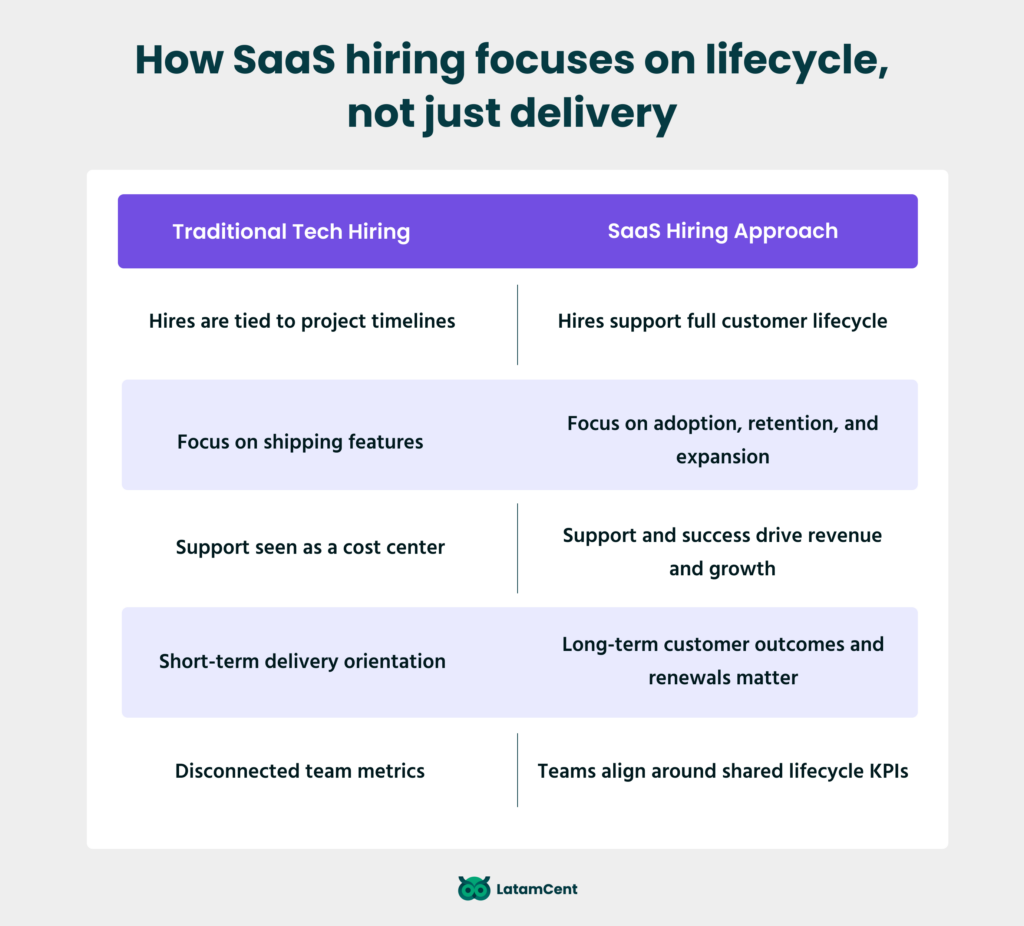
SaaS hiring sits inside a subscription model. Revenue comes from customers who sign, onboard, adopt, expand, and renew. If any part of that cycle breaks, you feel it in monthly recurring revenue.
That means you hire for the lifecycle, not just for delivery.
You need product direction to decide what to build and for whom.
Marketing and sales have to bring in the right customers who are a real fit, not a random stream of demo requests.
Customer success and onboarding reduce time to value, so new customers do not churn in month three.
Support and engineering keep the product stable enough that people trust it. Skills assessments should focus on practical evaluations, such as coding challenges or real-world problem-solving simulations, rather than degrees.
Customer retention changes the math. Even a slight increase in retention can significantly boost profits over time. To attract top talent, SaaS companies should hyper-target passive candidates through proactive engagement and refined sourcing strategies.
Keeping customers and expanding them is often several times cheaper than finding new ones. That turns customer success and related roles from “nice to have” into “profit center”.
Traditional tech can treat support and success as cost functions. SaaS companies cannot.
Hiring for SaaS is about putting the right people around the customer lifecycle, then ensuring these roles align with the same key metrics. Offering competitive compensation packages, including equity and bonuses, can enhance the attractiveness of job offers in SaaS.
Fast Iteration Demands Strong Cross-Functional Alignment
The growth stage of SaaS lives on fast iteration. You need to ship often, learn fast, and adjust without breaking everything. Candidates must demonstrate proficiency in using AI agents and automation tools across various roles in a SaaS company.
That speed does not come from hiring more engineers alone. It comes from alignment between product, engineering, design, marketing, sales, and customer success.
When these teams are not aligned, you build what some leaders call “alignment debt”. Sales is selling one thing. The product is building another.
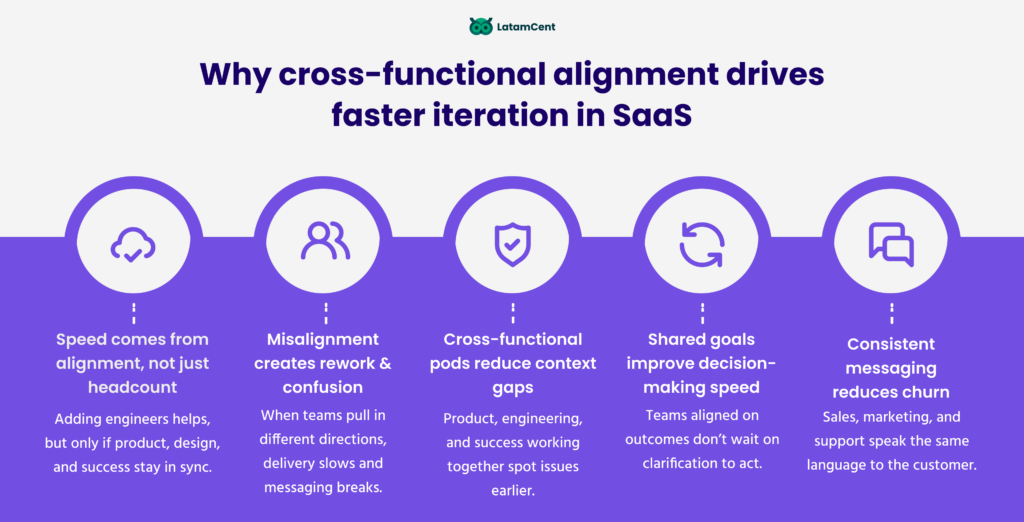
Marketing is telling a different story. Customer success is about keeping everyone happy in the middle. The result is confused customers, rework, and slow delivery.
Cross-functional hiring reduces this by building teams that share context and goals. A product manager, a designer, and a group of engineers can work with a customer success manager on the same feature set.
Marketing and sales can share the same description of the ideal customer and communicate it consistently, rather than working from separate slide decks.
Studies on agile teams and cross-functional work show that when teams like this stay together, time-to-market improves and errors drop. For a growth-stage SaaS company, that is the difference between testing three ideas in a quarter or twelve.
Hiring with alignment in mind means you ask a simple question for every new role. Does this person help connect product, customers, and revenue? Or are you adding another silo?
Customer Retention Drives Hiring Priorities in SaaS
In a subscription model, retention is more than a health number. It is the engine.
Small changes in retention compound. If you keep more of your customers every month, you do not need as much new business to grow. Some companies reach a point where net revenue retention exceeds 100%.
That means they can increase revenue from the current customer base even if new sales pause for a period.
This has direct hiring consequences.
At the growth stage, many SaaS founders assume they should scale sales first. They add sales development representatives and account executives.
Sometimes that is right. But if churn is high or expansion is weak, piling on more new customers just feeds a leaky bucket.
Customer success, onboarding, and support roles are how you fix that leak. Customer success managers own adoption, value, and long-term outcomes for accounts. Onboarding specialists shorten the time from contract signed to real usage.
Support specialists keep daily friction low so users do not quietly give up on the product.
Retention economics justify hiring these people earlier than many teams expect. It is often easier to defend a customer success hire than a second layer of sales management.
Roles Must Balance Product Speed With Customer Outcomes
Speed matters. But speed without stability or customer value just gives you more chances to disappoint people. Add team members gradually as the product grows and demands increase.
Many startup founders start working on their products alone or with a co-founder.
SaaS engineering teams often track a small set of delivery metrics. How frequently do you deploy?
How long does it take for code to reach production? How often do changes fail? How fast do you recover from incidents? High-performing teams manage to deploy often while keeping failure rates low.
Your hiring plan needs to reflect that balance.
If you only add feature builders, you might ship fast but break often.
That burns customer trust and fills your support queue. If you only add people focused on stability, you may move so slowly that competitors win on product.
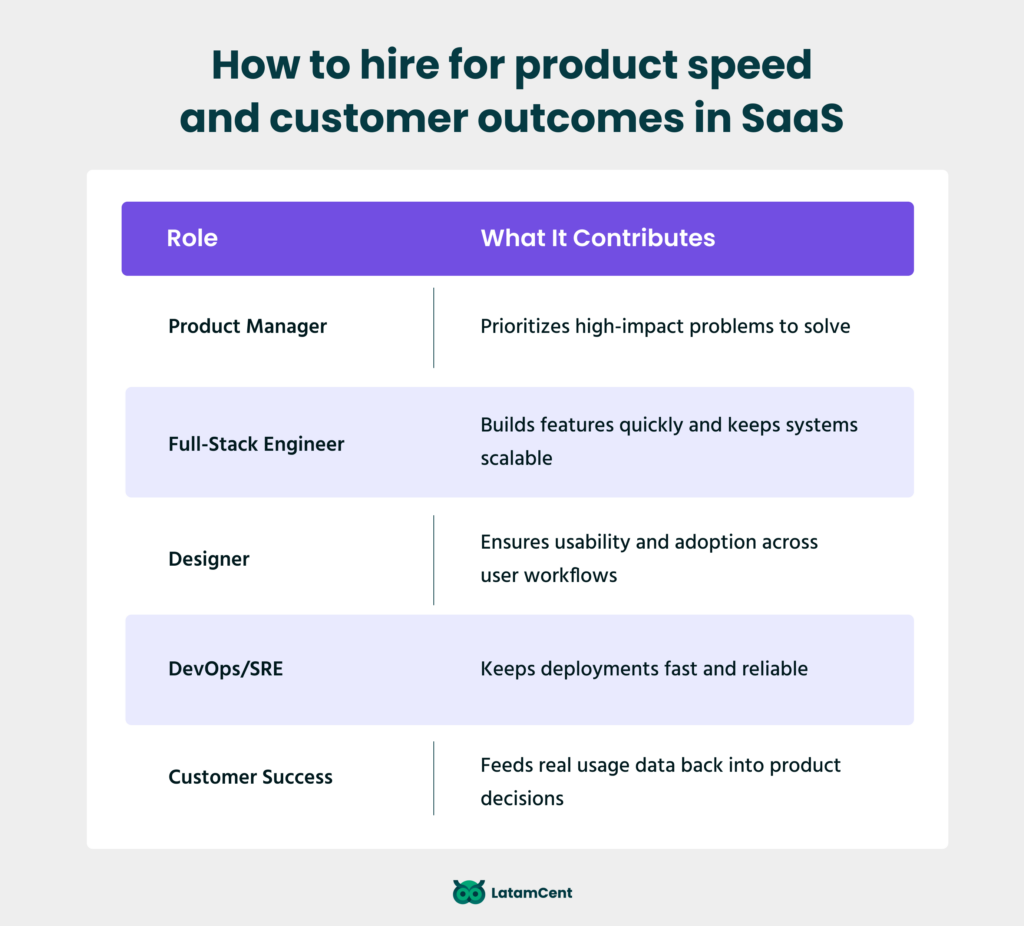
A healthier mix includes product managers who decide which problems are worth solving now, back-end or full-stack engineers who can build reliable systems, designers who make sure people can use what you create, and DevOps or SRE specialists who keep deployments smooth and incidents under control.
Customer-facing roles then feed real usage data back into product decisions.
Hiring for balance means you tie roles to both product speed and customer outcomes. That keeps you out of the extremes. Fast but flaky products, or stable but close ones.
Outsourcing some of the work to a design agency is a smart decision for startups. Let’s see how.
Subscription Revenue Metrics Influence Hiring Decisions
SaaS leaders and investors closely monitor a small set of subscription metrics. These numbers should shape how you hire.
Net revenue retention is one of them. When NRR is above one hundred percent, your current customer base is expanding.
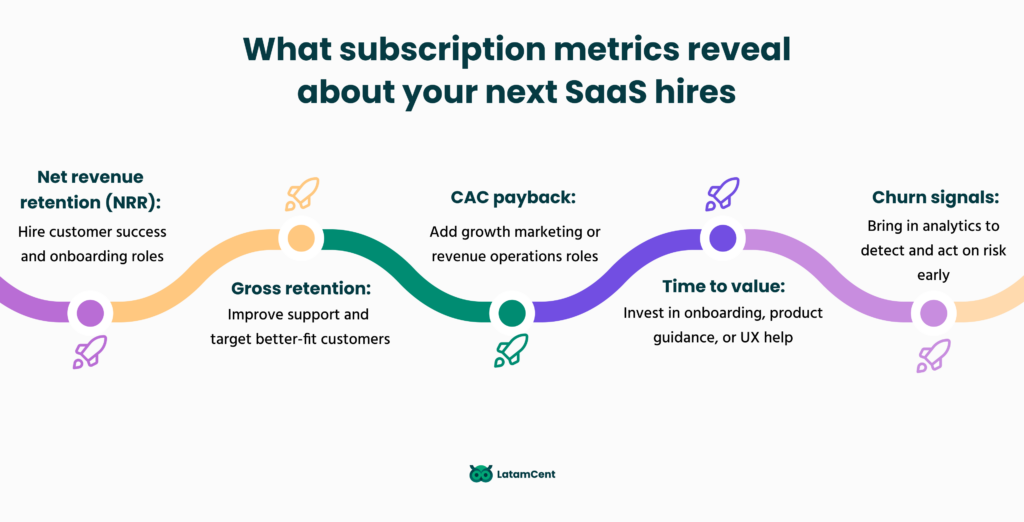
When it is below, you have a retention problem. Roles that influence onboarding, product adoption, and expansion, such as customer success, onboarding, and analytics, move up the priority list.
Gross retention shows how many customers stay. If gross retention is weak, it means customers are leaving completely.
That often points to missing product value for key segments, poor support, or bad customer fit from sales. Better success, support, and sometimes better targeting can address that.
CAC payback shows how efficient your go-to-market engine is and how fast you recover customer acquisition cost.
When CAC is high, or payback is slow, you may need more precise targeting, stronger product-led loops, or better coordination between marketing and sales. That can justify hires in growth marketing, content, and revenue operations.
Time to value is critical too. If customers take months to reach the first meaningful outcome, churn risk rises. Stronger onboarding, more precise product guidance, and simpler packaging might matter more than another closing rep.
For each metric, you can map the roles that most affect it. That is how a growth-stage company avoids random hiring. Instead of “we need more people in sales”, the plan becomes “we need one more AE to cover demand in this segment, one CSM to protect NRR in this range, and one data analyst to give us visibility into churn signals”.
SaaS Relies Heavily on Customer-Facing Growth & Retention Roles
SaaS companies sell through relationships and outcomes, rather than one-time transactions. Soft skills such as collaboration, problem-solving, communication, and empathy are crucial for candidates in SaaS environments.
That is why customer-facing roles have so much weight.
Sales development representatives start conversations with the right prospects and protect account executives’ time.
Account executives run discovery, shape solutions, and close business with customers who have complex needs.
Customer success managers stay with customers after the contract is signed and focus on long-term value rather than just renewal dates.
Marketing managers keep a steady flow of qualified interest through content, campaigns, and events that address real problems, not just features.
Onboarding and support teams help new users get past the early friction that kills so many new deployments.
These roles are not just about being nice to customers or clients. They are how you protect revenue, reduce churn, and create expansion by giving people access to the right help at the right time.
When you plan hiring for SaaS, you cannot treat customer-facing roles as an afterthought behind engineering. They are the other half of the system that keeps revenue moving.
Main SaaS Roles Every Growth-Stage Startup Must Hire
By the growth stage, most SaaS companies converge on a set of essential roles. Early-stage SaaS companies should prioritize hiring versatile generalists, while growth-stage companies should transition to specialists for scaling roles.
Titles change. The logic stays the same. Each role in a SaaS company has specific KPIs that measure their impact on business outcomes.
| Role | Primary Focus | Key Responsibilities | Metrics or Outcomes | Business Impact |
|---|---|---|---|---|
| Product Manager (PM) | Strategic roadmap and feature direction | Define priorities, collect feedback, translate strategy into deliverables | Activation rate, retention, release success rate | Aligns teams, accelerates roadmap execution |
| Full-Stack / Backend Engineer | Scalable product architecture | Build, maintain, and secure APIs, databases, and backend logic | Uptime, latency, deployment frequency | Ensures reliability and system performance |
| UX/UI Designer | User experience and interface clarity | Research behavior, design intuitive flows, improve usability | Conversion rate, onboarding completion, satisfaction score | Improves product adoption and reduces churn |
| Sales Development Representative (SDR) | Lead generation and qualification | Identify prospects, personalize outreach, schedule demos | Meeting conversion, opportunity creation | Expands top of funnel and drives revenue pipeline |
| Account Executive (AE) | Deal closure and revenue generation | Run demos, handle objections, manage contracts | Win rate, deal size, close time | Converts qualified leads into paying customers |
| Customer Success Manager (CSM) | Retention and client outcomes | Onboard users, track adoption, manage renewals and upsells | Renewal rate, expansion revenue, NPS | Protects recurring revenue and strengthens loyalty |
| Digital / Growth Marketer | Demand generation and funnel optimization | Run campaigns, track analytics, refine targeting | CAC, LTV, conversion rate | Improves acquisition efficiency and marketing ROI |
| DevOps / SRE | Platform reliability and deployment automation | Manage infrastructure, monitor systems, ensure uptime | Downtime incidents, recovery time, deployment stability | Keeps platform reliable and supports rapid scaling |
Product Manager (PM)
A product manager (PM) gives direction and clarity on how a SaaS product grows. This role turns company strategy into a roadmap that engineers and designers can act on. Every release should push meaningful metrics such as activation, retention, and recurring revenue.
PMs keep attention on results that matter. They collect user feedback, review data, and translate insight into practical product changes. Clear communication helps align teams around what success means for each sprint and feature.
PMs working in SaaS companies must blend customer understanding with analytical thinking. They are responsible for identifying opportunities, documenting decisions, and keeping progress measurable.
Essential skills and tools for SaaS product managers:
- Knowledge of SaaS growth indicators like churn rate and lifetime value
- Experience using planning tools such as Jira, Notion, or Productboard
- Ability to read data from Mixpanel, Looker, or similar platforms
- Competence in writing concise product specs and release notes
- Collaboration with design, engineering, and revenue teams
A qualified product manager keeps momentum steady, priorities clear, and team output aligned with company goals.
Full-Stack or Back-end Engineers
Full-stack and back-end engineers build the core systems that power every SaaS product. At the growth stage, startups need engineers who can scale performance, secure data, and maintain reliability under higher user loads.
Backend engineers focus on system logic, databases, and integrations. They design APIs, manage infrastructure, and keep response times fast. Full-stack engineers handle both backend and user-facing layers, ensuring features are delivered consistently from database to interface.
Skills and tools for SaaS engineers:
- Proficiency in frameworks like Node.js, Django, or Rails
- Database expertise with PostgreSQL, MySQL, or MongoDB
- Cloud platform experience on AWS, GCP, or Azure
- CI/CD setup and version control management
- Strong debugging and performance-monitoring ability
Hiring experienced full-stack or back-end engineers early gives a SaaS startup the technical base it needs to grow without slowing product delivery. Reliable engineering teams keep systems fast, secure, and ready for scale.
UX/UI Designer
A UX/UI designer shapes how users interact with the SaaS product every day. Their work defines the clarity, usability, and flow that turn new users into long-term customers.
In growth-stage companies, design decisions influence key business metrics, activation rate, conversion, and customer satisfaction. A skilled designer maps user journeys, identifies friction, and works with product managers and engineers to simplify complex actions.
They rely on data as much as creativity. User interviews, heatmaps, and A/B testing reveal how people actually use the product. From there, they refine layouts, typography, and navigation to shorten the path between intent and action.
Essential skills and tools of UX/UI designers:
- Experience using Figma, Sketch, or Adobe XD for interface design
- Understanding of UX research, usability testing, and accessibility standards
- Familiarity with analytics platforms such as Hotjar or FullStory
- Ability to translate user behavior data into design improvements
- Collaboration with engineers to ensure design accuracy in implementation
A SaaS-focused UX/UI designer delivers intuitive workflows that reduce churn, improve onboarding, and create a consistent visual identity that supports brand trust and product adoption.
Sales Development Representative (SDR)
The sales development representative (SDR) drives pipeline growth by identifying and qualifying potential customers before they reach the account executive stage. In a SaaS startup, the SDR team often serves as the first point of contact between the company and its market.
Their goal is simple but demanding: find high-quality leads that fit the company’s target profile and move them efficiently toward a demo or trial. SDRs research industries, segment prospects, and personalize outreach through email, social channels, or calls.
They track engagement metrics, reply rate, meeting conversions, and opportunity creation, to evaluate which campaigns generate the strongest return. An effective SDR learns the product deeply enough to speak credibly about its value, while knowing when to hand off the lead to a more technical team member for deeper technical discussions.
Essential skills and tools of SDRs:
- Proficiency with CRM systems like HubSpot, Salesforce, or Pipedrive
- Strong research and list-building habits using LinkedIn Sales Navigator or Apollo
- Clear writing and concise communication in outreach campaigns
- Understanding of SaaS pricing models and value propositions
- Consistent follow-up and lead qualification discipline
An effective SDR team fills the pipeline with qualified opportunities, shortens sales cycles, and provides feedback to help marketing and product teams refine positioning to drive stronger revenue growth.
Account Executive (AE)
An account executive (AE) turns qualified leads into paying customers. In a growth-stage SaaS company, the AE’s job is not only to close deals but to manage a predictable, data-backed sales process.
They guide prospects through demos, address technical and business objections, and align pricing with value. Effective AEs maintain disciplined pipelines, tracking every stage of the buyer journey to understand which messages convert best.
Revenue growth depends on how well this role balances consultation with persuasion. The AE listens for the underlying business challenge behind each conversation and connects the product’s capabilities to that need. This consultative approach shortens deal cycles and increases average contract value.
Key skills and tools of account executives:
- Proficiency in CRM systems such as Salesforce, HubSpot, or Close
- Strong discovery questioning and objection-handling technique
- Understanding of SaaS sales metrics: conversion rate, deal velocity, churn prevention
- Experience running live product demos and handling multi-stakeholder negotiations
- Consistent reporting on pipeline movement and forecast accuracy
Hiring an account executive who can manage repeatable sales motion gives startups the revenue consistency needed for scale.
Customer Success Manager (CSM)
A customer success manager (CSM) ensures that customers realize measurable results after purchase. This role bridges post-sale experience and long-term retention, helping users achieve their goals while expanding product adoption.
CSMs monitor usage patterns, adoption metrics, and renewal risk. They run onboarding programs, review feature engagement data, and identify where customers need training or support. The best CSMs focus on outcomes that matter to the client, time saved, revenue protected, or workflows improved, not just ticket resolution.
They also function as a feedback channel. Insights gathered from customer conversations feed into product decisions and marketing strategies, improving the entire customer lifecycle.
Key skills and tools of customer success managers:
- Expertise with customer-success platforms like Gainsight, Vitally, or ChurnZero
- Ability to analyze health scores, renewal data, and usage dashboards
- Structured onboarding and retention playbook creation
- Strong communication and problem-solving under pressure
- Coordination with product and sales to manage renewals and upsells
An experienced customer success manager protects recurring revenue, strengthens client relationships, and transforms customer feedback into tangible product improvements, cornerstones of steady SaaS growth.
Digital or Growth Marketer
A digital or growth marketer builds predictable demand for the SaaS product through data-driven experimentation and channel mastery.
In growth-stage startups, this role integrates acquisition, activation, and retention into a single performance system. You need a marketing manager to develop a go-to-market strategy and reach potential customers.
They design and test campaigns across paid, organic, and referral channels to identify what scales efficiently. Each experiment focuses on improving cost per acquisition, conversion rate, or trial-to-paid activation. The marketer tracks funnel performance, runs A/B tests, and refines messaging based on customer behavior data.
The best growth professionals operate with a full-funnel mindset. They know how to generate qualified leads, reduce friction in the signup flow, and nurture users until they experience product value.
Key skills and tools of growth marketers:
- Expertise in Google Ads, LinkedIn Ads, and SEO optimization for SaaS products
- Proficiency with analytics tools like Google Analytics, Mixpanel, or HubSpot
- Knowledge of conversion rate optimization, lead scoring, and email automation
- Clear understanding of SaaS growth metrics: CAC, LTV, activation, and retention
- Ability to manage cross-channel campaigns and performance dashboards
A skilled digital or growth marketer creates measurable revenue impact by improving the efficiency of every acquisition dollar and building the marketing foundation for scale.
DevOps / SRE
A DevOps or Site Reliability Engineer (SRE) maintains system stability while enabling rapid delivery. For SaaS startups handling increasing user volume, this role ensures uptime, speed, and security remain consistent as the platform expands.
They manage infrastructure, automate deployments, and monitor system performance to prevent incidents before they affect users. Configuration, version control, and observability practices fall under their responsibility, helping engineering teams ship faster with less risk.
Their work connects technical reliability to customer satisfaction. Every second of downtime or delayed response affects revenue and trust, making this role critical to sustainable SaaS operations.
Key skills and tools of DevOps and SREs:
- Proficiency with cloud services such as AWS, GCP, or Azure
- Hands-on experience with Docker, Kubernetes, and CI/CD automation
- Monitoring and alerting setup using Prometheus, Grafana, or Datadog
- Knowledge of infrastructure as code (Terraform, Ansible, Pulumi)
- Security compliance understanding for data protection and access control
Hiring an experienced DevOps or SRE professional ensures reliable uptime, smoother deployments, and faster incident recovery, directly improving user experience and business continuity.
Optional But High-Impact Roles for Scaling SaaS Startups
Once the initial team is in place, a few extra roles can unlock another level of performance.
| Role | Primary Focus | Key Responsibilities | Metrics or Outcomes | Business Impact |
|---|---|---|---|---|
| RevOps / Sales Ops | Revenue process optimization | Standardize sales systems, maintain CRM data accuracy, design automation, create revenue dashboards | Forecast accuracy, data quality, pipeline velocity | Improves visibility, speeds decision-making, reduces operational friction |
| Data Analyst / Analytics Lead | Insight generation and data reliability | Build dashboards, manage data pipelines, model SaaS metrics, support data-driven decision-making | Retention rate, churn prediction accuracy, LTV growth | Strengthens strategy through verified insights and performance measurement |
| Customer Support Specialists | Customer satisfaction and retention | Resolve tickets, track common issues, escalate product bugs, maintain customer communication | CSAT, first-response time, resolution time, ticket backlog | Protects customer trust, reduces churn, and enhances product feedback loop |
RevOps / Sales Ops
A revenue operations (RevOps) or sales operations professional brings structure to how revenue flows through a SaaS company. At the scaling stage, this role integrates marketing, sales, and customer success data into a single coordinated system.
They standardize processes, clean CRM data, and build reporting that shows how leads move from first contact to renewal. This visibility exposes bottlenecks, improves forecasting accuracy, and prevents teams from operating on conflicting data.
RevOps professionals also handle automation. They design workflows that keep records synchronized across platforms, reducing manual work for sales reps and managers. Their work ensures every department follows the same metrics and definitions of success.
Key skills and tools of RevOps and salesops:
- Advanced CRM configuration in Salesforce or HubSpot
- Knowledge of revenue attribution, pipeline forecasting, and data hygiene
- Experience with automation tools like Zapier or Workato
- Ability to build dashboards in Looker, Tableau, or Google Data Studio
- Understanding of SaaS revenue metrics such as ARR, ACV, and renewal rate
Adding RevOps or sales ops converts scattered data into a consistent operating model, helping leadership make faster and more confident decisions.
Data Analyst or Analytics Lead
A data analyst or analytics lead turns product and customer data into strategic insight. For growth-stage SaaS startups, this role provides the measurement layer that guides product development, marketing efficiency, and retention strategy.
They design dashboards, model key metrics, and identify patterns in user behavior. With accurate data pipelines, the company can predict churn risk, discover which features drive engagement, and understand which acquisition channels perform best.
Analytics leaders also help teams interpret results correctly. Instead of relying on intuition, every department can test ideas and measure outcomes objectively.
Key Skills and Tools of data analysts or analytics leads:
- SQL proficiency and experience with BI tools like Looker, Metabase, or Tableau
- Knowledge of data modeling and warehouse management (BigQuery, Snowflake)
- Familiarity with event tracking tools such as Segment or Amplitude
- Understanding of SaaS KPIs: churn, retention cohorts, LTV, MRR
- Clear communication of insights for non-technical stakeholders
Hiring a data analyst or analytics lead ensures every strategic choice, product, marketing, or customer success, is supported by evidence, not assumptions.
Customer Support Representatives
Customer support representatives keep the customer experience reliable and responsive as the user base expands. Their job extends beyond answering tickets, they protect customer satisfaction and retention by resolving issues quickly and maintaining product trust.
Support teams track and analyze incoming requests to find recurring pain points. These insights guide product improvements, improve onboarding materials, and reduce future ticket volume. The best teams measure success by speed, accuracy, and customer sentiment.
They also act as a communication bridge between customers and internal teams, ensuring that user feedback reaches product and engineering with full context.
Key skills and tools of CSSs:
- Proficiency in tools like Zendesk, Intercom, or Freshdesk
- Strong written communication and documentation practices
- Familiarity with ticket tagging and trend analysis for SaaS platforms
- Patience and empathy for handling high-volume support queues
- Collaboration with product teams to update FAQs and guides
Well-structured customer support specialists improve satisfaction scores, protect brand reputation, and reduce churn, outcomes that directly affect long-term revenue stability.
How to Prioritize Your First Important Hires During the Growth Stage
Identify Your Biggest Operational Bottlenecks First
Before expanding headcount, founders should examine what slows progress inside the business. Growth-stage SaaS companies often face recurring friction in three areas: product delivery, sales execution, and customer onboarding.
The goal is to identify where additional talent will produce measurable gains, not simply add capacity. Look at metrics such as feature release delays, deal cycle length, or churn after onboarding. Each of these signals a structural issue that the right hire can fix.
If engineering output stalls because developers split time between support and shipping, the bottleneck sits in development operations. If qualified leads aren’t converting, sales or product alignment is likely off. If retention drops after the first month, onboarding and customer success need reinforcement.
Map out each department’s constraints and rank them by business impact. This approach prevents reactionary hiring and ensures every new role contributes to revenue efficiency or delivery speed.
A growth-stage team should grow intentionally, guided by data on where time, talent, or information consistently gets stuck. Once those pressure points are visible, hiring decisions are grounded in evidence rather than intuition.
Prioritize Roles That Directly Impact Revenue & Retention
Every early hire in a scaling SaaS company should connect to either new revenue or long-term retention. That principle keeps growth sustainable without overextending payroll.
Roles tied to revenue, such as Account Executives, SDRs, and Growth Marketers, expand pipeline capacity and increase customer acquisition. They directly affect cash flow and determine how fast the company scales its reach.
Roles tied to retention, such as Customer Success Managers, UX Designers, and Support Specialists, reduce churn and improve user satisfaction. High retention rates lower acquisition pressure and extend customer lifetime value, creating stable recurring income.
Founders should evaluate each department through this lens:
- Does this role create new customers, keep current ones longer, or remove a cost inefficiency?
- Will performance be measurable within one or two quarters?
Positions that meet those criteria deserve priority in the next hiring round.
Focusing on revenue and retention roles first ensures the startup strengthens both sides of the growth engine, acquisition and loyalty, before expanding into support or operations functions.
Balance Early Generalists With High-Impact Specialists
During the growth stage, the hiring process should balance speed with precision. Startups often begin with generalists who manage multiple responsibilities, but as the business scales, these same employees reach their limit.
A strong operations manager, marketing manager, or product lead can no longer handle every project, client meeting, and internal process at once. That’s the signal to bring in high-impact specialists who raise standards in focused areas such as design, engineering, or customer success.
Generalists keep the team adaptable, while specialists deepen capability. This balance prevents burnout and ensures that new team members bring measurable improvement rather than redundancy.
For remote or hybrid SaaS teams, specialists also bring consistency to distributed workflows. Clear ownership, documented handoffs, and accountability help the organization maintain predictable output without constant oversight.
Key advice: Prioritize specialists who can train others, automate repetitive tasks, and improve systems. Their responsible approach to process design multiplies the effectiveness of existing resources and prevents hiring bloat.
Map Each Hire to Short-Term Needs & Long-Term Scalability
Every new position should connect to both immediate and future goals. Before posting jobs or interviewing a candidate, identify what the company needs now, faster releases, clearer analytics, or stronger client support, and what it will need six to twelve months ahead.
For example, a marketing manager may focus short-term on lead generation campaigns but long-term on building an inbound service engine. A customer success hire may begin by reducing ticket volume and later lead the full onboarding process for enterprise clients.
Mapping roles to both timelines helps founders avoid reactive hiring. It ensures every full-time role contributes to scalability and doesn’t disappear once one milestone is met.
During onboarding, define how success will be measured, output delivered, tools implemented, or retention improved. Providing structured feedback early helps new hires integrate quickly and understand their responsibilities within the software and technologies that power daily operations.
Validate Which Roles Get the Fastest Cross-Functional Advantage
A practical way to sequence hiring decisions is to test which roles create the largest cross-functional benefit. The best hires don’t just perform their own jobs well; they improve surrounding systems.
An operations manager, for example, helps sales, product, and customer teams communicate better by designing repeatable processes and introducing clear documentation tools. A strong DevOps engineer reduces downtime, directly helping marketing campaigns, supporting employees, and building overall customer trust.
When evaluating candidates, ask how their work supports other departments. Look for proactive problem-solvers who naturally build connections across teams rather than working in isolation.
Use measurable indicators such as reduced handoff time, improved client satisfaction, or faster completion rates to confirm impact. Early hires that enable multiple departments often deliver higher ROI than isolated specialists.
Building this evaluation into your hiring process turns team growth into a data-backed exercise rather than guesswork. The result is a successful SaaS organization where every role contributes directly to business resilience and customer satisfaction in a competitive digital technology industry.
Start Building Your High-Performing SaaS Team With LatamCent
Scaling a SaaS company requires more than job descriptions, it demands a hiring partner who understands how to find talent that delivers measurable outcomes. Outsourcing can provide a quicker solution to hiring challenges for startups.
LatamCent is a top nearshore and staffing company that connects startups with experienced professionals ready to join your team and make an impact from day one.
Whether you need a marketing manager to drive growth, engineers to enhance your software, or customer-facing employees who own the client relationship, LatamCent helps you identify the right candidate for each position.
Every placement is based on skills, accountability, and long-term alignment with your product and culture.
Our team manages the full hiring process, from sourcing to the onboarding process, so founders can focus on building features and revenue instead of reviewing hundreds of resumes. Each professional we recommend is responsible, goal-driven, and equipped to develop solutions that keep pace with the SaaS world.
Working with LatamCent also gets you access to pre-vetted resources across multiple time zones. You gain the benefits of faster recruiting, reduced risk, and seamless integration with your current workflows, whether the role is full-time or project-based.
If your next stage of growth depends on hiring people who can complete projects on time and improve team output from day one, LatamCent provides the system, structure, and network to make that happen.
Conclusion
Hiring for SaaS is not about copying an org chart from a bigger company. It is about building a team that can win in a subscription model.
You hire throughout the customer lifecycle more than you do within departments. You tie every role to key metrics, especially retention and net revenue retention.
You build a clear connection between hiring, product strategy, and revenue, and you balance product speed with reliability and customer outcomes so you can see real progress.
You bring in customer success, support, and growth roles early enough that you are not pouring new customers into a system that cannot keep them.
These roles give you a starting point. Product, engineering, design, sales, customer success, marketing, DevOps, and a few key people in revenue operations, analytics, support, and operations cover the essential tasks for each position, so the team can use its technical skills to serve customers well and succeed.
The sequence is yours to decide. Start by asking where your system is breaking today. Then hire the people who can fix that break and help the rest of the team do their best work.
If you want a partner to help source and vet SaaS talent in Latin America, you can start a conversation with LatamCent.