



Managing SaaS remote teams in Latin America is one of the fastest-growing trends among startups in 2026, and for good reason. The region offers top-tier technical talent, aligned time zones, and hiring costs up to 40% lower than major U.S. hubs.
But scaling a remote SaaS team across Mexico City, Bogotá, or São Paulo isn’t just about finding talent, it’s about mastering SaaS team management in a distributed setting. Once you lose the ability to walk over to someone’s desk, you need clear systems for communication, accountability, and delivery.
This guide breaks down how to manage SaaS remote teams in Latin America effectively, so your startup can maintain velocity, reliability, and retention without burnout or chaos.
Key Takeaways:
What is Remote Management?
Remote management is the practice of leading SaaS teams without relying on physical proximity, using written systems, measurable outcomes, and digital collaboration tools to maintain alignment and accountability across different time zones.
Decisions get documented. Metrics define success, and documentation replaces the context you used to get from overhearing conversations or staring at someone’s screen in a team meeting.
For SaaS teams, solid remote team management usually rests on five elements. Transparent decision making so everyone knows who owns what and where to find the latest version. Async first communication, where most coordination happens in writing, with clear response time expectations for every communication channel. Outcome-based metrics that track what ships, not who has a green dot.
Documentation that turns tribal knowledge into shared knowledge for the entire team. And deliberate culture building, because connection will not happen by accident in a remote work environment.
The test is simple. If people in different cities can work from the same playbook, collaborate effectively, and ship without pinging you for every detail, you have real remote management. If your roadmap lives inside Slack search, you do not have remote management. You have organized chaos.
Why is Managing SaaS Remote Teams in Latin America Challenging?
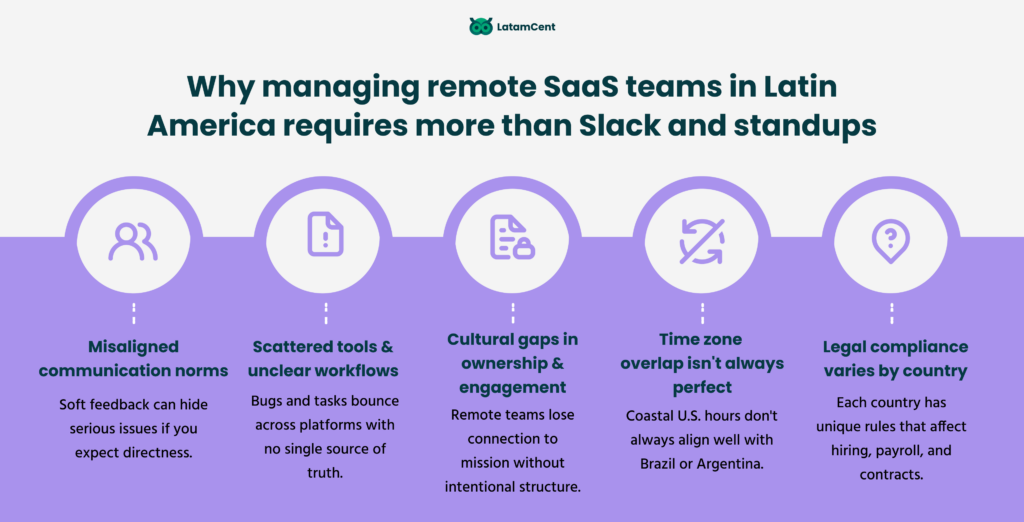
Managing SaaS remote teams in Latin America combines familiar remote-work issues with regional complexities that can slow execution and decision-making. The lack of face-to-face interaction in remote work can lead to a breakdown in communication skills among team members.
Beyond the typical remote challenges, leaders face cultural nuance, language gaps, and compliance differences across multiple countries.
The main challenges include:
- Visibility and accountability across distributed teams
- Fragmented communication and tool overload
- Declining engagement and ownership in remote environments
- Language and feedback style differences
- Narrow collaboration windows due to time zones
- Country-specific legal and payroll compliance
- Difficulty maintaining a consistent company culture
None of these obstacles is fatal. Teams that thrive treat them as SaaS system-design problems, not people problems. Burnout is a significant risk for remote employees, as they may struggle to separate work from personal life.
A skilled remote leader focuses on building clear systems, not chasing activity metrics, to keep distributed teams aligned and productive across Latin America.
Best Practices for Managing SaaS Remote Teams

Establish Clear Communication Channels & Protocols
To improve remote communication, establish clear norms for tools and response times and prioritize structured check-ins.
Pick one tool per job and write down the rules for each. Use Slack or similar for quick coordination and instant messaging during work hours. Develop virtual spaces for informal communication, such as ‘water cooler’ channels or virtual coffee breaks, to foster social interaction.
Use Linear or Jira for tasks and project management. Use Notion or Confluence as the system of record for specs, decisions, and documentation. Define response expectations per channel so remote team members know what needs a fast reply and what can wait.
Create one source of truth for each decision. When someone asks what was decided about authentication or a database migration, there should be exactly one place to check.
Distributed teams with clear communication channels and open communication resolve blockers faster because people stop hunting for context and start doing the work. Meetings should only be held for topics that cannot be resolved asynchronously, with agenda shared 24 hours in advance.
Bake this into the onboarding process. Make sure new remote employees understand tools, norms, clear communication guidelines, and communication preferences in their first weeks. A remote work environment is calmer when nobody is guessing where to ask, what to ask, or which communication tools to use.
Team meetings and virtual meetings work better when they sit on top of clear rules, not as the only way to share information.
Set Performance Expectations & Measure Outcomes
Creating accountability measures helps remote employees understand their responsibilities and the metrics by which their success will be evaluated.
Define three to five outcome metrics per team and make them visible to the entire team. For engineering, track deployment frequency, lead time from commit to production, and incident volume.
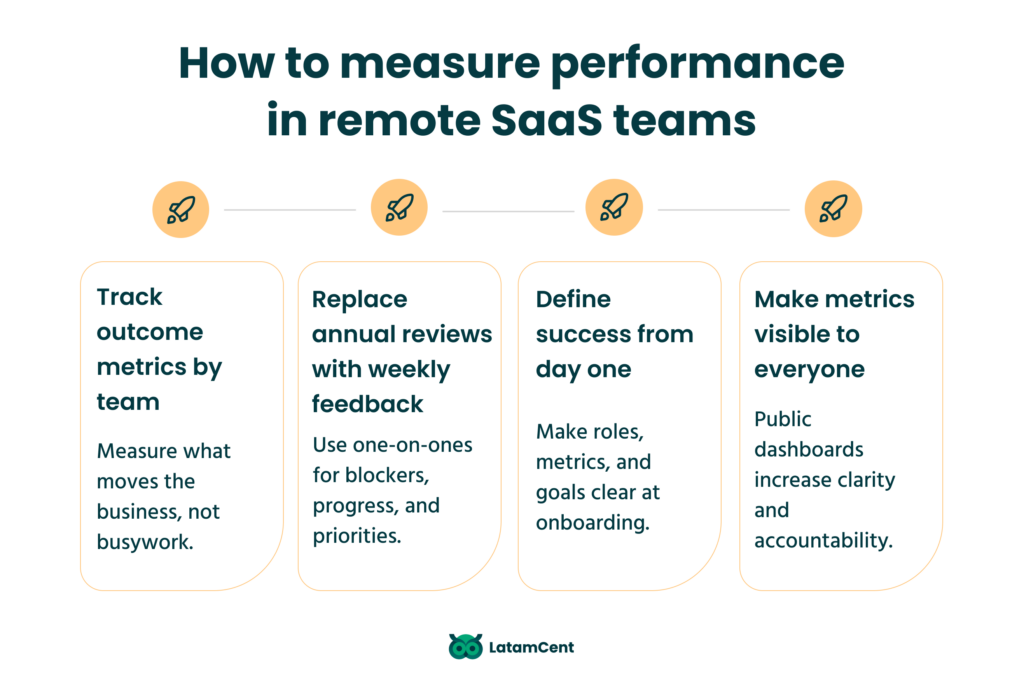
For sales, track pipeline health and close rates. For customer success, track resolution time and expansion revenue. This gives you valuable insights into what actually drives the business.
Replace annual reviews with continuous feedback in weekly one-on-ones.
Use those conversations with direct reports to communicate priorities, project progress, and blockers, not to read status updates.
Make expectations explicit from day one so remote team members know what success looks like.
Measure what actually moves the business forward, not activity that just looks busy. If a remote worker in São Paulo ships clean code on time with fewer bugs, their physical distance from headquarters should not matter.
Use SaaS Collaboration & Project Management Tools
Keep your stack boring and tight. Issue tracker. Code repo. Documentation system.
Overcommunicating is often necessary in remote settings to ensure that all team members are aligned and informed about project updates and changes.
Chat. Video for virtual meetings. A simple dashboard for project progress and key metrics. Connect tools, so updates move automatically instead of relying on manual status recaps.
Make documentation part of the workflow, not an extra task. When engineers close tickets, they update the docs.
When product specs change, the change gets logged so everyone can see it. When someone discovers a workaround for a tricky deployment bug, that knowledge is added to a runbook. That’s how continuous improvement becomes normal.
Give remote team members full access to the right tools from day one. Train them on workflows during onboarding so they can collaborate effectively rather than reverse-engineering how things work. The right tools plus clear rules beat a “best tool stack” with no discipline every time.
Project management platforms are there to support remote team management, not to create more work for remote workers. Check out our list of the best tools to manage remote teams.
Build a Healthy Remote Team Culture
Run weekly one-on-ones with every remote team member. Not for status reports. You already have project management platforms for that. Use this time to talk about workload, friction, work-life balance, and career goals.
Share mission and strategy in writing so remote workers know why they are building what they are building. When team members see how their work connects to company values and business goals, they behave like owners, not contractors.
Give public recognition to remote contributors when they ship important features, help direct reports, or support the team’s success. Recognizing and celebrating team wins boosts morale and engagement among remote employees.
Include remote voices in planning discussions early, rather than announcing decisions after the fact.
You do not need forced fun on Zoom. A few light team-building activities or virtual coffee breaks can help people feel connected on a personal level, but real team cohesion comes from fair decisions, clear expectations, and work that matters.
Save face-to-face interactions for occasional off-sites where in-person interactions actually move relationships forward. Team bonding is a side effect of good systems plus honest communication, not a separate project.
When team members feel connected to each other and to the work, you do not have to push culture on them. You just have to protect it.
Encourage Accountability Through Transparency
Make OKRs, roadmaps, and deadlines visible to the entire team. Use short written status updates that everyone can check, rather than relying on what was said in a single meeting. Providing ongoing feedback helps remote employees understand their performance and areas for improvement, which is vital for their development.
Assign clear ownership for each feature, project, and decision. When people know who owns what, they can unblock themselves instead of waiting on you. That lets remote team members collaborate effectively without constant escalation.
Transparency creates accountability without heavy control. When everyone can see commitments and current project progress, most people keep themselves on the same page without being chased.
Open communication about what is working and what is blocked keeps the entire team aligned.
Support Work–Life Balance and Employee Well-Being
Encouraging flexibility in work hours can help remote employees balance their personal and professional lives, leading to increased job satisfaction.
Define quiet hours and stick to them. Do not book recurring late-night team meetings just because time zones are annoying. Avoid treating every offline moment as suspicious. Encourage regular breaks and normal work hours.
Protect mental health on purpose.
Guard deep work. Block time where engineers work without constant pings. Move most updates to async channels and use live time for discussions that truly need a call.
Remote work blurs the boundary between work and home, especially when people work from the same space they live in. Leaders who protect work-life balance experience lower burnout and better employee engagement. That shows up directly in quality and retention as the team grows.
Provide Continuous Training & Skill Development
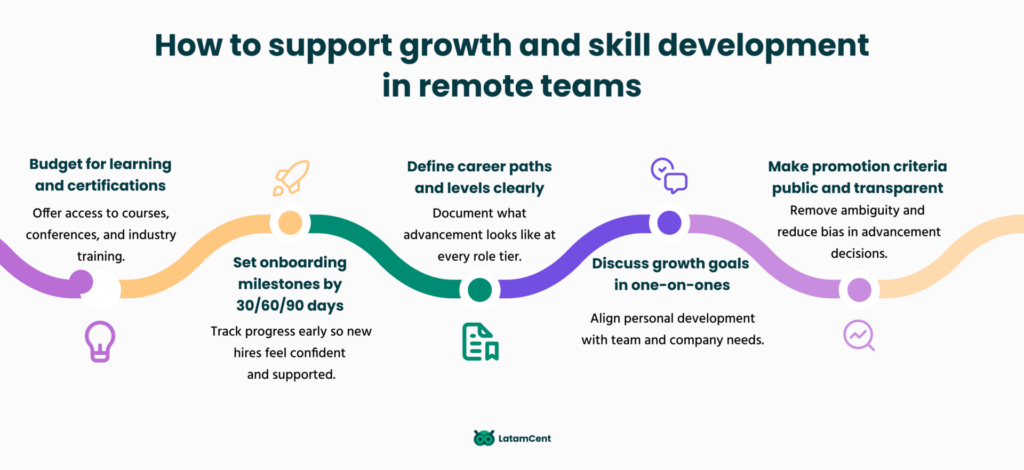
Providing ongoing training and development is vital when managing remote teams. Professional development opportunities through mentorship programs and online learning platforms help prevent career stagnation for remote workers.
Give remote team members the same learning options as people near HQ. Budget for courses, certifications, and conferences. Build a clear onboarding process with milestones at 30, 60, and 90 days so new hires know how they are doing.
Define visible career progression levels so people know what a senior engineer, a staff member, or a team lead looks like at your company. Talk about skill development and continuous learning in one-on-ones and build plans that align personal goals with team needs.
Regular one-on-one meetings and feedback sessions are valuable opportunities to address concerns and questions during onboarding.
Remote employees constantly worry that they are less visible for promotion opportunities.
Writing down criteria for growth and making them public removes guesswork and politics. Ongoing support is vital beyond the initial onboarding period.
Strengthen Security Practices for Distributed Teams
Require VPNs for sensitive systems. Turn on two-factor authentication for any account that touches production or customer data.
Encrypt data at rest and in transit. Run security training regularly so remote workers know how to handle credentials, spot phishing, and escalate issues.
Trust remote employees with the access they need to do their jobs. If someone is trusted to write production code, they should not have to beg for access to logs. Build security into tools and processes instead of relying on office walls.
Developers in Mexico City should follow the same security practices as developers in San Francisco. Location should not change the standard.
Improve Cross-Functional Collaboration Across Time Zones
Use async standups. People post short updates at the start of their workday. Keep live team meetings for decisions, not reciting what everyone did yesterday.
Give every project a clear decision owner so you do not need six people on every call to move forward. Structure collaboration so remote team members contribute during regular work hours instead of logging into virtual meetings early in the morning or late at night.
Most of Latin America sits within a few hours of US time zones. Cities like Mexico City, Bogotá, and Lima overlap well with Eastern Time. Use that overlap for work that really benefits from live discussion, such as retros, sprint planning, and incident response.
Let everything else run through project management tools and written communication, so distributed teams can collaborate effectively without burning out.
Standardize Processes to Ensure Consistent Team Alignment
Build a simple handbook that explains how your team works. Include code review, deployment, incident response, customer escalations, and decision making.
Define what “done” means for different types of work. Create runbooks for common issues so people do not improvise in production.
Make updating the handbook part of everyday work. When someone finds a better way to handle releases or a bug, capture it. That is continuous improvement in practice.
When new hires join remote teams in Latin America, they should be able to read the handbook and understand how to work, who decides what, and how to ask for help. Clear communication guidelines and written processes create alignment as the team grows.
Why SaaS Startups Are Hiring Remote Teams in Latin America?
Open senior engineering roles drag the roadmap. Features slip. Bugs linger.
Technical debt compounds. Hiring only in San Francisco or New York is slow and expensive.
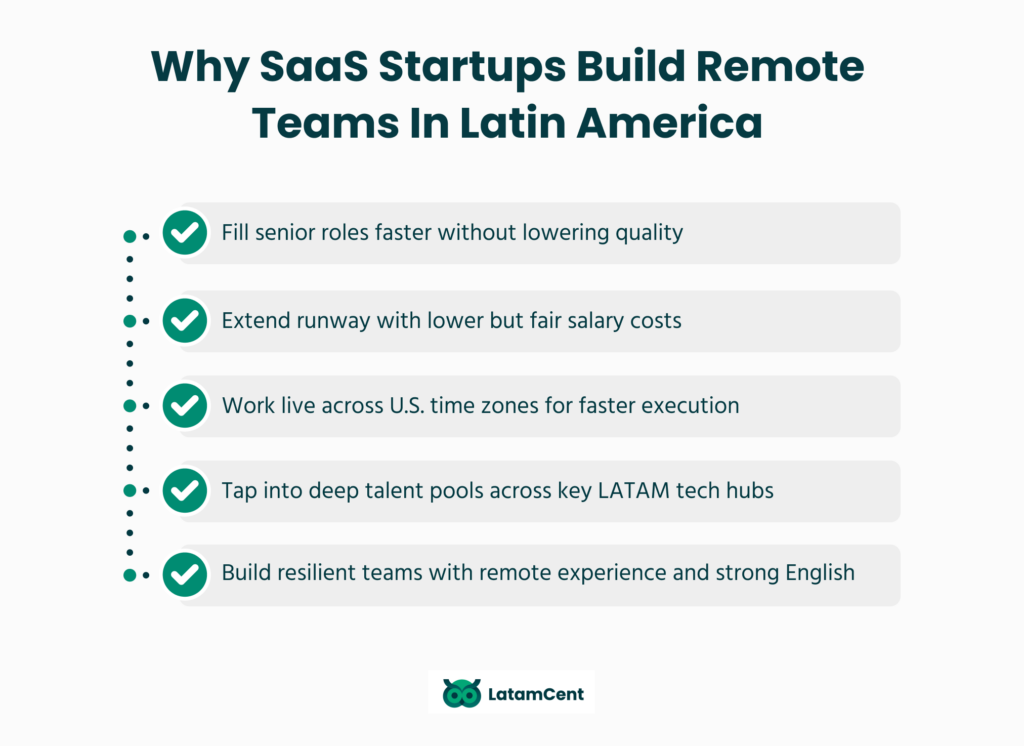
Many SaaS startups use Latin America to fill senior roles faster, at lower cost, without trading down on technical proficiency.
Cost matters, but it is not the only lever. Senior back-end developers in Latin America usually earn less than their peers in major US markets, while still earning strong salaries locally. That gap gives you room to extend runway and reinvest in product or go-to-market work, without underpaying your team.
Time zone alignment is a big win. Mexico City, Bogotá, and Lima share or closely track US time zones. Teams can run live sprint planning, resolve blockers the same day, and handle incidents in real time. Compared with locations eight to twelve hours away, collaboration is simpler.
The talent pool is deep and growing. Revelo’s Latin America Remote Tech Talent Report analyzed data from more than 185,000 pre-vetted developers across 12 countries, with strong hubs in Brazil, Mexico, Argentina, Colombia, and Costa Rica.
Other research suggests the number of developers in the region could grow significantly by the middle of this decade, making more experienced people available to remote teams. Many have already worked with US-based companies and understand the unique challenges of working remotely on distributed teams.
Demand from global companies keeps rising. Platforms that focus on Latin American tech talent now report hundreds of thousands of vetted developers in their networks and sharp increases in demand from US companies, especially for AI-related roles.
Supply is no longer the main constraint. The constraint is whether your systems can turn that talent into an effective remote team.
English proficiency and culture are manageable with clear communication. English proficiency is high in countries like Argentina, Costa Rica, and Uruguay, and many engineers in Brazil and Mexico collaborate effectively in English, especially in tech hubs.
Many US-based startups are hiring developers in Brazil.
Cultural differences in feedback and communication preferences exist, but good onboarding, explicit norms, and open communication help mitigate most friction.
For SaaS companies, remote teams in Latin America are not just a cost-cutting trick. They are a way to increase delivery capacity, reduce hiring bottlenecks, and build a more resilient organization that is comfortable with remote work.
Conclusion
Managing SaaS remote teams in Latin America is mostly about designing better systems. Clear metrics. Written processes. Intentional culture. When those are weak, remote work feels risky and slow. When they are strong, LATAM teams become one of the most reliable parts of your operating model.
With the right systems, leadership style, and tools, SaaS startups can build remote teams in Latin America that actually improve delivery instead of slowing it down.
Remote work forces discipline around documentation, communication, and outcomes. That discipline does not just help your Latin America hires. It makes the entire company sharper. Most “remote problems” turn out to be documentation problems or measurement problems, not geography.
If you are serious about building or scaling remote teams in Latin America, start by designing the systems you want those teams to run on, then hire into that structure instead of improvising as you go. The sooner you treat remote team management as an operating decision, the sooner you get what you actually want.
Senior talent in your business hours. Stable project progress.
Healthier work life balance for your team. And a remote setup that feels less like damage control and more like the grown-up version of how your company should always have worked.
Get in touch with LatamCent today.